.png)

Nine Point Checklist to Decide Auction or Dealer Watches in the UK
- lewisvrichards3
- 3 days ago
- 8 min read

For most UK buyers who want certainty, buying from a reputable dealer is the safer route; for collectors chasing rare or discontinued pieces, auctions often make more sense, provided you do the arithmetic on buyer’s premium first. Sellers usually net a stronger price at auction when a watch has genuine rarity or provenance, but a trusted dealer wins on speed and a guaranteed sale. The real trade-off in every auction vs dealer watches UK decision is warranty and certainty versus access and upside.
TL;DR:
Buying at auction offers access to rare and discontinued models that are typically unavailable through dealers, but involves higher total costs due to premiums, VAT, and shipping.
Dealer purchases provide immediate, authenticated, and warrantied watches with no buyer’s premium, making them ideal for those valuing certainty and quick access.
The buyer’s premium in UK auctions often ranges from 26% to 29%, significantly increasing the total cost once VAT and shipping are included, often exceeding dealer prices.
Sellers with provenance or rare references may achieve higher prices at auction, but face longer timing, higher fees, and risk, while dealers offer faster, confidential sales with less uncertainty.
Buyers and sellers should carefully calculate the full costs, including premiums, VAT, and servicing, before choosing between auction and dealer routes for better financial certainty.
Table of Contents
Auction vs dealer watches UK: weighing up the pros and cons
The choice between buying at auction and buying from a dealer comes down to what you value more: access to something rare, or protection against getting it wrong. Neither route is universally better. Each suits a different buyer, a different watch, and a different appetite for risk.
Buying at auction gives you access to watches that simply don’t turn up on a dealer’s shelf. Discontinued Patek references, early Rolex tool watches, unusual dial variants. Auction houses also generate real publicity around headline lots, which can push prices upward fast, sometimes beyond sensible value. Serious bidders should always review catalogues released four to eight weeks before the sale and set a hard all-in ceiling before the hammer falls.
Access to rare, vintage, and discontinued models rarely seen elsewhere.
Prices can spike due to competitive bidding and headline publicity.
Buyer’s premium adds a substantial percentage on top of the hammer price.
No mechanical guarantee; watches are typically sold as seen.
Requires catalogue study, condition report reading, and firm budget discipline.
Buying from a dealer trades some of that upside for certainty. A reputable UK dealer authenticates the watch, offers a warranty, and hands it over immediately, no waiting for a sale date or shipping delay. The sticker price can look higher than an auction estimate, but there’s no buyer’s premium stacked on top, and the risk of a condition surprise drops sharply. That certainty is exactly what buyers are paying for when they choose a dealer over an auction house.
Authenticated, warrantied, and ready to wear straight away.
No buyer’s premium, though margins are built into the asking price.
Limited to what’s currently in stock or sourced on request.
Best suited to in-production or recently discontinued sports models.
For sellers, the same split applies in reverse. Auction publicity can produce a genuinely higher hammer price for a watch with strong provenance or rarity, but it comes with time, fees, and uncertainty. A dealer sale is faster and guaranteed, which suits anyone who needs a clean, confidential transaction rather than a gamble on the room.
What does a watch really cost at auction versus at a dealer?
Comparing a hammer price to a dealer’s asking price is not a fair fight until you add everything else in. Auction buyer’s premiums in the UK typically run around 26% to 29%, tapering slightly at very high price tiers, and that’s before VAT and shipping.
Take a watch with a hammer price of £20,000. Add a typical buyer’s premium and you’re already paying significantly more. VAT may apply depending on the lot’s tax status and the buyer’s location, and shipping or collection adds extra cost. The realistic all-in figure often exceeds dealer prices for similar references that come with a warranty and immediate availability.
Buyer’s premium can turn an apparent auction bargain into the more expensive option once VAT, shipping, and the true landed cost are added. This single line item is the one most buyers underestimate.
Timing differs too. Auction catalogues are usually released four to eight weeks ahead, with a viewing window before the sale and a strict payment deadline after. Dealers, by contrast, offer immediate collection or same-week bank transfer, no waiting on a saleroom calendar. If you need the watch now, that gap matters as much as the money.
Checking authenticity and condition before you commit
Auction houses publish condition reports, but “sold as is” is the operating principle. A report might note case polish or a replaced crystal, yet it won’t carry the same weight as a dealer’s mechanical guarantee. Buyers should budget separately for independent authentication and servicing after the sale, particularly on vintage pieces.
Dealers work differently. A reputable UK dealer typically authenticates before listing and offers a warranty period, which shifts much of that risk off your shoulders entirely.
Watch for these red flags before bidding or buying:
Blurry or cropped images of the case back, movement, or serial number.
Vague descriptions (“running well” without service history).
No response from a specialist when you ask about provenance.
Mismatched box, papers, or service records for a supposedly full-set watch.
Pro Tip: Speak to the auction specialist before the sale, not just the day of viewing. A five-minute call often surfaces provenance detail that never makes it into the printed catalogue.
Budget realistically for post-purchase servicing, particularly on older pieces bought at auction, as these costs vary depending on the maker and scope of work needed.
Should you sell your watch at auction or to a dealer?
The right channel depends on what you’re selling and how quickly you need the money. A rare Daytona, an early Nautilus, or a watch with documented celebrity or historical provenance can attract genuine bidding heat at auction, sometimes pushing well past a dealer’s offer. A common, in-production Submariner or Speedmaster rarely benefits from that same competitive pull, and a dealer sale is usually cleaner.
Check rarity and provenance first. If the watch is discontinued, limited, or has a documented history, auction interest could genuinely outperform a dealer offer.
Weigh speed against upside. Auctions take weeks from consignment to payment; a dealer can transfer funds within days.
Understand seller’s fees and reserves. Auction houses charge a seller’s commission and may require a reserve price; agree both before consigning.
Prepare the lot properly. Gather box, papers, service history, and clear photographs, whichever route you choose. Incomplete documentation depresses both auction estimates and dealer offers.
Get more than one opinion. A straightforward sale enquiry with a specialist dealer costs nothing and gives you a real benchmark against any auction estimate.
Confidentiality matters to some sellers too. A dealer transaction stays private; an auction result is public record.
A nine-point checklist to decide right now
Run through these questions before you bid or buy, and the right route usually becomes obvious.
Is this watch for wear or for investment? Wear favours a dealer; investment sometimes favours rarity at auction.
Is the reference currently in production? If yes, buying new or from a dealer is usually lower risk.
Is it discontinued or genuinely rare? Auctions become the real market here.
How urgent is the purchase? Dealers deliver immediately; auctions run to a fixed calendar.
What’s your absolute budget ceiling, hammer plus premium plus VAT plus shipping?
How comfortable are you with condition risk and no mechanical guarantee?
Does provenance or full service history matter to you? Ask the specialist directly.
Do you need a warranty on the movement?
Are there logistical constraints, such as needing to inspect in person before committing?
If the dealer price is close or lower, and a warranty comes attached, the decision largely makes itself. If the auction watch is genuinely unavailable elsewhere, book a viewing and speak with the specialist beforehand.
How Horology-kings supports UK buyers and sellers
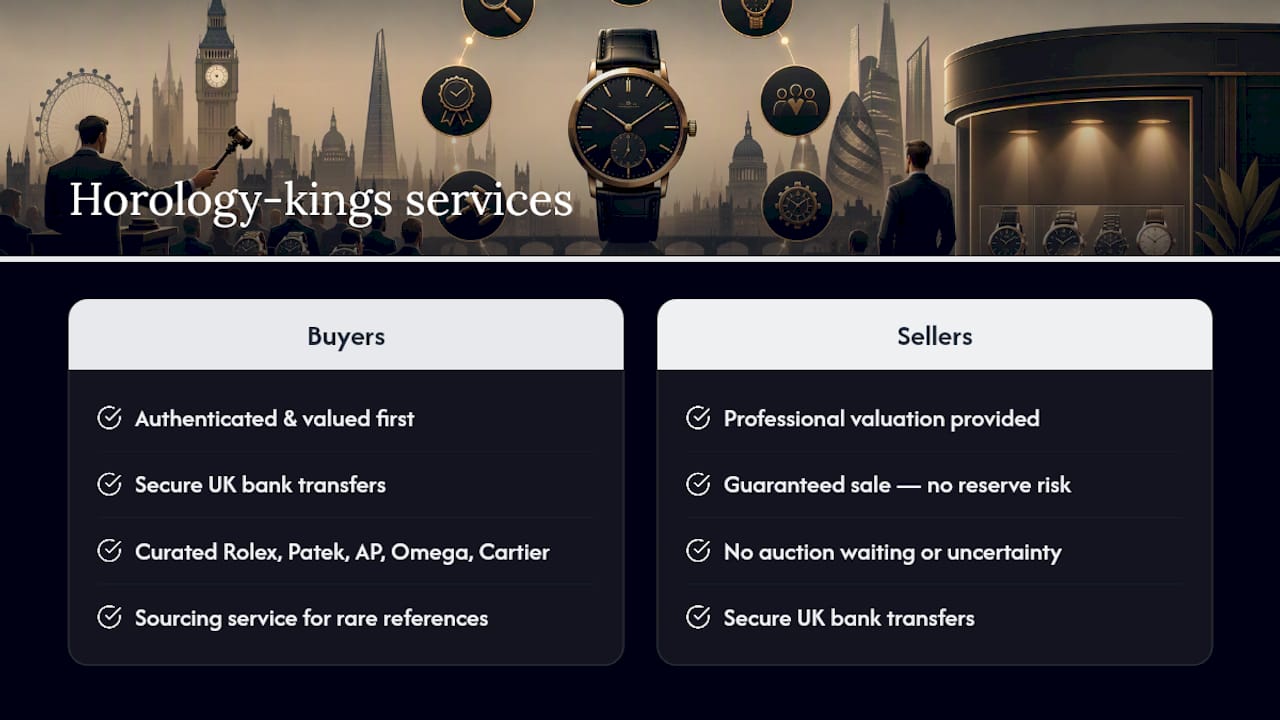
Horology-kings operates as a specialist dealer based in Hertfordshire, built around exactly the certainty that auctions can’t offer. Every watch passing through the business is authenticated and valued by specialists before it reaches a buyer, with secure UK bank transfers handling every transaction discreetly.
For buyers who’ve decided a dealer is the right route, Horology-kings offers a curated selection of pre-owned Rolex, Patek Philippe, Audemars Piguet, Omega, and Cartier pieces, each checked for authenticity and condition before listing. For collectors chasing something specific that isn’t currently in stock, the sourcing service uses an expert network to track down rare or hard-to-find references, without the wait or uncertainty of a saleroom.
Sellers get the same certainty in reverse: a professional valuation and a straightforward path to a guaranteed sale, with no reserve risk and no waiting on a bidding room to decide the outcome. For anyone who has read this far and concluded a dealer relationship suits their situation better than an auction gamble, that’s precisely the gap Horology-kings fills.
What working with UK collectors has taught me
The most common mistake isn’t picking the wrong route. It’s skipping the arithmetic. Buyers fixate on the hammer price and forget the premium, VAT, and shipping stacked on top, then feel stung when the final invoice lands.
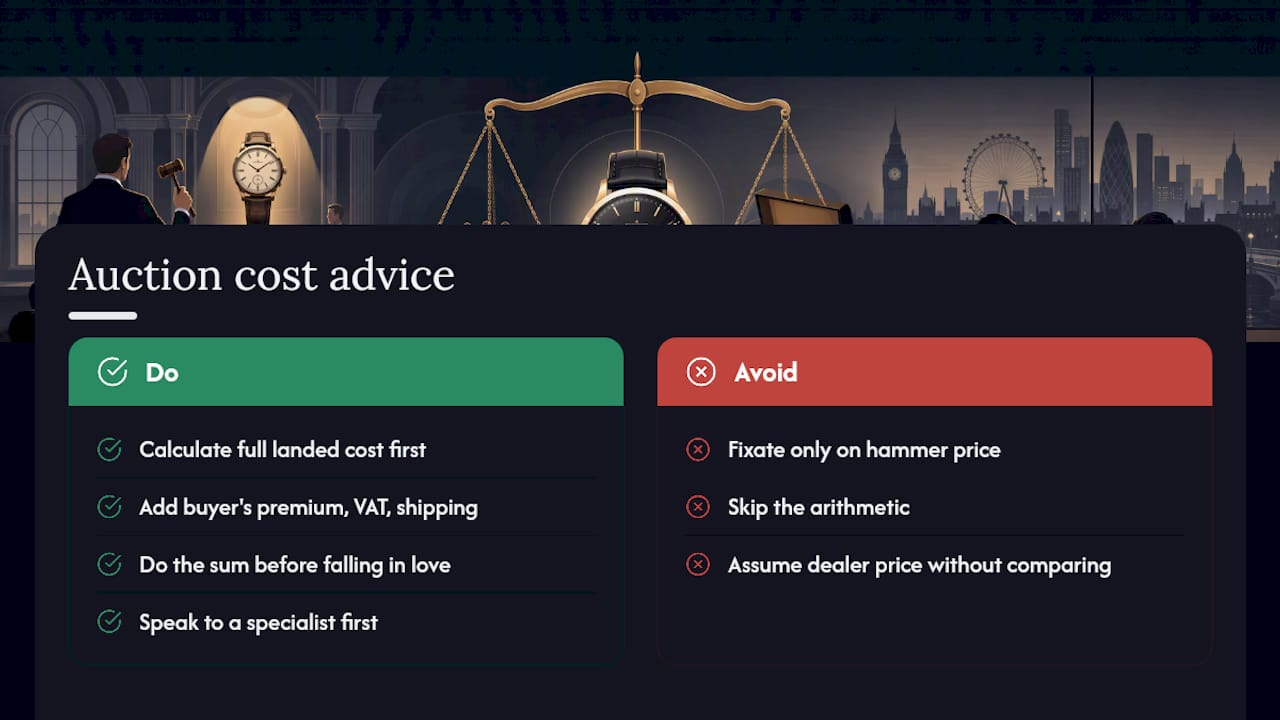
One pattern comes up repeatedly: a buyer bids confidently on a “bargain” lot, wins it, and only later realises the all-in cost matched or exceeded a warrantied dealer price for the same reference, minus any guarantee. A five-minute conversation with a specialist beforehand would have surfaced that.
The immediate action worth taking: before you bid on anything, calculate the full landed cost first. Do the sum before you fall in love with the lot, not after.
— Lewis
Where to check auction catalogues and sale results
For UK sale calendars and recent results, check aggregator platforms such as Fellows, TheSaleroom, and Barnebys, alongside major house catalogues.
Get certainty on your next purchase or sale
If the arithmetic above has convinced you that certainty beats a gamble, Horology-kings is the practical alternative to bidding blind at auction. Rather than tracking a catalogue for weeks, budgeting for an unknown premium, and hoping the condition report tells the full story, you get an authenticated watch with a warranty, ready to collect, at a price that’s already fixed.

Whether you’re after a specific reference through the sourcing service or want to browse the current catalogue on Horology-kings, the process stays the same: transparent valuations, secure UK bank transfers, and no buyer’s premium hiding in the small print. If you’re selling, the same certainty applies in reverse, with a guaranteed offer instead of a reserve-price gamble. Get in touch for a free valuation and see exactly where your watch stands before you decide which route to take.
Sources
Recommended
Comments