.png)
Same day CHAPS and Escrow: Secure Bank Transfers for UK Watch Buyers

Yes, you can buy a luxury watch on sale by bank transfer in the UK, but only after specific checks. Bank transfers are accepted and widely used for high-value watch purchases, yet they are effectively irrevocable once sent. Use this payment method only with authorised dealers, established specialist brokers, or private sellers you have thoroughly vetted, ideally with an invoice and delivery safeguards in place.
TL;DR:
Use bank transfers only with verified authorized dealers, specialist brokers, or thoroughly vetted private sellers to minimize the risk of fraud and ensure proper documentation.
Always verify the seller’s identity, request recent, specific photographs with serial numbers, and insist on written proof of ownership before sending funds.
International bank transfers may take one to two days, with additional fees for sending and receiving banks; CHAPS offers same-day settlement for large sums.
Escrow services can reduce the risk by holding funds until you confirm receipt and condition of the watch, but they do not eliminate all risks.
Always confirm payment details match the seller’s registered business, and avoid private transactions without a strong reputation, documented invoices, and insured delivery.
Table of Contents
Where to find UK sale watches that accept bank transfer
Not every seller treats bank transfer the same way, and the channel you choose determines how much risk you are carrying. Authorised retailers sit at the safest end of the spectrum. Their sale pages typically list bank transfer alongside card and finance options for larger orders, and they issue proper invoices with delivery guarantees built in. Watches of Switzerland’s sale listings are a useful example of how mainstream retailers structure discounted stock and payment routes, though availability of any given model shifts constantly with retailer inventory.
Specialist pre-owned dealers and brokers occupy the next tier. Most will happily accept bank transfer, and a reputable one will hand over authentication paperwork, service history, and insured shipping as standard rather than as an upsell. This is the space where a secure watch transactions guide earns its keep, because the paperwork trail is what separates a smooth purchase from a costly mistake.
Vetted marketplaces sometimes offer escrow or a secure payment channel that holds funds until you confirm receipt. This matters because escrow services meaningfully reduce risk when you cannot fully verify a seller’s reputation through other means. It does not remove risk entirely, but it buys you a checkpoint that a direct transfer never gives you.
Private sales and enthusiast forums carry the heaviest vetting burden. Here are the essentials before you even consider sending funds privately:
Confirm the seller’s identity against a verifiable address, phone number, and online history.
Ask for dated photographs of the actual watch, including the serial number and box or papers if claimed.
Request proof of ownership, such as a previous purchase receipt or service record.
Walk away if the seller pushes for speed over scrutiny.
Watch forum communities are blunt about this. The recurring advice across WatchUSeek’s discussion on bank transfer safety boils down to one phrase: buy the seller, not just the watch.
How does a bank transfer actually work for a watch purchase?
Sending several thousand pounds to a stranger’s account feels different from paying for groceries, and the mechanics are worth understanding before you touch your banking app.
Gather the recipient details. For a UK domestic transfer, you need the account name, sort code, and account number. For an international payment, you need the IBAN and BIC/SWIFT code. The account name must match the seller’s registered business or personal name exactly. A mismatch is your first warning sign.
Choose the right transfer speed. Faster Payments handles most UK transfers within minutes to a few hours, but many banks cap the amount. CHAPS is built for same-day settlement on larger sums and comes with a formal audit trail, which matters if a dispute ever arises. International transfers via SWIFT typically take one to two business days, according to guidance on wire transfer timing, though currency conversion and receiving-bank processing can add delay.
Check who absorbs the fees. CHAPS transfers often carry a flat fee from the sending bank, while international transfers can involve both a sending charge and a receiving-bank deduction. Clarify upfront whether the seller expects the full sale price to land, fees included.
Send only once everything is confirmed. Once a bank transfer is recognised by the receiving institution, your bank generally cannot claw it back automatically. Treat that moment as final.
Pro Tip: Ask for a pro forma invoice listing the watch’s serial number before you transfer a penny, insist on insured tracked shipping, and confirm the receiving account is registered to the seller’s actual trading entity, not a personal account acting on the business’s behalf.
Seller-vetting checklist before you send a bank transfer for a watch
A watch sale that looks legitimate on the surface can still hide a hollow business behind it. Running through a consistent set of checks costs you ten minutes and can save you thousands.
Start with identity. A genuine UK dealer will have a Companies House registration number you can look up in seconds, a VAT registration where turnover requires it, a business landline that someone actually answers, and a registered trading address that isn’t a residential flat with no signage.
Move on to authenticity. Ask for the serial number and cross-check it against the model’s known range, request the service history if one exists, and insist on recent photographs taken specifically for your sale rather than recycled stock images. A watch authentication checklist is worth running through properly rather than skimming.
Then confirm the transaction itself is documented:
A formal invoice stating the watch, price, serial number, and delivery terms.
Agreed delivery method, ideally an insured courier requiring ID on arrival.
A written note of the watch’s condition as described at the point of sale.
Community experience is consistent on the warning signs. Forum members repeatedly flag personal bank accounts used for business sales, pressure to complete “today or the deal’s off”, paperwork that contradicts itself between messages, and payment instructions that route through a third party unconnected to the advertised seller. Any one of these is reason enough to stop and reconsider, not to push forward faster.
What buyer protection exists, and how does VAT apply?
Bank transfer buyers give up something card payments and PayPal offer as standard: the ability to claw money back after the fact. Card payments carry chargeback rights through your card scheme, and PayPal’s buyer protection covers eligible disputes automatically. A bank transfer has neither. Once the funds clear, your recourse depends entirely on the paperwork you collected beforehand and, in the worst cases, the small claims court.
Escrow services close part of that gap by holding funds until you confirm the watch matches what was promised, which is why they’re worth requesting whenever a seller’s reputation isn’t fully verifiable.
VAT treatment also affects what a fair invoice should look like:
Watches sold new by a VAT-registered dealer include VAT on the invoice at the standard rate.
Second-hand dealers often trade under the VAT margin scheme, where VAT is calculated only on the dealer’s margin rather than the full sale price, and the invoice should say so explicitly.
Always ask which basis applies before you pay, and keep the invoice number and the seller’s VAT or company registration details on file.
A comparison of payment methods for luxury watch purchases sets out these trade-offs in more depth if you’re weighing bank transfer against other routes.
How Horology Kings handles secure bank-transfer purchases
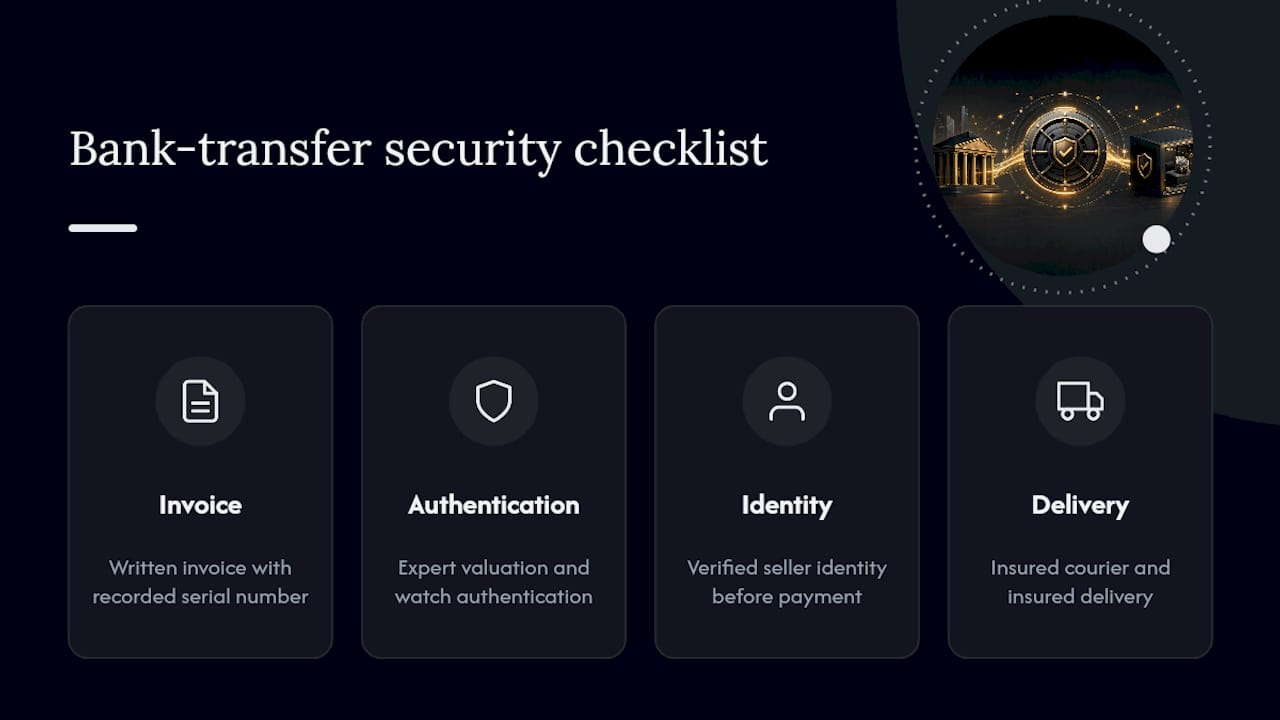
Horology Kings accepts secure UK bank transfers as standard, backed by documented invoices, expert valuations, and authentication on every watch that passes through. Every transaction includes a recorded serial number and insured delivery, so the paperwork trail exists before you ever send funds.
That’s the template worth demanding from any seller: a written invoice, verified identity, insured courier, and a clear condition statement agreed before payment. The full process is set out in Horology Kings’s secure sale procedure, which reflects how a properly run bank-transfer transaction should look from start to finish.
When would I personally trust a bank transfer?
I’d send one to an authenticated dealer with documented paperwork and insured delivery in place. I wouldn’t send one to a private seller without verifiable reputation and proof of ownership. Escrow narrows that gap, but for private sales, caution beats speed every time.
— Lewis
Horology Kings: a secure route for your next bank-transfer purchase
Horology-kings is the alternative to gambling on an unverified private seller. Every sale comes with a documented invoice, serial-number authentication, and insured delivery arranged before your bank transfer leaves your account, so you’re never sending funds on trust alone.

Whether you’re after a specific reference at a sale price or need help tracking one down, the process starts the same way. Horology-kings’s sourcing service uses an established network to locate rare and sought-after models, with the same secure bank transfer and authentication standards applied throughout. If you have a model in mind, source a watch directly through Horology-kings and get the paperwork sorted before you pay, or visit the main site to see current stock.
Sources
Two sources shaped the payment guidance here: Value Your Watch’s wire transfer guide, which covers banking mechanics and invoice practice, and WatchUSeek’s community thread on bank transfer safety, which reflects real buyer experience and the recurring advice to vet the seller above all else.
Recommended
Comments