.png)

Buying a pre-owned Rolex: the safest way to get it right
- lewisvrichards3
- Aug 28
- 10 min read
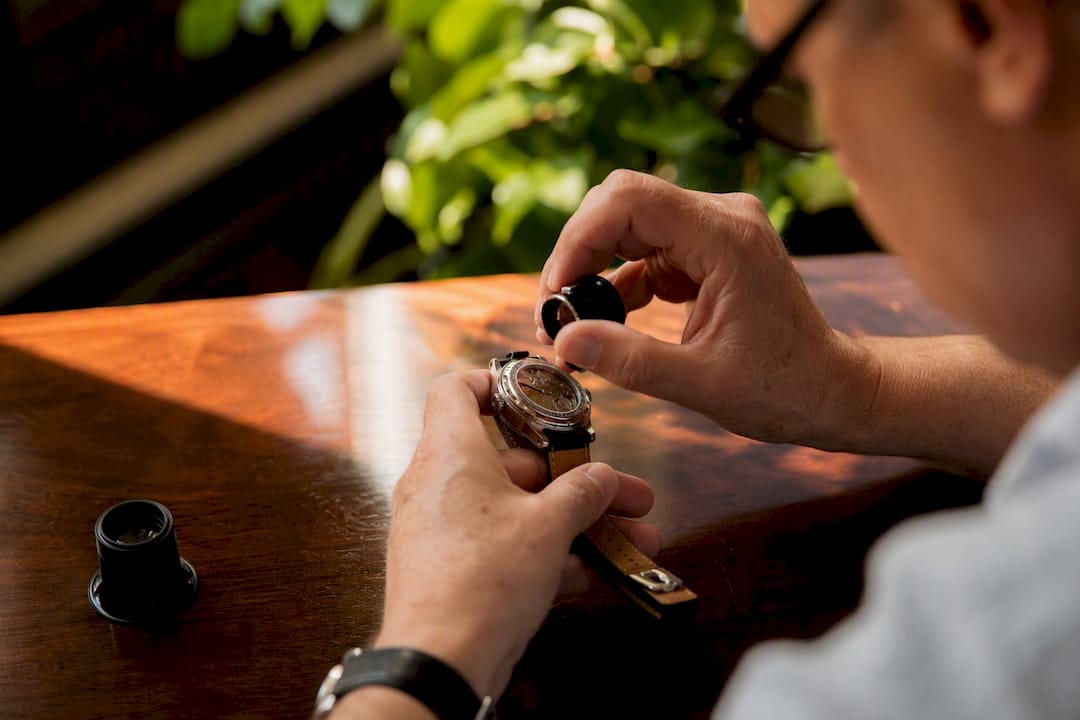
The safest route to buying a pre-owned Rolex is through Rolex Certified Pre-Owned or a reputable specialist dealer offering documented authentication and a genuine dealer warranty. If speed and choice matter more, a vetted specialist dealer with independent authentication and a short return window is your next best option. Buying privately? Never pay before an in-person inspection or an authenticated third-party report.
TL;DR:
Private sales offer the lowest prices but carry the highest risks, making in-person inspection and authentication essential before purchase.
Certified pre-owned Rolex watches provide the highest certainty, including official warranties and service by Rolex-trained staff, often at a premium.
Specialist dealers offer a balanced mix of curated stock, authentication, and warranties, making them a reliable choice for value and trust.
Authenticity checks should include detailed photo comparisons, serial number verification, and, ideally, a movement inspection by an independent watchmaker.
The total cost includes potential import taxes, insurance, and service expenses, which can significantly increase the initial purchase price.
Table of Contents
Where to buy pre-owned Rolex watches: comparing your options
Every purchase channel trades certainty against price, and understanding that trade-off is the whole game when buying pre-owned Rolex watches. Get this decision right and everything downstream, authentication, negotiation, aftercare, becomes far easier.
Rolex Certified Pre-Owned (CPO) is Rolex’s own guarantee scheme, run through authorised retailers. A watch sold under CPO has been inspected and serviced where necessary by Rolex-trained staff and carries an official warranty card. It’s the closest thing to buying new that the pre-owned market offers, but that certainty often carries a price parity or premium versus new retail, so you’re paying for peace of mind rather than a discount.
Specialist dealers, businesses that deal exclusively or primarily in luxury watches, sit in the middle ground. They curate stock, authenticate before listing, and typically back sales with a dealer warranty and a defined returns window. This is where in-house authentication and warranties reduce risk compared with private sales, and it’s usually where you’ll find the best balance of trust, choice, and value.
Online marketplaces offer volume and price competition, but protection varies enormously by platform. Some run certified-seller programmes with escrow and authenticity guarantees; others are little more than classified listings with a payment gateway bolted on. Buyer protection quality varies widely by channel, so read the platform’s actual guarantee terms, not just its marketing.
Private sales offer the sharpest prices, and the sharpest risks. There’s no warranty, no recourse, and no institutional authentication behind the transaction.
Rolex CPO: highest certainty, official warranty, price parity or premium
Specialist dealers: curated stock, dealer warranty, strong value for the certainty offered
Marketplaces: wide selection, protection depends entirely on the platform
Private sales: best prices, zero built-in protection, inspection is non-negotiable
How do you authenticate a pre-owned Rolex before buying?
Authentication isn’t a single check, it’s a sequence, and skipping steps is how buyers end up with a “genuine” watch built from mismatched parts.
Scrutinise the listing photos first. Compare the dial font, hands, and bezel markings against verified reference images for that exact model and year. Rolex fonts and finishes shift subtly across production runs, and a mismatch is an early warning sign.
Cross-check the reference number against the described model. The reference should match the bracelet type, dial colour, and bezel material described. Sellers occasionally misdescribe watches innocently, but a deliberate mismatch is a red flag.
Request close-up shots of the case back, crown, and clasp if buying remotely. Genuine Rolex engraving is crisp and evenly spaced; counterfeit engraving often looks slightly soft or irregular under magnification.
At in-person viewing, check the weight and action. Genuine Rolex movements have a distinctive heft and a smooth, silent sweep of the seconds hand. A ticking or jerky motion is disqualifying.
Inspect the serial and model numbers between the lugs (pre-2005 models) or on the rehaut (post-2005). Confirm they’re consistent with the watch’s claimed production year, and that neither has been re-engraved or polished away.
Ask for the service history and any independent authentication report. Horology Kings’ authentication guide sets out the fuller technical checklist, including movement inspection and provenance verification, that specialist dealers use as standard.
If anything feels inconsistent, involve an independent watchmaker. A qualified horologist can open the case back and confirm the movement matches Rolex’s specification for that reference, which private sellers should never refuse.
Refuse to proceed if a seller resists in-person inspection, pressures you toward same-day payment, or offers a price so far below market that it can’t be explained by condition alone.
Pro Tip: Photograph the movement through the case back if you can, and send it to an independent watchmaker before you commit. A five-minute video call can save you from a five-figure mistake.
Horology Kings’ own watch authentication checklist is a useful companion for anyone inspecting a watch in person for the first time.
Do box and papers really affect a Rolex’s resale value?
Yes, and the uplift is measurable rather than sentimental. A complete set, meaning the original box, warranty card, and manuals, typically adds 5 to 15% to value on modern references, and considerably more on collectible vintage pieces where documentation is scarce.
The warranty card itself needs scrutiny, not just presence. Check that the date, model reference, and case number printed or stamped on the card match the watch precisely, and that the retailer’s stamp looks consistent with genuine authorised-dealer stamps from that period. Service stamps in an accompanying booklet, or a digital service record from an authorised centre, carry real weight because they confirm the watch has been maintained through official channels.
Ask to see the original box, card, and any manuals before agreeing a price
Verify the warranty card’s details match the watch exactly, not approximately
Request documented proof of any service, ideally from an authorised centre
If papers are missing, expect a discount that reflects the 5 to 15% uplift you’re forgoing, not a token reduction
A watch with no papers isn’t necessarily fake or problematic, but it should be priced accordingly, and you should factor that gap into any negotiation.
What should you expect to pay for a pre-owned Rolex?
Price expectations differ sharply by model tier, and treating “Rolex” as one price category is where a lot of buyers overpay or undervalue what they’re offered.
Entry-level references, think Oyster Perpetual or Air-King, typically trade 5 to 15% below retail on the secondary market. Demand exists but isn’t frenzied, so pre-owned genuinely saves you money here.
Sport icons behave completely differently. The Submariner, GMT-Master II, and Daytona routinely command prices above retail because production can’t keep pace with demand, a scarcity premium rather than a condition premium. Gold models and discontinued references sit somewhere in between and move with their own logic entirely, so always check recent comparable sales rather than relying on a general “Rolex is expensive” assumption.
Market context matters too. An MSRP increase early in 2026 pushed some new prices higher, which has widened the gap where certain pre-owned examples now trade below the new retail price, a genuine opportunity if you’re flexible on exact reference.
Entry-level: often 5 to 15% below retail, low scarcity pressure
Sport icons: frequently above retail due to persistent scarcity
Gold and discontinued references: check comparable sales individually
Always add likely servicing costs to any comparison; a cheaper watch needing immediate service isn’t actually cheaper
Why does servicing history matter so much for pre-owned Rolex?
Condition grading and service history are where real value hides or leaks away, and both deserve more attention than the polish and shine that first catch your eye.
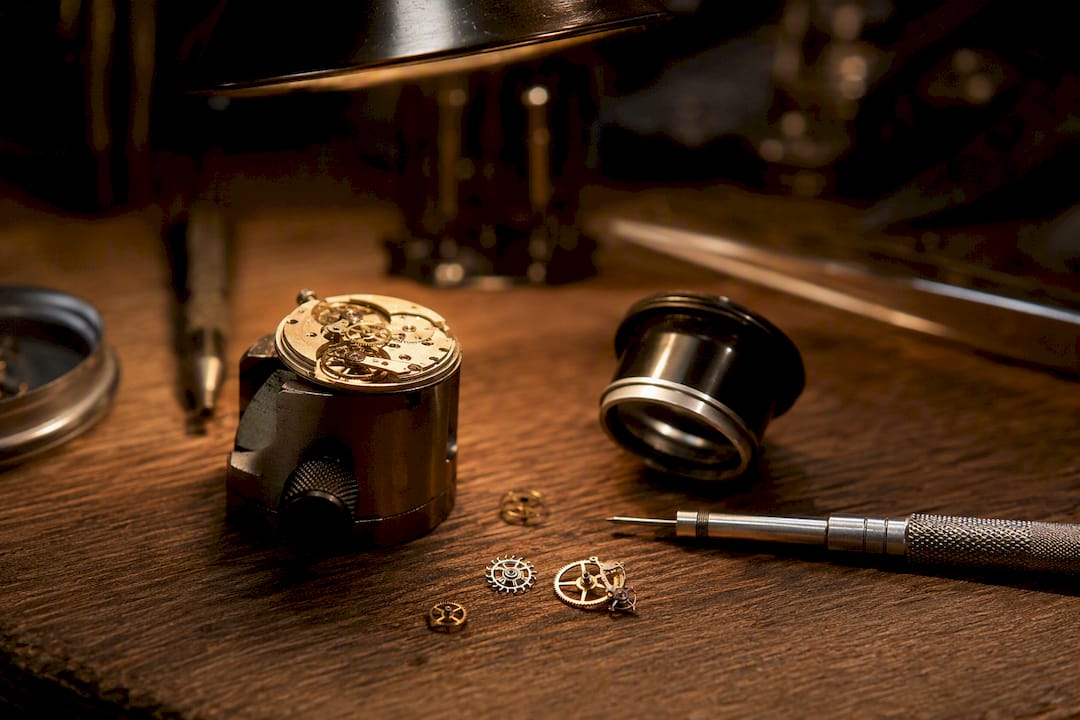
A heavily polished case loses its original sharp edges, and while it can look “better” in photos, collectors generally value crisp, unpolished cases more highly. Bracelet stretch is another giveaway of heavy wear; a loose, sagging bracelet suggests years of daily use and may need costly link or clasp repair.
Rolex recommends professional servicing roughly every 5 to 10 years, and documented recent service adds genuine buyer confidence, often justifying a modest premium over an otherwise identical watch that’s overdue. In the UK, a full service through an authorised centre or a specialist independent horologist typically runs into several hundred pounds depending on the model and movement complexity, so factor that into your budget if the watch you’re eyeing hasn’t been serviced recently.
Unpolished cases and tight bracelets generally command higher resale value
Documented recent service justifies paying a modest premium
Authorised service centres offer manufacturer-grade parts and documentation
Independent specialists can offer comparable quality at a lower cost, provided they’re reputable
Pro Tip: Ask specifically when the watch was last serviced and by whom, not just whether it “runs fine”. A watch that runs fine today can still be overdue for maintenance that prevents costly damage later.
For more on why this matters long-term, Horology Kings’ guide on servicing high-end watches for lasting value covers the mechanics in more depth.
How do you choose a trustworthy Rolex dealer?
Comparing dealers comes down to a short set of questions you should ask before you ever discuss price.
How long have you been trading, and can I see independent reviews? A long trading history and genuine third-party feedback, Trustpilot reviews are a common example, tell you far more than a polished website ever will.
What authentication process does this watch go through before sale? A specialist dealer should describe a specific process, visual inspection, movement check, provenance review, not a vague assurance.
What warranty and returns policy applies to this purchase? Insist on this in writing before you pay, including the exact return window and what voids it.
How is payment handled, and what security applies to high-value transfers? Secure UK bank transfer with clear documentation is the standard for serious dealers; anything pushing you toward untraceable payment methods is a warning sign.
Will you provide full documentation of the sale, including reference, serial and condition notes? A dealer confident in their stock will hand this over without hesitation.
Trust signals worth weighing: a dealer specialising specifically in luxury watches rather than general jewellery, transparent published policies rather than terms you have to request, and consistent positive feedback across several years rather than a burst of recent reviews.
Horology Kings’ authentication and sourcing process
Horology Kings applies a structured process to every pre-owned Rolex that passes through its hands, and it’s worth understanding as a benchmark for what any serious dealer should offer.
Visual and reference verification: dial, bezel, hands and case details are checked against verified references for the exact model year
Serial and movement inspection: numbers and movement specification are confirmed against Rolex’s known production standards
Provenance and service history review: prior ownership and maintenance records are checked wherever available
Secure transaction handling: sales are documented in full and settled through secure UK bank transfer, giving both parties a clear paper trail
This mirrors the checklist detailed in Horology Kings’ complete authentication guide, which buyers can use as a standard against which to measure any dealer, not just this one.
What does the buying process actually look like, start to finish?
Buying pre-owned Rolex watches with confidence follows a fairly predictable timeline, and knowing it in advance stops you from either rushing a decision or losing a good watch to hesitation.
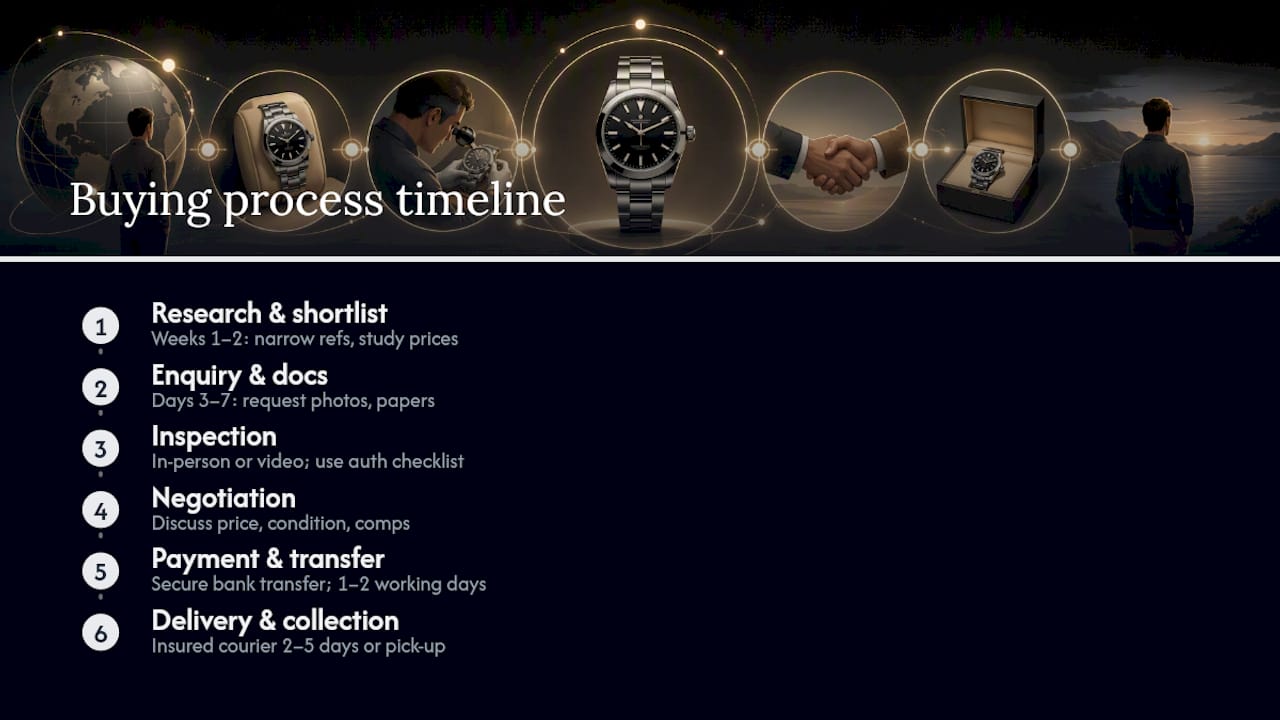
Weeks one to two: research and shortlisting. You narrow down references, study typical price ranges for your target model, and identify two or three dealers or platforms worth approaching.
Days three to seven after shortlisting: initial enquiry and documentation review. You request photos, service history, and warranty documentation from sellers. Any dealer unwilling to share this promptly should drop off your list immediately.
Inspection window. For specialist dealers, this often means viewing in person or via detailed video call; for private sales, an in-person meeting is close to mandatory. This is where the authentication checklist above earns its place.
Negotiation and agreement. Price discussions typically factor in condition, papers, service history, and comparable recent sales, often taking a few days as both sides settle on fair value.
Payment and transfer. Secure bank transfer is standard for high-value purchases; funds typically clear within one to two working days before the watch is released or shipped.
Delivery or collection. Insured courier delivery for remote purchases usually takes two to five working days; in-person collection can be immediate once payment clears.
Altogether, a considered purchase from first enquiry to watch on wrist usually spans two to four weeks, longer if you’re holding out for a specific reference at the right price.
What’s the true total cost of buying a pre-owned Rolex?
The sticker price is rarely the full cost, and affluent buyers who skip this arithmetic often find the real figure runs higher than expected.
VAT applies to most UK dealer sales at the standard rate, usually already included in the advertised price for UK-based specialist dealers, but worth confirming explicitly before you commit. Private sales between individuals typically don’t attract VAT, one reason private prices can look more attractive on paper.
Import duty and taxes become relevant if you’re buying from overseas, whether a specialist dealer abroad or an international marketplace listing. Watches brought into the UK from outside the EU can attract import VAT and potentially customs duty, calculated on the declared value plus shipping, so factor this in before assuming a foreign listing is genuinely cheaper.
Insurance is the cost buyers most often forget. A pre-owned Rolex worth several thousand pounds or more typically needs a specific addition to a home contents policy or standalone valuables cover, since standard policies often cap individual item value well below what these watches are worth.
Servicing reserves deserve a place in your budget too. If the watch you’re buying hasn’t been serviced in the last few years, set aside several hundred pounds for that eventuality rather than treating it as a surprise expense later.
How Horology Kings helps you buy with confidence
Horology Kings exists precisely for buyers who want the certainty of Rolex CPO combined with the choice and personal attention of a specialist dealer. Every pre-owned Rolex in our curated inventory has been through the authentication process outlined above, visual, serial, movement, and provenance checks, before it’s ever listed for sale.
If you’re hunting a specific reference rather than browsing general stock, our sourcing service lets you brief us directly. We use our specialist network to locate rare or sought-after models on your behalf, verify them to the same standard, and handle the transaction through secure UK bank transfer with full documentation at every stage. There’s no waitlist uncertainty, no guesswork on authenticity, and no pressure selling, just a straightforward, discreet route to the watch you actually want. Browse our current authenticated stock or start a sourcing brief today, and let us handle the certainty while you focus on choosing the watch.
An editorial note on trusting the paperwork
The single biggest mistake I see buyers make isn’t overpaying, it’s assuming a confident seller is the same thing as a documented one. Confidence is cheap. A verified serial number, a genuine warranty card, and a recent service record are not.
If you take one habit from this guide into your own search, make it this: never let enthusiasm for a specific reference override your insistence on paperwork and independent authentication. Cross-reference every claim against Horology Kings’ authentication guide before you transfer a single pound, whoever you’re buying from.
— Lewis
Sources
Recommended
Comments