.png)
Customs duties when importing watches into the UK

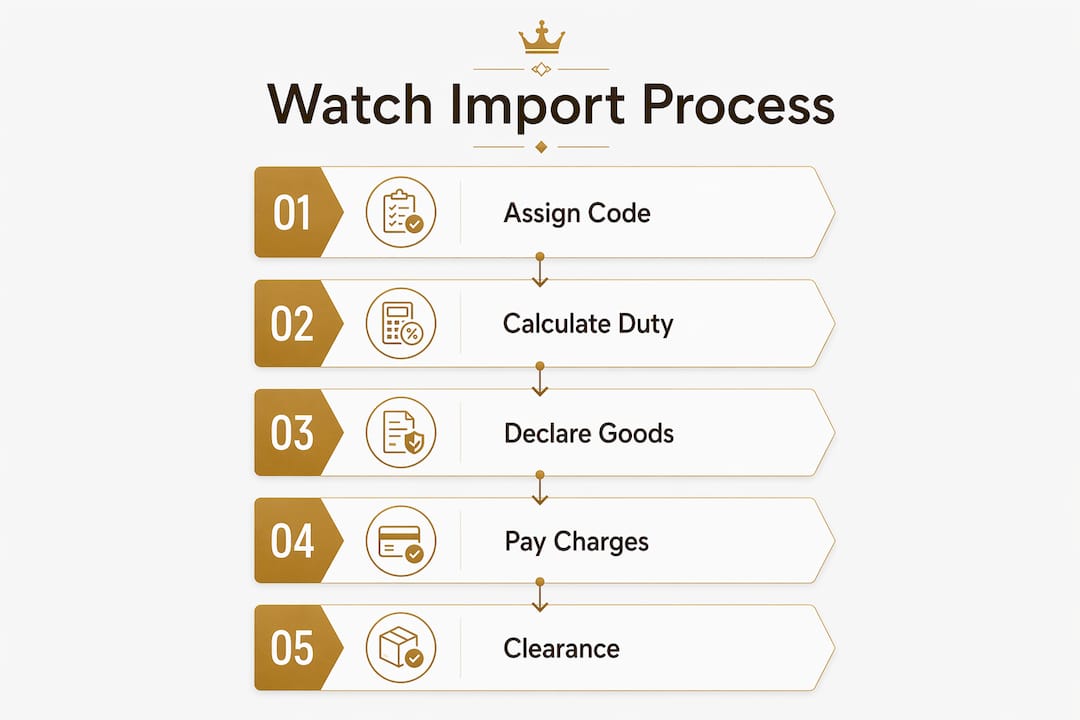
Customs duty and import VAT apply to every watch imported into Great Britain, whether new or pre-owned, and both charges must be declared accurately to HMRC to avoid penalties. For personal imports, the simplified duty rate for watches and clocks is 2%, applied when the total value of goods exceeds £630. Import VAT is then charged on top at the standard UK rate, calculated on the combined value of the goods, the customs duty, and any transport costs. Understanding these charges before you import protects you from unexpected bills, shipment holds, and the risk of seizure.
Key charges at a glance:
Customs duty: a simplified rate applies on watches and clocks for personal imports exceeding a certain value threshold.
Import VAT: charged at the standard UK rate on goods value plus duty plus transport costs
Applies to both new and used watches: age or prior ownership does not exempt a timepiece from tax
Declaration required: all imports must be declared to HMRC with the correct commodity code, value, and country of origin
Courier responsibility: services such as Royal Mail and Parcelforce typically handle customs clearance and notify you of charges owed
Penalties for non-compliance: incorrect or missing declarations can result in fines, seizure of goods, or prosecution
How are watches classified for UK customs purposes?
Every watch imported into the UK must be assigned a commodity code from the UK Trade Tariff, and that code determines the duty rate, import VAT position, and any licensing requirements. There is no single flat rate for all watches. The correct code depends on the case material, the movement type, and how the watch displays the time.
The UK Trade Tariff places watches under Chapter 91, split broadly between two headings. Heading 9101 covers watches whose case is wholly of precious metal or metal clad with precious metal. Heading 9102 covers all other wristwatches, including those with a base metal case inlaid with precious metal. Within each heading, further sub-codes distinguish electrically operated from mechanical watches, and automatic winding from manual. The third country duty rate across these sub-codes is 20% VAT, with an additional supplementary unit charge of £0.20 per piece.
Smartwatches sit in their own defined position. HMRC’s Tariff Notice 10, published in April 2025, classifies touch-sensitive wearable devices under CN code 9102 12 00 as electrically operated wristwatches with opto-electronic display only. This applies even when the device performs communication, health monitoring, or fitness tracking functions alongside telling the time.
Precious metal case watches: heading 9101 (e.g. solid gold Rolex or Patek Philippe cases)
All other wristwatches: heading 9102 (steel, titanium, base metal cases)
Smartwatches with touch display: CN code 9102 12 00
Watch straps and bracelets: heading 9113 (classified separately from the watch itself)
Watch movements imported alone: headings 9108 or 9109
Pro Tip: Verify your commodity code on the UK Trade Tariff on the actual day you import. Codes and duty rates are updated periodically, and a code that was correct six months ago may no longer apply.
How to calculate customs duty and import VAT on a watch
The customs value is the starting point for every calculation. It equals the price you paid for the watch plus the cost of freight and insurance to bring it to the UK. Customs duty is then a percentage of that customs value, and import VAT is charged on the customs value plus the duty plus any transport costs already included.

Watch type | Customs value | Duty rate | Duty payable | VAT base | Import VAT (20%) |
Steel wristwatch (non-precious case) | — | 2% simplified | — | — | — |
Precious metal case watch (heading 9101) | — | 2% simplified | — | — | — |
Smartwatch (CN 9102 12 00) | — | 2% simplified | £10 | — | — |
Pre-owned luxury watch | — | 2% simplified | — | — | — |
The simplified rate applies to personal imports where the total goods value exceeds the relevant threshold for duty application. For commercial imports, the precise duty rate is determined by the commodity code and the country of origin, and trade agreements can reduce or eliminate duty entirely for qualifying goods. Swiss-made watches, for example, may attract a different rate depending on the terms of the UK-Switzerland trade arrangement at the time of import.
Online duty calculators provide estimates only. Final liability is determined by HMRC upon acceptance of the customs declaration and supporting documents. Never treat a calculator figure as a guaranteed bill.
Pro Tip: Always add freight and insurance to your customs value before calculating duty. Omitting these costs is one of the most common valuation errors and can trigger a reassessment.
Declaring imported watches and complying with UK customs
Accurate declaration to HMRC is a legal requirement, not a formality. Every import must carry the correct commodity code, the true customs value, and the country of origin. Getting any of these wrong exposes you to delays, surcharges, or worse.
GB EORI number: you must register for an EORI number before importing goods into Great Britain. Without one, customs processing cannot proceed.
Courier-managed declarations: for personal imports, courier services such as Royal Mail or Parcelforce typically submit the customs declaration on your behalf and then notify you of the VAT and duty owed before releasing the parcel.
Documentation to retain: purchase receipt or invoice, insurance certificate, freight cost evidence, proof of origin (if claiming preferential duty), and any valuation supporting documents for high-value pieces.
Proof of origin: valid origin documentation is required to claim a preferential duty rate under a UK trade agreement. Without it, the standard rate applies regardless of where the watch was made.
Penalties for non-compliance: failure to declare goods or submitting an incorrect declaration can result in seizure of the watch, financial penalties, and in serious cases, prosecution under UK law.
For commercial importers, a customs agent or freight forwarder experienced in luxury goods can manage the declaration process and reduce the risk of errors. The complexity of Chapter 91 classifications makes professional handling worth considering for any shipment above a few thousand pounds in value.
Common pitfalls when importing luxury watches to the UK
The most expensive mistakes in watch importing are almost always avoidable. They tend to cluster around three areas: misclassification, inadequate valuation evidence, and misconceptions about used goods.

Misclassification is the single most frequent cause of delays and unexpected charges. Many buyers assume there is a universal “watch rate,” but the exact duty payable depends on the commodity code assigned based on case material, movement type, and function. A precious metal case watch under heading 9101 and a steel case watch under heading 9102 are treated differently, and a smartwatch under CN 9102 12 00 has its own defined classification. Using the wrong code can trigger a customs hold and a reassessment with surcharges.
Inadequate valuation evidence is particularly costly for luxury timepieces. HMRC can challenge a declared customs value if it appears understated, and without supporting documentation, you have little recourse. Auction results, authenticated purchase receipts, and courier records all serve as credible evidence.
The used watch misconception catches buyers regularly. Import duties and VAT apply equally to new and pre-owned watches. A second-hand Rolex Submariner imported from Japan attracts the same charges as a brand-new one.
Verify the commodity code on the UK Trade Tariff before shipping, not after
Keep all purchase receipts, insurance documents, and freight invoices
Do not rely on the seller’s declared value if it differs from what you actually paid
Use couriers with experience in high-value watch shipments
Check whether the watch strap or bracelet needs a separate commodity code
Pro Tip: If your watch has a strap made from exotic materials such as certain leathers, coral, or ivory, it may require a CITES permit to enter the UK lawfully. Confirm the licensing position before the goods are shipped.
Expert insights on luxury watch valuation and customs from Horology-kings
Accurate valuation is the foundation of a clean customs clearance for any high-value timepiece. HMRC has the authority to query a declared customs value, and for a Patek Philippe or Audemars Piguet worth tens of thousands of pounds, the financial consequences of a dispute are significant. The customs valuation guidance published by HMRC sets out the accepted methods, with the transaction value (what you actually paid) as the primary basis.
For luxury watch imports, the declared customs value must be supported by verifiable evidence. Auction comparables, authenticated purchase receipts, and courier records are all accepted by HMRC. Understating value to reduce duty is not only ineffective when challenged, it carries the risk of seizure and prosecution. Our advice to every client is simple: declare accurately, document thoroughly, and use the UK Trade Tariff as your sole reference for classification. The cost of getting it right is always lower than the cost of getting it wrong.
VAT-registered businesses importing watches commercially should consider Postponed VAT Accounting. Rather than paying import VAT at the border, PVA allows the liability to be accounted for on the periodic VAT return, which protects cash flow on high-value consignments. For a £20,000 watch, that is £4,000 in VAT that does not need to leave your account at the point of import.
Horology-kings works with clients across the full spectrum of luxury watch acquisition, from sourcing rare references to advising on accurate watch valuations that withstand HMRC scrutiny. The luxury watch acquisition process involves more than finding the right piece; understanding the tax and customs position before purchase is part of buying with confidence.
What exemptions and allowances apply to personal watch imports?
Personal imports benefit from a simplified regime, but the exemptions are narrower than many buyers expect. The key threshold is £630: if the total value of goods you are bringing into Great Britain personally exceeds this amount, customs duty and import VAT apply. Below £630, a different simplified rate structure applies, but watches and clocks at 2% still attract duty once the threshold is crossed.
There is no blanket personal-use exemption for luxury watches. A Rolex brought back from a trip to Geneva is not automatically free of charges simply because you wore it on the flight home. HMRC expects goods acquired abroad and brought into the UK to be declared, and the burden of proof that an item was already owned before travel sits with the importer.
Returning UK residents who owned a watch before travelling may be able to claim relief under the Returned Goods Relief scheme, provided they can demonstrate the item left the UK originally and has not been modified or repaired abroad. Keeping a record of serial numbers and original purchase documentation is the most straightforward way to support such a claim.
Gifts sent from abroad are not exempt either. If someone sends you a watch as a gift and its value exceeds the relevant threshold, VAT and potentially duty will apply. The courier or postal service will notify you of the charges before releasing the parcel.
How do you pay customs duties and VAT on imported watches?
For most personal imports, payment is handled through the courier or postal service managing the shipment. Royal Mail and Parcelforce collect duty and VAT on behalf of HMRC before releasing the parcel, and they will contact you with the amount owed and the payment method. This is typically done online through the carrier’s own portal.
For commercial imports, payment is made through HMRC’s Customs Declaration Service (CDS), which replaced the older CHIEF system. Importers or their customs agents submit declarations electronically, and duty is either paid immediately or deferred through a duty deferment account. A duty deferment account allows approved importers to consolidate payments and settle them monthly rather than per shipment, which is useful for businesses importing watches regularly.
VAT-registered businesses can use Postponed VAT Accounting, as noted earlier, to account for import VAT on their VAT return rather than paying at the point of entry. This requires the correct procedure code on the customs declaration. HMRC’s online account for import VAT certificates (C79 certificates) provides the monthly statement needed to reclaim import VAT through the VAT return.
For high-value shipments, some importers use a customs warehouse to defer duty and VAT until the goods are released for sale or use in the UK. This is less common for individual watch purchases but relevant for dealers importing stock.
How to dispute or appeal a customs duty assessment
If HMRC issues a customs duty assessment you believe is incorrect, you have the right to challenge it. The process begins with a formal review request submitted to HMRC, typically within 30 days of the decision. This is not an appeal to a tribunal; it is an internal review where HMRC reconsiders the assessment in light of any additional evidence you provide.
The most common grounds for dispute are an incorrect customs value, a wrong commodity code applied by the carrier or HMRC, or a failure to apply a preferential duty rate under a trade agreement. In each case, your supporting documentation is what determines the outcome. Purchase receipts, freight invoices, origin certificates, and independent valuations all carry weight.
If the internal review does not resolve the matter, you can escalate to the First-tier Tribunal (Tax Chamber). This is a formal legal process, and for high-value disputes involving luxury watches, professional representation from a customs solicitor or specialist adviser is worth the cost. HMRC’s own guidance on reviews and appeals sets out the timelines and procedural requirements in detail.
Acting promptly matters. Delays in requesting a review can result in the right to appeal lapsing, and in the meantime, goods may remain held or duty may accrue. If you believe a charge is wrong, raise it immediately rather than waiting to see whether the issue resolves itself.
Work with Horology-kings on your next luxury watch purchase

Navigating UK customs on a high-value timepiece is straightforward when you have the right support. Horology-kings is a specialist luxury watch dealer based in Hertfordshire, working with collectors and buyers across the UK to source, authenticate, and acquire pieces from Rolex, Patek Philippe, Audemars Piguet, Omega, and Cartier. Every transaction is handled with discretion, transparency, and the kind of expertise that comes from years in the market.
Whether you are sourcing a specific reference or looking to buy or sell through a trusted dealer, Horology-kings provides the professional guidance that makes the process secure and straightforward. Visit Horology-kings to explore the current collection or request a free valuation.
Key takeaways
Customs duty and import VAT apply to all watches imported into the UK, with the 2% simplified rate and standard VAT applying to personal imports above £630.
Point | Details |
Simplified duty rate | Watches and clocks attract a 2% customs duty rate for personal imports where total goods value exceeds £630. |
Import VAT basis | VAT is charged at the standard UK rate on goods value plus customs duty plus transport costs. |
Commodity code accuracy | The correct code from the UK Trade Tariff determines duty rate, VAT position, and any licensing requirements. |
Used watches are taxable | Pre-owned watches attract the same import duty and VAT as new ones; age provides no exemption. |
PVA for VAT-registered buyers | Postponed VAT Accounting lets VAT-registered importers account for import VAT on their return rather than paying at the border. |
Recommended
Comments