.png)
Hidden markings on high-end watches: a collector's guide

What are hidden markings on high-end watches?
Hidden markings on high-end watches are deliberate, often invisible features embedded by luxury manufacturers to certify authenticity, denote precious materials, and sign their work as an artist would a canvas. They appear on the dial, case back, crystal, rehaut, bracelet clasps, and even within movement bridges. Far from being incidental, these marks serve three distinct purposes: anti-counterfeiting, hallmarking precious metals to regulated standards, and creating a private language between brand and collector.
Key locations and functions at a glance:
Dial engravings: secret signatures visible only under oblique light, such as those found on Breguet and Blancpain timepieces
Crystal micro-engravings: laser-etched logos on the sapphire or Hesalite crystal, as seen on Rolex from the early 2000s
Case and lug hallmarks: Helvetia and assay marks confirming precious metal content on Swiss-exported pieces
Rehaut inscriptions: text encircling the inner bezel ring, used by Rolex as an anti-counterfeiting serial reference
Embedded stones: Patek Philippe’s discreet diamond in platinum cases, introduced in 1999
Movement signatures: hand-engraved artisan initials on bridges, as carried by Vacheron Constantin’s Métiers d’Art dials
Authentication professionals at Horology-kings treat these markings as primary verification tools, cross-referencing them against known brand standards before any transaction proceeds.
Common hallmarks and precious metal symbols on luxury cases
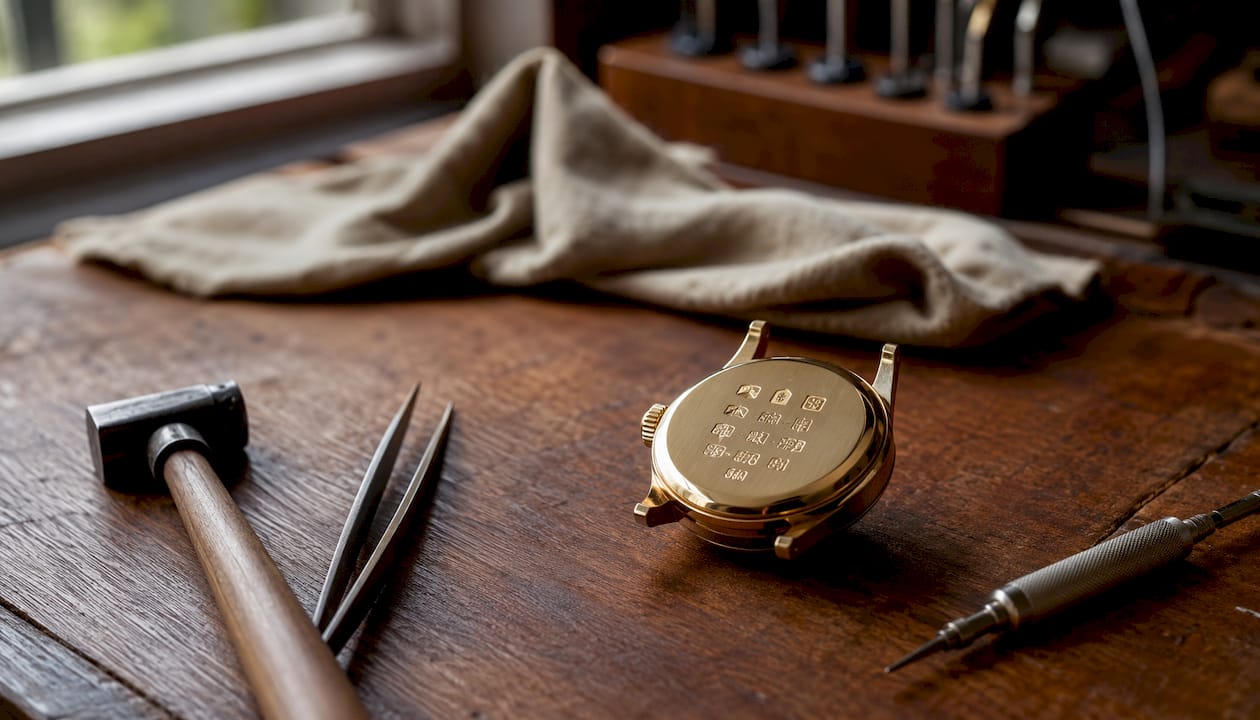
Hallmarking is the oldest regulated form of exclusive watch markings, predating most brand-specific signatures by centuries. Swiss hallmark regulations enforce strict controls for precious metal markings, protecting consumers and guaranteeing material quality. The Helvetia hallmark, depicting a female head in profile, indicates Swiss assay office approval and appears most commonly on precious metal cases exported from Switzerland.
Hallmark symbol | Metal indicated | Typical location |
Helvetia head | Gold, silver, or platinum | Case back, lug |
18K | 18-carat gold | Case back, clasp |
PT950 | Platinum | Case band, lug |
— | Sterling silver | Case back |
Assay office letter | Varies by canton | Case back |
Vintage Swiss watches often carry a combination of the Helvetia head alongside a fineness number and an assay office letter indicating the canton where the piece was tested. Modern watches tend to use laser-stamped fineness marks alongside the Helvetia symbol, though the underlying regulatory framework remains consistent. UK collectors importing Swiss pieces should note that the British Assay Offices in London, Birmingham, Sheffield, and Edinburgh apply their own hallmarks when watches are assayed domestically, so a single case may carry both Swiss and British marks.
Hallmarks appear most reliably on the case back, between the lugs, and on bracelet clasps
Vintage pieces may show wear to hallmarks; a loupe reveals whether the symbol retains its original sharpness
Mismatched fineness numbers and Helvetia marks are a common counterfeit tell
Brand-specific secret signatures and hidden design features
The most compelling secret features of luxury watches are those unique to individual maisons, functioning as a private handshake between maker and owner.
Breguet introduced the concept of the secret signature in 1795, using a drypoint pantograph to etch an almost imperceptible mark on the dial. Abraham-Louis Breguet stated his intent plainly: to ensure the public was not deceived by imitations. That tradition continues on every modern Breguet, now executed by laser. On engine-turned guilloche dials, look for the signature on either side of the 12 o’clock numeral; on enamel dials, it sits on the lower half.
Patek Philippe takes a different approach to material authentication. Since 1999, every platinum timepiece leaving the Geneva workshops carries a small brilliant-cut diamond set into the case middle between the lugs. Thierry Stern, President of Patek Philippe, described the idea simply: a discreet way to prove platinum construction without writing it on the dial.
Rolex deploys two distinct hidden marks. A laser-etched crown logo sits at 6 o’clock on the crystal of most models produced from the early 2000s, etched at varying depths to preserve crystal integrity. Separately, the rehaut engraving repeats “ROLEXROLEXROLEX” around the inner bezel ring, with the serial number positioned at 6 o’clock as an additional anti-counterfeiting layer.

Vacheron Constantin uses two approaches. Its Métiers d’Art dials may carry the initials “AP,” the signature of enamel dial artist Anita Porchet. For the Quai de l’Île model, the brand collaborated with a banknote printer to embed a watermark beneath the sapphire crystal.
IWC and Audemars Piguet both use engraved motifs as identity markers. Audemars Piguet’s secret watches conceal the dial entirely beneath an engraved lid, combining high-jewellery artistry with a functioning mechanical movement. The Établisseurs Peacock, built on a white-gold case, opens at a gentle press to reveal a hand-sculpted interior.
Parmigiani Fleurier takes the concept of hidden features into complication design. The Tonda PF Chronograph Mystérieux presents as a clean three-hander until the monopusher at 7:30 is activated, at which point the chronograph function reveals itself. This philosophy of hidden complications that appear only on demand defines the brand’s approach to private luxury.
Cartier hides its name within the Roman numerals at either 7 or 10 o’clock on most watch dials. The word “CARTIER” replaces the “I” in the numeral, requiring only close attention rather than specialist equipment to find.
Blancpain reserves its secret signature for grand feu enamel dials. The initials “JB,” referencing founder Jehan-Jacques Blancpain, are engraved between the 4 and 5 or 7 and 8 numerals, visible only when light strikes the dial at an oblique angle.
How hidden markings help you authenticate and appreciate a watch
Collectors use these marks as a practical authentication checklist alongside serial number verification and movement inspection. The process is methodical.
A jeweller’s loupe at 10x magnification combined with careful light manipulation is the standard starting point. Tilt the dial under a single directed light source rather than diffuse overhead lighting; oblique angles reveal engravings that disappear under flat illumination.
Practical authentication steps:
Examine the crystal at 6 o’clock under magnification for a laser-etched crown logo (Rolex) or brand symbol (Omega on vintage Hesalite crystals)
Tilt the dial at 30–45 degrees under a directed light source to reveal secret signatures (Breguet, Blancpain)
Inspect the rehaut for text repetition and serial number placement (Rolex)
Check the case band between the lugs for an embedded diamond (Patek Philippe platinum models)
Examine Roman numerals at 7 and 10 o’clock for hidden text (Cartier)
Verify hallmark sharpness on the case back using a loupe; worn but legible marks are normal on vintage pieces, but blurred or inconsistent symbols warrant further scrutiny
Pro Tip: Some hidden marks confirm material rather than authenticity. Patek Philippe’s platinum diamond is a material indicator, not a general anti-counterfeiting device. Knowing the difference prevents misreading a steel watch’s absence of a diamond as a sign of inauthenticity.
How hidden markings evolved from the 18th century to today
The history of concealed marks in watchmaking begins with a practical problem: counterfeiting has existed as long as desirable objects have.
Period | Development |
1795 | Breguet introduces the secret signature using a drypoint pantograph |
— | Precious metal hallmarking becomes regulated across Swiss cantons |
— | Assay offices standardise fineness marks; Helvetia symbol adopted |
— | Omega etches microscopic brand symbols onto Hesalite crystals |
1999 | Patek Philippe introduces the platinum diamond hallmark |
Early 2000s | Rolex adopts laser-etched crown logos on sapphire crystals |
2000s–present | Brands expand hidden marks to watermarks, artisan initials, and concealed complications |
The shift from mechanical pantograph etchings to laser engravings maintained the anti-counterfeiting utility of hidden marks while dramatically increasing their precision and reproducibility. Counterfeiters have responded with better technology of their own, which is precisely why brands continue to add complexity. Vacheron Constantin’s banknote-printer watermark and Parmigiani Fleurier’s hidden complications represent the current frontier: marks and features so technically demanding that replication is effectively impossible at scale.
Expert tips for UK collectors on spotting hidden markings
Knowing where to look is only half the skill. Understanding what you are looking at separates a confident collector from one who is simply going through the motions.
Use a 10x loupe, not a smartphone camera. Camera lenses distort at close range and miss the oblique-light effect that reveals dial engravings
Single directed light source only. A small LED torch held at a low angle to the dial surface is more effective than any overhead lamp
Cross-reference hallmarks against known standards. UK collectors can verify Swiss fineness marks against the British Assay Office guidelines, which publish recognised foreign hallmark equivalents
Distinguish security marks from decorative ones. Rolex’s rehaut engraving is anti-counterfeiting; Vacheron Constantin’s Anita Porchet initials are an artisan signature. Both matter, but for different reasons
Limited editions carry additional marks. Edition numbers, special case back engravings, and unique dial treatments are standard on limited releases and should match documented production records
Pro Tip: When buying a pre-owned Rolex, check that the rehaut engraving aligns correctly with the dial orientation. On genuine pieces, the serial number sits precisely at 6 o’clock. Misalignment is a reliable counterfeit indicator.
How limited editions differ in their hidden markings
Limited edition watches routinely carry markings absent from standard production models, and those differences have real authentication and collector value.
Edition-specific case back engravings are the most common addition. A standard Patek Philippe Calatrava carries the usual hallmarks and serial number; a limited commemorative release adds an engraved edition number, often alongside a reference to the occasion. These engravings are documented in brand records and can be verified against production certificates.
Dial treatments also differ. Grand Seiko’s limited editions use the eight-pointed star symbol to denote special dial materials, a mark that does not appear on standard references. Breguet’s Classique Souscription 2025, produced for the brand’s 250th anniversary, features the secret signature created by an original period pantograph rather than a modern laser, making the mark itself historically distinct from the standard production version.
Some limited pieces carry artisan signatures that standard models never receive. Vacheron Constantin’s Métiers d’Art series, where Anita Porchet’s “AP” initials appear, is produced in very small numbers. Collectors seeking these pieces should request documentation confirming the specific artisan’s involvement, as the initials alone are not sufficient without provenance.
The practical implication for UK collectors: always request the original papers and box for a limited edition, then verify that the case back engraving matches the edition number on the certificate. A mismatch between the two is a clear authentication failure, regardless of how convincing the watch appears under a loupe.
Key takeaways
Hidden markings on high-end watches function simultaneously as anti-counterfeiting tools, precious metal certifications, and artisan signatures that reward knowledgeable collectors.
Point | Details |
Breguet’s secret signature | Introduced in 1795, still present on every modern Breguet dial, visible only under oblique light. |
Patek Philippe platinum diamond | A brilliant-cut diamond set in the case middle since 1999 confirms platinum construction discreetly. |
Rolex dual hidden marks | A laser-etched crown on the crystal and “ROLEXROLEXROLEX” on the rehaut both serve as anti-counterfeiting features. |
10x loupe and oblique light | These two tools are the standard starting point for revealing micro-engravings and secret signatures. |
Limited editions carry extra marks | Edition numbers, artisan initials, and special engravings on limited releases must match original documentation to confirm authenticity. |
Discover authenticated luxury watches with Horology-kings

At Horology-kings, every timepiece we buy, sell, or source is inspected against the hidden markings and hallmark standards covered in this guide. Our team in Hertfordshire verifies rehaut engravings, crystal micro-etchings, precious metal hallmarks, and brand-specific signatures before any watch changes hands. Whether you are looking to buy or sell a luxury watch or need expert guidance on a specific piece, we offer discreet, professional service backed by genuine authentication expertise. For watches requiring servicing to preserve their markings and value, our watch repair and servicing team handles every brand we stock.
Recommended
Comments