.png)

Source Rare UK Watches Securely and Fast With a 9 Point Brief
- lewisvrichards3
- Aug 30
- 9 min read
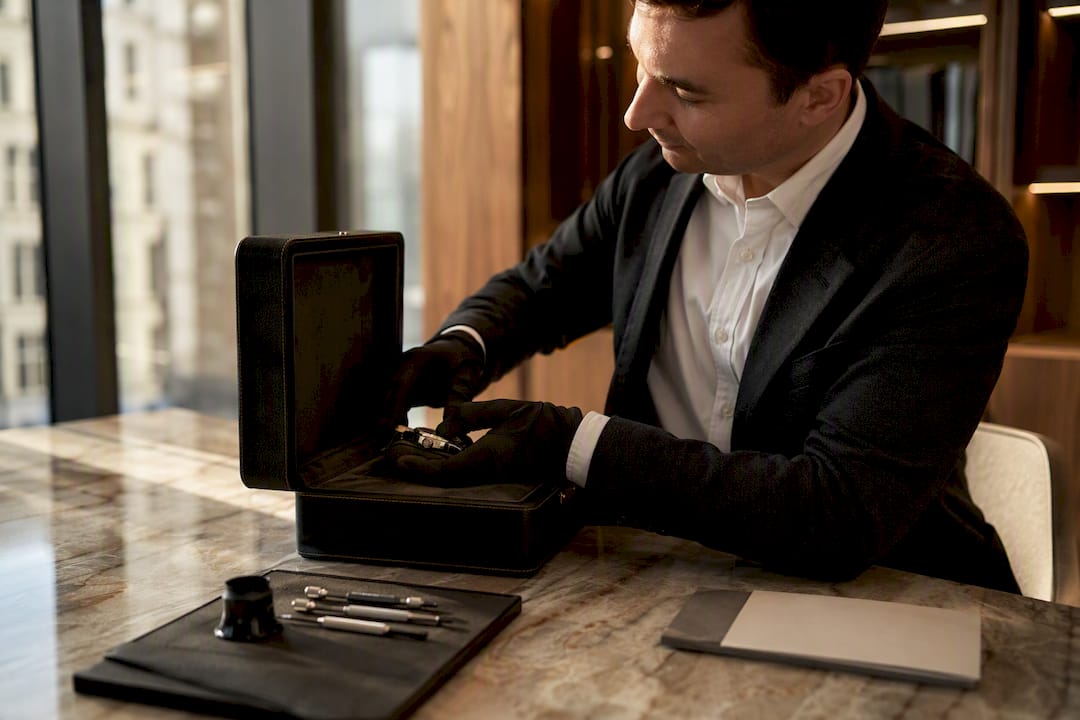
The most reliable way to find a rare or vintage luxury watch in the UK is to hire a specialist dealer to source it for you. Horology-kings is a UK-based option built for exactly this brief. You will need to supply a reference number, acceptable condition range, and budget before a proper search can begin.
TL;DR:
A clear, detailed brief with specific reference, condition, variant, provenance, and budget is essential to speed up the search process significantly.
Specialist dealers have access to private networks, trusted brokers, and auction contacts that are often unavailable to casual buyers, ensuring better selection and authenticity.
Verification steps include independent authentication, secure UK transfers, and insured delivery, with genuine dealers prioritizing provenance and aftercare.
Red flag signs include overpromising, unclear fee structures, lack of transparent sourcing, and absence of after-sales support, which increase fraud risk.
Realistic timelines can range from days to months depending on scarcity, documentation, and cross-border logistics, with premiums applying for rare or discontinued models.
Table of Contents
How professional watch sourcing works for UK collectors
Rare watch sourcing UK collectors rely on starts with a brief, not a browse. A dealer cannot search efficiently for “a vintage Daytona” the way they can for a specific reference, dial variant, and year. The brief is the foundation everything else is built on, and a vague one produces vague results.
Once the brief is locked in, the search moves through several channels simultaneously.
Private networks — long-standing relationships with collectors and estates who are not listing publicly.
Auction houses — upcoming lots and post-sale enquiries where a piece failed to meet reserve.
Vetted secondary market contacts — trusted dealers and brokers who share stock quietly rather than online.
Authorised brand contacts — useful for newer references still moving through official allocation chains.
Impeccable Time, a London sourcing specialist, describes presenting curated options within 24 to 72 hours for many requests, complete with photographs, condition reports, and provenance notes. That speed is realistic for well-documented references; rarer pieces take longer.
Once a candidate is agreed, payment typically moves through an escrow-style arrangement, funds released only once authentication is confirmed. The final stage covers independent authentication, insured UK delivery, and, for older pieces, a service recommendation before the watch reaches your wrist. Aftercare does not end at delivery. A safe sourcing process treats the handover as the start of a relationship, not the end of a transaction.
Why a specialist UK dealer adds value over self-sourcing
Searching auction catalogues and forums yourself will occasionally turn up a bargain. It will far more often turn up disappointment, wasted weeks, or a watch that is not quite what the listing claimed. A specialist watch dealer closes that gap in four concrete ways:
Private inventory access — pieces that change hands between trusted contacts before they ever reach a public listing.
Authentication depth — spotting a redialled face or a mismatched movement number that a casual buyer would miss entirely.
Fraud and misdescription protection — checking a watch’s history against known stolen registers and serial databases before money moves.
Bundled services — valuation, discreet brokerage, and insured logistics handled under one instruction rather than three separate suppliers.
The value of relationships over raw listings is not a niche opinion. WATCHO’s recent acquisition of Peter Jackson the Jeweller was explicitly framed around expanding collector-focused heritage events, a sign that established UK retailers are investing in exactly the kind of in-person trust and community sourcing that online marketplaces cannot replicate.
Pro Tip: Ask any dealer how they’d find a specific reference that isn’t currently listed anywhere. A confident, specific answer about where they’d look tells you far more than a polished sales pitch.
What to tell a sourcing specialist: the brief checklist
A sourcing specialist can only move as fast as the information you give them. Specialists routinely say a granular brief cuts search time dramatically, because it removes ambiguity from the first phone call onward. Send this in your first message or form submission:
Reference or model number — the exact code, not just the family name.
Production year or range — even an approximate era narrows the search meaningfully.
Acceptable condition — mint, lightly worn, or open to honest signs of age.
Variant details — dial colour, bracelet type, box and papers preference.
Provenance requirements — full set only, or comfortable with service history alone.
Budget range — a realistic ceiling, not an aspirational floor.
Timeline expectations — flexible, or working to a specific date.
Delivery preference — collection, or insured courier to a UK address.
Willingness to accept serviced or restored examples — this alone can double the pool of candidates.
One further practical point worth a single sentence: always confirm the watch’s legal provenance and, where the piece is being imported rather than sourced from existing UK stock, ask whether import duty or VAT applies before you commit funds.
Sourcing fees, premiums, and realistic timelines
Sourcing services generally charge one of two ways: a flat fee agreed upfront, or a percentage commission calculated against the final purchase price. Full payment, or a deposit against the agreed price, is usually required once a matching watch is confirmed and before authentication and delivery proceed.
Flat fee model — predictable cost, common for well-documented references.
Percentage commission — scales with the watch’s value, more typical for six-figure or ultra-rare pieces.
Premiums on scarcity — expect a cautious range rather than a fixed number; a genuinely rare dial variant or a discontinued complication can command a significant premium over a standard example.
Timelines vary just as widely. A common reference in good supply might surface within days to a few weeks, broadly consistent with Impeccable Time’s 24 to 72 hour turnaround for curating initial options. A genuinely scarce piece, particularly one requiring full provenance or import clearance, can take weeks to several months. Scarcity, documentation demands, and cross-border logistics are the three factors that most reliably slow a search down.
Verifying authenticity and provenance before you buy
Every serious purchase starts with the same four checks: original papers, a complete service history, serial number verification against the manufacturer’s records, and an independent valuation from someone with no stake in the sale.
Physically, inspect for the signs that separate a well-preserved watch from a compromised one:
Overpolishing — softened case edges and lost lug definition.
Replaced parts — hands, crowns, or bezels that do not match the era of the movement.
Dial refinishing — text or lume that looks too crisp for the watch’s claimed age.
Certain seller behaviours should stop a purchase outright: a price implausibly below market, resistance to an independent inspection, or insistence on untraceable payment methods rather than a traceable bank transfer. ChronoCare’s guidance on vintage watch care and documentation reinforces why paperwork matters well beyond the point of sale; a watch without a maintained history loses both value and buyer confidence over time.
Pro Tip: Insist on secure UK bank transfers and insured delivery as standard, never as an optional extra. Legitimate sellers expect this and will not push back on it.
Choosing the right watch sourcing specialist in the UK
Expertise, reputation, network depth, and verifiable client history separate a genuine specialist from someone simply reselling whatever they can find online. Look for a dealer with demonstrable knowledge of the specific brand and reference you want. Someone fluent in Rolex sports models is not automatically equipped to authenticate a vintage Patek Philippe complication, and a good specialist will say so rather than overpromise.
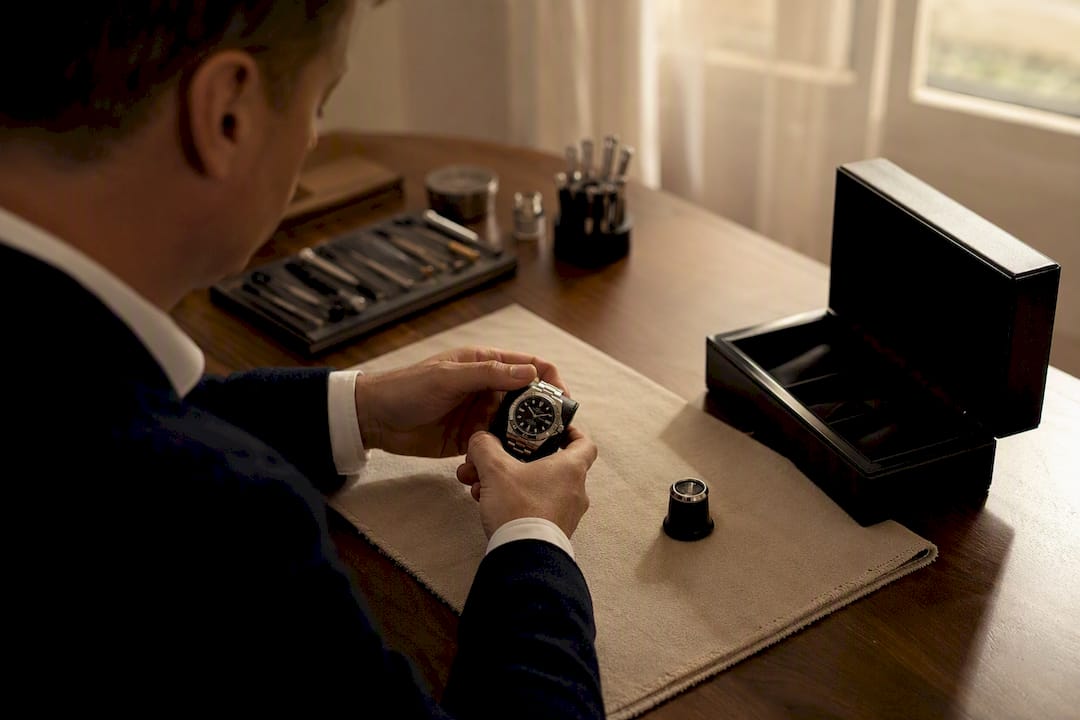
Reputation shows up in longevity and how a business behaves under scrutiny, not just in star ratings. The wider UK market gives some useful signals here: Richemont’s acquisition of Watchfinder was framed around the maturity of the authenticated pre-owned sector, a reminder that trust and verification infrastructure now sit at the centre of this market, not the fringe. Similarly, continued investment activity, such as Dyens & Co.'s advisory role in the acquisition of C.W. Sellors, points to a UK dealer network that is expanding rather than contracting.
Network breadth matters more than most buyers realise. A specialist tied to one or two supply routes will struggle the moment your reference isn’t moving through them. Ask how many independent channels they draw from, and whether that network extends beyond the UK when a piece genuinely requires it.
Client history, meanwhile, is the plainest test available: a dealer with a consistent, checkable track record of completed sourcing mandates is a far safer bet than one relying on promises about “access” they cannot demonstrate.
Questions to ask before hiring a watch sourcer
A short call before you commit will tell you more than any website copy. Ask these five questions directly and pay attention to how specifically they’re answered:
“What’s your experience with this exact brand and reference?” A specialist should be able to speak to specific past mandates, not general enthusiasm.
“Which regions or channels would you search first for this piece?” Vague answers (“everywhere”) are a weak sign; specific answers about auction cycles or dealer networks are a strong one.
“What happens if the piece can’t be found within my timeline?” Good specialists are honest about scarcity rather than promising the impossible.
“How do you authenticate before delivery, and who bears risk if something is wrong?” This should have a clear, confident answer involving independent checks.
“What guarantees or return terms apply if the watch isn’t as described?” A reputable dealer will have clear terms here, not a shrug.
Listen for confidence grounded in specifics rather than confidence grounded in volume of claims. A sourcer who says “we’ve placed three examples of this reference in the last two years” is more credible than one who claims access to “everything in the market.”
Red flags when hiring a watch sourcing service
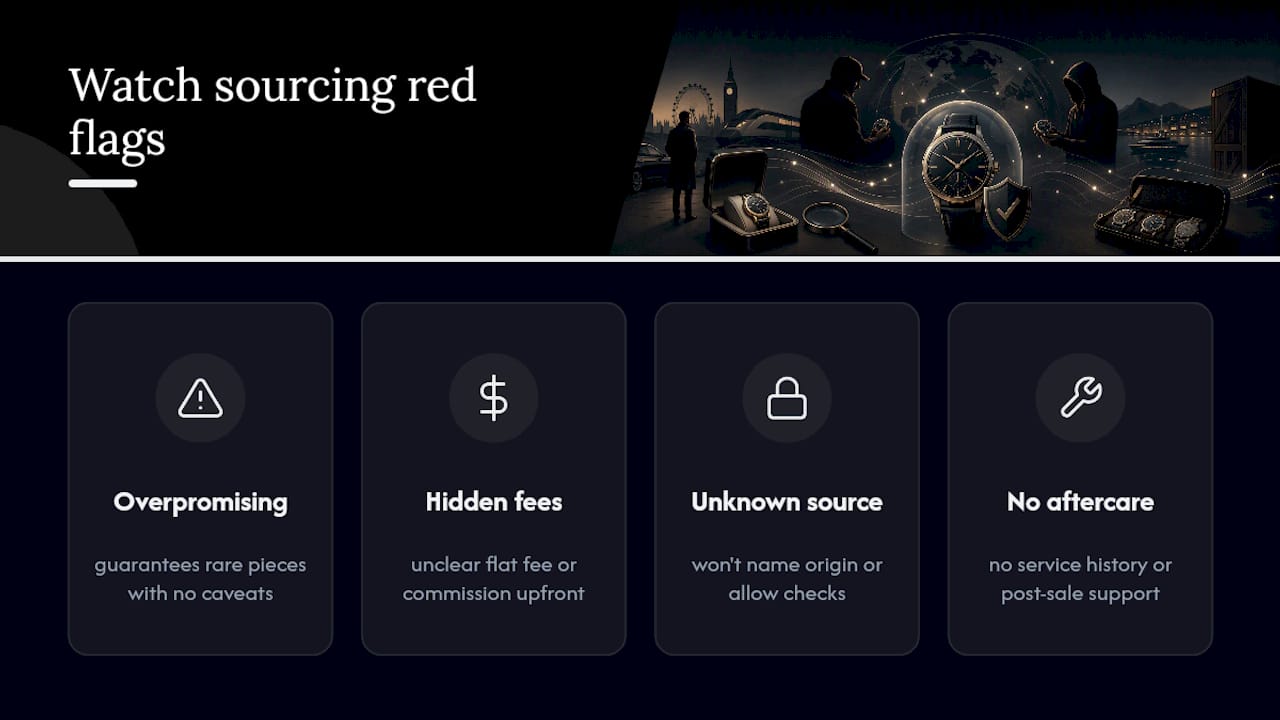
Overpromising is the clearest warning sign in this industry. Anyone who guarantees a specific ultra-rare piece within days, with no caveats about scarcity or price, is either inexperienced or being deliberately misleading. Genuine specialists talk in ranges and probabilities, not certainties, because that’s the honest reality of chasing scarce watches.
Lack of transparency around fees is another. If a sourcer won’t clearly explain whether they charge a flat fee or a commission, or won’t state it before you commit, treat that as a reason to walk away rather than a minor inconvenience to raise later.
Unverifiable suppliers are the most serious risk of all. If a sourcer can’t or won’t explain where a watch is coming from, or resists an independent authentication step before payment, the deal carries real fraud risk. The same applies to pressure toward untraceable payment methods instead of a secure, traceable bank transfer. Genuine UK dealers build their process around documentation and traceability precisely because it protects both sides.
A final, quieter red flag: no service history or aftercare offering once the sale completes. A dealer who disappears after the transfer clears is treating you as a one-off sale rather than a client relationship, and that tells you something about how seriously they took the sourcing in the first place.
Publisher perspective: how we source rare watches and protect buyers
Every mandate we take on starts with the brief, because a vague request wastes everyone’s time. Our network spans private collectors, trusted trade contacts, and auction relationships built over years, which is what lets us surface pieces that never reach a public listing. Every candidate goes through independent authentication before it’s presented, and again before it leaves our hands.
Buyer protection isn’t an add-on. Secure UK bank transfers and insured delivery are standard on every instruction we take, and we’d rather lose a sale than cut a corner on provenance. If you want to see how a bespoke brief translates into a search, source a watch with us directly.
— Lewis
Ready to instruct a search? Here’s what happens next
Horology-kings is the direct route to a properly sourced rare or vintage watch, without the weeks of forum trawling and unverifiable private sellers that self-sourcing usually involves.
Submitting a brief is straightforward. Use the checklist above: reference number, year, condition, variant details, budget, and delivery preference. We’ll confirm fees upfront, whether that’s a flat rate or a commission tied to the final price, before any search begins. Every piece we present has been through independent authentication, and every completed purchase moves through secure UK bank transfers with insured delivery as standard, never an optional extra.
If your watch needs attention once it arrives, our servicing and restoration team can handle that too, so the relationship doesn’t end at the handover. Ready to start? Submit your sourcing brief and we’ll come back to you with a realistic timeline and next steps.
Sources
Recommended
Comments