.png)

Role of service history in luxury watch value
- lewisvrichards3
- Jul 13
- 8 min read
TL;DR:
Documented service history increases a luxury watch’s resale value by providing verifiable proof of maintenance. It reduces perceived risk and attracts more buyers, especially for recent, certified services on modern watches. However, for vintage pieces, originality and proper documentation are crucial, as inappropriate servicing can diminish value.
Documented service history is the verified record of maintenance performed on a luxury timepiece, and it directly shapes what a watch commands on the secondary market. Collectors and investors who understand the role of service history in value hold a clear advantage when buying, selling, or assessing high-end pieces. A stamped service card from a Rolex authorised dealer, a Patek Philippe workshop invoice, or a certified movement report each tells a buyer something a photograph never can: that the watch has been cared for by someone who knew what they were doing. This guide explains how service documentation works as a valuation tool, when it adds price and when it does not, and how to use it effectively.
How does service history influence value in the secondary market?
Documented service history acts as currency in the secondary luxury watch market. It provides a narrative of ownership and responsibility that turns a mechanical object into a verifiable asset. Buyers paying five or six figures for a pre-owned Audemars Piguet Royal Oak or an Omega Speedmaster Professional are not just buying a watch. They are buying confidence that the movement is sound, the parts are correct, and the previous owner treated the piece with care.
Service records reduce perceived risk. A buyer who sees a recent service invoice from a certified workshop knows the movement has been cleaned, oiled, and tested to manufacturer standards. That certainty commands a price premium because it removes the cost and uncertainty of an unknown service requirement. Proper documentation attracts broader buyer interest and supports lasting market appeal, which means well-serviced watches sell faster and with fewer negotiation concessions.
The quality of the documentation matters as much as its existence. Vague or old service notes carry far less weight than clear, certified records from reputable workshops. A handwritten note saying “serviced 2019” without receipts or testing results does almost nothing for a buyer’s confidence. A dated invoice from a manufacturer’s service centre, listing parts replaced, timing results, and water resistance testing, is a different proposition entirely.
Stamped service cards from authorised dealers confirm work was carried out to brand standards.
Workshop invoices listing parts, labour, and testing results provide a verifiable paper trail.
Certified movement reports from independent watchmakers with recognised credentials add credibility for non-manufacturer servicing.
Photographic records taken before and after servicing document the watch’s condition at each stage.
Pro Tip: When buying a pre-owned watch, request the original service documentation rather than a summary. The specific workshop name, date, and parts list are what matter to future buyers.
When does service history protect value, and when can it reduce it?
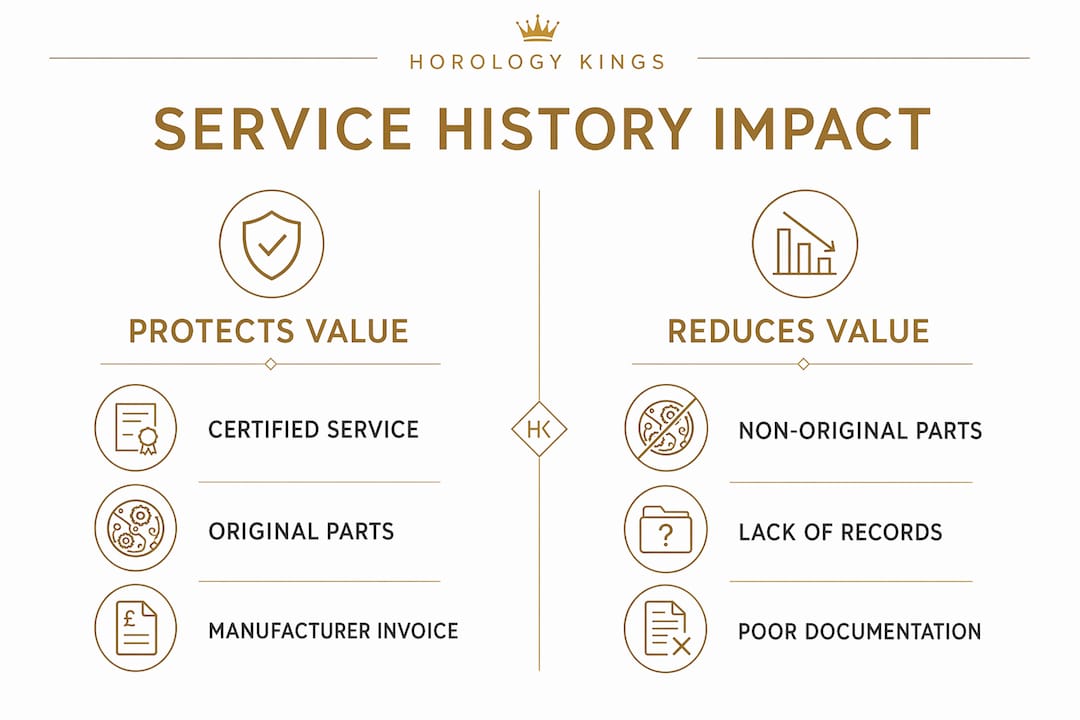
The impact of service records on value is not uniform across all watches. The distinction between vintage and modern pieces is critical, and collectors who miss this nuance pay for it.
For modern watches, recent and detailed service history is almost always a positive. A Rolex Submariner or Cartier Santos serviced within the last three to five years by an authorised centre gives buyers mechanical confidence without any originality concerns. The watch is expected to run to specification, and documented proof that it does is worth real money.
Vintage watches operate under different rules. Buyers prioritise originality in vintage pieces because originality drives desirability and long-term value. A 1960s Rolex Daytona with its original dial, hands, and case finish intact commands far more than the same reference with a refinished case and replaced hands, even if the latter runs perfectly. Over-polishing removes the sharp edges that define original case geometry. Aftermarket parts break the chain of authenticity that serious collectors pay to own.
The risks of inappropriate servicing include:
Case polishing that removes original brushed or bevelled surfaces, reducing collector appeal significantly.
Dial replacement with non-original or refinished dials, which destroys provenance and authenticity.
Aftermarket parts substituted during movement servicing, which undermine originality and raise authentication concerns.
Excessive cleaning of aged components that removes patina valued by vintage collectors.
Undocumented servicing by unqualified workshops, which creates doubt rather than confidence.
Pro Tip: For vintage watches, honest wear and original parts outperform a fresh service with non-original components. If you are considering servicing a vintage piece before selling, consult a specialist first. The cost of the wrong service can exceed the cost of no service at all.
Service history alone protects against depreciation caused by neglect, but it does not guarantee premiums beyond what condition and rarity already support. Servicing is the baseline required to command the expected market price. It is not a mechanism for manufacturing value that the watch does not otherwise possess.
How should collectors document and present service history?
Effective documentation is a discipline, not an afterthought. Collectors who archive service records meticulously and include them in sales listings gain measurable negotiation leverage. A clear maintenance timeline removes buyer objections before they arise and positions the seller as a credible, trustworthy counterparty.
The authentication process for any serious pre-owned transaction now routinely includes service history review alongside physical inspection. Buyers and their advisers look for consistency between the watch’s physical condition and its documented maintenance. A watch claiming a recent service but showing worn crown threads or a scratched caseback raises immediate questions.
Practical steps for building and presenting a strong service history package:
Keep every invoice, receipt, and correspondence from authorised service centres in a dedicated folder, physical or digital.
Photograph the watch before and after each service, noting the date and workshop details.
Record the movement’s timing performance before and after servicing using a timegrapher reading.
When selling, present service records chronologically so buyers can see the full maintenance timeline at a glance.
Obtain a written condition report from a qualified watchmaker if the watch has not been serviced recently, to establish a baseline for buyers.
Documentation type | Value impact |
Manufacturer service centre invoice | Highest. Confirms brand-standard work and parts. |
Independent certified watchmaker report | Strong. Credible if the watchmaker is recognised and the report is detailed. |
Stamped service card without invoice | Moderate. Confirms service occurred but lacks detail. |
Verbal or undocumented service claim | Minimal. Adds no verifiable value and may raise suspicion. |
Understanding why documentation matters is the first step. Acting on it consistently across every watch in a collection is what separates serious investors from casual collectors.
How does service history fit alongside other valuation factors?
Service history does not operate in isolation. It works alongside brand reputation, model scarcity, condition, and provenance to determine where a watch sits in the market. Understanding how these factors interact is what allows collectors to make accurate value assessments.
Brand desirability sets the ceiling. A Patek Philippe Nautilus or a Rolex Daytona in stainless steel carries inherent demand that no amount of documentation can replicate for a lesser brand. The Patek Philippe Caretaker Philosophy formalises this relationship between preservation, documentation, and generational stewardship, contributing to average annual appreciation rates of 6–8%. That figure reflects what happens when brand prestige and meticulous maintenance history combine over time.
Rarity and condition work with service history rather than against it. A scarce reference in excellent original condition with complete service records is the strongest possible combination. Remove any one of those three elements and the value proposition weakens. A rare watch in poor condition with no service history is a restoration project. A common watch in perfect condition with full records is a reliable, liquid asset.
The factors driving luxury watch value in 2026 increasingly reward transparency. Buyers in the current market are more informed than at any previous point. They use specialist platforms, consult experts, and cross-reference auction results before committing. A watch with a clear, documented service history stands out in that environment because it answers questions before they are asked.
Long-term investment potential also connects to service documentation. A watch with a complete record from new is easier to insure, easier to authenticate, and easier to sell at any point in its ownership history. That liquidity advantage compounds over time.
Key takeaways
Documented service history is the single most controllable factor in a luxury watch’s secondary market value, and collectors who treat it as such consistently achieve better outcomes when buying and selling.
Point | Details |
Service history as market currency | Verified records build buyer confidence and support stronger resale prices. |
Vintage versus modern distinction | Originality outweighs servicing for vintage pieces; modern watches benefit directly from recent certified service. |
Documentation quality matters | Detailed invoices from authorised centres carry far more weight than vague or undated notes. |
Service protects, not inflates | Servicing prevents depreciation from neglect but does not create value beyond condition and rarity. |
Consistent archiving pays off | A chronological service file gives sellers negotiation leverage and speeds up authentication. |
Service history in 2026: what the market is actually telling us
The shift I have observed over the past several years is not subtle. Buyers in the pre-owned luxury watch market have become genuinely sophisticated about documentation. Five years ago, a watch in good physical condition with a plausible service story was often enough. Now, buyers routinely ask for the actual invoices, not a summary, and they know the difference between an authorised service centre stamp and a generic watchmaker’s receipt.
What concerns me is the number of collectors who still treat servicing as a cost rather than a record-keeping opportunity. Every time a watch goes in for service without generating a proper paper trail, its future value takes a quiet hit. The movement may run perfectly, but the market cannot verify that without documentation.
The other mistake I see regularly is over-servicing vintage pieces in pursuit of a “cleaner” presentation. A 1970s Omega Constellation with its original dial and honest patina is worth considerably more than the same watch with a refinished dial and polished case, regardless of how well it runs. The service history value of a vintage watch is inseparable from its originality. Collectors who understand that distinction make better buying decisions and better selling decisions.
My advice is straightforward. Build the file from day one. Keep every piece of paper. Photograph everything. And before you service any watch, particularly a vintage one, get a specialist opinion on whether the service will help or harm its value.
— Lewis
Horology-kings: expert support for collectors and investors
Horology-kings works with collectors and investors across the UK who take documentation and provenance seriously. Whether you are looking to sell or source a watch with a verified service history, or you need a professional assessment of how a watch’s maintenance records affect its current value, the team at Horology-kings provides the expertise to guide that decision. The watch repair and servicing offering covers everything from full movement overhauls to condition assessments, with detailed documentation produced at every stage. Every transaction is handled with transparency, and every valuation reflects the real market, not an optimistic estimate.
FAQ
Does service history affect the price of a luxury watch?
Service history directly affects resale price by building buyer confidence and reducing perceived risk. Detailed, certified records from authorised workshops support stronger asking prices and faster sales.
Is service history more important for vintage or modern watches?
For modern watches, recent certified service history is a clear positive. For vintage watches, originality takes priority, and inappropriate servicing can reduce value even when the watch runs well.
What documents count as valid service history?
Manufacturer service centre invoices, stamped service cards, and certified independent watchmaker reports all count. Undocumented or verbal service claims carry no verifiable weight with informed buyers.
How often should a luxury watch be serviced to protect its value?
Most manufacturers recommend servicing every five to ten years depending on the calibre and usage. Consistent servicing within that window, with full documentation retained, protects the watch from depreciation linked to neglect.
Can a watch with no service history still sell well?
A watch with no service history can still sell, but it will typically attract lower offers and a smaller pool of buyers. Sellers without records often concede on price to compensate for the uncertainty they are passing to the buyer.
Recommended
Comments