.png)
Rolex database: the UK buyer's complete guide
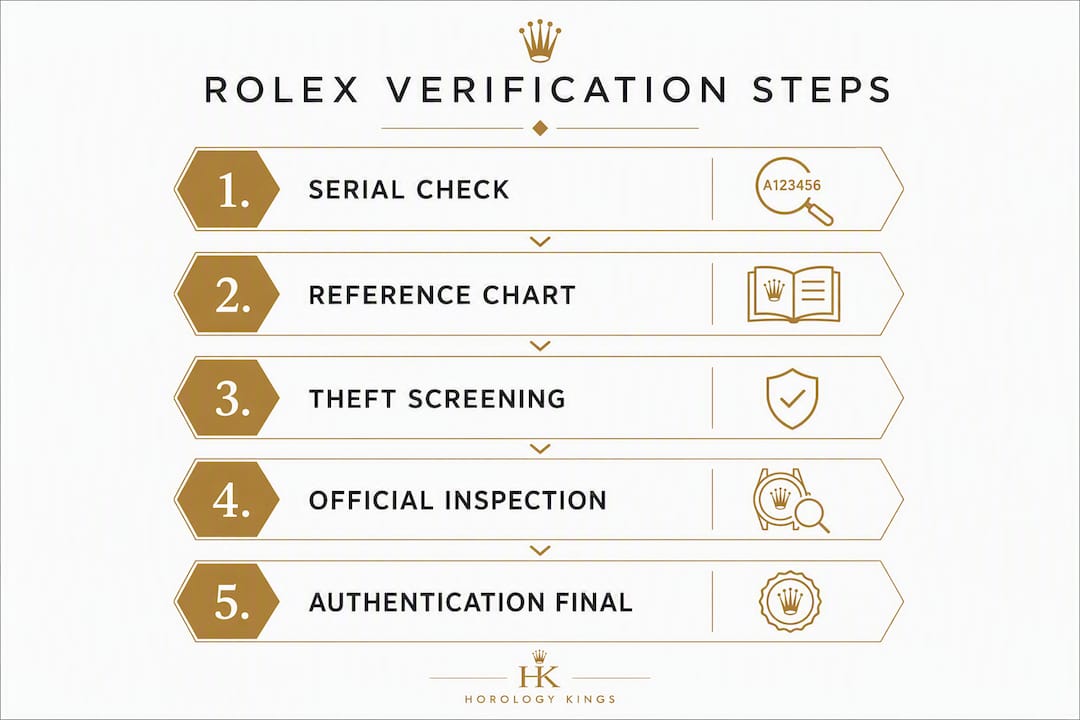
A public, official Rolex database does not exist. Rolex provides no online serial lookup tool for consumers, and no third-party registry can confirm a watch is genuine. What you can do right now is run a stolen-watch check, cross-reference a serial-reference chart for an approximate production window, and arrange a paid inspection at an authorised Rolex Service Centre if anything is uncertain.
Start here before any purchase:
Run a search on The Watch Register, the UK’s primary stolen and lost watch registry, to screen the serial number against theft and insurance reports.
Cross-reference the serial against collector-compiled reference charts to get an approximate production era (reliable for pre-2010 watches only).
Check the reference number against a model database such as WatchBase or BezelBase to confirm the model family and variant details.
Arrange an authorised inspection if the watch is high-value, the paperwork is incomplete, or anything looks inconsistent.
Pro Tip: Stop any transaction the moment a serial number returns a match on The Watch Register. Do not proceed, do not hand over money, and do not return the watch to the seller without first contacting Action Fraud or your local police.
Table of Contents
1. Which public databases and UK services exist for Rolex serial checks
2. What a Rolex serial number lookup can and cannot tell you
6. Where to get a definitive, official verification in the UK
8. Why serials alone are insufficient: what a professional inspection actually checks
Horology-kings: authentication, valuation and sourcing in the UK
1. Which public databases and UK services exist for Rolex serial checks
The honest answer is that no single resource does everything. You need to combine several tools, and you need to understand what each one actually proves.
The Watch Register is the most important first stop for any UK buyer. It aggregates records from insurers, law enforcement agencies, and private registrants to flag watches reported stolen or lost. A search returns either a match (stop immediately) or a clear result. A clear result does not confirm authenticity; it confirms only that the serial has not been reported to that registry.

Community serial-reference charts, maintained by collector communities and researchers, map serial number ranges to approximate production windows for watches made between 1926 and 2010. These are not official Rolex records, but they are well-established and widely used by dealers and collectors. They give you a production era, not a guarantee.
WatchBase catalogues thousands of Rolex references, covering model families, production spans, movement types, and dial variants. It is a model-identification tool, not a serial-authentication tool. TroveStar offers a similar structured catalogue, useful for reference-level research and market context. BezelBase goes deeper, documenting per-reference production years, movement specifications, dial variants, and authentication cues for each reference number.
Rolex itself provides no public serial lookup. Official verification is performed by authorised service centres during a paid service or inspection, where technicians can access factory records and physically examine the movement.
Use each tool for what it does well: The Watch Register for theft screening, serial charts for approximate dating, model databases for reference identification, and authorised centres for definitive authentication.
2. What a Rolex serial number lookup can and cannot tell you
Serial lookups answer two questions reliably: whether the serial appears on a stolen or lost registry, and (for pre-2010 watches) which approximate production window the number falls within. That is genuinely useful, but it is also the limit of what a serial alone can prove.
What a serial check can confirm:
Whether the serial has been reported stolen or lost on The Watch Register.
An approximate production era for watches made before 2010, using collector-compiled reference charts.
Whether the serial format is consistent with Rolex’s known numbering systems.
What a serial check cannot confirm:
Whether the dial, bezel, bracelet, or movement are original to that case.
Whether the serial engraving has been altered, re-engraved, or swapped from another case.
Whether the watch is genuine, even if the serial is valid and unregistered as stolen.
Post-2010 Rolex watches use randomised alphanumeric serials, which cannot be mapped to a production year. If you are looking at a modern reference, the serial tells you almost nothing about age.
Component swapping is a well-documented problem in the pre-owned market. Cases, dials, and bracelets from different watches are combined to create pieces that pass a superficial serial check but are not original. Professional authentication goes well beyond the serial: movement inspection, component patina matching, dial provenance, and case finishing all carry weight that a database search cannot replicate.
A clear Watch Register result is a meaningful step. It is not a certificate of authenticity.
3. Where to find your Rolex serial and reference numbers
Knowing where to look is the first practical step, and the answer depends on when the watch was made.
Historic placements (pre-2005 approximately)
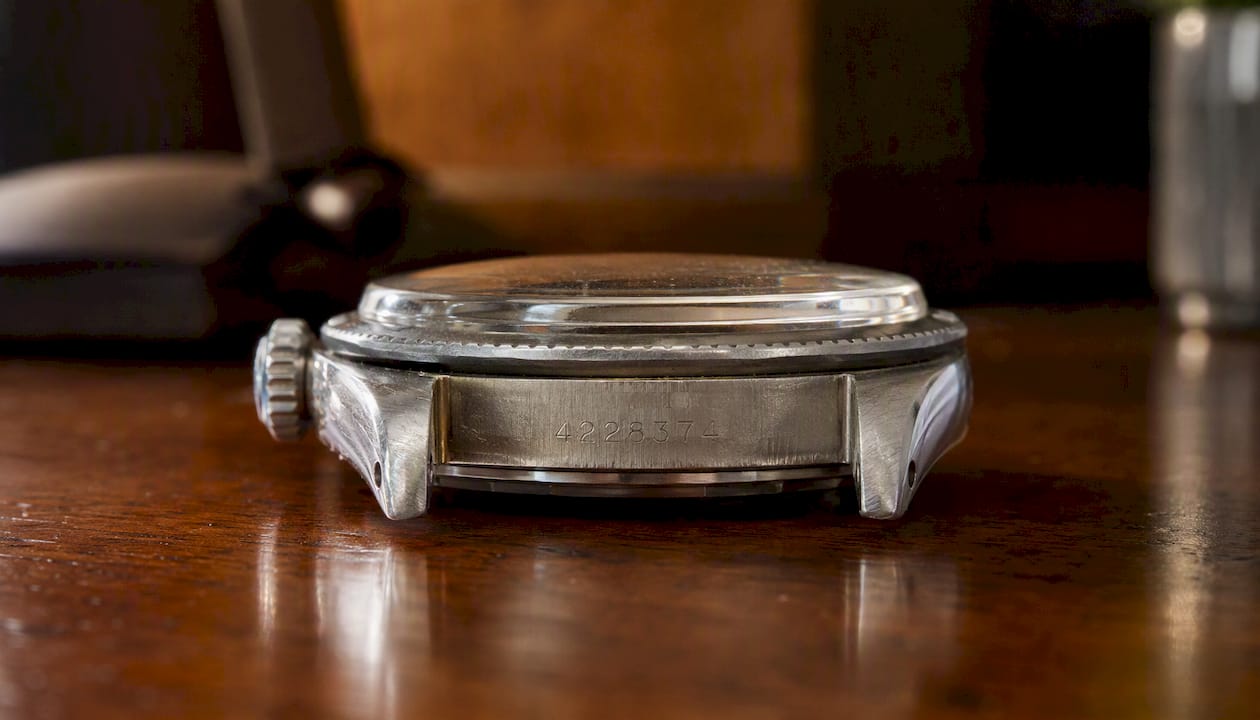
On older Rolex watches, the serial number is engraved between the lugs at the 6 o’clock position, visible when the bracelet is removed. The reference number sits between the lugs at the 12 o’clock position. Both engravings should be crisp, consistent in depth, and free of any signs of re-engraving or polishing.
Modern placements (post-2005 approximately)
Rolex moved both numbers to the rehaut, the inner bezel ring visible through the crystal at the 6 o’clock position. This change was partly a security measure. On modern watches, the serial is also printed on the warranty card and, where applicable, on the green Rolex card introduced in 2020 to replace the traditional paper warranty.
Bracelet and caseback codes
The bracelet endlinks and clasp often carry date codes stamped inside the clasp, indicating the bracelet’s production quarter and year. These should be consistent with the watch’s production era. The caseback on most Rolex models is plain and smooth; an engraved caseback on a model that should have a plain one is an immediate red flag.
Serial system summary:
System | Period | Date usefulness |
Numeric sequences | Pre-2010 | Approximate year from reference charts |
Letter-prefix system | — | Approximate year from reference charts |
Randomised alphanumeric | ~2010 onwards | Cannot be dated by serial alone |
Pro Tip: Photograph both the serial and reference engravings in strong, raking light before any transaction. Send those images to a professional for remote vetting before you commit to a purchase.
4. A practical authentication checklist before you buy
Run through this before handing over any money. The order matters: paperwork first, then physical checks, then movement behaviour.
Paperwork and provenance:
Warranty card or green Rolex card with serial number matching the watch.
Original box with matching reference and serial stickers where present.
Service receipts showing the watch’s history, ideally from an authorised Rolex Service Centre.
Original purchase receipt or proof of purchase, particularly for watches under ten years old.
Any import documentation for watches purchased abroad.
Visual and mechanical checks:
Dial printing: text should be sharp, correctly spaced, and consistent with the reference. Blurred or uneven printing is a fast red flag.
Lume plots: colour, shape, and alignment should be consistent across all indices and hands.
Crown function: the crown should wind smoothly, set the date with a clean click, and show no wobble.
Movement behaviour: the seconds hand should sweep continuously, not tick. A ticking seconds hand on a Rolex is a definitive sign of a non-genuine movement.
Case finishing: brushed and polished surfaces should meet at clean, sharp edges. Over-polishing softens those edges and destroys value.
Serial engraving quality: crisp, consistent depth, no signs of re-engraving.
Bracelet and clasp:
Endlinks should fit flush to the case with no gap.
Clasp date codes should be consistent with the watch’s production era.
Stretch in the bracelet links is normal with age but should be proportionate to the stated service history.
When to stop and seek an authorised inspection:
Missing or mismatched paperwork on a watch over £5,000.
Any inconsistency in serial engraving quality.
A seller who refuses to allow an independent inspection.
Any Watch Register match, however partial.
For a full step-by-step framework, Horology-kings’s watch authentication checklist covers each of these points in detail.
Pro Tip: Ask the seller to hold the watch face-up and film the seconds hand for ten seconds. A genuine Rolex movement sweeps; a fake ticks. This one check takes ten seconds and costs nothing.
5. How to check if a Rolex is stolen in the UK
Locate the serial number on the rehaut (post-2005) or between the lugs at 6 o’clock (pre-2005). Photograph it clearly.
Search The Watch Register using the serial number. The Watch Register holds records from UK insurers, police forces, and private registrants, making it the most comprehensive UK-focused stolen-watch resource available.
Interpret the result carefully. A match means the watch has been reported stolen or lost. Stop the transaction immediately. A clear result means the serial is not on that registry, not that the watch is clean.
Request a Search Certificate or written evidence of the search result. This document is useful if you later need to report a suspected theft to police or provide evidence to an insurer.
Contact Action Fraud (0300 123 2040) if you believe a watch has been offered to you fraudulently, or report to your local police if you have already purchased a watch that later returns a stolen result.
Preserve all evidence: screenshots of listings, seller contact details, photographs of the watch and its serial, and any written communications.
For buyers, the practical rule is straightforward: request a Search Certificate before completing any significant purchase. Professional dealers routinely provide this as part of a sale, and its absence on a high-value piece is itself a warning sign.
6. Where to get a definitive, official verification in the UK
The only route to a definitive answer on component originality and authenticity is an authorised Rolex Service Centre. Rolex boutiques and authorised retailers in the UK can refer watches for service inspection, during which technicians access factory records, open the caseback, and physically examine the movement and components.
What an authorised inspection covers:
Movement reference verification against factory records.
Component originality checks (dial, hands, crown, bracelet, bezel).
Serial number confirmation against internal records where available.
Identification of any non-original or aftermarket parts.
A written service record on completion.
What to expect on timescales and costs:
Authorised inspections are typically performed as part of a paid service, not as a standalone free check. Opening the caseback and inspecting the movement moves the process from a same-day answer to a multi-week service appointment. Budget accordingly, particularly for vintage pieces where parts availability may extend the timeline further.
Bring the watch’s full paperwork, any service history, and the Watch Register search result. The more documentation you provide, the faster the assessment.
Trust signals to look for in any verification:
A written Search Certificate from The Watch Register.
Documented service history from an authorised centre.
A written inspection report confirming component originality.
Consistent serial numbers across the watch, paperwork, and any service records.
7. Red flags to watch for and what to do when you find them
Immediate red flags:
Serial number on the watch does not match the warranty card or service records.
Engraving is shallow, uneven, or shows signs of re-cutting.
Dial printing is blurred, incorrectly spaced, or uses the wrong typeface for the reference.
Seconds hand ticks rather than sweeps.
Aftermarket parts: non-original bezel, bracelet, or crown.
A Watch Register match on the serial number.
Seller refuses an independent inspection or is unwilling to provide provenance documents.
Immediate actions:
Stop the transaction. Do not hand over payment.
Request the original warranty card, box, and purchase receipt.
Ask for a Search Certificate from The Watch Register.
If you suspect fraud, contact Action Fraud on 0300 123 2040 or report to your local police.
If you have already purchased:
Gather all evidence: photographs, seller communications, payment records, and the watch itself.
Do not attempt to sell or transfer the watch until its status is confirmed.
Contact Action Fraud and your local police with the evidence package.
Reach out to a trusted UK dealer for an appraisal and guidance on next steps, including whether the watch can be legitimately resold or should be surrendered to police.
For guidance on the legal aspects of transferring or selling a watch with unclear provenance, Horology-kings’s guide on selling a gifted Rolex legally covers the key considerations under UK law.
8. Why serials alone are insufficient: what a professional inspection actually checks
A serial number confirms format and stolen status. It does not confirm what is inside the case. This distinction matters enormously in the pre-owned Rolex market, where component swapping is a documented and widespread practice.
What a qualified watchmaker examines beyond the serial:
Movement reference number and its consistency with the case reference.
Component patina: genuine ageing on the dial, hands, and movement should be consistent and proportionate to the stated age.
Soldering and case finishing: factory finishing has specific characteristics that aftermarket work does not replicate.
Dial provenance: re-dialled watches (where an original dial has been refinished or replaced) can look correct to the untrained eye but show inconsistencies under magnification.
Movement serial, where applicable, and its relationship to the case serial.
Authorised service centres can access Rolex factory records during an inspection and confirm whether components are original to the watch in many cases. That access is what separates an authorised inspection from any database check or visual assessment.
Collector encyclopaedias such as BezelBase document per-reference production years, movement types, and dial variants in detail. They are invaluable for identifying what a genuine example should look like, but they are secondary to authorised records when the question is whether a specific watch is original.
This is why the authentication workflow recommended by experienced dealers always ends at an authorised inspection for any watch above a certain value threshold, regardless of how clean the paperwork looks.
Key takeaways
No online Rolex database confirms authenticity: combine a Watch Register stolen check, serial-reference charts for pre-2010 dating, and an authorised service inspection for any definitive result.
Point | Details |
No public Rolex serial lookup exists | Rolex provides no consumer database; official checks require a paid authorised service inspection. |
The Watch Register is your first stop | Search the serial before any UK purchase; a clear result screens for theft but does not confirm authenticity. |
Post-2010 serials cannot be dated | Randomised alphanumeric serials from around 2010 onwards give no production-year information. |
Component swaps defeat serial checks | Dial, bracelet, and movement swaps are common; only a physical inspection confirms component originality. |
Horology-kings offers UK authentication | Horology-kings provides appraisal, authentication, and sourcing services for UK buyers and owners seeking a trusted next step. |
The serial check is the start, not the finish line
There is a persistent assumption among buyers that finding a serial number and running it through a database is the due diligence. It is not. It is the first five minutes of a process that, for any watch worth serious money, should end with a qualified professional opening the caseback.
What concerns me most, having seen the pre-owned market from the inside, is how often buyers treat a clean Watch Register result as a green light. The registry is excellent at what it does: flagging watches that have been reported. It cannot flag a watch that was stolen but never reported, a watch built from genuine components sourced from multiple damaged pieces, or a watch where the serial has been carefully re-engraved to match stolen paperwork. Those cases exist, and they are not rare.
The collector databases, WatchBase, TroveStar, and BezelBase, are genuinely useful tools. They help you understand what a genuine example of a specific reference should look like, which makes visual inspection more productive. But they are reference libraries, not authentication services.
The buyers who get this right are the ones who treat every check as additive rather than conclusive. Serial chart plus Watch Register plus visual inspection plus authorised service: each layer adds confidence, and none of them alone is sufficient. The authorised service centre is the only point in that chain where someone with factory access physically examines the movement. For a watch at the price point of most Rolexes, that step is not optional.
Horology-kings: authentication, valuation and sourcing in the UK
When a serial check raises questions and you need a trusted next step before committing to a purchase, Horology-kings offers exactly that. Based in Hertfordshire and serving clients across the UK, Horology-kings provides professional appraisal, authentication, and sourcing services for Rolex and other Swiss luxury watches, with secure transactions and transparent guidance at every stage.
Where an authorised Rolex Service Centre inspection is the right call, Horology-kings can advise on the process and help you prepare the documentation you need. For buyers sourcing a specific reference, the team draws on an expert network to locate genuine, verified pieces, removing the risk of navigating the pre-owned market alone. Every watch handled by Horology-kings goes through a thorough authentication process before any transaction completes.
If you have a watch you want appraised, a purchase you want verified, or a specific reference you are trying to source, get in touch with the team at Horology-kings or use the source a watch service to start the process.
Useful sources for UK Rolex checks
The Watch Register — the primary UK resource for stolen and lost watch checks. Search before any purchase and request written evidence of the result.
WatchBase — model-level catalogue for reference identification, production spans, and family-level data. Use for model research, not serial authentication.
TroveStar Rolex catalogue — structured reference inventory useful for production-range research and market context.
BezelBase — per-reference documentation covering production years, movement types, dial variants, and authentication cues. Valuable for understanding what a genuine example should look like.
Horology-kings — UK-based dealer offering appraisal, authentication, and sourcing services for Rolex and other Swiss luxury watches.
Recommended
Comments