.png)
Selling a gifted Rolex legally: your UK guide

TL;DR:
You can legally sell a gifted or inherited Rolex in the UK if you hold clear ownership and follow legal requirements. Proper documentation, proof of ownership, and compliance with HMRC and probate rules are essential. Reputable dealers and authenticated sale channels help ensure a secure, lawful transaction.
Yes, you can legally sell a Rolex you received as a gift or inheritance in the UK, provided you hold clear legal title, comply with any applicable probate requirements, and follow HMRC’s record-keeping expectations. The single most important first step is to confirm ownership and preserve every document that supports it.
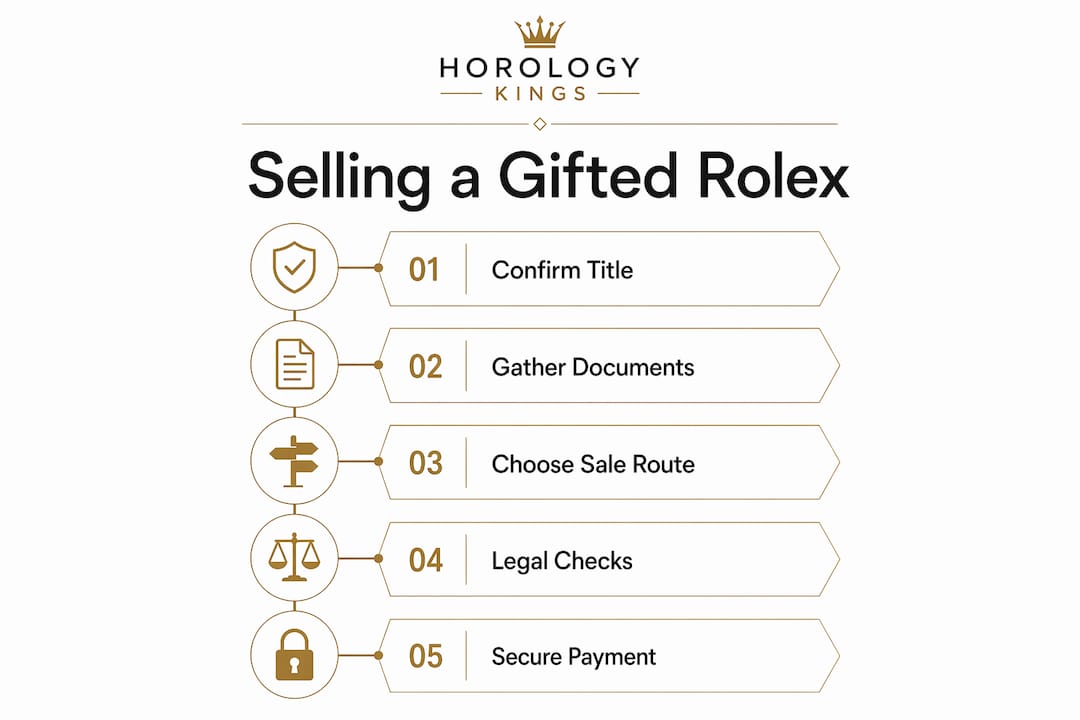
Before you list the watch anywhere, run through this quick checklist:
Confirm legal title. You must be the rightful owner, whether through a completed gift or proper estate distribution.
Gather documentation. Warranty card, service records, original receipt, any gift letter or correspondence.
Check probate rules if inherited. An executor must have authority before any estate asset is sold.
Assess your tax position. Most private sales of mechanical watches fall outside Capital Gains Tax (CGT) under HMRC’s wasting asset rules, but trading activity changes that.
Authenticate the watch. Independent authentication protects both you and the buyer.
Choose a safe sale route. Reputable dealers, specialist auction houses, and private sales each carry different legal and financial trade-offs.
The sections below cover each of these steps in detail, with specific UK legal and tax guidance drawn from HMRC and Alto Accounting.
Table of Contents
Selling an inherited Rolex: what do probate and executors require?
What are the UK tax rules when selling a gifted or inherited Rolex?
What AML and legal safety checks should you expect when selling?
How does a professional dealer support a secure, legal sale?
Horology-kings: valuations, authentication, and secure sales for gifted watches
How do you prove legal ownership of a gifted Rolex?
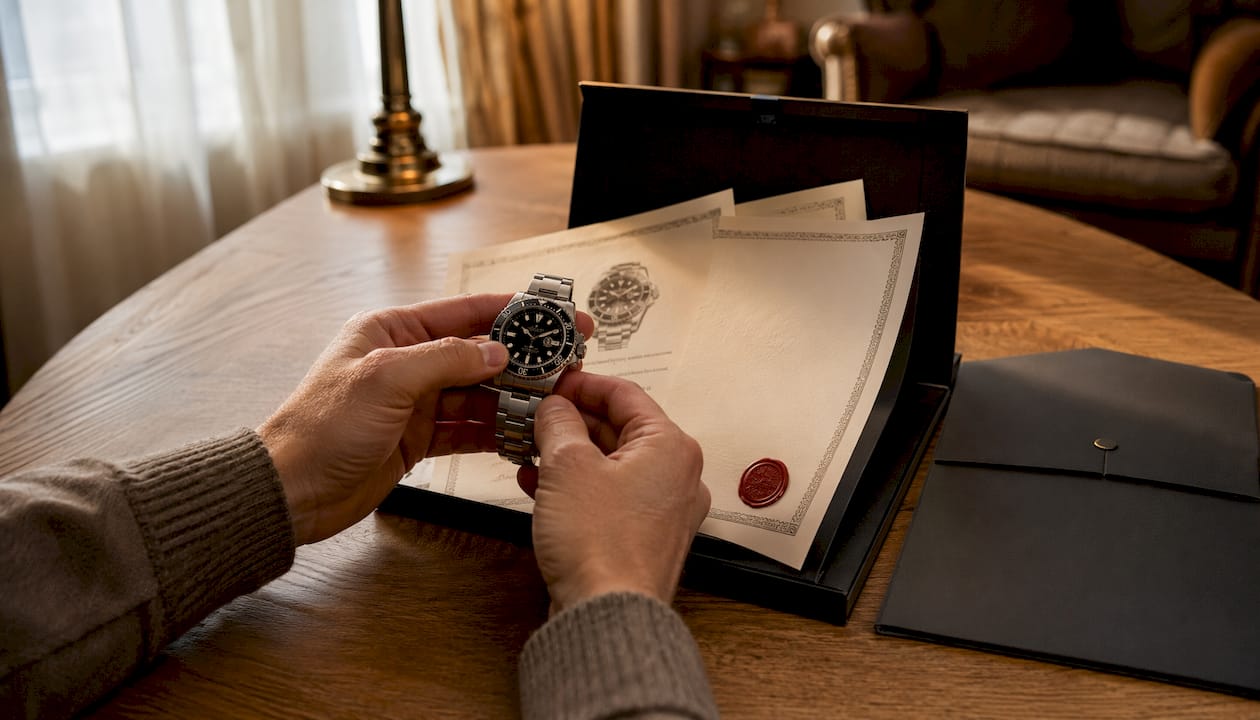
Ownership of a gifted watch rests on four legal elements: the donor’s clear intent to give, physical delivery of the watch, your acceptance of it, and the donor’s mental capacity at the time. If any of these is missing or disputed, title can be challenged. Gifts made close to the donor’s death attract particular scrutiny, since courts and HMRC may question whether undue influence was involved.
In practice, most gift transfers are straightforward; the challenge is proving them later. Useful evidence includes:
A dated gift letter or card, signed by the donor
Emails or text messages referencing the gift
Bank transfers made at the time (for example, if the donor paid for the watch shortly before giving it)
The original purchase receipt in the donor’s name
The Rolex warranty card and certificate of authenticity
Serial number records and any authorised service centre paperwork
Photographs of the watch being presented, if available
If no paperwork exists at all, possession combined with corroborating evidence such as witness statements, service records in your name, or photographs can support your claim. That said, gift disputes can become complicated when documentation is thin, particularly if family members contest the transfer.
Pro Tip: Write a short contemporaneous record now if you have not already: date of gift, circumstances, the donor’s full name and contact details, and the watch’s serial number. Store it alongside the original documents in a secure location.
Selling an inherited Rolex: what do probate and executors require?
When a Rolex forms part of a deceased person’s estate, the rules are more structured than for a straightforward gift. Who can sell the watch, and when, depends on the estate’s legal status.
Who has authority to sell:
An executor named in the will, once probate has been granted
An administrator appointed by the court if there is no valid will
A beneficiary, but only after the watch has been formally transferred to them under the will or intestacy rules, not before
Selling an estate asset before probate is granted, or before a proper transfer to the beneficiary, can expose the executor to personal liability and may invalidate the sale.
Practical steps for executors:
Obtain a professional valuation of the watch at the date of death. This figure forms the tax base for estate accounts and any later CGT calculation.
Record the valuation in the estate paperwork and notify all beneficiaries.
Arrange appropriate insurance for the watch while it remains in the estate.
Document the sale proceeds and pay them into the estate account.
Keep all records for at least six years after the estate is wound up.
The watch’s cost base for tax purposes is its fair market value on the date of death, not the original purchase price. This matters if the watch has appreciated significantly and the beneficiary later sells it.
If a family member disputes whether the watch was a gift or part of the estate, pause any planned sale immediately. Seek independent legal advice and preserve all documents. Proceeding with a contested sale can create serious legal exposure.
What are the UK tax rules when selling a gifted or inherited Rolex?
For most private sellers, the tax position is more straightforward than it first appears. HMRC classifies mechanical watches as wasting assets, meaning assets with a predictable useful life of 50 years or less. Under Section 45 of the Taxation of Chargeable Gains Act 1992, wasting assets are generally exempt from CGT when disposed of privately. The GOV.UK guidance on limited-lifespan possessions confirms this treatment for most watches.
When CGT can still apply
The wasting asset exemption is not universal. CGT may apply if:
The watch is held by a company rather than an individual (company-owned watches are treated differently, and providing a watch to an employee can create a benefit-in-kind charge under HMRC’s employment income rules)
HMRC determines the watch is not a wasting asset in a specific case
The activity is reclassified as trading (see below)
Trading risk: when HMRC treats you as a dealer
If you regularly buy and sell watches, or if HMRC concludes you acquired a watch with the intention of reselling it at a profit, the profits may be treated as trading income subject to income tax or corporation tax rather than CGT. The distinction between a private collector and a trader is not always obvious. HMRC looks at factors including frequency of transactions, whether the activity is conducted in a businesslike way, and whether the primary motive was profit from resale.
“The most common mistake sellers make is failing to document the nature of the sale. Sellers should retain a contemporaneous record proving the disposal was a private sale, not trading activity.” — Alto Accounting
Inheritance tax and VAT
For executors, the watch’s value at date of death is included in the estate for inheritance tax purposes. If you operate as a business selling watches, the VAT Margin Scheme may apply, allowing VAT to be charged only on the profit margin rather than the full sale price.
Pro Tip: Keep a clear written record of how you acquired the watch (gift, inheritance, or purchase), the date of acquisition, and the circumstances of the sale. Alto Accounting recommends retaining purchase receipts, gift or estate paperwork, sale invoices, and bank transfer records. HMRC can enquire into transactions for up to four years from the end of the relevant tax year, and up to six years where a return was submitted.
Where should you sell a gifted or inherited Rolex?
The right sale route depends on your priorities: maximum price, speed, legal safety, or minimal paperwork. Each channel carries a different balance of these factors.
Sale route | Price expectation | Speed | Key trade-off |
Specialist dealer (e.g. Horology-kings) | Good market rate, transparent offer | Fast, often same week | Lower than private sale ceiling, but vetted buyers and managed AML |
Specialist auction house | Potentially highest price | Weeks to months | Seller’s commission and no guaranteed sale |
Private sale (marketplace/forum) | Highest potential net | Variable | Counterparty risk, no AML support, payment risk |
Trade-in to jeweller | Quick | Immediate | Usually lowest return |
Private sales can yield the highest net price, but they place the full burden of AML checks, payment verification, and buyer vetting on you. Auction houses offer broader reach and authentication credibility, but fees and timelines add up. Specialist dealers offer a middle path: a fair, transparent offer, managed paperwork, and secure payment.
Provenance and documentation strongly influence which route makes sense. A well-documented watch with original papers, full service history, and a clean serial number record is well suited to auction or consignment, where buyers pay a premium for certainty. A watch with missing papers is better placed with a trusted dealer who can authenticate it independently before sale. You can read more about preparing your watch for sale to maximise whichever route you choose.
Pro Tip: Always insist on payment by traceable bank transfer, regardless of the sale route. Cash transactions for high-value watches attract AML scrutiny and leave you without a clear audit trail for HMRC.
Owners also have a clear legal right to sell on the secondary market. Grey market dealing is legal in the UK: once ownership is established, brands cannot prevent resale, and the secondary market for Rolex is well established and highly liquid.
What documentation do buyers and dealers expect to see?
Original paperwork is not just a nice addition. It directly affects the price you achieve and the speed of the sale. Provenance and original documentation are the single biggest boosters of buyer confidence and final sale price.
The documents that matter most, in order of priority:
Original warranty card (with purchase date and retailer details)
Original purchase receipt from an authorised dealer
Service history from Rolex or an authorised service centre
Box and additional accessories (crown, links, hang tags)
Serial number records matching the case and movement
Provenance statement explaining how you came to own the watch
Selling without original papers is possible, but watches sold without papers typically command 15–25% less than equivalent examples with full documentation, depending on the model and market conditions. Independent authentication mitigates part of this discount.
If papers are missing, take these practical steps before listing:
Commission an independent authentication report from a qualified horologist
Photograph the serial number, case back, dial, and movement in high resolution
Compile any service receipts, even from non-Rolex service centres
Write a clear provenance statement covering the watch’s history as you know it
Non-factory parts or aftermarket modifications reduce value further and complicate authentication. Always disclose any modifications and obtain a service report before sale. Horology-kings’s guide to wristwatch provenance covers this in detail.
Pro Tip: Store high-resolution photographs of the serial number, movement, and dial in a cloud folder alongside digital copies of all paperwork. This speeds up buyer due diligence considerably and reduces the chance of a sale falling through.
What AML and legal safety checks should you expect when selling?
UK regulations require regulated dealers to conduct anti-money-laundering (AML) and Know Your Customer (KYC) checks on high-value transactions. The Consumer Rights Act 2015 applies to business sellers, and regulated dealers are legally obliged to verify the identity of both buyers and sellers for transactions above the relevant threshold.
As a seller, you should expect to provide:
Valid government-issued photo ID (passport or driving licence)
Proof of current address (utility bill or bank statement, dated within three months)
Provenance documents for the watch (gift letter, estate paperwork, or purchase receipt)
Bank account details for payment by traceable transfer
Dealers and auction houses often run formal AML/KYC checks for high-value items; selling through a regulated dealer reduces your exposure to anti-money-laundering enquiries because the dealer manages the compliance process on your behalf.
Stolen goods risk is a separate concern. Before selling, verify the watch’s serial number has not been flagged as stolen. Reputable dealers run serial number checks as part of their authentication process. If a watch is flagged during this process, do not proceed with the sale. Contact the police and seek legal advice.
Pro Tip: Have your ID, proof of address, and provenance documents ready before you approach any dealer or auction house. Sellers who arrive prepared move through the due diligence process faster and signal credibility from the outset.
How does a professional dealer support a secure, legal sale?
Selling through a specialist dealer such as Horology-kings removes most of the legal and administrative burden from you. The services a reputable dealer provides go well beyond a simple cash offer.
Expert valuation: A current market appraisal based on model, condition, provenance, and recent comparable sales.
Full authentication: Inspection by certified horologists to confirm the watch is genuine, unmodified, and in the stated condition.
Provenance checks: Serial number verification and review of all available documentation.
AML/KYC management: The dealer handles identity verification and compliance, so you are not exposed to direct regulatory risk.
Secure payment: Settlement by UK bank transfer, fully traceable and documented for your HMRC records.
Insured handling: The watch is covered throughout the valuation and sale process.
For sellers of gifted or inherited watches, this matters particularly because the documentation trail may be incomplete. A specialist dealer can authenticate the watch independently, provide a written valuation for estate or HMRC records, and manage the buyer relationship so you do not have to. The secure sale process at Horology-kings is designed specifically for sellers who want a discreet, professionally managed transaction.
Pro Tip: Request a written valuation report from your dealer, even if you ultimately sell elsewhere. A dated, signed valuation from a specialist is useful evidence for HMRC and for any estate accounts.
Key takeaways
Selling a gifted or inherited Rolex legally in the UK requires clear title, proper documentation, and the right sale route. Most private disposals of mechanical watches fall outside CGT under HMRC’s wasting asset rules, but trading activity and missing paperwork can complicate matters significantly.
Point | Details |
Confirm legal title first | Establish ownership through gift evidence or estate distribution before approaching any buyer. |
Probate applies to inherited watches | An executor must have authority and a date-of-death valuation before selling any estate asset. |
Wasting asset rule usually removes CGT | HMRC classifies mechanical watches as wasting assets, typically exempting private sales from Capital Gains Tax. |
Missing papers typically reduce value by 15–25% | Independent authentication and a provenance statement partially offset the price discount for undocumented watches. |
Horology-kings manages the full process | Expert valuation, authentication, AML compliance, and secure bank transfer in one place for sellers of gifted or inherited Rolex watches. |
The mistakes that cost sellers most
The sellers who run into trouble are rarely those who have done something wrong. They are usually those who simply did not document what they did right.
Accepting cash for a high-value watch is the most common error, and it is entirely avoidable. Without a bank transfer record, you have no clean audit trail for HMRC, no proof of the sale price, and no recourse if a buyer later disputes the transaction. The same logic applies to verbal agreements: a signed receipt costs nothing and protects both parties.
Failing to authenticate before sale is the second most costly omission. A buyer who later discovers a non-factory part or a discrepancy in the serial number will seek to unwind the sale or claim a price reduction. Getting an independent authentication report before listing removes that risk entirely. It also signals to serious buyers that you are a credible seller.
The third pitfall is treating a series of private sales as though they are invisible to HMRC. They are not. If the pattern of activity looks like trading, HMRC has the tools to reclassify it. A contemporaneous record showing each watch was a personal possession, acquired and sold for personal reasons, is the clearest defence available.
The practical fix for all three is the same: slow down, document everything, and use a regulated channel for payment. Sellers who take these steps rarely face problems. Those who skip them occasionally face very expensive ones.
Horology-kings: valuations, authentication, and secure sales for gifted watches
Selling a gifted or inherited Rolex involves more moving parts than a standard private sale. You need a credible valuation, a clean authentication record, and a payment method that satisfies both HMRC and your own peace of mind.
Horology-kings, based in Hertfordshire, provides exactly this for sellers across the UK. The team of certified horologists carries out full authentication and provenance checks, produces written valuation reports suitable for estate accounts or HMRC records, and settles every purchase by secure UK bank transfer. There are no hidden fees, no pressure, and no requirement to commit before you have seen an offer. Discreet, insured handling is standard throughout.
Whether your watch comes with a complete set of papers or a thinner documentation trail, Horology-kings can assess it fairly and guide you through the sale process from first contact to final payment. Request a free valuation or visit Horology-kings.com to start a secure, professionally managed sale today.
Useful sources and next steps
For official guidance on the UK tax and legal framework:
HMRC: Capital Gains Tax on personal possessions with limited lifespan — the primary GOV.UK page on wasting assets and CGT exemptions for watches and other chattels.
HMRC Capital Gains Manual CG76721 — detailed HMRC internal guidance on chattels and wasting assets.
HMRC Helpsheet HS293: Chattels and Capital Gains Tax — self-assessment guidance for disposals of personal possessions.
HMRC Business Income Manual BIM20205 — guidance on the trading versus investment distinction relevant to watch sellers.
Alto Accounting: Selling a Rolex — tax for UK owners — accountant-reviewed guidance on CGT, wasting assets, and record-keeping for UK watch sellers.
GOV.UK: Probate and estate administration — starting point for executors needing to understand their authority and duties.
Horology-kings: free valuation and secure sale — request a written valuation or begin a managed sale for your gifted or inherited Rolex.
Selling watches online: your 2026 guide to top returns — practical marketplace and platform guidance for sellers considering online sale routes.
This article provides general information about UK tax and legal considerations for selling gifted or inherited watches. It is not professional legal, tax, or financial advice. Confirm your specific position with HMRC, GOV.UK guidance, or a qualified professional before proceeding with any sale.
Recommended
Comments