.png)
UK Buyers: How to Verify a Rolex Superlative Chronometer (±2s/day)
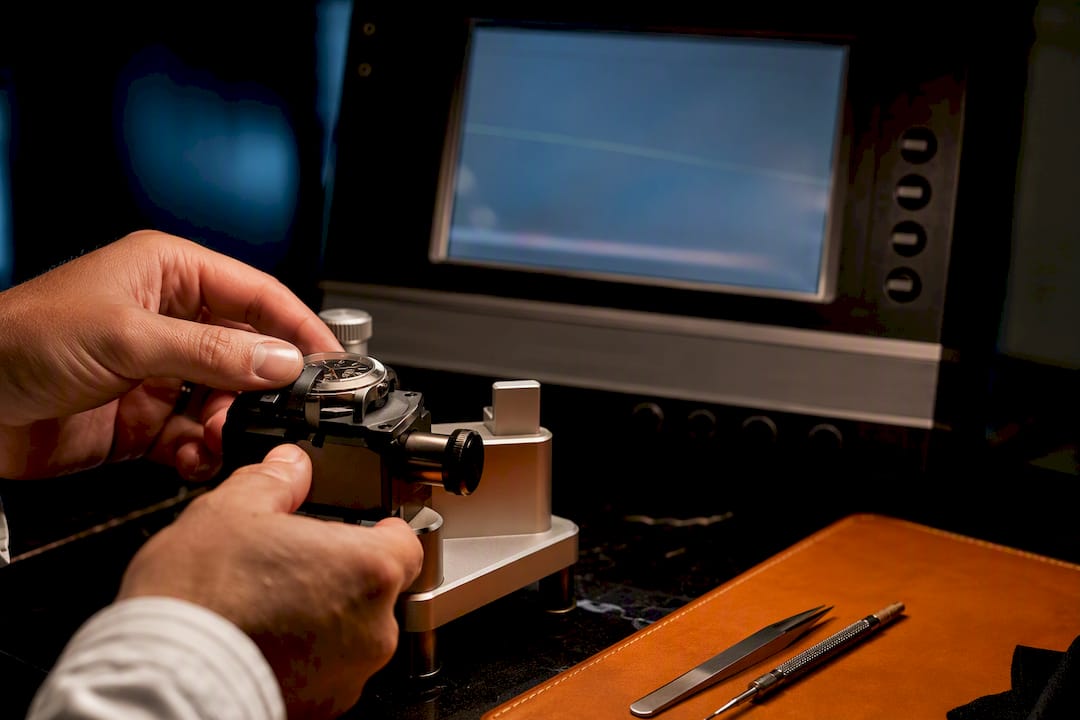
A Superlative Chronometer is a finished, cased Rolex watch that has passed COSC certification and then survived a second round of testing at Rolex itself, which tightens the accepted rate to around −2/+2 seconds per day. It is a two-stage process: Rolex, the manufacturer, and COSC, the independent Swiss testing body, both play a part before the label applies.
TL;DR:
Rolex’s Superlative Chronometer certification requires the finished watch to pass internal testing with a strict tolerance of about ±2 seconds per day, tighter than COSC standards.
The process includes testing the uncased movement at COSC, then re-evaluating the fully assembled watch for accuracy, water resistance, power reserve, and self-winding performance.
Certification alone offers limited assurance since external factors like magnetism and wear can affect accuracy over time, making ongoing verification important.
Authentic paperwork involves a COSC certificate matching the movement serial and a green Rolex seal, but regular servicing can alter the watch’s rated accuracy.
Independent experts can verify ongoing performance through testing and authentication, which is critical before purchase or sale for maintaining value and trust.
Table of Contents
Superlative chronometer meaning: how the certification process works
The phrase does real work here, and it starts with COSC. Every movement destined for a Superlative Chronometer watch first goes through COSC’s standard protocol: an uncased movement, tested alone, over 15 days, in five positions, at three temperatures. That is the baseline that every Swiss chronometer, from any brand, must clear before anyone can use the word “chronometer” on a dial.
Rolex does not stop there. Once the movement passes, it goes into the case, gets its dial, hands, bracelet and rotor, and then heads back through testing at Rolex’s own facilities. This is the step that gives the modern designation its teeth.
COSC stage – uncased movement, 15 days, five positions, three temperatures.
Rolex cased-watch stage – the completed watch, tested internally after assembly.
Final verification – rate, waterproofness, power reserve, and self-winding checked as a finished object.
Casing a movement changes how it behaves. A case, dial feet, hands, and a rotor swinging with wrist motion all introduce friction and positional effects that an uncased movement never experiences on a COSC test bench. That is precisely why Rolex’s official description frames the Superlative Chronometer designation as validation of the whole watch, not just the engine inside it.
What gets tested and to what tolerance
The number most collectors quote is ±2 seconds per day, and it is the one that matters most in practice. That is Rolex’s own tolerance for the finished, cased watch, measured after assembly rather than on a bare movement, and it is noticeably tighter than the COSC standard alone allows.
Pro Tip: If you want to sanity-check a watch’s accuracy yourself, wear it consistently for a week and log the deviation each morning against a reliable time source. Anything drifting well outside ±2 seconds a day on a modern Superlative Chronometer piece is worth raising with a specialist.
Beyond timekeeping, the finished-watch tests cover several other areas:
Waterproofness, tested in laboratory conditions beyond the watch’s stated depth rating, with some models subjected to experimental pressure simulations that go further still.
Power reserve, checked against Rolex’s published figures for that calibre.
Self-winding performance, confirming the rotor winds efficiently under normal wrist motion.
Magnetic resistance and long-term reliability, criteria Rolex has continued to expand as part of its updated Superlative Chronometer standard, alongside broader sustainability commitments in how the watches are produced and finished.
Chronometer vs superlative chronometer vs Master Chronometer
Three labels get thrown around loosely, and they are not interchangeable. Here is how they actually differ:
Chronometer (COSC): an independent certification of the uncased movement only, permitting a rate tolerance of −4/+6 seconds per day. Any brand can submit movements to COSC, and the certificate says nothing about the finished watch.
Superlative Chronometer (Rolex): builds on COSC by testing the completed, cased watch in-house, tightening the accepted rate to roughly ±2 seconds per day and adding checks for waterproofness, power reserve, and self-winding.
Master Chronometer (METAS): an independent standard run by the Swiss Federal Institute of Metrology, with published test criteria and a strong emphasis on magnetic resistance, used most notably by Omega.
For an owner, the practical difference comes down to what each label guarantees. A COSC certificate alone tells you the movement was accurate in isolation. A Superlative Chronometer designation tells you the watch you actually wear performed to a tighter standard after assembly. A Master Chronometer certificate tells you an independent government-linked lab verified magnetic resistance and rate on the finished watch, with its methodology published for scrutiny.
A brief history: what changed in 2015
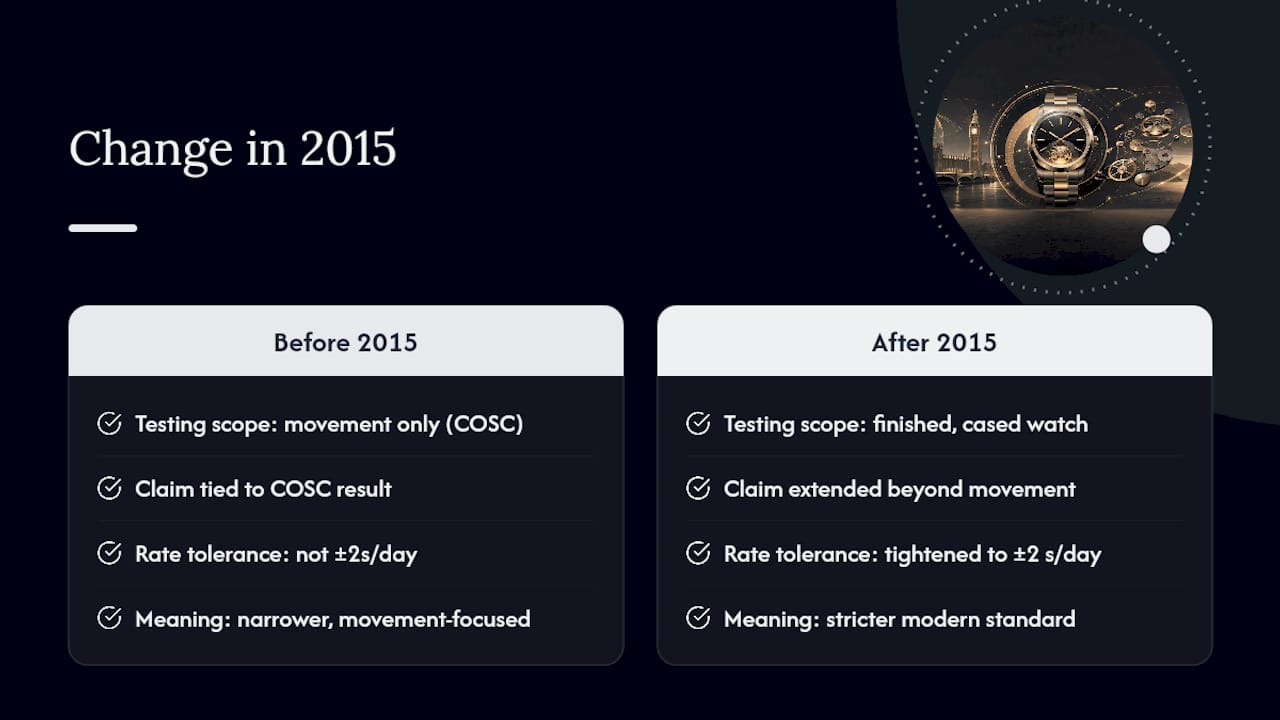
Rolex has used variations of “Superlative Chronometer” on its dials since the middle of the 20th century, but the phrase has not always meant the same thing. For decades, it was closely tied to the COSC result on the movement, a meaningful claim, but a narrower one than what the words imply today.
Rolex modernised the standard around 2015, formally extending testing to the finished, cased watch and tightening the rate tolerance to ±2 seconds per day. This is a useful dating tool: a watch built and certified before that shift reflects the older, movement-focused usage, while anything conforming to the tightened claim reflects the post-2015 standard. It matters when you are comparing a vintage piece against a modern one and wondering why the same words on the dial seem to carry different weight.
What to check before you buy
Paperwork and physical checks both matter here, and neither substitutes for the other.
Check the certificate. A genuine COSC certificate confirms the movement passed independent testing; Rolex’s own warranty card confirms the finished watch was validated internally.
Look for the green seal. Rolex uses this as its own mark of factory-condition validation, applied alongside the COSC paperwork rather than instead of it.
Ask about service history. Regulation and servicing can shift a watch’s rate over time, and a recent service affects both accuracy and how a valuation should be read.
Pro Tip: A green seal and box are reassuring, but they describe the watch’s condition at the point of sale, not forever. Ask when it was last regulated, not just whether it was ever certified.
Verifying the claim yourself: what to look for
Genuine COSC certificates carry a unique serial number matching the movement, and a genuine Rolex warranty card matches the case reference and serial on the watch itself. Neither document alone proves authenticity, but a mismatch between paperwork and watch is an immediate red flag worth walking away from.
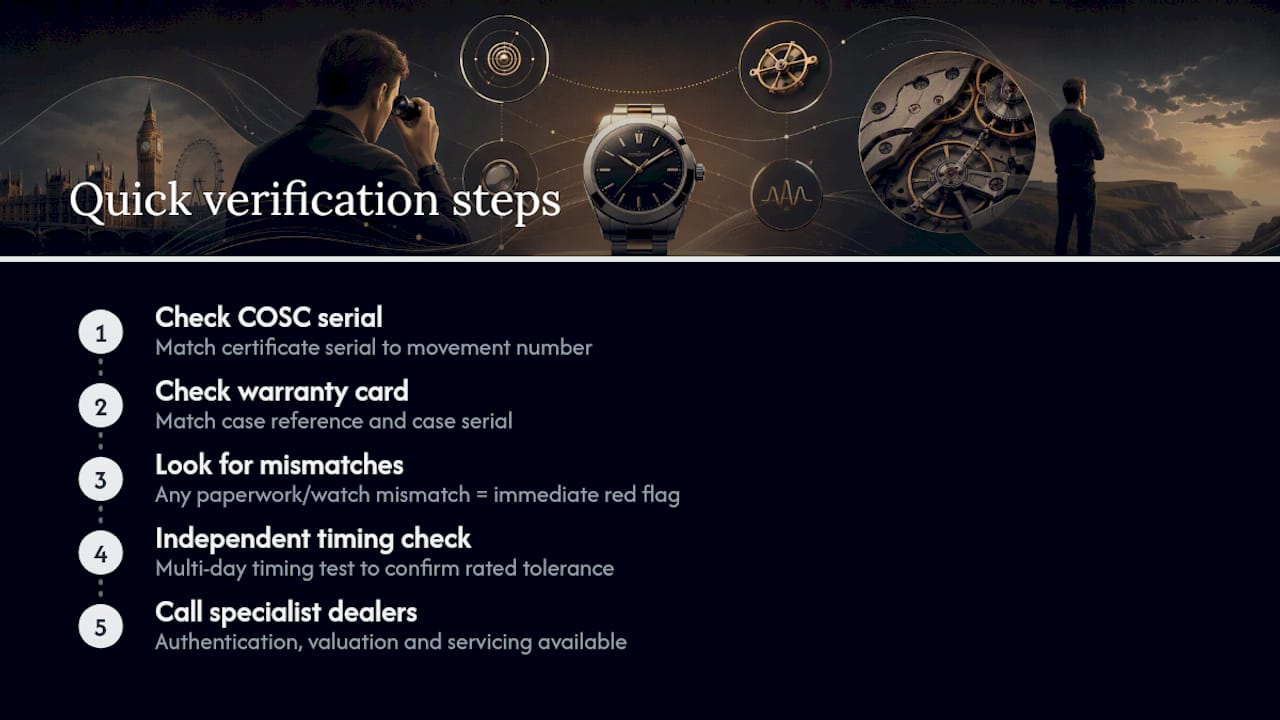
If you are unsure whether a watch is still performing to its rated tolerance, an independent timing check over several days settles the question quickly. A full service resets both the mechanical condition and, often, the accuracy of an older piece, which matters for both peace of mind and resale value. Specialist dealers offer authentication, valuation, servicing and sourcing as separate services for exactly this kind of verification, without pressure to buy or sell on the spot.
Why the label matters less than most people think
Finished-watch testing is a genuinely meaningful signal. It tells you Rolex validated the object you actually wear, not just the movement hidden inside it, and that is a higher bar than most watchmaking certifications set.
But a certificate describes a moment, not a lifetime. Magnetism, knocks, and years without servicing will drift any watch away from its certified rate eventually. When you are weighing up a purchase, put certification alongside provenance, condition, and service history rather than treating it as the whole story.
— Lewis
How Horology-kings supports buyers checking certification
If you are weighing up a Superlative Chronometer piece and want the paperwork and the watch checked properly, that is exactly where a specialist earns their keep. Horology-kings offers full Rolex servicing to confirm a watch is still performing to its rated tolerance, alongside authentication support that goes beyond a quick glance at a green seal.
If you already own a certified piece and want to know what it is worth, Horology-kings provides a straightforward watch valuation service, with secure UK bank transfers and no pressure to sell. Looking for a specific certified example instead? The sourcing service uses an established network to track down particular references, including pieces conforming to the post-2015 standard discussed above. Whichever stage you are at, a specialist check before you commit to a purchase or sale is worth the short delay it costs.
Official references and primary sources
Sources
FAQ
What is the difference between a chronometer and a Superlative Chronometer?
A chronometer has passed COSC testing on its uncased movement alone, with a tolerance of −4/+6 seconds per day. A Superlative Chronometer has passed that same COSC test and then a second round of testing by Rolex on the finished, cased watch, tightening the tolerance to roughly ±2 seconds per day.
Is the Superlative Chronometer officially certified?
Yes, but in two stages rather than one. COSC, an independent Swiss institute, certifies the movement first, and Rolex then carries out its own in-house testing on the completed watch, as described on Rolex’s official pages.
How is a chronometer different from a regular watch?
A regular watch has no independent accuracy certification at all. A chronometer has been tested by COSC and met a defined rate tolerance, which most ordinary watches never attempt to meet or claim.
What is considered the “poor man’s Rolex”?
This is a popular nickname often applied to more affordable Swiss chronometer-certified watches from other brands, not an official industry term, and it varies depending on who is asked. It has no bearing on the Superlative Chronometer standard, which is specific to Rolex’s own two-stage testing process.
Does servicing affect Superlative Chronometer accuracy?
Yes. A watch’s rate can drift over years of wear, and regulation during a service can bring it back within its original tolerance. This is why service history matters as much as the original certification when assessing a used piece.
Recommended
Comments