.png)
Watch box essentials for UK collectors: a practical guide
TL;DR:
A quality watch box must have non-abrasive interior lining, durable exterior, secure closure, and appropriate capacity to protect watches.
Choosing the right materials, construction, and environmental protection ensures long-term preservation and value.
A quality watch box must deliver four things without compromise: a non-abrasive interior lining, a durable exterior, a secure closure, and the right capacity for your collection today and tomorrow. Get those four right and your watches are protected against scratches, humidity, dust, and opportunistic theft. Miss any one of them and you are accepting a risk that no amount of insurance paperwork fully resolves.
Before you buy, check these at a glance:
Lining material: velvet, suede, or microfibre only — nothing synthetic that can scratch a dial or strap
Closure type: magnetic, keyed lock, or combination; avoid boxes that simply press shut with no mechanism
Capacity: one size larger than your current rotation, minimum
Environmental protection: sealed compartments and, for long-term storage, silica gel or a desiccant packet
Table of Contents
What are the watch box essentials to check before you buy?
Run through this list in under two minutes, whether you are in a shop or reading a product page online.
Does the lining feel genuinely soft? Drag a fingernail lightly across it — velvet and suede resist, cheap polyester snags
Do the cushions grip the watch without squeezing the bracelet or strap?
Is the closure positive and deliberate, not just friction-fit?
Does the box feel weighty for its size? Hollow weight signals hollow construction
Are the hinges smooth with no lateral wobble?
Does the seller specify materials clearly, with a return policy?
Pro Tip: Open and close the lid ten times in quick succession. A quality hinge stays smooth and aligned throughout; a cheap one begins to feel loose or misaligned by the fifth or sixth repetition.
Materials and construction: what separates lasting quality from cheap finishes
The interior lining is the single most important material decision. Velvet, suede, and microfibre are preferred interior linings because they protect watch surfaces. Avoid unspecified soft fabrics that may damage watches.
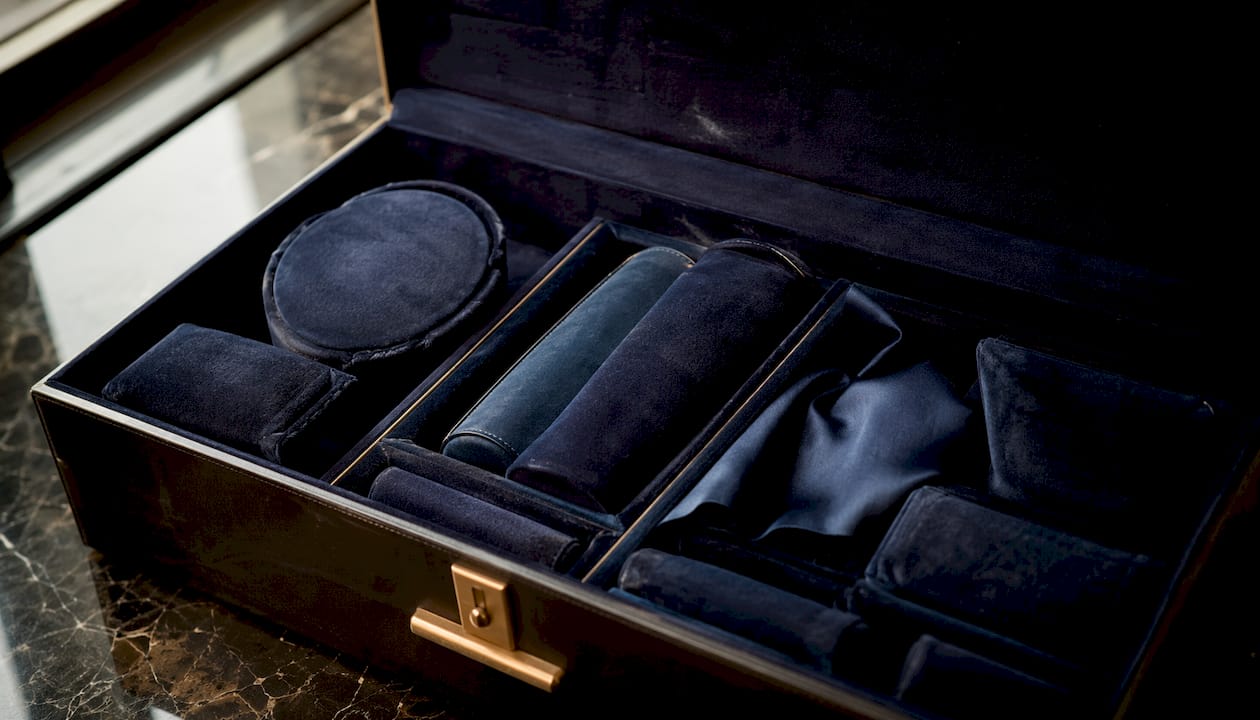
For the exterior, full-grain leather, solid hardwood (walnut, cherry, ash), and brushed metal frames are the materials that age well and signal genuine build quality. Solid wood boxes, in particular, offer natural humidity buffering that synthetic exteriors cannot match. When inspecting construction, look at the stitching, hinge smoothness, and weight rather than the surface finish — hand-stitched seams and weighty, seamless hinges are far more reliable indicators of longevity than a glossy exterior.
Closure mechanisms matter more than they appear to. Magnetic closures are convenient for daily-access boxes; keyed locks and combination mechanisms are appropriate for higher-value pieces or shared households. A magnetic closure on a display box is not a security measure — it is a dust seal.
Velvet/suede/microfibre: non-abrasive, recommended for dials, cases and straps
Full-grain leather exterior: durable, ages well, resists deformation
Solid hardwood: natural humidity buffer, structurally stable
Hand-stitching: outlasts machine-stitched seams under regular use
Weighty hinges: satin-finished metal hardware indicates long-term functionality
Capacity, fit, and modularity: choosing the right size for now and later
Common configurations run to 3, 6, and 12 slots, with modular systems available for collections beyond 30 pieces. The practical rule is to buy one size larger than your current holdings. A collector with four watches who buys a 6-slot box avoids replacing the storage unit the moment a fifth or sixth piece arrives.
Fit is where many boxes fail silently. Cushions that are too narrow allow a watch to rock; cushions that are too wide compress the bracelet and can deform a leather strap over months. Look for adjustable or removable inserts that accommodate both slim dress watches and larger sports cases — a 44mm Omega Seamaster and a 36mm Rolex Datejust need very different pillow diameters.
Modular systems, such as those with removable interior walls, let you reconfigure the box as your collection management needs change. Some designs also include an accessory drawer for spare straps, spring bars, and cleaning cloths — genuinely useful rather than decorative.
Pro Tip: Press the cushion firmly with two fingers before placing a watch on it. A quality pillow compresses and rebounds evenly; a cheap one collapses flat and stays there, offering no real support.
Which storage type should you choose?
Storage type should match how you use each piece, not just how many you own.
Display boxes suit watches in active rotation. A glass-top display box keeps dust off, allows you to see the collection at a glance, and makes daily selection quick. They are not, however, a security solution for high-value pieces.
Watch winders are appropriate for automatic watches with complications — perpetual calendars, moon phases — where resetting after a power-down is time-consuming. Use winders inside a locked safe when possible; a winder sitting on an open shelf is both a dust trap and a visible target.
Travel rolls and compact cases covering 1–6 watches are the practical standard for trips. Suede-lined leather rolls absorb minor shocks, take up minimal luggage space, and attract far less attention than a branded display case. For travel, a nondescript exterior is a feature, not a compromise.
Safes and offsite storage become relevant once a collection reaches meaningful value. Serious collectors diversify storage locations across a home safe and a bank safety deposit box to reduce the risk of a single-point loss. For UK collectors, most high-street banks offer safety deposit facilities, and specialist vault services operate in London and other major cities.
Pro Tip: For travel, choose a roll or case with no external branding and a plain, dark exterior. A nondescript bag attracts no attention at airports or hotels — discretion is the most underrated security feature.
Security, humidity control, and environmental protection
Mechanical watches are sensitive to moisture. The recommended storage humidity range for mechanical movements is generally 40–60% relative humidity — below that, rubber seals and leather straps dry out; above it, moisture can infiltrate case backs over time. A small hygrometer inside a sealed storage cabinet costs very little and removes the guesswork. Silica gel packets or desiccant canisters, refreshed every few months, handle the rest.
Direct sunlight is the other primary threat. UV exposure fades dials — particularly cream, tropical, and coloured lacquer dials — and degrades leather straps faster than almost anything else. Store boxes away from windows and avoid display cases positioned opposite south-facing glass.
For security, proper storage and jewellery care guidance consistently recommends sealed, lockable compartments as the baseline. At home, a quality safe rated to at least Sold Secure Silver (a UK standard recognised by insurers) provides meaningful protection. For collections worth more than your home contents policy covers, speak to a specialist insurer such as Hiscox or Chubb — both offer dedicated watch and jewellery cover in the UK and will ask about your storage arrangements before quoting.
Humidity: target 40–60% relative humidity; use silica gel and a hygrometer
Light: keep boxes away from direct sunlight and UV exposure
Temperature: stable room temperature; avoid garages, lofts, or conservatories
Locks: keyed or combination for home storage; safe-rated enclosures for high-value pieces
Insurance: document serial numbers, provenance papers, and photographs before any claim arises
Maintenance and long-term care for watches in storage
Automatic watches left unworn for extended periods will stop, which is fine for simple three-hand models but inconvenient for complicated pieces. A winder solves this for automatics, but hand-wound movements should simply be left unwound — running a hand-wound movement dry on a winder causes unnecessary wear. Check servicing schedules and wind hand-wound pieces gently every two to four weeks if they are not being worn.
Box maintenance is straightforward but often neglected. Brush suede linings with a soft suede brush every few months to lift dust and restore the nap. Leather exteriors benefit from a light application of a pH-neutral leather conditioner once or twice a year — not shoe polish, which can transfer pigment. Avoid silicone-based sprays near watch movements or straps.
Collectors who retain original manufacturer boxes for provenance are making the right call. Keep the original box, inner cushion, and all paperwork together in a dry location. Move the watch itself into a higher-quality display or travel solution for daily use — the manufacturer box is a provenance document as much as a storage vessel.
Pro Tip: Store bracelets in the closed position and leather-strapped watches flat rather than upright. Upright storage on a narrow cushion over months can cause a leather strap to develop a permanent curve at the lug, which is difficult to reverse.
Where to buy in the UK, what to pay, and red flags to avoid
Quality watch boxes in the UK fall into three broad price bands:
Entry tier (£30–£80): synthetic or bonded leather exterior, machine-stitched, adequate velvet lining; suitable for casual owners with modest collections
Mid tier (£80–£300): genuine leather or solid wood, hand-stitching, quality hinges, better cushion fit; appropriate for serious collectors
Heirloom tier (£300+): bespoke or artisan-made, custom compartment count, integrated winders, premium materials throughout; bespoke boxes command a premium and require vetting for construction quality and warranty terms
Before purchasing, ask the seller: what is the lining fibre specification? Is the exterior full-grain or bonded leather? What is the warranty period and return policy? For winder-equipped boxes, ask about the rotation settings and whether the motor is serviceable.
Red flags to walk away from: PU leather described as “genuine leather,” suspiciously light weight for the stated materials, cushions that do not compress evenly, hinges with lateral play, and any “luxury bespoke” item with no maker’s name or provenance. For in-person purchases, specialist watch accessory retailers and established horological dealers in the UK are the most reliable sources. Online, prefer platforms with clear returns policies and material specifications — vague listings are a warning sign.
Key takeaways
A watch box is an investment in the watch itself: the right lining, build, and environment preserve both the mechanism and the resale value of every piece in your collection.
Point | Details |
Interior lining is non-negotiable | Velvet, suede, or microfibre only — any other material risks scratching dials, cases, and straps. |
Buy one size larger than you need | Common 3, 6, and 12-slot configurations exist; choose a capacity that accommodates your next acquisition. |
Match storage type to use case | Display boxes for daily rotation, travel rolls for trips, safes and deposit boxes for high-value pieces. |
Control humidity and light | Target 40–60% relative humidity with silica gel; keep boxes away from direct sunlight to protect dials and straps. |
Horology-kings as your next step | For authenticated sourcing, valuations, and servicing that complement proper storage, Horology-kings offers specialist support across the UK. |
A collector’s perspective on storage and provenance
Storage is not a footnote to collecting — it is part of the watch’s story. When a Patek Philippe or a Royal Oak arrives at Horology-kings for valuation, the condition of the box, the presence of original papers, and the evidence of careful keeping all influence what we can offer and what a buyer will pay. A watch stored carelessly in a drawer, however mechanically sound, carries a provenance gap that is difficult to close.
The collectors who get the best outcomes — at sale, at service, and at sourcing — treat storage as stewardship. They keep the original manufacturer packaging for authentication, use a quality display or travel solution for daily access, and document their holdings properly. That discipline pays off in resale value, in insurance claims, and in the confidence that comes from knowing exactly what you own and how well it has been kept.
How Horology-kings supports collectors who want expert guidance
Choosing the right storage is one part of responsible watch ownership. The other is knowing the provenance, condition, and current market value of what you hold. Horology-kings, based in Hertfordshire, works with collectors across the UK on exactly that: authenticated sourcing, professional valuations, and certified repair and servicing by qualified horologists.

Before getting in touch, gather the following: photographs of the watch and its box in good light, the serial number and reference number, and any provenance papers or service records you hold. That preparation makes every conversation faster and every valuation more precise.
Whether you are looking to buy, sell, or source an authenticated luxury timepiece, or need a professional service to bring a stored piece back to full working order, Horology-kings is the practical next step.
Useful sources and further reading
The following sources informed this guide and are worth consulting directly for additional detail:
Watch Boxes 101: 7 essential features — Just In Time: most useful for interior materials and cushion fit guidance
The best watch box for men — OPUMO Magazine: strong on build quality indicators and capacity planning
How to store your watches — GQ: expert advice on location diversification and provenance habits
How to choose your watch box — Scatola del Tempo: detailed on winders and bespoke options
Watch box and papers — Horology-kings: why original packaging matters for resale and authentication
Recommended
Comments