.png)

How long does a watch service take in the UK?
- lewisvrichards3
- 10 minutes ago
- 9 min read
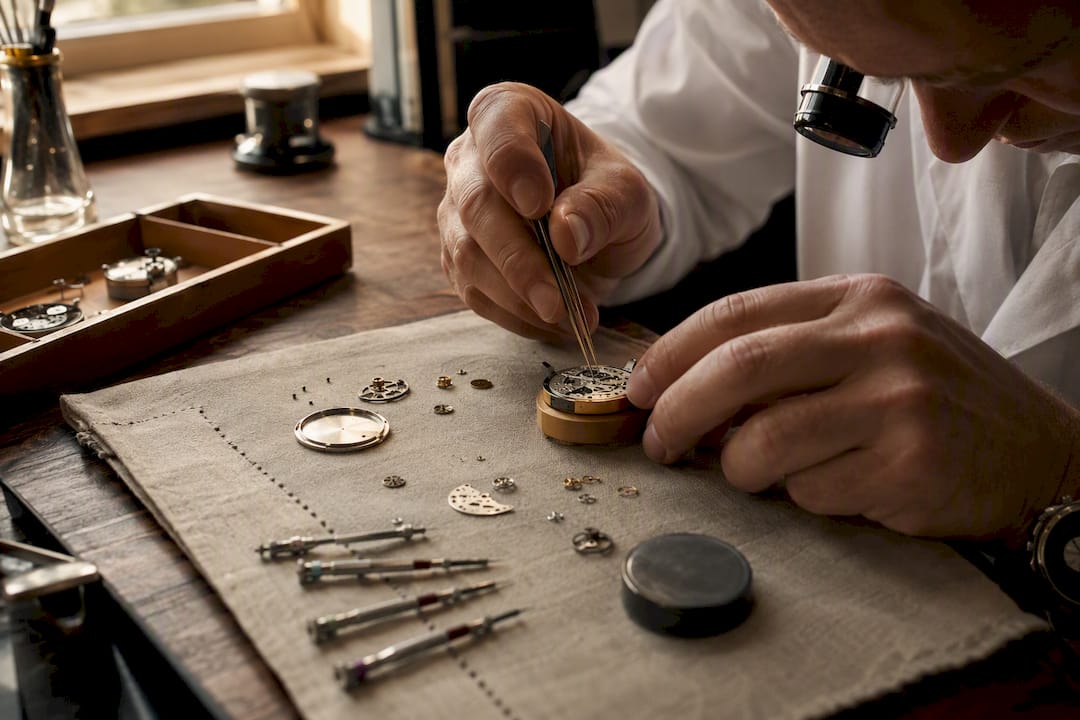
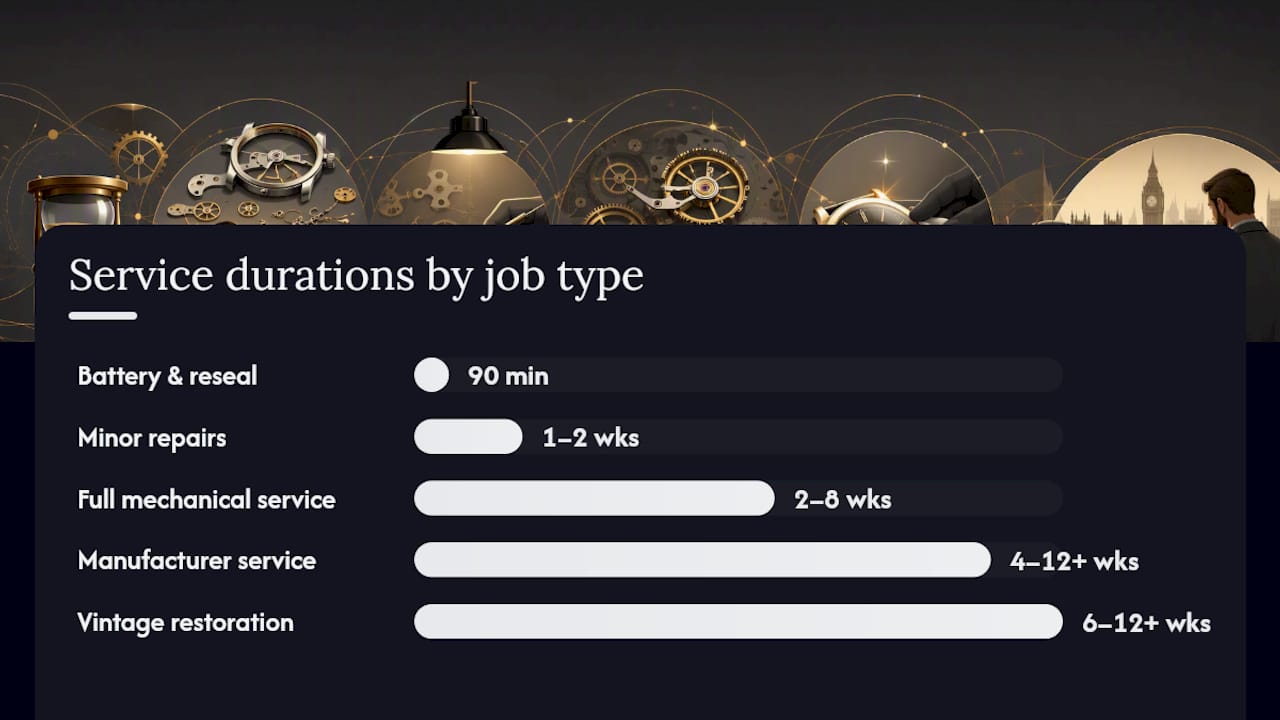
If you’re waiting on a watch, here’s what you need to know: a battery swap or reseal is often done in 90 minutes or the same day, minor repairs typically run 1 to 2 weeks, and a standard full mechanical service at an accredited UK workshop usually takes 2 to 8 weeks. Manufacturer-authorised routes tend to run longer, often 4 to 12 weeks or more, and vintage restoration can stretch to 6 to 12 weeks or beyond depending on parts.
These figures cover bench time and total turnaround together, not just the hands-on work. The single biggest variable is parts, not effort, so any quote that ignores parts lead time is telling you half the story.
Battery/reseal: same day, or a 90-minute appointment
Minor repairs and regulation: 1 to 2 weeks
Standard full service (independent, accredited): 2 to 8 weeks
Manufacturer-authorised service: 4 to 12+ weeks
Vintage restoration: 6 to 12+ weeks
Assessment and quoting happen separately, and usually much faster than the service itself.
TL;DR:
Parts availability, especially on vintage watches or those with complications, primarily determines the longest delays beyond the actual bench work.
Battery and reseal work can often be completed in a same-day 90-minute appointment, but full mechanical services typically take between 2 to 8 weeks.
Manufacturer-authorised services usually extend to 4 to 12+ weeks due to longer queues and sourcing, particularly for complex or vintage pieces.
Reputable independent workshops often provide faster service with transparent quotes and detailed timelines, including bench hours, parts lead times, and warranties.
Multi-day testing and pressure checks after repair contribute significant additional days to the overall turnaround time.
Table of Contents
Watch repair time UK: typical durations by job type
Not every visit to a workshop means weeks on a shelf. The type of job dictates the clock far more than the brand on the dial, and knowing where your watch sits on that scale saves you from ringing the workshop every three days asking for updates.
Battery and reseal work sits at the fast end. Many UK jewellers and specialist workshops handle this while you wait, and battery replacement and reseal jobs can often be completed in a same-day 90 minute appointment, with assessment and quoting taking as little as 30 minutes. Send it by post instead and you’re looking at 7 to 14 days once shipping is factored in.
Minor repairs and regulation (a stuck crown, a bent second hand, timing that’s drifted) generally take 1 to 2 weeks. The range depends on whether the part is in stock and whether the watch needs a full timing check afterwards.
A full mechanical service at an accredited independent UK workshop is where most owners land, and it typically runs 2 to 8 weeks. That’s a wide window, and it’s wide for a reason: workshops report typical independent service times of 2 to 6 weeks, stretching towards 8 when a backlog or parts delay hits. A five-year-old chronograph with common movement parts will move through that window faster than a watch needing a discontinued component.
Manufacturer-authorised servicing almost always takes longer. Brand service centres often quote 4 to 12+ weeks, and GQ’s reporting puts manufacturer turnaround at 1 to 2 months or longer, with complex outsourced work stretching to 4 to 6 months. The queue length at the brand’s central workshop, not the difficulty of your particular watch, tends to drive this.
Vintage restoration is the outlier. Sourcing or fabricating obsolete parts is the primary reason service time varies so widely, and a 1960s chronograph missing a discontinued pusher assembly can sit in restoration for 6 to 12 weeks or considerably longer while a specialist machines a replacement.
Most manufacturers and UK service centres recommend a full service every 3 to 5 years to keep a mechanical movement running accurately, bringing that forward if the watch loses time or shows any sign of moisture under the crystal.
Why does a watch service take weeks, not days?
Bench time is the number of actual hours a watchmaker spends working on your movement. Turnaround is the full calendar time from drop-off to collection, including the queue before your watch reaches the bench, the parts wait, and any testing period after the work is done. A quote of “10 hours bench time” and a turnaround of “6 weeks” aren’t contradictory. They’re describing two different clocks.
A full service moves through a fixed sequence, and each stage adds its own delay:
Assessment — the watchmaker opens the case back and diagnoses wear, checking the movement against the reference specification.
Disassembly — every component is removed, logged, and checked against what the movement should contain.
Ultrasonic cleaning — parts are cleaned in stages to strip old oil and debris without damaging finishing.
Inspection and parts replacement — worn jewels, mainsprings, or gaskets are identified and ordered if not in stock.
Reassembly and lubrication — the movement goes back together with fresh, movement-specific oils.
Timing and regulation — the watchmaker adjusts the balance to bring the rate within tolerance.
Pressure testing — the case is tested for water resistance before the movement goes back in.
Multi-day timing checks — the completed watch runs on a timing machine across multiple positions and days.
That last stage matters more than most owners realise. Reputable UK workshops often run multi-day mechanical testing, sometimes 5 days, to confirm the watch holds a stable rate before it goes back in the post. A simple three-hand movement might pass this in a couple of days. A chronograph with a column wheel, or a watch with a perpetual calendar, needs longer because more functions have to be checked independently, and any deviation sends it back to the bench.
Pro Tip: Ask your workshop whether the quoted timeframe includes the multi-day timing test or ends when the watch is “put back together.” The two numbers can differ by a week.
What causes the biggest delays in watch service times?
Parts availability causes more delay than any other factor. Vintage items or watches with complications may require sourcing or fabrication, and that single issue can turn a routine service into a three-month wait.
Parts availability: discontinued or manufacturer-only components can add weeks, particularly on vintage pieces.
Complications: chronographs, calendars, and repeaters simply have more parts to inspect, adjust, and test.
Manufacturer routing: an independent workshop sometimes has to send a part request to the brand’s own centre and wait in that queue too.
Backlog and season: January (post-Christmas gifting) and the run-up to summer both tend to bring workshop backlogs.
When you’re reading a quote, ask three questions: what’s the bench time alone, what’s the parts lead time, and what’s the warranty length. It’s worth remembering that quotation lead time is a separate figure from bench time, so a fast quote doesn’t guarantee a fast service.
Which watch services are available quickly in the UK?
Not everything needs to disappear for six weeks. Several jobs suit a same-day or short-turnaround route, provided you’re clear about what each option actually offers.
While-you-wait services: battery changes and reseals that don’t require a pressure test can often be done in a single 90-minute visit.
Secure postal servicing: insured post adds transit time both ways, typically 2 to 4 days each direction, on top of the workshop’s own turnaround.
Priority or emergency services: some workshops offer expedited slots for a premium, though this rarely applies to full mechanical overhauls with multi-day testing built in.
Manufacturer pick-up: appropriate when you need brand-specific warranty history preserved, but expect the longest queue of any route.
An independent accredited workshop can service and repair most jobs faster than a manufacturer centre simply because it isn’t competing with a single brand’s global backlog.
How do you choose a UK watch service provider?
Speed on its own is a poor filter. A workshop that promises an unrealistically fast turnaround on a full service is usually cutting corners on testing, not working faster.
Check the estimate speed. A reputable workshop should give you a written estimate within 48 to 72 hours of receiving the watch, as independent UK workshops commonly do.
Ask about parts sourcing. Manufacturer-approved parts protect resale value but can extend lead time, whereas some independent accredited workshops source through broader networks or fabricate in-house.
Confirm testing procedures. You want both a pressure test for water resistance and a multi-day timing check, not a same-day “it’s ticking” handover.
Check warranty length. Most reputable UK services offer 12 to 24 months on the work carried out.
Look for accreditation. BHI membership or Swiss-trained technicians are a reliable signal that the workshop follows a proper process rather than a shortcut.
Pro Tip: If a workshop won’t put bench time, parts lead time, and warranty length in writing before you commit, treat that as a red flag rather than an oversight.
Choose a manufacturer-authorised centre when you need brand-documented service history for a recent high-value purchase. Choose an accredited independent when speed, transparency, and value matter more than a brand stamp in the paperwork.
What can you expect from Horology Kings’ watch servicing?
Horology Kings, based in Hertfordshire, offers repair, servicing, and sourcing for Swiss brands including Rolex, Patek Philippe, Audemars Piguet, Omega, and Cartier, alongside its buying and selling business. Servicing sits alongside valuations and authentication as one of the core in-house capabilities.
Typical timing looks like this: battery and reseal work is handled quickly, often within a day or two; a standard full service generally follows the same 2 to 8 week window seen across accredited UK workshops; vintage restoration takes longer while parts are sourced, with clients kept updated at each stage of that process.
A written quotation typically follows within 48 to 72 hours of assessment, and every service carries a warranty of 12 to 24 months depending on the work carried out.
Swiss-trained technicians handling disassembly, cleaning, and regulation in-house
Secure, insured postal service for clients outside Hertfordshire
Written quotes within 48 to 72 hours of assessment
Warranty coverage of 12 to 24 months on completed servicing
Key Takeaways
The single most useful fact for UK watch owners is that turnaround time depends far more on parts availability and testing depth than on brand prestige or price.
Point | Details |
Match the job to the timeline | Battery/reseal is same-day; minor repairs run 1–2 weeks; full service runs 2–8 weeks. |
Parts drive delays | Discontinued or manufacturer-only parts, especially on vintage watches, cause the longest waits. |
Bench time isn’t turnaround | Ask separately for bench hours, parts lead time, and total calendar turnaround. |
Testing adds real days | Multi-day timing checks and pressure tests happen after the mechanical work is finished. |
Horology Kings as a local option | Offers Swiss-trained servicing in Hertfordshire, quotes within 48–72 hours, and 12–24 month warranties. |
What UK watch owners get wrong about service times
Most owners fixate on the wrong number. They ask “how long will it take” when the question that actually matters is “what’s driving the estimate.” A quote of 3 weeks with no mention of parts lead time is less trustworthy than a quote of 6 weeks that spells out exactly why: sourcing a specific mainspring, running a five-day timing check, waiting on a pressure test slot.
The conventional advice, “always use the manufacturer,” undersells how often an accredited independent workshop matches or beats brand centres on both speed and transparency, particularly once a watch is out of its original warranty period. Brand centres carry prestige, not necessarily pace.
If you take one thing from this, prioritise the written estimate. A workshop that gives you bench time, parts lead time, and warranty length within 72 hours has already shown you how it operates. One that gives you a vague verbal promise hasn’t, and that gap tends to show up later as an unexplained delay rather than an unexplained saving.
— Lewis
Get your watch serviced with clear timelines and no surprises
Horology Kings services and repairs the same Swiss brands it buys and sells, which means the workshop already handles Rolex, Patek Philippe, Audemars Piguet, Omega, and Cartier movements daily rather than occasionally. That familiarity is what keeps quoting fast and turnaround predictable, instead of the vague “we’ll let you know” you get when a generalist jeweller sends your watch elsewhere for the actual work.

If you’re in Hertfordshire or further afield, you can send your watch in securely by insured post or bring it in directly, and expect a written quotation within 48 to 72 hours covering bench time, parts, and warranty length together, not as three separate conversations. Every service carries 12 to 24 months of warranty cover, and Swiss-trained technicians handle the disassembly, cleaning, and regulation stages in-house rather than outsourcing to a third party.
Start by getting a free valuation and assessment from Horology Kings, and you’ll have a clear, written timeline before you commit to anything.
Sources
Recommended
Comments