.png)

What is your watch worth? Estimate and next steps
- lewisvrichards3
- Aug 16
- 12 min read
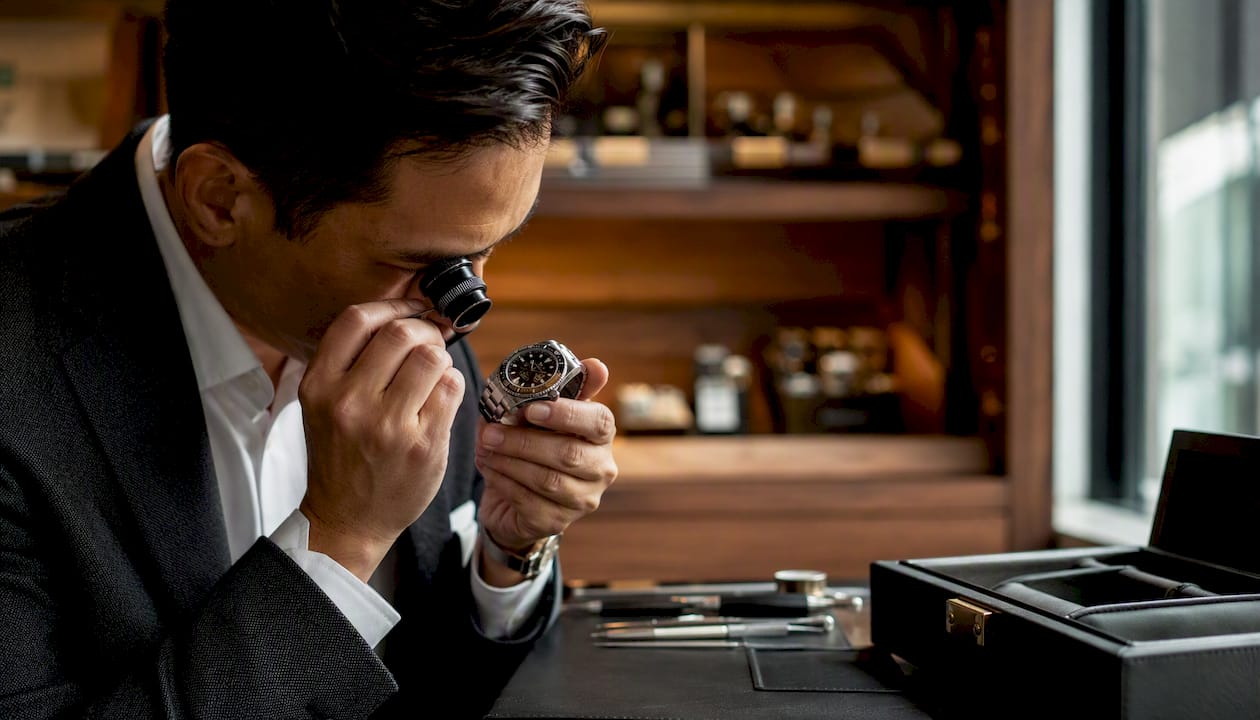
The fastest accurate estimate of your watch’s worth comes from a market-data aggregator or photo-scanner tool, cross-referenced against at least three recent sold listings in matching condition, then confirmed by a professional for any piece you value above your personal threshold. You can have a credible range in under ten minutes.
Start here:
Run a photo scan or price database check using a tool such as PriceSnap, Chrono24’s valuation feature, or Loupe to pull live market comps instantly.
Compare three recent sold listings for the same reference and condition, not asking prices.
Book a professional appraisal for any watch you believe is worth more than your chosen threshold, or where comps are sparse or conflicting.
The trust signals that matter: sold-price comps (not listings), price-history charts showing trend and volume, image recognition that identifies the exact reference number, and a documentation check covering box, papers, and service records.
Key takeaways
The most reliable watch worth estimate combines a photo-scanner identification, at least three recent sold comparables in matching condition, and a professional inspection for any piece above your personal value threshold.
Point | Details |
Start with a photo scanner | Tools like PriceSnap identify the exact reference from images, preventing the most common valuation error. |
Use sold prices, not asking prices | Aggregators such as Chrono24 and Loupe pull completed-sale data, which reflects what buyers actually pay. |
Condition and completeness move the number | Original box, papers, and an unpolished case consistently command a premium over watch-only, undocumented equivalents. |
Escalate rare or high-value pieces | Conflicting comps, sparse sold history, or a value above your threshold all warrant an in-person professional inspection. |
Horology-kings offers a full valuation path | From initial photo review to written valuation, direct purchase, or consignment, with secure UK bank transfer throughout. |
Table of Contents
What tools give you an instant watch worth estimate?
Three distinct tool classes exist, and choosing the wrong one wastes time or produces a misleading number.
Market-data aggregators pull sold and listed prices from multiple sources and display them as a range or index. Loupe computes market valuations from live listing and recent sale data, updating frequently so the figure reflects active secondary-market conditions rather than manufacturer retail prices. Chrono24’s free valuation feature compares your watch against hundreds of thousands of listings and sold records on its platform.
Photo-based scanners are the fastest entry point when you do not have the reference number to hand. PriceSnap’s photo-first scanner identifies brand, model, and reference from images, then pulls recent sold prices across Chrono24, eBay, and dealer inventories to produce a watch-only and full-set price range. Photo tools improve initial accuracy because they capture dial variants and bezel or bracelet details that a text search often misses.
Marketplace appraisal widgets sit inside buying and selling platforms and are useful for a quick sanity check, though they tend to reflect asking prices more than completed sales.
Tool class | Accuracy | Speed | Cost | GBP support | Input needed | Supports authenticated sale |
Good for common refs | Seconds | Free | Yes (multi-source) | Photo only | No | |
Strong for liquid refs | Under 1 min | Free | Yes | Reference number or photo | Chrono24: yes | |
Remote expert / dealer estimate | High | Hours to 1 day | Free to paid | Yes | Photos + details | Yes |
In-person professional inspection | Highest | 1–5 days | Paid | Yes | Watch + paperwork | Yes |
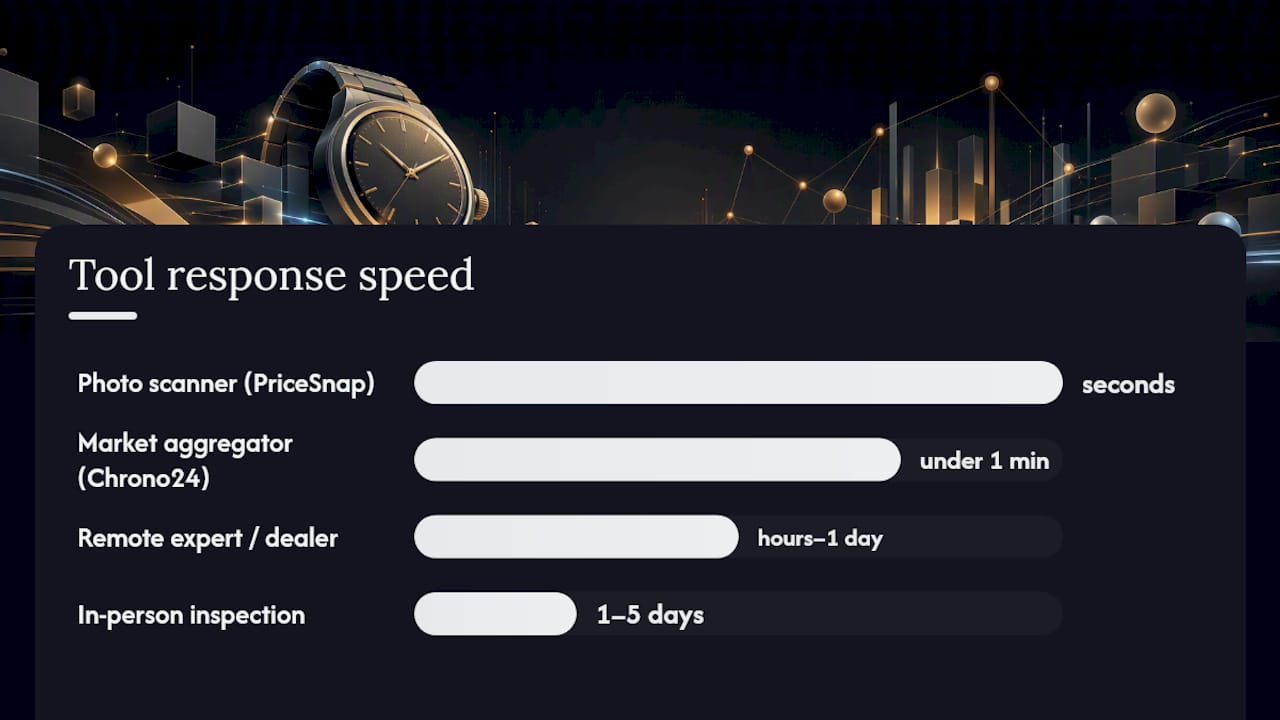
Never rely on a single asking-price listing as your benchmark. Sellers price optimistically; buyers pay market.
Pro Tip: Use a photo scanner first to confirm the exact reference number, then switch to an aggregator for a deeper price-history review. Two minutes of cross-checking often reveals a £500–£2,000 spread between tool outputs for the same watch.
How to identify your watch precisely before valuing it
An imprecise identification is the single most common reason a valuation goes wrong. Two watches that look identical to the untrained eye can differ in value by thousands of pounds if their reference numbers or dial variants differ.
The definitive identifiers to capture
Exact reference number — found on the caseback, between the lugs at 12 o’clock, or on the original papers. This is the most critical input for any valuation tool.
Full model name — including sub-model or collection name (e.g. Submariner Date vs. Submariner No-Date).
Case material — stainless steel, yellow gold, white gold, two-tone, titanium.
Dial variant — colour, texture, applied indices vs. printed, presence of specific text or logos.
Serial number and engraving location — used to date production and verify authenticity.
Movement — calibre number where visible, or confirm via service records.
Photo checklist
Take clear, well-lit images of:
Dial (straight-on, no glare)
Caseback (closed and, if possible, open to show movement)
Between the lugs at 12 o’clock and 6 o’clock (reference and serial)
Clasp and bracelet (for hallmarking codes)
Crown and pushers
Any visible scratches, dial patina, lume condition, or bezel wear
A different reference number, not a different colour, is what typically separates a £6,000 watch from a £12,000 one. Dial variants within the same reference can also shift value considerably, particularly for vintage pieces where original tropical or gilt dials command significant premiums. Check the essential signs that reveal a watch’s true value before you run any tool.
How condition, box & papers, and service history change the price
Condition and completeness are the two variables that most owners underestimate when forming an initial view of their watch’s resale value.
Condition tiers
Mint / near-mint: No visible scratches on case or crystal, unpolished surfaces, sharp lugs, original bracelet stretch within tolerance. Commands the highest comps.
Very good: Light surface marks consistent with careful wear, no deep scratches or dings, dial and hands undamaged. Typically sits at or slightly below the median comp.
Fair: Visible scratches, polished case (which removes original finishing), minor dial marks or faded lume. Expect a meaningful discount to median.
Needs service / parts: Mechanical issues, cracked crystal, damaged crown, missing bracelet links. Priced for parts or project buyers only.
The completeness premium
Original box, warranty card, hang tags, manuals, and service receipts collectively form what the market calls a “full set.” Original documentation and service records materially affect resale value and buyer confidence — a full set typically commands a meaningful premium over the same watch sold without paperwork, and that gap widens for high-demand references where authenticity scrutiny is intense. For a deeper look at how certificates specifically affect pricing, the role of certificates in watch resale value is worth reading before you list.
Original box and papers present: Premium over watch-only, often significant for sought-after references.
Papers only (no box): Smaller premium, but still meaningful for authentication purposes.
Watch only: Baseline comp; buyers price in the risk of unverifiable provenance.
Service history and originality
Manufacturer-serviced history, evidenced by dated receipts from an authorised service centre, preserves value and reassures buyers. An unpolished case is frequently worth more than a polished one of the same reference, because polishing removes the original brushed or bevelled finishing. Aftermarket dials, hands, bezels, or bracelets reduce value, sometimes substantially, because they compromise originality.
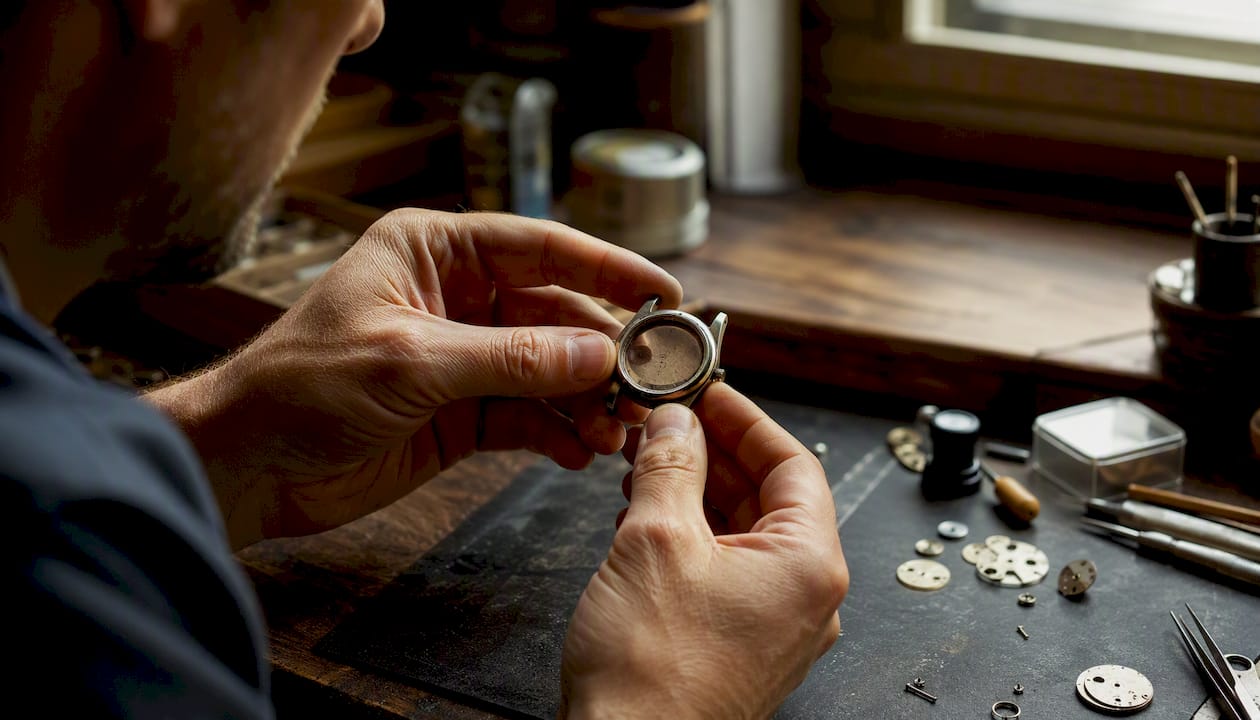
Pro Tip: If your watch has been serviced, locate the receipts before requesting any valuation. A documented service history from a recognised service centre can shift a dealer’s offer noticeably upward.
How to use recent sold comparables to refine your estimate
A photo scan gives you a starting range. Sold comparables sharpen it into a number you can actually use for insurance, sale, or negotiation.
Step-by-step workflow
Find three sold listings within the past 6–12 months for the exact same reference number.
Match condition tier as closely as possible (mint to mint, fair to fair).
Note completeness: full set, papers only, or watch only. Adjust your estimate up or down accordingly.
Check whether any listing included a recent service; factor that in.
Average the three adjusted figures to produce a realistic market range.
Where to find reliable sold prices
Chrono24 — sold-price history is available on the platform and reflects a large, liquid secondary market.
Loupe — real-time aggregation of live listings and recent sales, updated continuously.
Auction house results — useful for rare or vintage pieces, but treat single high results as potential outliers rather than the market.
Dealer completed-sales pages — reflect actual transaction prices rather than aspirational listings.
Reading a price-history chart
Look for three things: the direction of the trend over 12–24 months, the volatility (wide swings suggest thin liquidity), and the number of sales underpinning the chart. Market stabilisation since 2023 means some previously overheated premiums have moderated; multi-year charts reveal this far more clearly than a single-date snapshot. A solitary high auction result for a rare reference should be treated as an outlier unless at least two further sales corroborate it.
Data source | Price type | Update frequency | Best used for |
Sold + asking | Continuous | Liquid, modern references | |
Sold + live listings | Real-time | Quick market-rate check | |
Auction house archives | Hammer prices | Post-sale | Rare, vintage, or high-value pieces |
Dealer completed sales | Transaction prices | Periodic | Calibrating dealer offers |
Which valuation method suits your situation?
The right method depends on the watch’s likely value, how quickly you need a figure, and what you plan to do with it.
Method | Accuracy | Typical turnaround | Cost | Best for |
Photo scanner | Moderate | Seconds | Free | Quick reference ID and ballpark |
Online aggregator | Good | Under 1 min | Free | Liquid references with ample comps |
Remote expert estimate | High | Hours to 1 day | Free to low | Pre-sale or insurance guidance |
In-person inspection | Highest | 1–5 days | Paid | High-value, rare, or disputed pieces |
A professional appraisal also catches authenticity issues that no online tool can detect from photos alone. For a full explanation of what professional valuation involves, the 2026 guide to luxury watch valuation covers the methodology in detail.
Pro Tip: For any watch you believe is worth more than £5,000, treat the online estimate as a starting point only. An in-person inspection by a specialist will identify polishing history, movement condition, and component originality that photos cannot reveal.
Where to sell and how the channel affects what you receive
The channel you choose affects net proceeds as much as the price you agree.
Private sale via marketplace (Chrono24, eBay): highest gross potential, but you pay listing and transaction fees, handle authentication queries, and manage payment risk yourself. Buyer audiences are broad and international.
Dealer direct sale: faster, lower friction, and payment is typically immediate via secure bank transfer. The offer reflects the dealer’s margin, so net proceeds are lower than a private sale at full market value, but the certainty and speed often justify the difference.
Consignment with a specialist: the dealer sells on your behalf and takes a commission. You retain upside if the market moves, but the timeline is less predictable.
Auction house: best for rare, vintage, or highly provenance-documented pieces where competitive bidding can exceed private-market comps. Seller premiums and buyer premiums both apply, and the timeline from consignment to payment can run several months.
For owners who prefer a direct, specialist route, Horology-kings’s sourcing and purchase service offers a structured alternative to public marketplace listings, with secure UK bank transfer and no public exposure of the watch.
Channel | Typical net vs. market | Speed | Security | Best for |
Private marketplace | Highest (minus fees) | Weeks | Buyer-dependent | Common, liquid references |
Dealer direct | Below market (margin) | Days | High | Speed and certainty |
Consignment | Near-market (minus commission) | Weeks to months | High | Mid-to-high value pieces |
Auction | Variable (minus premiums) | Months | High | Rare or vintage pieces |
Always confirm payment method before agreeing a sale. Secure escrow or verified bank transfer are the only acceptable options for high-value transactions.
Which watches are most likely to hold or grow in value?
Not every luxury watch is a store of value. The attributes that consistently correlate with strong resale performance are specific and well-documented.
Brand equity: Patek Philippe, Rolex, and Audemars Piguet consistently lead secondary-market performance. WatchValueScore’s research found that only a small share of brands return more than $1 per retail dollar on the secondary market, with those three brands among the top performers in their dataset.
Steel sports models: Stainless steel sports references from top-tier brands have historically outperformed their gold counterparts in resale liquidity and premium retention.
Scarcity and limited editions: Low production numbers, discontinued references, and limited editions with documented allocation histories attract collector premiums.
Hallmark complications: Perpetual calendars, minute repeaters, and tourbillons from recognised complications houses hold value better than entry-level mechanical pieces.
Documented provenance and original components: Watches with unbroken ownership history, original parts, and full paperwork command premiums that undocumented equivalents cannot match. Wristwatch provenance is a subject worth understanding before you buy or sell.
The caveat: age and precious metal content alone do not create value. An old gold watch with a polished case, missing papers, and no documented service history may be worth far less than a younger steel sports model in unpolished condition with a full set. Condition, rarity, and documentation consistently outweigh material value.
For collectors interested in displaying their passion alongside their collection, Rolex wall art from Luxury Art Canvas pairs well with a curated watch display.
How to avoid scams and verify authenticity before accepting a price
Counterfeits and tampered watches are a genuine risk in the secondary market, and a fraudulent piece is worth nothing regardless of what any tool estimates.
Red flags in listings and offers
Seller history that cannot be independently verified (no reviews, new account, vague location)
Prices significantly below or above market with no clear explanation
Provenance described in vague terms (“bought abroad,” “inherited,” no paperwork)
Requests for payment via bank transfer to a personal account, cryptocurrency, or gift cards
Pressure to complete quickly without time for inspection
Authentication checklist
Use the watch authentication checklist as your reference, and verify:
Serial and reference numbers match each other and the stated production period
Movement matches the reference (calibre number, finishing, engravings)
Hallmarking codes on bracelet links and clasps are correct for the brand and period
Original box and papers are present and consistent with the watch’s stated age
No signs of dial refinishing, hand replacement, or bezel swap
If you suspect a counterfeit or tampered watch
Pause the transaction immediately. Do not transfer funds or hand over your watch.
Request a documented inspection from an independent specialist before proceeding.
If the transaction must continue, insist on secure escrow held by a recognised third party until authenticity is confirmed.
Report suspected counterfeits to the relevant trading standards authority.
How Horology-kings values watches: our inspection and valuation process
A professional valuation from Horology-kings follows a structured, documented process designed to produce a defensible market value, not a quick guess.
Our step-by-step process
Initial intake and photos: We review submitted images and details to confirm the reference, model, and apparent condition before any in-person appointment.
Reference and provenance check: We verify the reference number against production records and cross-reference serial numbers with known databases.
Movement and case inspection: A certified horologist examines the movement for originality, service history, and condition; the case is assessed for polishing, dings, and lug wear.
Service history review: We examine all available service receipts and authorised service centre records.
Market comps and final value report: We pull recent sold comparables from multiple sources and produce a written valuation with a supported market range.
What we check in detail
Reference verification and component originality (dial, hands, bezel, bracelet)
Case condition and polishing history (unpolished cases are documented as a positive)
Service records and movement authenticity
Box, papers, and any additional documentation
Reliable comparables from liquid secondary-market sources
Trust signals
Horology-kings operates from Hertfordshire with secure UK bank transfers for all transactions. Owners can choose between an immediate purchase offer or consignment, with documented provenance safeguards throughout. Our physical presence is verifiable via our Google Maps listing.
Pro Tip: Bring every piece of documentation you own to an in-person valuation, even items you think are irrelevant. A hang tag, a receipt from a boutique, or a photograph of the watch on the original owner’s wrist has moved valuations in the past.
The part of watch valuation most owners get wrong
The conventional advice is to “check what similar watches are selling for online.” That is a reasonable starting point, but it conflates asking prices with sold prices, and it ignores the single most consequential variable: the exact reference number and its dial variant.
Two watches that look identical in a thumbnail can differ by £10,000 or more if one carries a more desirable reference. Photo scanners exist precisely because text searches miss this. Yet most owners still type a model name into a search bar, find a listing that looks right, and anchor to that number. The result is a valuation that is either dangerously low (if you are selling) or embarrassingly high (if you are insuring).
The second mistake is treating the secondary market as static. Since 2023, premiums on several previously overheated references have moderated. A valuation from 2021 or 2022 is not a current market value; it is a historical artefact. Multi-year price-history charts, not single-date spikes, are the only honest picture of where a reference stands today.
The practical priority: identify the exact reference first, use a photo scanner to confirm it, then run a sold-comps search. Everything else, condition adjustments, completeness premiums, service history, is a refinement on top of that foundation. Get the reference wrong and no amount of condition grading will save your estimate.
A trusted professional valuation from Horology-kings
Online tools give you a range. Horology-kings gives you a documented, specialist-backed valuation with a clear next step attached.
For owners who want certainty rather than a ballpark, Horology-kings offers a professional in-person inspection, a written valuation with supported market comps, and the option to sell directly or consign, all with secure UK bank transfer and no public marketplace exposure. Services include expert valuation, direct purchase, consignment, watch sourcing, and certified repair and servicing for presentation-ready condition.
The process is straightforward: submit photos and details for an initial review, then book an in-person appointment at our Hertfordshire premises. You leave with a written valuation and, if you choose to sell, a same-day offer backed by a secure payment. Request your valuation or sell your watch directly through Horology-kings today.
Useful data sources and tools to check now
PriceSnap — photo-first scanner; identifies reference from images and pulls sold prices across multiple platforms. Updates continuously.
Chrono24 valuation — free market-value estimate using the platform’s listing and sold-price database. Strong coverage of modern references.
Loupe — real-time aggregation of live listings and recent sales; useful for a fast secondary-market rate check.
ValueSnap — resale value guide with model examples and market context, including trend analysis since 2023.
WatchValueScore — brand-level resale performance research; useful for understanding which brands and tiers hold value best.
Recommended
Comments