.png)

Water damage watch repair: can your timepiece be saved?
- lewisvrichards3
- Aug 15
- 10 min read
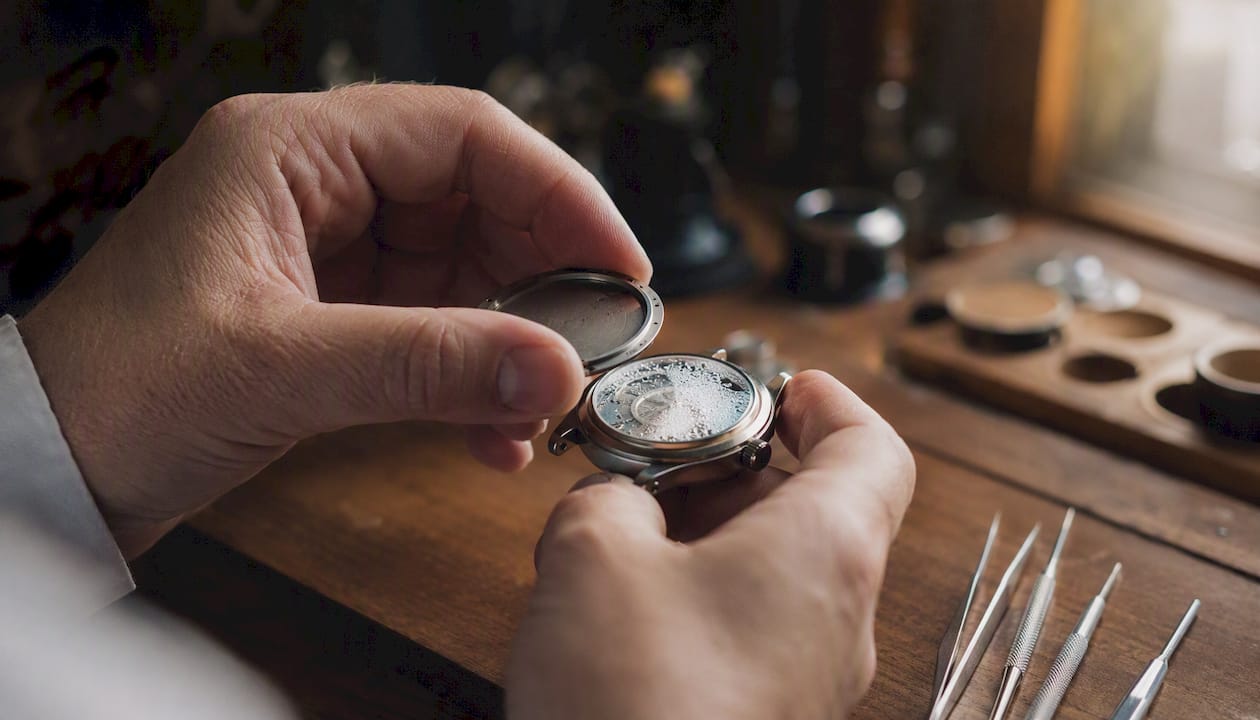
Most water-damaged watches can be repaired, particularly when you act within the first 24–48 hours. The outcome depends on the watch type, the volume of water involved, and how quickly you respond. If you have just spotted moisture under the crystal or noticed your watch behaving erratically after water exposure, here are the three things to do right now:
Remove the watch from your wrist and dry the exterior with a lint-free cloth.
Place it in a sealed container with silica gel packets to begin absorbing ambient moisture.
Pull the crown to the time-setting position (if your watch has a standard screw-free crown) to allow trapped humid air to vent — a useful first step for light condensation, though not a remedy for significant ingress, as noted by Rapidrepair.
Seek professional assessment promptly if you see visible water droplets inside the crystal, if the movement has stopped, or if the watch was exposed to saltwater. These are signs that home stabilisation alone will not be sufficient.
Pro Tip: Do not press any pushers or operate the crown while moisture is present inside the case. Doing so can draw water deeper into the movement.
Key takeaways
Water-damaged watches are usually recoverable when professional assessment is sought within 24–48 hours of moisture being discovered.
Point | Details |
Act within 24–48 hours | Silica gel, a sealed container, and a vented crown buy time; persistent fog beyond 48 hours needs a watchmaker. |
Saltwater needs immediate attention | Salt residues accelerate corrosion even after water evaporates; do not delay professional cleaning. |
Professional process matters | A proper repair includes ultrasonic cleaning, gasket replacement, and a pressure test — ask for the certificate. |
Service every 2–5 years | Regular gasket replacement and pressure testing prevent seal failure before moisture gets in. |
Horology-kings for luxury pieces | Certified horologists, pressure-testing equipment, and itemised diagnostics for Swiss luxury watches across the UK. |
Table of Contents
How do you know if your watch has water damage?
Condensation under the crystal signals that moisture has already breached the case seals and may be affecting internal components. Catching it early is the difference between a straightforward reseal and a full movement overhaul.
Signs to look for:
Fogging or condensation on the inside of the crystal
Visible water droplets behind the glass
Stopped, slow, or erratic movement
Discolouration on the dial, hands, or indices
A musty or metallic smell when the crown is pulled
Crown stiffness, or a crown that feels loose or spins without resistance
Triaging by severity matters. Light fogging that appears briefly after a temperature change and clears within an hour or two may resolve on its own. Persistent fog lasting more than a few hours, any visible droplets, or a movement that has stopped all require professional attention without delay. A watch that was submerged in saltwater should go straight to a watchmaker regardless of how it looks externally, because salt residues accelerate corrosion even when no fog is visible.
Pro Tip: Give a minor fogging incident no more than two hours to clear on its own. If the condensation has not fully disappeared by then, treat it as a workshop case rather than waiting further.
Why does moisture get inside a watch in the first place?
Understanding the cause helps you prevent a repeat. Watches are sealed systems, and moisture finds its way in through specific failure points.
Mechanical failure modes:
Worn or perished gaskets around the caseback, crown, and crystal
A case opened for a battery change or repair without replacing seals and pressure testing afterwards
A crown left in the pulled-out position during water exposure
A cracked or chipped crystal that breaks the seal
An impact or knock that distorts the caseback or crystal seating
Environmental causes:
Hot showers and steam (the combination of heat and pressure forces vapour through ageing seals)
Rapid temperature changes, such as moving from a warm gym to cold air, which cause condensation to form inside the case
Sweat during exercise, which is mildly acidic and degrades rubber gaskets over time
Accidental submersion beyond the watch’s rated depth
Saltwater exposure at the beach or in the sea
A common scenario: a watch rated to 30 metres is worn in the shower daily for two years. The gaskets degrade gradually, and one morning the owner notices fog. The watch never exceeded its rating, but the seals were never serviced. Another frequent cause is a battery change carried out at a high-street jeweller without a subsequent pressure test, leaving the case technically closed but no longer sealed to its original specification. Understanding water-resistance ratings and their real-world limits is the first step to avoiding this.
What should you do immediately after spotting moisture?
Speed is the single most important variable in watch water damage repair. Every hour of delay allows corrosion and lubricant contamination to progress.
Do this, in order:
Remove the watch from your wrist immediately and pat the exterior dry with a clean, lint-free cloth.
If the crown is not a screw-down type, pull it to the time-setting position to allow humid air to vent.
Place the watch in a small, airtight container with several silica gel packets. Silica gel is significantly more effective than uncooked rice at drawing moisture from the air around the watch, and it will not leave starch residue near the crown.
Leave the watch undisturbed in the container for 24–72 hours, checking periodically for improvement.
Stop wearing the watch entirely until it has been assessed.
Do not do any of the following:
Use a hairdryer, oven, radiator, or any direct heat source. High heat warps gaskets and damages lubricants, compounding the original problem.
Press pushers or operate the chronograph while moisture is present.
Attempt to open the caseback yourself unless you are a trained watchmaker. An improperly resealed case is worse than a wet one.
Shake or spin the watch to try to dislodge water.
Pro Tip: Silica gel works best in a genuinely sealed container. A small zip-lock bag or a Tupperware box with a tight lid is more effective than leaving the watch on a windowsill with a sachet nearby.
If fog persists for more than a couple of days, if you can see free water droplets, if the movement has stopped, or if the watch was in saltwater, move straight to professional repair. Waiting without intervention typically increases damage and repair complexity, and what starts as a gasket reseal can become a full movement overhaul.
Can a water-damaged watch actually be repaired?
Yes, in most cases. The realistic outcome depends on several factors working together.
Primary deciding factors:
Watch type: Quartz movements are generally more forgiving of brief moisture exposure than mechanical movements, which have more components requiring lubrication. Smartwatches with adhesive-sealed cases and sensitive electronics are often the hardest to recover.
Volume and type of water: Light condensation from a temperature change is far less damaging than submersion. Saltwater exposure is the most aggressive scenario because salt residues remain active after the water evaporates.
Duration of exposure: A watch that fogged briefly and was dried promptly has a much better prognosis than one that sat wet for several days.
Whether the battery was running: In a quartz watch, a running battery in the presence of water accelerates corrosion of the movement’s electrical contacts.
Service history: A watch with recently replaced gaskets and a documented service history is better positioned for a straightforward reseal than one that has not been opened in a decade.
Typical outcomes by scenario:
Condensation only, cleared within hours: Often resolved with a professional reseal and pressure test.
Persistent fog, no visible droplets, movement still running: Likely requires disassembly, drying, and gasket replacement, with a good chance of full recovery.
Visible droplets, movement stopped: Full strip-down, ultrasonic cleaning, and possible parts replacement. Recovery is achievable but depends on how long the water was present.
Saltwater submersion: Immediate professional cleaning is strongly recommended. Salt residues accelerate corrosion rapidly, and professional intervention should not be delayed.
DIY methods can reduce visible fog but rarely resolve moisture trapped deep in a movement. For any watch of value, professional teardown and cleaning is the only reliable path to a full cure.
What does a professional watch repair actually involve?
A reputable watchmaker follows a structured process for fixing water-damaged watches. Knowing the steps helps you evaluate whether the service you are being offered is thorough.
Typical workshop workflow:
Intake and diagnosis: The watchmaker examines the case, crystal, crown, and caseback for visible damage, then notes the movement’s condition.
Case opening and movement removal: The caseback is removed under controlled conditions, and the movement is extracted.
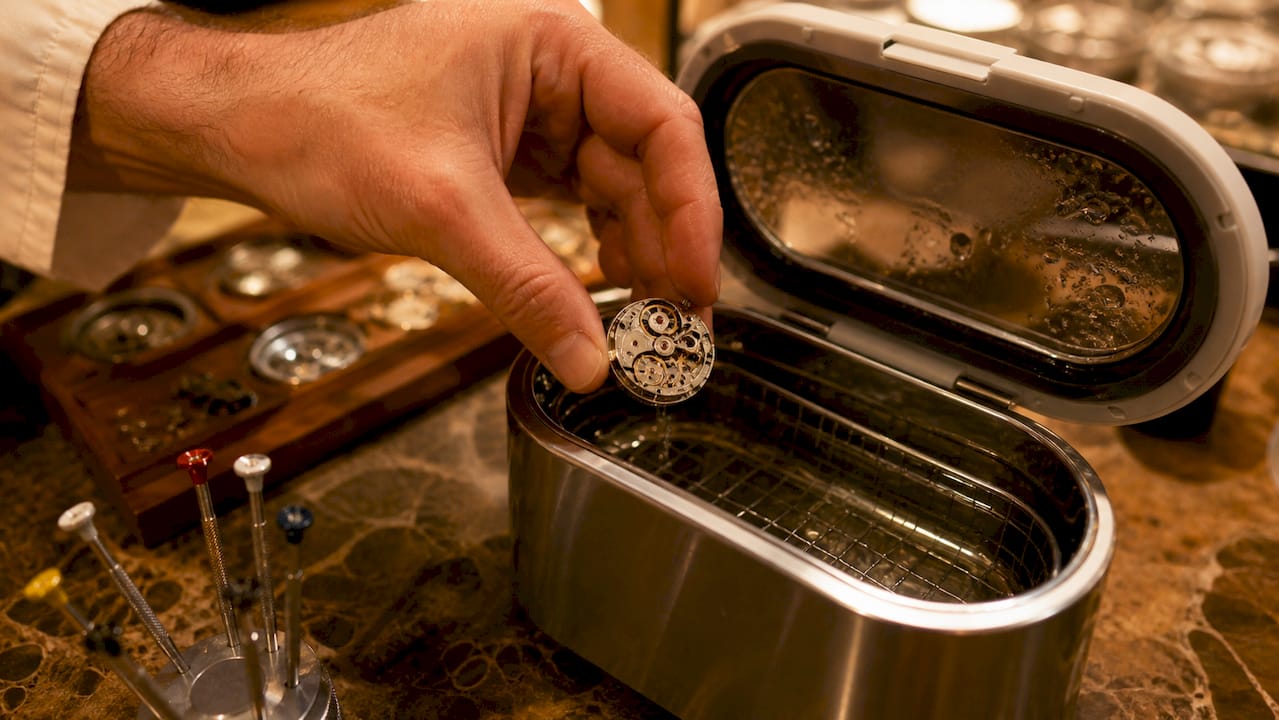
Drying and ultrasonic cleaning: The movement components are cleaned using an ultrasonic bath to remove moisture, corrosion, and contaminated lubricants.
Corrosion assessment: Individual components are inspected for pitting or oxidation. Severely corroded parts are replaced rather than cleaned.
Parts replacement: Gaskets, crown seals, and any damaged hands or dial components are replaced as needed.
Lubrication and reassembly: The movement is lubricated with the correct grade of oil for each component and reassembled.
Pressure and water-resistance testing: The reassembled watch is pressure tested to verify that the case is sealed to its rated specification.
Final regulation and report: The movement’s accuracy is regulated and a service record is issued.
Timelines vary by case. A diagnostic assessment alone typically takes one to three days. A basic reseal and pressure test for a quartz watch might be completed within a week. A full mechanical overhaul, particularly for a vintage piece requiring sourced components, can take four to eight weeks.
Trust signals to ask for:
A pressure-test certificate after any reseal or repair
Watchmaker qualifications or horologist credentials
An itemised diagnostic report and written quote before work begins
Before-and-after photographs for significant restorations
How much does water damage watch repair cost in the UK?
Costs vary considerably by service type, watch category, and parts availability. The table below gives realistic UK price bands as a practical guide; actual quotes will depend on the make, model, and extent of damage.
Service | Everyday quartz | Mid-range automatic | High-end mechanical | Vintage/collectible |
Diagnostic assessment | £30 | £50 | £80 | £100 |
Gasket reseal and pressure test | £60 | £100 | £150 | £200 |
Movement clean and partial repair | £100 | £180 | £300 | £400 |
Full movement overhaul | £150 | £300 | £600 | £800 |
Dial or hand restoration | £80 | £150 | £300 | POA |
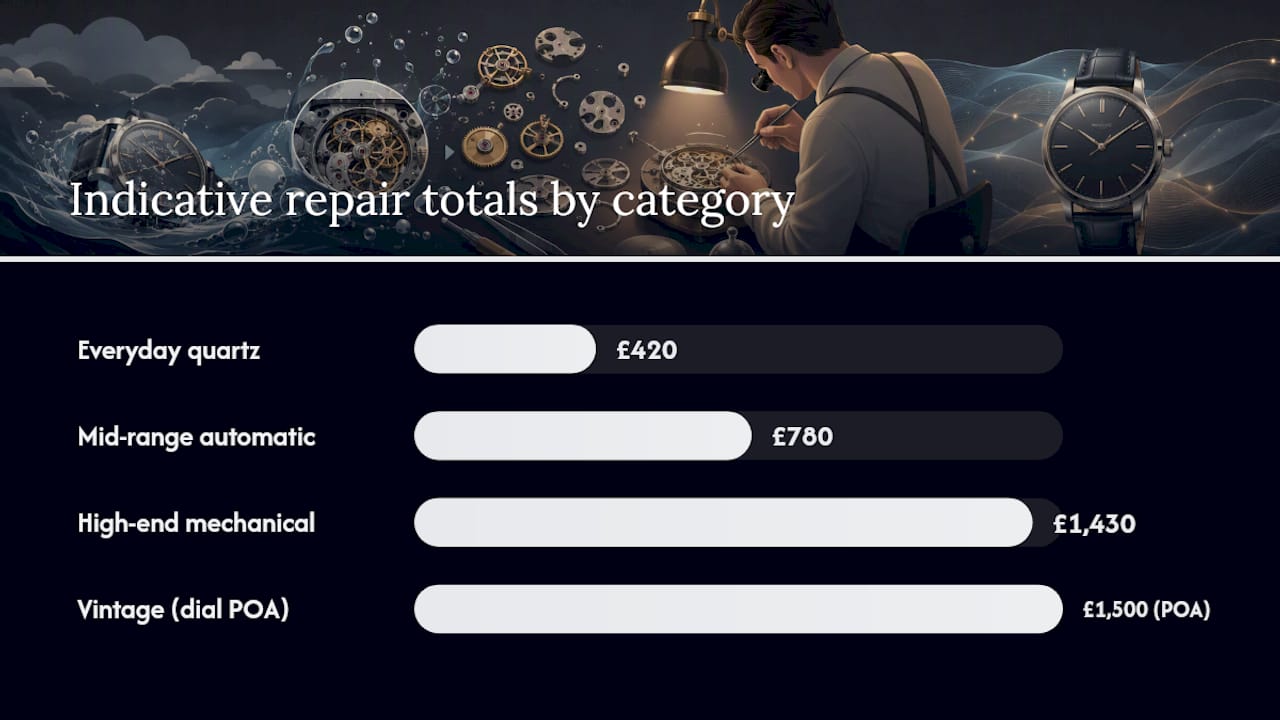
Prices are indicative ranges for the UK market and exclude parts surcharges for rare or discontinued components.
When does repair exceed replacement value?
If the repair quote approaches or exceeds the watch’s current market value, replacement is the rational choice for everyday quartz pieces.
For mechanical watches with sentimental value, documented provenance, or collector significance, repair often makes sense even at a higher cost, because originality preserves long-term value.
Vintage and heritage pieces warrant specialist restoration rather than standard service, since incorrect parts or techniques can reduce authenticity and resale value.
A documented service history adds measurable value to any watch at resale, making professional repair a sound investment for quality timepieces.
How do you prevent moisture problems in future?
Prevention is straightforward once you understand the failure points. A few consistent habits and a simple maintenance schedule reduce the risk significantly.
Daily habits:
Remove your watch before showers, saunas, and steam rooms, regardless of its water-resistance rating.
Always push or screw the crown fully home before any water exposure.
Rinse the watch with fresh water after saltwater contact, then dry thoroughly.
Pat the watch dry after exercise rather than leaving sweat to sit on the case.
Maintenance schedule:
Service the watch every 2–5 years, including gasket replacement, to maintain seal integrity. Regular servicing and annual pressure testing for watches frequently exposed to water is the most reliable way to prevent moisture ingress.
After any battery change or case opening, insist on a reseal and pressure test before resuming water exposure.
For watches used in swimming or diving, annual pressure testing is advisable rather than waiting for the full service interval.
Storage in the UK climate:
Store watches with a desiccant pouch inside the watch box, particularly in damp or unheated rooms. Silica gel accessories and proper watch storage solutions are worth the modest investment.
Avoid storing watches in unheated lofts or garages where temperature swings cause repeated condensation cycles.
Pro Tip: A quick seasonal check — pull the crown, look for stiffness or resistance, and inspect the crystal for any micro-cracks — takes thirty seconds and can catch a failing seal before it becomes a repair bill.
How Horology-kings handles water-damaged watches
Horology-kings, based in Hertfordshire, offers professional watch repair and servicing carried out by certified horologists with direct experience across Swiss luxury makes including Rolex, Omega, Patek Philippe, and Audemars Piguet.
The intake and diagnostic workflow:
Submit your watch via secure postal intake or visit the Hertfordshire branch directly.
A certified watchmaker conducts a full diagnostic assessment and documents the condition of the case, movement, and seals.
You receive an itemised written quote before any repair work begins. No work proceeds without your authorisation.
Repairs are carried out using correct-grade lubricants, manufacturer-specification gaskets, and ultrasonic cleaning equipment.
Every reseal is followed by a pressure test to verify water resistance is restored to the watch’s original rating.
A documented service record is issued with the returned watch.
Trust signals Horology-kings provides:
Certified horologist credentials
Pressure-testing equipment and test certificates issued post-repair
Secure, insured handling throughout the repair process
Experience with high-value and vintage Swiss timepieces
Transparent, itemised diagnostics with no obligation to proceed
For watches of collector significance, Horology-kings’s team understands the importance of preserving original components wherever possible. Book a repair or service assessment to receive a professional diagnostic and written quote.
The urgency of acting quickly: a perspective
The most common mistake owners make with a wet watch is waiting to see whether it clears up on its own. Sometimes it does. More often, the fog disappears from view while corrosion and lubricant contamination continue silently inside the movement. By the time the watch stops or starts losing significant time, what could have been a straightforward reseal has become a full overhaul.
For collector pieces, the stakes are higher still. A movement that has been improperly dried or opened by an unqualified hand can lose original components that are irreplaceable. The difference between a watch that retains its originality and one that has been rebuilt with substitute parts is measurable in both authenticity and resale value.
My honest view: treat any moisture inside the case as a professional matter from the outset. Home stabilisation with silica gel buys you time to get to a watchmaker, nothing more. The cost of a diagnostic assessment is modest compared to the cost of a movement overhaul that could have been avoided. Act quickly, preserve the watch’s originality, and let a qualified horologist make the call.
Horology-kings: professional assessment for your water-damaged watch
When a timepiece you value has been exposed to moisture, the difference between a straightforward reseal and an expensive overhaul often comes down to how quickly you reach a qualified watchmaker.

Horology-kings offers certified horologist-led watch repair and servicing for luxury Swiss timepieces, with pressure testing, itemised diagnostics, and secure handling as standard. Whether your watch needs a basic reseal or a full movement restoration, you receive a written quote before any work begins and a pressure-test certificate when it is complete. Postal intake is available across the UK for owners who cannot visit the Hertfordshire workshop in person. To get started, contact Horology-kings for a professional assessment and quote.
Sources
Recommended
Comments