.png)
What is a perpetual calendar watch? A collector's guide
TL;DR:
A perpetual calendar watch automatically adjusts for varying month lengths and leap years through advanced mechanical engineering. It symbolizes centuries of horological innovation, requiring minimal manual correction, primarily at the century turn of 2100. These complications represent a profound connection to time’s passage, blending technical mastery with emotional legacy.
Most mechanical watch owners accept date correction as routine, adjusting the calendar at the end of every short month without a second thought. A perpetual calendar watch eliminates that entirely. It is, without exaggeration, one of the most intellectually demanding complications ever engineered into a wristwatch, capable of tracking months, years, and leap years without any input from you. For collectors seeking genuine horological depth, understanding what a perpetual calendar watch is, and why it commands such reverence among Swiss manufactures, is essential knowledge.
Table of Contents
The historical evolution and significance of perpetual calendar watches
Comparing perpetual calendar watches: key models from Swiss masters
How to buy and authenticate a perpetual calendar watch in the UK market
Why perpetual calendar watches remain the ultimate collector’s treasure
Explore and acquire perpetual calendar watches with Horology Kings
Key Takeaways
Point | Details |
Complex mechanical design | Perpetual calendar watches automatically adjust for varying month lengths and leap years using intricate mechanical systems. |
Historical horological milestone | These watches embody centuries of craftsmanship and follow the Gregorian calendar, making them prestigious among collectors. |
Rare manual correction needed | Adjustments are required only in exceptional years like 2100 due to calendar exceptions, illustrating the mechanism’s precision. |
Collector’s prized complication | They combine engineering excellence with emotional and historical significance valued highly in Swiss luxury watchmaking. |
Maintenance is essential | To preserve functionality and value, perpetual calendars require expert servicing and careful daily handling. |
Understanding the perpetual calendar complication
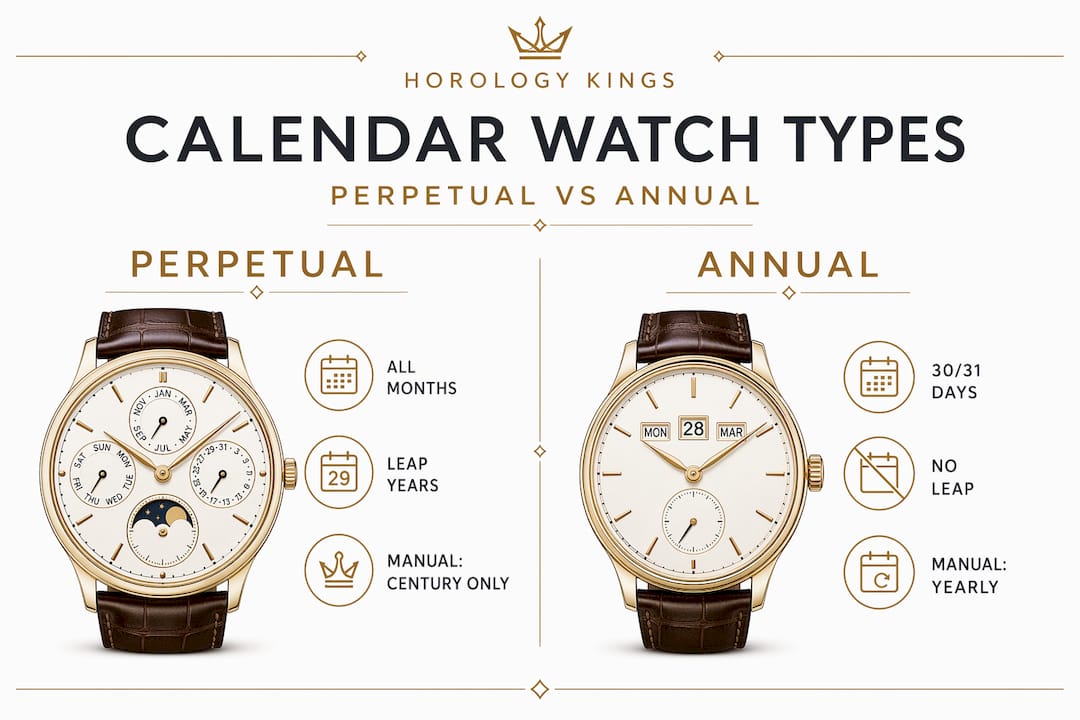
A perpetual calendar watch is a timepiece whose movement automatically accounts for the varying lengths of calendar months, including the 28, 29, 30, and 31-day variations, as well as the four-year leap year cycle. The watch does this entirely through mechanical means, with no electronics or digital programming involved. As perpetual calendar watches demonstrate, the mechanism requires correction only at the turn of certain centuries, not during everyday use.
The engineering behind this is genuinely extraordinary. Inside the movement sits a series of gears, cams, and levers programmed to simulate the Gregorian calendar. A cam with 48 positions, representing the 48 months in a four-year leap year cycle, drives the date display forward by the correct number of days for each month. The movement essentially memorises the calendar, allowing it to roll from 28th February to 1st March in a non-leap year, or to 29th February and then 1st March in a leap year, all on its own. If you want to understand the broader world of horology explained, this complication sits near its summit.
The most common perpetual calendar displays include:
Date: Shown as a date window or retrograde hand, advancing one day at a time
Day of the week: Usually displayed in a secondary window or via a disc
Month: Tracking all twelve months including their individual lengths
Leap year indicator: A small display showing position within the four-year cycle
Moon phase: A rotating disc showing the current phase of the lunar cycle, present in many models
The one exception to its automatic accuracy is a quirk of the Gregorian calendar itself. The years 1700, 1800, 1900, and 2100 are not leap years despite being divisible by four, because the Gregorian system skips a leap year every 100 years, with the exception of years divisible by 400. Most perpetual calendar movements do not account for this, meaning owners will need to advance the date manually on 1st March 2100. Given that this correction is required once per century, it is a remarkably minor concession for a purely mechanical system.
The historical evolution and significance of perpetual calendar watches
The perpetual calendar complication is based on the Gregorian calendar introduced in 1582, making its accurate mechanical replication a demonstration of centuries-spanning craftsmanship. Understanding this history adds considerable weight to owning one.
The key milestones in the development of perpetual calendar watchmaking include:
Pocket watch origins: The earliest perpetual calendar mechanisms appeared in pocket watches during the 18th century, where space was less constrained and craftsmanship was focused on astronomical complications.
Swiss manufacture adoption: Swiss houses began integrating the complication with increasing refinement during the 19th century, establishing the technical traditions that still define the genre today.
Wristwatch adaptation: Migrating the mechanism to a wristwatch case, which is dramatically smaller than a pocket watch, required generations of engineers to reduce component sizes without sacrificing reliability.
Four-digit year display: The introduction of a visible four-digit year indication, showing exactly where the movement sits within its leap year cycle, added both practicality and visual drama to the dial.
Precision moon phases: Advances in moon phase displays brought extraordinary accuracy, with some modern movements deviating from the actual lunar cycle by just one day over several centuries.
Major Swiss manufactures including Jaeger-LeCoultre and IWC have dedicated considerable resources to this complication over decades, each approaching the engineering challenges with their own philosophical emphasis. When choosing Swiss watches, the perpetual calendar represents the point at which a timepiece becomes not just a tool but a statement of intent. The collector who acquires one is not simply buying a watch. They are acquiring a piece of an unbroken intellectual tradition.
Comparing perpetual calendar watches: key models from Swiss masters
With historical context established, the differences between today’s leading perpetual calendar references become far more meaningful. The complication appears across a wide range of price points and aesthetics, and understanding those distinctions shapes intelligent collecting decisions.
Model | Case size | Power reserve | Notable feature | Price bracket |
IWC Portofino Perpetual Calendar | 40mm | 7 days | Double moon phase, user-friendly | Upper mid-range |
Jaeger-LeCoultre Master Ultra Thin | 39mm | 43 hours | Extreme thinness, elegant dial | High-end |
Patek Philippe Ref. 5327 | 38mm | 40 hours | Instantaneous display, Geneva Seal | Prestige |
Frederique Constant Classic Perpetual | 42mm | 3 days | Accessible entry, simple pushers | Accessible |
IWC’s Portofino Perpetual Calendar features a compact 40mm case with user-friendly controls and a double moon phase display accurate to one day in 577.5 years, a remarkable achievement for a watch that wears as comfortably in a boardroom as it does at a countryside estate. The Portofino’s combination of usability and precision makes it a genuine first choice for collectors stepping into the perpetual calendar category.
Jaeger-LeCoultre’s Master Ultra Thin takes a different path entirely, prioritising dial restraint and case depth. The result is a watch that feels almost impossibly refined, with multiple calendar indications arranged across a dial that never feels cluttered. At the opposite end of the approachability spectrum, the Frederique Constant Classic Perpetual Calendar Manufacture offers a three-day power reserve and straightforward push-button corrections at a price point that brings in-house mechanical complexity within reach of a broader audience.

Beyond specifications, collector preferences often come down to dial readability and the visual hierarchy of the calendar information. Some enthusiasts prefer the immediate legibility of sector or retrograde displays. Others favour a restrained approach where the complications are present but whisper rather than shout.
Pro Tip: When evaluating a perpetual calendar watch, test all calendar indications by manually advancing the date through several month-end transitions before purchase. This reveals any stiffness or hesitation in the mechanism that may indicate a service is overdue.
For broader context on acquiring specific references, the watch industry insights available from specialists can help you track market movements and identify undervalued references.
Maintaining and caring for your perpetual calendar watch
The features of perpetual calendar watches come with a corresponding responsibility. The same intricate mechanisms that make these timepieces remarkable also make them sensitive to incorrect handling and deferred maintenance.
Key care practices include:
Avoid corrections during changeover: Never adjust the date or calendar indications between roughly 9pm and 2am, when the movement’s calendar mechanism is mid-advance. Forcing the setting wheels during this window can bend or break delicate components.
Service every five to eight years: Complex complications accumulate wear across their many interacting parts. Regular servicing is essential for complex complications to maintain precision and longevity.
Store thoughtfully: Keep the watch in a stable environment, away from strong magnetic fields, sharp impacts, and humidity. A quality watch box or safe is a worthwhile investment.
Wind manually after storage: If the watch has been unworn and the mainspring is depleted, wind it gently by hand before wearing. This avoids the movement trying to power calendar jumps without adequate energy reserve.
Follow brand-specific schedules: Patek Philippe and IWC, for instance, provide their own servicing guidance. Adhering to these recommendations protects both the movement and the manufacturer’s warranty where applicable.
Pro Tip: Always have a perpetual calendar watch serviced by a watchmaker who specifically lists experience with calendar complications. General watch servicing expertise does not automatically extend to reassembling a 48-month cam correctly. For specialist care, review the luxury watch maintenance tips that apply specifically to complex movements.
How to buy and authenticate a perpetual calendar watch in the UK market
Acquiring a perpetual calendar watch in the UK requires a sharper eye than purchasing a straightforward three-hand timepiece. The complexity of the mechanism and the prestige of the brands that produce them make the category a target for fakes and misrepresented examples.
Authentication check | What to look for |
Box and papers | Original manufacturer packaging, guarantee cards, and dated service receipts |
Serial number verification | Cross-referenced against manufacturer records |
Caseback inspection | Signed movement, correct calibre designation |
Calendar function test | All indications advancing correctly through month transitions |
Dial quality | Print clarity, correct lume application, no blemishes under magnification |
Buying from reputable dealers with verified provenance and service history protects your investment in rare perpetual calendar watches. Provenance matters enormously here. A Jaeger-LeCoultre Master Perpetual with a complete service history from an authorised centre commands meaningfully more than an identical reference without documentation.
Understanding value drivers is equally important when making purchasing decisions:
Brand prestige: Patek Philippe perpetual calendars hold value differently from those of smaller manufactures, even when the technical specifications are comparable.
Condition: Calendar complication watches lose value quickly when indicators of deferred maintenance are visible.
Rarity: Limited production references, anniversary editions, and early examples with historical significance attract collector premiums.
Complexity: Additional indications such as minute repeaters, tourbillons, or split-seconds chronographs combined with perpetual calendars multiply both value and desirability.
The watch service history of any perpetual calendar watch you are considering should be examined before any price discussion takes place. A clear, documented service trail is not optional. It is foundational to a sound acquisition.
Why perpetual calendar watches remain the ultimate collector’s treasure
There is a perspective worth challenging in how many collectors approach the perpetual calendar complication. The dominant narrative focuses almost entirely on complexity, as if the hundreds of components and the 100-year correction interval are the whole story. They are not.
What genuinely separates a perpetual calendar from every other watch you might own is the relationship it creates with time itself. A smartwatch tells you the date because it receives a radio signal. A perpetual calendar knows the date because a watchmaker of the past reasoned through the entire Gregorian system, translated that reasoning into metal, and built it to last generations. There is no battery. No update required. Just engineering applied with such rigour that the passage of months and years becomes automatic.
We have seen collectors overlook extraordinary perpetual calendar references because the dial lacks the visual drama of a tourbillon. That is a mistake. The perpetual calendar is arguably the more intellectually honest complication, solving a genuine practical problem rather than addressing the issue of positional error in a wristwatch that rarely spends time in the positions where a tourbillon would matter. For luxury horology insights that reframe how you think about complications, it is worth reconsidering what problem each mechanism was actually designed to solve.
There is also a compelling emotional dimension that market analysis cannot capture. Perpetual calendar watches owned across multiple generations carry the lived experience of those who wore them during the calendar transitions the watch navigated on its own. Every correct month-end advance is a small, silent act of precision that has been repeating, unwatched, for decades. That continuity is rare in any object. In a wristwatch, it is extraordinary.
Explore and acquire perpetual calendar watches with Horology Kings
If this guide has deepened your appreciation for what perpetual calendar watches represent, the logical next question is where to find authentic examples you can trust.

At Horology Kings, we specialise in sourcing, buying, and selling authenticated luxury watches from the world’s foremost Swiss manufactures. Whether you are looking to source a specific perpetual calendar reference or need expert watch repair and servicing for a piece already in your collection, our Hertfordshire-based team provides the provenance assurance and specialist knowledge that serious collectors require. Every transaction is handled with transparency, discretion, and secure UK bank transfers, so you can focus entirely on the watch.
Frequently asked questions
What makes a perpetual calendar watch different from an annual calendar watch?
A perpetual calendar watch automatically adjusts for all month lengths and leap years, requiring correction only in exceptional century years, whereas annual calendars do not handle leap years automatically and need a manual adjustment at the end of shorter months.
How often do perpetual calendar watches require manual correction?
Generally, only once per century. Because the Gregorian calendar eliminates certain leap years every hundred years, most perpetual calendar owners will need to advance the date manually on 1st March 2100.
Can perpetual calendar watches display moon phases?
Yes, many models include moon phase complications of remarkable precision. IWC’s moon phase display deviates from the actual lunar orbit by only one day after approximately 577.5 years.
Are perpetual calendar watches suitable for everyday wear?
They can be worn daily, but their intricate mechanisms benefit from careful handling and scheduled maintenance. Complex complications require regular servicing to maintain precision and protect their long-term function.
Recommended
Comments