.png)
What is a sigma dial Rolex? The collector's guide
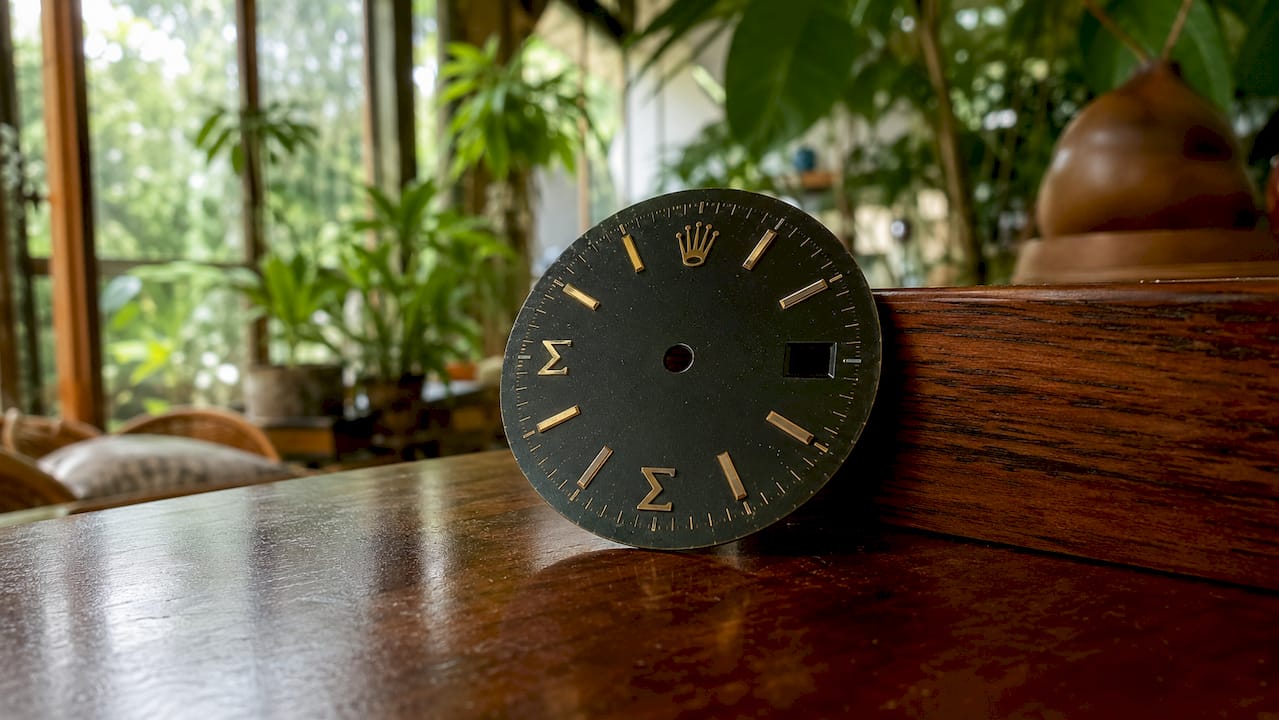
A Rolex sigma dial is a vintage dial bearing the small Greek letter sigma, placed flanking the word “Swiss” or “Swiss Made” near the 6 o’clock position. That symbol carries a specific, verifiable meaning: the hands and hour markers are crafted from solid 18k gold, hand-applied rather than painted or plated. For collectors, it is one of the most telling details on any vintage Rolex from the 1970s.
Key recognition markers at a glance:
The sigma symbol appears as two small lowercase Greek letters flanking “Swiss” or “Swiss Made”
Gold indices and hands are applied, not printed or plated
Found predominantly on dress models such as the Datejust and Day-Date
Absent from tool watches like the Submariner and Sea-Dweller, which used painted tritium markers
Production concentrated in the 1970s, with Rolex phasing the mark out by the decade’s end
Where did the sigma dial come from?
The sigma marking was not a Swiss government regulation, nor was it imposed across the entire industry. It was a voluntary initiative by members of APRIOR, the Association pour la Promotion Industrielle de l’Or, a trade body formed to promote the use of gold components in mechanical watches. That distinction matters for collectors: not every luxury brand used it, and its absence on a dial does not indicate inferior materials.
Period | Key development |
Early 1970s | Earliest confirmed Rolex sigma dials appear, predating formal APRIOR establishment |
Early 1970s | Sigma symbol trademarked, before APRIOR’s by-laws were drafted |
1972–1973 | APRIOR formally constituted; Federation of the Swiss Watch Industry backs the initiative |
Mid-to-late 1970s | Peak sigma dial production across Rolex, Patek Philippe, IWC, and Vacheron Constantin |
Late 1970s | Rolex ceases use of sigma dials as the quartz crisis reshapes the industry |
1990s and later | Patek Philippe and Vacheron Constantin used the mark legitimately well into the 1990s |
The economic backdrop explains the initiative clearly. Gold prices nearly quintupled between 1970 and 1974, and mechanical watches were under existential pressure from quartz movements. APRIOR’s logic was straightforward: if a watch contained genuinely precious materials, say so visibly. “A watch signed with the sigma is a durable investment,” the association stated in its marketing campaigns.
Common myths worth correcting:
Myth: Sigma dials began in 1973 when APRIOR was founded. Fact: Rolex watches from 1970 already carry the sigma, and the trademark was filed in August 1971.
Myth: The sigma was a compulsory Swiss industry marking. Fact: It was entirely voluntary, adopted only by APRIOR members.
Myth: A sigma dial on a 1990s watch is automatically a service replacement. Fact: Patek Philippe and Vacheron Constantin used the mark legitimately well into the 1990s.
Myth: All sigma dials appear on gold-cased watches. Fact: Stainless steel models also carried the mark when their hands and indices were gold.
What makes a sigma dial special in terms of craftsmanship?
The sigma mark is a guarantee of material quality, not merely a decorative flourish. On a sigma dial Rolex, the hour markers and hands are fabricated from solid 18k gold and individually applied to the dial surface by hand. This is a fundamentally different process from dials where indices are printed, lacquered, or applied using base-metal components with a surface treatment.
Key materials and craftsmanship attributes:
18k solid gold indices: Each applied marker is a discrete piece of gold, not a plated or filled substitute
18k solid gold hands: Hands carry the same gold specification as the markers, ensuring material consistency
Hand-application process: Indices are set individually onto the dial, requiring skilled labour and adding to production cost
Durability: Solid gold resists tarnishing and discolouration over decades, unlike plated alternatives
Stainless steel compatibility: The gold specification applies to the components, not the case; sigma dials appear on steel-cased watches where only the hands and markers are gold
Gold price context: The price of gold nearly quintupled between 1970 and 1974, giving the sigma mark genuine financial weight at the point of sale. A buyer in 1972 purchasing a sigma dial Datejust was acquiring measurably more precious metal than a buyer of a comparable non-sigma model.
Dial makers Stern and Singer produced sigma dials for multiple APRIOR member brands during this period. The fact that the same suppliers served Rolex, Patek Philippe, and IWC simultaneously explains why sigma dials share a consistent visual language across different manufacturers, even though each brand’s dial design remained distinct.
One model category worth noting: the Rolex Submariner and Sea-Dweller of this era do not carry sigma marks. Both references used painted tritium for their hour markers rather than applied metal indices, so the sigma designation simply did not apply. Collectors searching for sigma dials should focus on dress and sports-dress references.

How does a sigma dial affect Rolex value and collectability?
Sigma dials add genuine collector appeal to vintage Rolex watches, and that appeal translates directly into market value. An original, unrestored sigma dial in good condition confirms that the watch retains its factory-applied gold components, which is a meaningful authenticity signal. For appraising a Rolex accurately, dial originality is one of the first things a specialist examines.
The challenge for collectors is authentication. Service dials, replacement dials, and re-dials are common in the vintage Rolex market, and a sigma symbol on a dial does not automatically confirm originality. The dial must match the watch’s reference number and production period.
Collector considerations when buying or valuing a sigma dial Rolex:
Reference compatibility: Verify that the sigma dial was actually offered on that specific reference during the relevant production years
Serial number alignment: Cross-reference the case serial number with known sigma dial production windows for that model
Condition of the sigma symbols: Original sigma marks are crisp and consistent; worn, smudged, or asymmetric symbols warrant closer inspection
Hands and indices: Confirm the gold components show appropriate age-consistent patina rather than signs of recent replacement
Service history: A watch with documented Rolex service history may have received a replacement dial; check whether the sigma dial is noted as original or fitted during service
Model scope: Submariner and Sea-Dweller references of this era never carried sigma dials; any such example should be treated with scepticism
Pro Tip: When examining a potential sigma dial purchase, use a loupe to inspect the sigma symbols under magnification. Original marks sit cleanly within the dial printing, with no bleeding or misalignment. If the sigma appears to sit on top of the “Swiss Made” text rather than integrated with it, the dial may have been altered or replaced.
The discontinued Rolex models most associated with sigma dials include the Datejust references 1601, 1603, and 1625, the Day-Date in various gold configurations, and select Oyster Perpetual references from the early 1970s. These are the references where an original sigma dial carries the strongest premium.
Expert perspective from Horology-kings on sigma dials
At Horology-kings, we handle vintage Rolex watches regularly, and the sigma dial question comes up consistently among serious collectors. The key point our specialists stress: distinguishing an original sigma dial from a later service replacement is not always straightforward, but it is always consequential for value.
Authentication and valuation guidance from our team:
Treat the dial as the most sensitive component of any vintage Rolex valuation; a replaced dial, even a correct-period sigma dial, reduces originality
Cross-reference the reference number, serial number, and known production data before drawing any conclusions about dial authenticity
Seek specialist opinion before purchasing any sigma dial example at a significant premium; the cost of expert verification is negligible against the risk of overpaying for a non-original dial
Understand that sigma dials on Rolex are concentrated in a specific production window; a sigma dial on a reference that postdates Rolex’s known use of the mark is a red flag
Consider the broader watch collection management context: a sigma dial Rolex in original, unpolished condition with matching paperwork represents a genuinely rare combination
Horology-kings specialises in authenticated Swiss timepieces, with particular expertise in vintage Rolex. Our team offers expert valuations, discreet sourcing, and secure transactions for collectors across the UK. Whether you are looking to acquire a specific sigma dial reference or seeking a professional assessment of a piece you already own, we bring the depth of knowledge that these watches demand.

If you are looking to source a rare vintage Rolex or want a professional valuation on a sigma dial piece, Horology-kings is here to help. Visit Horology-kings to explore our curated inventory and speak with our specialists directly.
Key takeaways
A Rolex sigma dial, marked with solid 18k gold hands and indices, is one of the most reliable authenticity and value signals in the vintage Rolex market.
Point | Details |
Sigma meaning | The Greek letter sigma confirms that hands and hour markers are solid 18k gold, not plated or painted. |
Historical origin | Sigma dials appeared on Rolex watches as early as 1970, predating APRIOR’s formal founding in 1973. |
Voluntary mark | The sigma was never mandatory; only APRIOR member brands adopted it, which is why it does not appear across all Swiss watches of the era. |
Model scope | Rolex Submariner and Sea-Dweller references of this period do not carry sigma dials, as they used painted tritium markers instead. |
Collector priority | Dial originality is critical; a replacement sigma dial, even a period-correct one, reduces a watch’s value compared to an unrestored original. |
Recommended
Comments