.png)
What is a single-owner watch: the collector's guide
TL;DR:
A single-owner watch has only been owned by one person or family since purchase, making its ownership history clear and verifiable. This status enhances a watch’s authenticity, provenance, and resale value, especially when documented with receipts and service records. Collectors highly value single-owner pieces for their integrity and the story they tell, often commanding premiums at auction.
A single-owner watch is defined as a timepiece possessed by one individual or kept within the original family from the moment of purchase, creating an uninterrupted and verifiable ownership history. In the collector world, this status carries real weight. It signals authenticity, reduces the risk of undisclosed modifications, and places a watch in a category that auction houses actively market as premium. For anyone serious about buying, selling, or collecting luxury timepieces, understanding what is a single-owner watch is not optional. It is foundational.
What is a single-owner watch and why does it matter?
A single-owner watch, sometimes called a “fresh-to-market” piece in auction catalogues, is defined by its ownership history as a timepiece that has traded hands only once since leaving the retailer. The term appears frequently in vintage watch glossaries and major auction house listings alike. It serves as a key indicator of a watch’s life cycle and original condition.
The significance goes beyond sentiment. When a watch has had only one owner, the chain of custody is short and traceable. That traceability makes it far easier to confirm that the dial, hands, case, and movement are all original. Collectors refer to this as provenance clarity, and it is the single most important factor in professional appraisal.
The industry term most closely aligned with this concept is “provenance.” Provenance describes the documented history of an object’s ownership. A single-owner watch represents the clearest possible provenance: one purchase, one owner, one story. Horology-kings uses this standard when assessing watches brought in for valuation or sourcing.
How does single-owner status affect authenticity and provenance?
The primary value of a single-owner watch is the clarity it brings to provenance verification. A watch that has passed through multiple hands carries a higher risk of undisclosed part replacements, polishing, or dial restoration. Each additional owner is another opportunity for the watch to be altered without record.
The market term for a watch assembled from mismatched original parts is a “franken-watch.” These pieces look genuine but combine components from different references or production years. Single-owner status significantly reduces this risk because the watch has had fewer opportunities to be tampered with. That said, single ownership alone does not guarantee originality. Documentation does.
The types of paperwork that strengthen a single-owner claim include:
Original purchase receipt from an authorised retailer, showing the date, reference number, and serial number
Warranty card or guarantee booklet, ideally with the retailer’s stamp and the owner’s name
Service records from authorised service centres, confirming which parts were replaced and when
Family correspondence or photographs showing the watch being worn or gifted, particularly useful for estate pieces
Box and original accessories, which corroborate the watch’s retail origin
Documentation like these records directly influences appraisal outcomes. Without them, a single-owner claim carries little professional weight, regardless of how convincing the seller’s story sounds.
Pro Tip: Ask for the serial number before viewing any watch in person. Cross-reference it against the paperwork before you travel or commit to a viewing. Mismatches between serial numbers on the case and the documents are an immediate red flag.
What are the investment and resale benefits of single-owner watches?
Single-owner collections command premiums at auction due to the perceived security they offer in authenticity and condition. Major auction houses actively use single-owner status as a marketing designation for curated groups of watches. That designation signals to bidders that the pieces have not been circulated through the trade, reducing the likelihood of undisclosed work.
Rarity and provenance, established by being the first and only owner, enhance a piece’s investment potential in ways that multi-owner watches rarely match. Documented production notes, original purchase correspondence, and unbroken service histories increase resale value compared to watches with lost or fragmented histories. This is not speculation. It reflects how the collector market actually prices these pieces.
Factor | Single-owner watch | Multi-owner watch |
Provenance clarity | High: one traceable chain of custody | Variable: gaps common between owners |
Risk of undisclosed modifications | Lower: fewer opportunities for alteration | Higher: each owner adds risk |
Auction premium potential | Frequently commands above-estimate results | Dependent on condition and documentation |
Documentation completeness | Often intact from original purchase | Frequently partial or missing |
Collector desirability | Strong: “fresh-to-market” appeal | Moderate: depends on reference and condition |
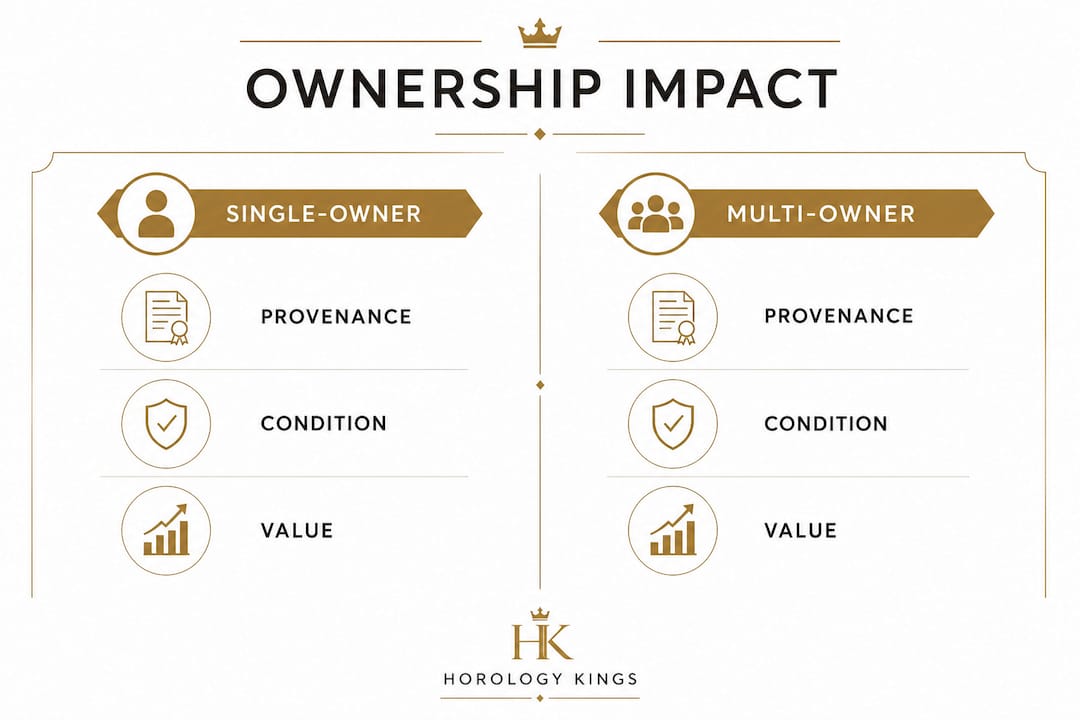
Watches with clear ownership histories also retain value more consistently over time. A Rolex Submariner or Patek Philippe Calatrava with full original paperwork and a single-owner history will almost always outperform an equivalent reference with a fragmented past at resale. The factors driving rare timepiece value consistently point to provenance as a top-tier differentiator.
How to identify and verify a genuine single-owner watch
Verification is the step most collectors underestimate. A seller’s claim of single ownership is a starting point, not a conclusion. The following process applies whether you are buying privately, through a dealer, or at auction.
Request all original documentation upfront. Ask for the purchase receipt, warranty card, and any service records before agreeing to view the watch. A genuine single-owner piece will almost always have at least some of these.
Cross-reference the serial number. The serial number on the case back should match the number on the warranty card and any service records. Discrepancies suggest the documents belong to a different watch.
Examine the case for signs of polishing. Original brushed or satin surfaces should show wear consistent with age, not a uniform sheen. Heavy polishing removes metal and erases original finishing, which is a common sign of a watch that has been prepared for resale.
Check the dial and hands under magnification. Refinished dials lose their original printing depth and texture. Replacement hands often show slight colour or finish differences when compared to period-correct examples.
Consult an authorised dealer or independent expert. Authorised dealer records can sometimes confirm a watch’s retail history. An independent appraiser with horological expertise can assess originality in ways a photograph cannot. Horology-kings offers expert appraisal services for exactly this purpose.
Research the reference. Know what the original dial, hands, and case should look like for the specific reference and production year. Reference guides, collector forums, and specialist publications are all useful here.
Pro Tip: For estate watches presented as single-owner pieces, ask for photographs of the original owner wearing the watch. Family photos or correspondence that includes the watch add a layer of human evidence that is very difficult to fabricate.
Common misconceptions about single-owner watches
Single-owner status does not automatically mean excellent condition. A watch worn daily for forty years by one person can show significant case wear, crystal scratches, and bracelet stretch. The ownership history is clean, but the physical condition may not be. Collectors who conflate single-owner with pristine condition regularly overpay.
The distinction between single-owner, unworn, and new old stock (NOS) is also frequently misunderstood:
New old stock (NOS) refers to a watch that was never sold at retail and has remained in its original packaging, often at a distributor or retailer.
Unworn means the watch was purchased but never worn, sometimes still with protective stickers on the case.
Single-owner simply means one person or family has held the watch since purchase. It may have been worn extensively.
Market perception can sometimes overvalue provenance without sufficient context. A single-owner watch from a private collector who never serviced it, stored it poorly, or wore it in conditions it was not designed for may be in worse shape than a multi-owner watch that received professional care at every stage. Provenance is one variable, not the whole picture.
The signs that reveal a watch’s true value always include physical condition alongside ownership history. Treat them as equal inputs, not a hierarchy.
Why single-owner watches matter to the passionate collector
A watch carries the life of its owner. That is not a romantic exaggeration. It is the reason collectors pay attention to who wore a piece, where they wore it, and what it meant to them. Provenance enhances emotional connection and collector satisfaction beyond financial considerations, reflecting personal stories and heritage that no amount of money can manufacture.
Famous single-owner collections illustrate this clearly. When auction houses present collections like the Kronos set or the OAK Collection, they are not just selling watches. They are selling documented ownership history and the cultural resonance of a coherent, curated life in horology. Collectors respond to that narrative because it connects them to something larger than the object itself.
“The value of a single-owner watch lies not only in what it is, but in what it has been. A watch worn by one person for decades carries an authenticity that no restoration can replicate. That continuity of ownership is the closest thing horology has to a living document.”
The culture of collecting has always been about meaning as much as money. A watch that has lived one life, with one owner, tells a cleaner and more compelling story than one that has passed through a dozen hands. For collectors who care about what defines a timepiece’s value, that story is the point.
Key takeaways
A single-owner watch commands collector premiums because its unbroken ownership history delivers provenance clarity that multi-owner pieces rarely match, making documentation the decisive factor in both appraisal and resale value.
Point | Details |
Single-owner definition | One individual or family has held the watch from purchase, creating a traceable ownership history. |
Documentation is decisive | Original receipts, warranty cards, and service records determine whether a single-owner claim holds appraisal weight. |
Premium but not perfect | Single-owner status often commands auction premiums, but condition must be assessed independently of ownership history. |
Verification requires process | Cross-reference serial numbers, examine finishing, and consult an expert before accepting any provenance claim. |
Emotional value is real | Single-owner watches carry personal and cultural stories that drive collector demand beyond pure financial logic. |
Why I think single-owner watches are the most honest category in collecting
The watch market rewards storytelling, sometimes too generously. I have seen pieces with compelling narratives but mediocre condition sell for prices that made no mechanical sense. Single-owner status can be part of that storytelling. But when it is backed by genuine documentation, it is the most honest signal the market produces.
What I find genuinely compelling about single-owner pieces is the absence of ambiguity. You are not piecing together a watch’s history from fragments. You are reading a single, coherent chapter. That clarity changes how you relate to the object. It is not just a watch. It is a record.
My practical advice: balance provenance with horological quality. A single-owner watch with a tired movement and a polished case is not a better buy than a well-maintained multi-owner piece with a fresh service. Provenance matters enormously, but it does not override the fundamentals of what makes a watch worth wearing and worth keeping.
— Lewis
Horology-kings and the search for single-owner timepieces
Collectors who know what they are looking for deserve a dealer who applies the same standards.
Horology-kings specialises in sourcing, appraising, and presenting luxury watches with verified provenance, including single-owner pieces from private collections across the UK and Europe. Every watch assessed by Horology-kings is examined for originality, documentation completeness, and condition before it reaches a collector. Whether you are looking to buy or sell a luxury watch or need help sourcing a specific reference, the team at Horology-kings brings the expertise and network to find pieces that meet the standards serious collectors actually require. Transparency and trust are not marketing language here. They are the operating standard.
FAQ
What is the single-owner watch definition in simple terms?
A single-owner watch is a timepiece that has been owned by only one person or family from the point of original purchase, with no change of hands outside that relationship.
Are single-owner watches always more valuable?
Single-owner status frequently commands a premium at auction and in private sales, but value also depends on condition, reference desirability, and the quality of supporting documentation.
How do I verify a single-owner watch claim?
Request original purchase receipts, warranty cards, and service records, then cross-reference the serial number across all documents and have the watch examined by an independent expert or authorised dealer.
What is the difference between single-owner and new old stock?
New old stock (NOS) refers to a watch never sold at retail, while a single-owner watch was purchased and used by one person. Single-owner pieces may show wear; NOS pieces typically do not.
Why do auction houses emphasise single-owner collections?
Auction houses use single-owner status as a marketing designation to signal provenance integrity and attract collectors who prioritise authenticity and clear ownership history over price alone.
Recommended
Comments