.png)
What is a watch warranty? A 2026 UK luxury buyer's guide

Luxury watch warranties protect your investment, yet many UK buyers misunderstand their scope and limitations. Warranties cover manufacturing defects, not accidents or theft, and vary widely by brand. Recent trends show some brands now offer up to 8 years coverage, yet confusion about exclusions, transferability, and claims processes remains widespread. This guide clarifies warranty fundamentals to help you safeguard your timepiece effectively.
Table of Contents
Key takeaways
Point | Details |
Warranty definition | A manufacturer’s promise to repair manufacturing defects during a specified period, not covering accidents or theft. |
Coverage scope | Protects against material and workmanship flaws; excludes wear, damage, and external risks requiring insurance. |
Duration range | Standard warranties span 2 to 5 years; select brands now extend protection to 8 years. |
Verification essentials | Authentic warranties require authorised dealer stamps, matching serial numbers, and original purchase documentation. |
Transfer impact | Warranty transferability varies by brand and significantly influences secondary market value and buyer confidence. |
Understanding what a watch warranty is
A warranty legally promises repair or replacement for manufacturing defects within a defined period. It’s the manufacturer’s commitment that your luxury timepiece will function as designed if properly maintained. This contractual protection applies exclusively to factory faults discovered during normal use.
A warranty differs fundamentally from insurance. Warranties address manufacturing errors, faulty materials, or workmanship issues that originate at the factory. Insurance, conversely, covers external risks like theft, accidental damage, or loss. Many buyers conflate these protections, leading to disappointing claim denials.
For luxury watches, warranties serve as quality assurances and value retention tools. They signal manufacturer confidence in their craftsmanship and provide peace of mind during ownership. However, warranties impose responsibilities. You must service your watch through authorised centres, avoid unauthorised modifications, and maintain proper documentation.
Key warranty limitations:
Manufacturing defects only, not user error
Normal wear components excluded
Unauthorised repairs void coverage
Claims require original documentation
Pro Tip: Register your watch immediately after purchase with the manufacturer’s online portal to create a digital warranty record alongside your physical card.
Typical coverage and common exclusions in luxury watch warranties
Luxury watch warranties typically cover defects in materials or workmanship that emerge during normal use. This includes faulty movements, defective hands or dials, case manufacturing flaws, and crown or pusher malfunctions traceable to factory errors. Luxury watch warranties exclude accidental damage, theft, wear and tear, and battery replacement, which remain your responsibility.

Understanding exclusions prevents costly surprises. Scratched crystals, worn straps, faded dials from sun exposure, and water damage from improper use fall outside warranty scope. Similarly, damage from unauthorised repairs, modifications, or neglected maintenance voids coverage entirely.
The distinction matters financially. A manufacturing defect repair costs nothing under warranty, whilst accidental damage might cost thousands at authorised service centres. Insurance fills this gap, covering risks warranties deliberately exclude.
Common warranty exclusions:
Accidental impacts and drops
Water damage from negligence
Theft and loss
Normal aging and patina
Cosmetic wear like scratches
Battery replacements for quartz models
Unauthorised service or alterations
Smart buyers recognise warranties and insurance as complementary protections. Warranties handle factory defects; insurance manages everything else. This knowledge shapes informed purchasing decisions and appropriate supplementary coverage.
Warranty duration: how long does your luxury watch warranty last?
Standard luxury watch warranties span 2 to 5 years, with significant variation by brand. Rolex provides 5 years coverage globally, whilst Omega offers 5 years with optional extensions. Some ultra-premium models now include 8 years protection, reflecting manufacturer confidence and competitive positioning.
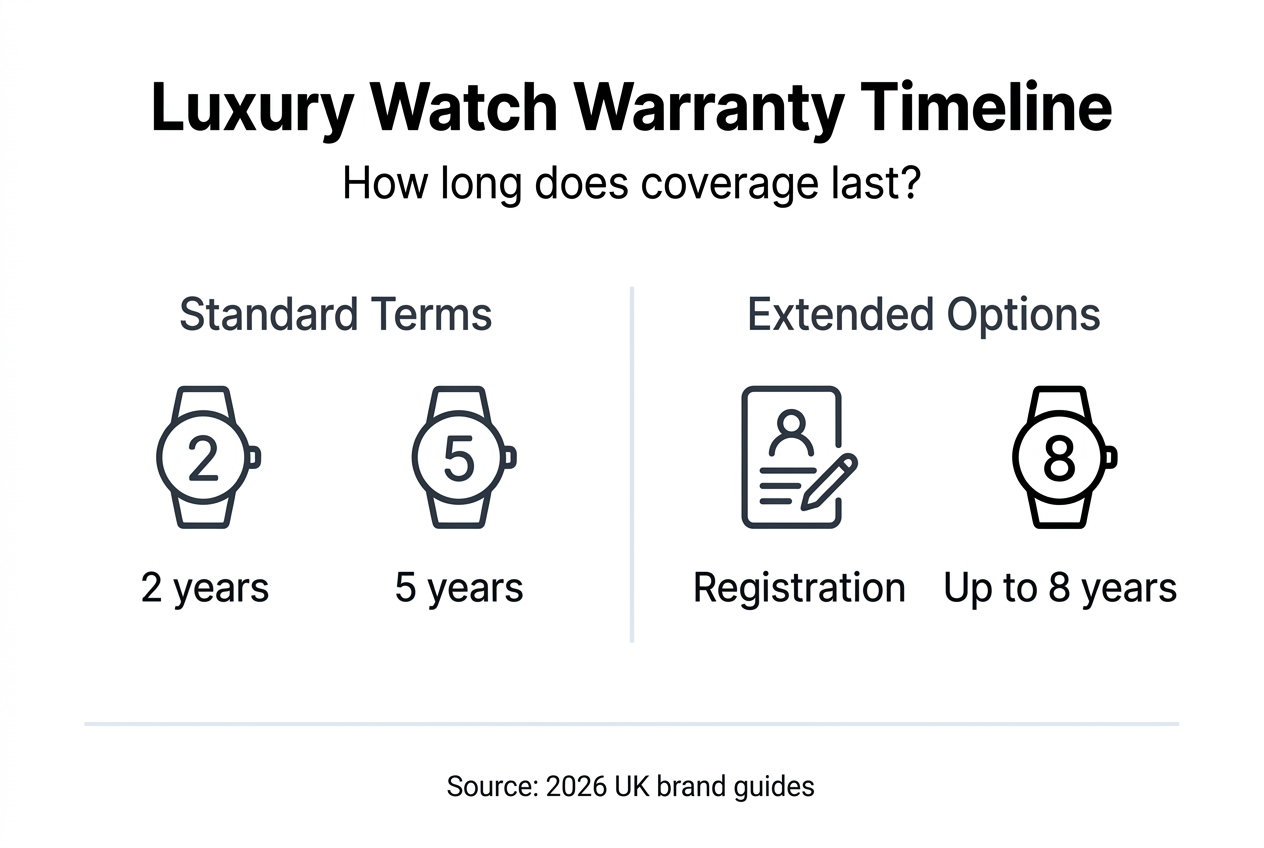
Warranty length influences buying decisions and secondary market appeal. Longer warranties reduce ownership risk and signal superior quality assurance. They’re particularly valuable for complex movements like perpetual calendars or minute repeaters, where repairs prove exceptionally costly.
Brand | Standard Warranty | Extended Options | Notes |
Rolex | 5 years | None | Applies to watches purchased from authorised dealers after 2015 |
Omega | 5 years | Up to 8 years | Extension requires registration and specific conditions |
Patek Philippe | 2 years | None | Limited by traditional approach; service excellence compensates |
Audemars Piguet | 2 years | None | Standard across most collections |
Cartier | 2 to 8 years | Varies by collection | Haute Horlogerie models receive extended coverage |
UK buyers benefit from alignment with consumer protection laws, though Brexit altered some EU frameworks. Brand policies determine coverage specifics rather than statutory minimums. Always verify your particular model’s warranty terms at purchase.
Pro Tip: Extended warranties often require online registration within 6 months of purchase, so complete this step promptly to maximise your coverage period.
Verifying authenticity and validity of your watch warranty
Authorised dealer stamps with purchase dates on warranty cards prove authenticity and activate coverage. Counterfeit warranty cards circulate in grey markets, making verification essential before purchasing pre-owned pieces.
Verification checklist:
Confirm warranty card serial number matches watch case back engraving exactly
Verify dealer stamp authenticity through brand’s authorised dealer list
Check purchase date alignment with watch production period
Examine card quality, printing precision, and holographic security features
Retain original purchase invoice as secondary proof
Register warranty online through manufacturer’s official portal
Fraudulent dealers sometimes provide fake warranty cards to misrepresent grey market watches as authorised sales. This deception voids coverage entirely, leaving buyers unprotected. Always purchase from verified authorised dealers or reputable specialists who transparently disclose warranty status.
Documentation validity affects resale prospects significantly. Buyers discount prices heavily for watches lacking proper warranty papers or with expired coverage. Complete, authentic documentation preserves value and facilitates future sales by providing buyer confidence.
Missing warranty cards can sometimes be replaced through authorised service centres if you provide purchase proof and the watch authenticates successfully. However, replacement processes vary by brand and may prove impossible for discontinued models.
Claiming warranty service: step-by-step for UK luxury watch owners
Authorised service centres in the UK handle warranty repairs according to manufacturer protocols, ensuring proper parts and techniques preserve your watch’s integrity and value.
Warranty claim process:
Gather warranty card, purchase receipt, and photo identification before contacting the service centre
Locate your brand’s authorised UK service centre through the official website or dealer network
Contact the centre to describe the issue and confirm warranty coverage applies
Submit your watch with complete documentation for assessment
Await diagnosis, which typically takes 1 to 3 weeks depending on complexity
Approve any non-warranty repairs if damage falls outside coverage scope
Collect your serviced watch with updated service documentation
Timelines vary considerably. Simple repairs like crown replacements complete within days, whilst movement overhauls require several weeks. Complex complications or rare models needing Swiss factory service may take 2 to 4 months.
Unauthorised repairs automatically void warranties, so always use approved service centres even for minor issues. The temptation to save money through independent watchmakers proves costly if subsequent warranty claims are denied due to prior unauthorised intervention.
Some brands require initial diagnosis fees that apply toward repair costs if warranty covers the issue. Clarify fee structures during your initial contact to avoid surprises. Keep all service records meticulously, as they document maintenance history and enhance resale value.
Transferability of warranties and its impact on resale value
Warranty transferability varies dramatically by brand, significantly affecting secondary market dynamics. Omega provides transferable warranties that enhance resale value, whilst Rolex warranties remain non-transferable, limiting their appeal to subsequent buyers.
Brand | Transferable | Transfer Process | Impact on Resale |
Omega | Yes | Requires proof of purchase and registration | Adds 5-10% premium to secondary market prices |
Rolex | No | Warranty stays with original purchaser | Buyers focus on remaining coverage duration |
Patek Philippe | Yes | Through authorised dealer documentation | Significant value enhancement, especially for complications |
Audemars Piguet | Limited | Varies by region and dealer | Moderate impact depending on remaining period |
Transferable warranties provide competitive advantages when selling luxury watches. They reassure buyers about authenticity, reduce perceived risk, and justify premium pricing. Buyers treat transferable coverage as value-added protection worth paying extra to secure.
Non-transferable warranties still matter. Remaining coverage duration influences pricing even when the warranty itself won’t transfer. A Rolex with 3 years remaining warranty coverage sells for more than an identical model with 3 months left, as the original buyer benefited from extended manufacturer protection.
Transfer documentation typically requires:
Original warranty card with dealer stamp
Purchase invoice or receipt
Signed transfer form from original owner
Registration with manufacturer showing ownership change
Transparency about warranty status builds buyer trust. Disclose transfer limitations clearly during sales negotiations rather than allowing misunderstandings that could derail transactions or damage your reputation.
Common misconceptions about luxury watch warranties
Forty percent of luxury watch buyers mistakenly believe warranties cover accidental damage and theft, leading to frustration when claims are denied. This misconception creates false security and inadequate insurance coverage.
Warranties never substitute for regular maintenance. Manufacturers require periodic servicing to maintain warranty validity, typically every 5 to 7 years depending on the model. Skipping maintenance voids coverage, as neglect can cause damage that appears similar to manufacturing defects.
Persistent warranty myths:
Warranties cover all repairs regardless of cause
Any watchmaker can perform warranty service
Warranties remain valid indefinitely if unused
Water resistance is permanently guaranteed
Magnetic exposure qualifies as a manufacturing defect
Warranty covers improvements or upgrades
Unauthorised modifications immediately void warranties. Installing aftermarket dials, hands, or bezels, even if expertly done, eliminates manufacturer liability. Some collectors unknowingly purchase modified watches, discovering too late that warranties vanished with the alterations.
Water resistance requires periodic gasket replacement and testing, which warranties don’t cover as preventive maintenance. If you neglect gasket service and suffer water damage, your warranty claim will be denied. Understanding this responsibility prevents expensive misunderstandings.
Pro Tip: Document your watch’s condition with detailed photographs before sending it for warranty service to protect against disputes about pre-existing damage versus service-related issues.
Realistic warranty expectations protect your investment. Recognise warranties as manufacturing defect insurance, not comprehensive protection plans. This clarity guides appropriate supplementary insurance purchases and proper maintenance scheduling.
Protecting your investment with expert guidance
Navigating luxury watch warranties requires expertise that Horology Kings provides to UK collectors and buyers. Understanding warranty intricacies influences purchasing decisions, ownership costs, and resale outcomes significantly.
Our Hertfordshire-based team verifies warranty authenticity for pre-owned pieces, advises on coverage transferability, and connects you with authorised service centres nationwide. Whether you’re buying your first luxury timepiece or expanding an established collection, we ensure you understand exactly what protection your warranty provides and what supplementary measures you should consider.
We specialise in sourcing watches with complete documentation, including valid warranties from authorised dealers. Our transparent approach means you’ll always know your warranty status, remaining coverage period, and transfer options before purchase. When selling, we accurately communicate warranty details to prospective buyers, maximising your return whilst maintaining trust throughout the transaction.
Frequently asked questions
What does a luxury watch warranty actually cover?
Manufacturing defects in materials and workmanship discovered during normal use, excluding accidental damage, theft, wear, or unauthorised modifications.
Can I transfer my watch warranty to a new owner?
Transferability depends on the brand; Omega and Patek Philippe allow transfers with documentation, whilst Rolex warranties remain with the original purchaser.
How long do most luxury watch warranties last?
Standard coverage ranges from 2 to 5 years, with some brands like Omega offering extensions up to 8 years through registration programmes.
Will unauthorised repairs void my warranty?
Yes, any service or modification by non-authorised watchmakers immediately voids manufacturer warranty coverage, even for subsequent unrelated issues.
Do warranties cover water damage to my watch?
Only if water damage results from a manufacturing defect like faulty gaskets when new; damage from neglected maintenance or misuse is excluded.
Recommended
Comments