.png)

How to date an Omega watch by serial number
- lewisvrichards3
- 1 day ago
- 9 min read
Dating an Omega watch accurately starts with the serial number. Locate the numeric code engraved on your watch, cross-reference it against a serial-range chart for the correct model family, and you will have an estimated manufacture year, typically accurate to within ±1–2 years. The Omega serial number decoder handles both standard Omega serials and the separate Speedmaster sequence, covering production from approximately 1895 to 2011. For high-value or rare pieces, that estimate is a starting point, not a final verdict.
Key steps at a glance:
Find the serial number (caseback, between the lugs, or on the movement)
Confirm whether your watch is a Speedmaster — it uses a different serial sequence
Cross-reference with the movement calibre number and reference/PIC code to narrow the year
Seek professional authentication for investment-grade or rare references
Pro Tip: If you are buying rather than selling, always date the watch before negotiating a price. A mismatch between the stated year and the serial range is one of the clearest early warning signs of a misrepresented piece.
Key takeaways
Serial-number dating gives you a reliable estimated manufacture year for most Omega watches, but calibre cross-referencing and professional inspection are essential for high-value or rare references.
Point | Details |
Find the serial first | Check the caseback, between the lugs, and the movement; serials are 5–9 numeric digits only. |
Use the correct table | Speedmaster serials run on a separate sequence; using a standard chart gives a wrong year. |
Cross-check with calibre and reference | Overlapping date ranges from serial, calibre, and reference/PIC give the most reliable estimate. |
Accuracy is typically ±1–2 years | Movement swaps, replacement cases, and re-engraving can widen that margin significantly. |
Horology-kings for UK verification | Book an in-person appraisal in Hertfordshire for authentication, valuation, or movement inspection. |
Table of Contents
How to read a serial-number chart for non-Speedmaster Omegas
Speedmaster serial numbers: why they differ and how to date one
Using calibre numbers and reference codes to refine the date
When serial dating reaches its limits: red flags and UK verification
How provenance, box, and papers strengthen dating confidence and value
Serial dating is reliable — but movement inspection is non-negotiable for high-value pieces
Horology-kings: authentication, valuation, and sourcing for UK owners
Where is the serial number on an Omega watch?
The serial number is the foundation of omega watch dating, so finding it correctly matters. Omega engraved serials in several locations depending on the era and model:
Caseback: The most common location on post-1970s watches. Look for a numeric code, usually 7–9 digits, stamped or engraved on the outer caseback.
Between the lugs: On many vintage Omegas, the serial sits on the case band between the upper lugs, visible only once the strap or bracelet is removed.
On the movement: Older pieces, particularly pre-1960s models, carry the serial on the movement plate itself, readable only when the caseback is opened.
Serials are numeric only, typically 5–9 digits. Do not confuse them with the reference number (which often contains letters and describes the model configuration) or the pictogram/PIC code found on warranty cards. A reference number like “ST 145.022” is a model identifier, not a production serial.
Pro Tip: To read between-lug serials without scratching the case, use a loupe and a soft cloth on a flat surface. For movement serials, have a qualified watchmaker open the caseback — forcing a screw-back case without the correct tool risks damaging the threads.
How to read a serial-number chart for non-Speedmaster Omegas
Serial-range charts work on a straightforward principle: Omega assigned serial numbers sequentially, so a given range of numbers corresponds to a span of production years. No single number maps to a single date; instead, you find the range your serial falls within and read off the approximate year.
The table below shows representative serial ranges and their approximate manufacture periods, drawn from the serial number decoder:
Typical accuracy is ±1–2 years for most periods. Three factors can widen that margin: a movement swap during servicing (the movement serial no longer matches the case), a replacement case fitted to an older movement, or re-engraving after a refinish. When any of those situations applies, the serial tells you when the movement was made, not when the watch left the factory in its current configuration. Cross-referencing with the calibre number and reference code, covered below, helps resolve the ambiguity.
Speedmaster serial numbers: why they differ and how to date one
Speedmaster serials follow a different sequence from standard Omega serials, so using a general Omega table on a Speedmaster can give an inaccurate manufacture year.
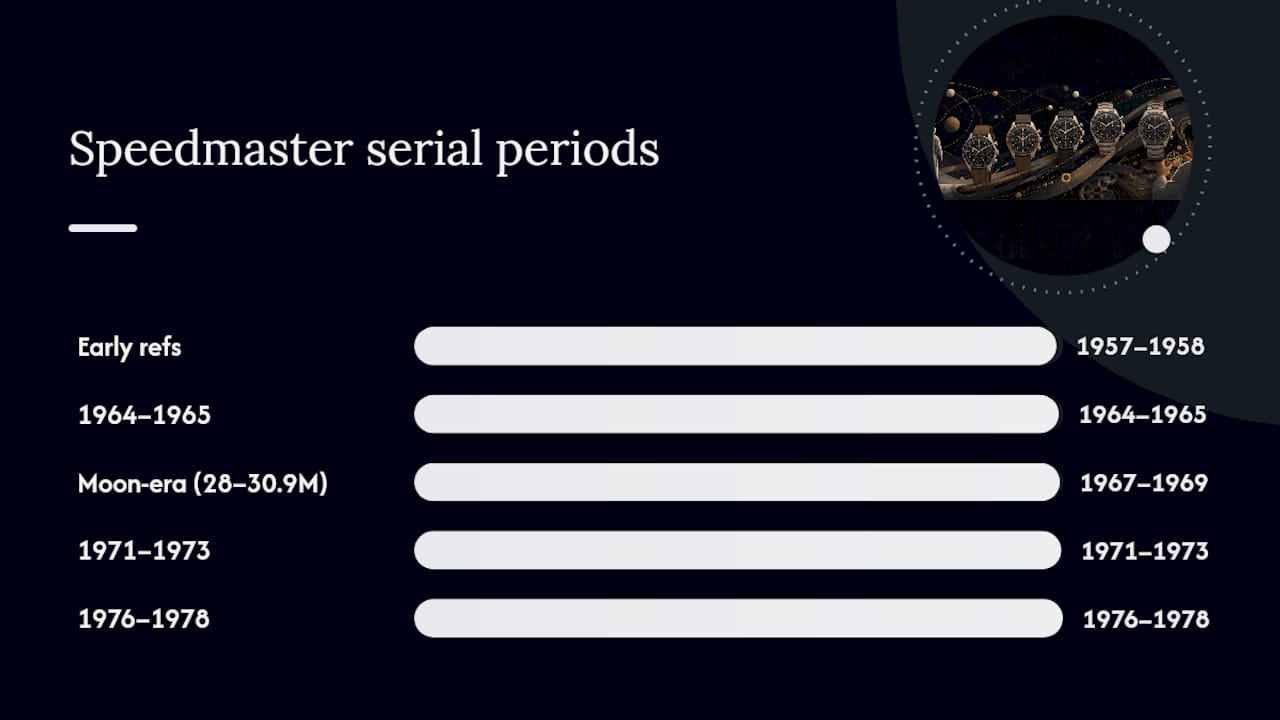
Representative Speedmaster serial ranges and approximate years:
Serial range | Approximate manufacture year |
— | 1957–1958 (early references) |
— | 1964–1965 |
28,000,000–30,999,999 | 1967–1969 (Moon-era references) |
— | 1971–1973 |
— | 1976–1978 |
Confirm you have a Speedmaster before using this table. The caseback of a genuine Speedmaster Professional carries the “SPEEDMASTER PROFESSIONAL” engraving and, on Moonwatch references, the NASA-qualified inscription. The reference number on the dial or caseback (for example, ST 145.022 for the pre-Moon Moonwatch) is the clearest confirmation.
Pro Tip: Distinguish between the original Moonwatch and later Speedmaster variants before looking up a serial. The Reduced, Automatic, and Racing variants each have their own reference structures and may need a specialist lookup rather than a standard Speedmaster table. GQ’s ranking of Omega’s greatest models provides useful context on how the Speedmaster family evolved.
Using calibre numbers and reference codes to refine the date
When the case serial is worn, absent, or ambiguous, the movement calibre number and the reference/PIC code become your primary tools. Used together, they can confirm or narrow the serial-based estimate considerably.
Where to find them:
The calibre number is stamped on the movement, usually on the main plate or a bridge. Common examples include Calibre 321 (used in early Speedmasters), Calibre 565 (Constellation, 1960s–70s), and Calibre 1120 (Seamaster, 1980s–90s).
The reference number appears on the caseback, dial, or original paperwork. On modern pieces it is also listed on Omega’s official product pages, which include technical specifications owners can use to confirm model identity.
The PIC code (pictogram code) appears on vintage warranty cards and boxes, encoding the model, metal type, and bracelet configuration.
How to cross-reference step by step:
Note the calibre number from the movement.
Look up the calibre’s production dates in a calibre database (the serial-number decoder includes calibre lookup alongside serial ranges).
Check the reference number against Omega’s official pages or a reference guide to confirm the model and approximate production era.
Compare the calibre date range with the serial date range. Where they overlap is your most reliable estimate.
If the ranges do not overlap, a movement swap is likely — flag this for professional inspection.
A calibre that post-dates the case serial by more than a few years is a strong indicator of a service replacement movement, which affects both dating accuracy and, in some cases, omega watch value.
Worked examples: dating Omega serials step by step
These illustrative examples show how the process works end to end.
Example 1: a non-Speedmaster Omega with serial 30,500,000
Serial 30,500,000 falls in the 30,000,000–34,999,999 range, suggesting manufacture circa 1968–1971.
The caseback reference reads “ST 166.032” — a Seamaster reference from the late 1960s.
Opening the caseback reveals Calibre 565, produced from 1965 to the mid-1970s.
All three indicators align: estimated manufacture year is 1969–1971.
Example 2: a Speedmaster with serial 29,500,000
Serial 29,500,000 falls in the Speedmaster range 28,000,000–30,999,999, suggesting 1967–1969.
The caseback carries the reference ST 145.012 and the “SPEEDMASTER PROFESSIONAL” engraving.
The movement is Calibre 321, used in Speedmasters from 1957 to 1968.
The calibre date slightly tightens the window: most likely 1967–1968, consistent with a pre-Moon Moonwatch.
Example 3: mismatched movement — a red flag
A Seamaster presents with serial 22,000,000, suggesting early 1960s.
The movement, however, is Calibre 1012, which Omega did not introduce until 1975.
The mismatch is clear: the case is from the early 1960s, but the movement is a later service replacement.
Common pitfalls these examples highlight:
A later calibre in an earlier case does not make the watch a fake, but it does affect collector value and dating confidence.
Refinished dials can remove or alter printed reference information, making cross-referencing harder.
Always treat a calibre-serial mismatch as a prompt for professional inspection, not a reason to walk away automatically.
When serial dating reaches its limits: red flags and UK verification
Serial-number dating is a reliable first step, not a guarantee. Several scenarios reduce its accuracy:
Movement swaps: Omega service centres historically replaced worn movements with period-correct or later calibres. The case serial and movement serial then refer to different production dates.
Replacement cases: A movement fitted into a later replacement case carries the new case’s serial, not the movement’s original date.
Re-engraved or refinished cases: Polishing can remove or blur serial engravings; re-engraving to restore them introduces the risk of error.
Non-sequential production runs: Omega occasionally allocated serial blocks non-sequentially for specific markets or retailers.
Red flags when buying or valuing a piece:
Reference numbers on the caseback that do not match the dial configuration
Misspelt “OMEGA” or “SWISS MADE” text on the dial
Poorly finished or uneven engravings on the caseback
A calibre number that post-dates the case serial by more than a few years
For rare references, potential investment pieces, or any watch where the serial and calibre do not align, an in-person appraisal from a certified horologist is the responsible next step. The watch authentication checklist at Horology-kings covers what experts examine during a physical inspection. Movement inspection, as market guides confirm, is the gold standard for assigning a reliable value to a dated Omega.
Pro Tip: In the UK, ask any watchmaker you approach whether they have specific experience with Swiss vintage movements. General jewellers often lack the calibre-specific knowledge that Omega dating requires.
How provenance, box, and papers strengthen dating confidence and value
Serial-number dating tells you when a watch was likely made. Provenance tells you what happened to it afterwards, and that distinction matters considerably when it comes to omega watch value.
Original box, warranty card, and service records do three things simultaneously: they corroborate the serial-based date, they establish continuity of ownership, and they materially increase resale value. A complete set of box and papers for a vintage Speedmaster or Seamaster can represent a meaningful premium over an identical watch sold without documentation, as the Omega Watch Value Guide makes clear.
Practical steps to strengthen your watch’s provenance:
Retain all original packaging, including the outer and inner box, hang tags, and any plastic protectors.
Keep the warranty card or pictogram card — even if the guarantee period has long expired, it confirms the original sale details.
Collect service receipts from every watchmaker who has worked on the piece, noting dates and parts replaced.
Photograph the serial number, caseback engravings, and movement before any service.
For UK sellers preparing a watch for appraisal or sale, Horology-kings recommends presenting the serial number, at least two clear photographs (caseback and dial), and any paperwork you hold. Where original paperwork has been lost, some provenance can be reconstructed through Omega’s Extract from the Archives service, which issues a certificate confirming the watch’s original specifications and approximate delivery date.
Pro Tip: Do not clean or polish the watch before an appraisal. Original patina and surface condition are part of the authentication evidence. A freshly polished case can reduce both dating confidence and collector value.
Serial dating is reliable — but movement inspection is non-negotiable for high-value pieces
Serial-number charts are a genuinely useful tool, and for the majority of Omega watches, they give you a defensible estimated year within a couple of seasons. What they cannot do is tell you whether the movement inside the case is the one that left the factory with it.
That distinction is academic for a watch you are buying as a daily wearer. It is not academic for a 1968 Speedmaster Professional, a Constellation Pie-Pan, or any reference where the difference between an original and a service movement runs to thousands of pounds. For those pieces, a serial lookup is the starting point of due diligence, not the end of it.
The other point worth making plainly: full disclosure of provenance is not just an ethical obligation for sellers, it is a commercial one. Buyers in the UK pre-owned market are increasingly informed, and a watch presented with accurate documentation, a clear account of its service history, and an honest note about any replacement parts will consistently attract stronger offers than one sold with vague claims about originality. Transparency builds trust, and trust is what moves watches at the right price.
Horology-kings: authentication, valuation, and sourcing for UK owners
Knowing the approximate manufacture year of your Omega is the first step. Knowing its current market value, and having that confirmed by a specialist, is what protects you whether you are buying, selling, or insuring.

Horology-kings, based in Hertfordshire, offers UK owners a direct route to professional authentication and valuation without the uncertainty of online-only estimates. Services include movement inspection and authentication, formal valuation for sale or insurance, watch repair and servicing by certified horologists, and a sourcing service for specific references. All transactions are handled with secure UK bank transfers and discreet, insured handling. To book an appraisal or discuss a sale, visit Horology-kings and bring your serial number, photographs, and any box or papers you hold. The team will take it from there.
Sources
Recommended
Comments