.png)
Watch valuation costs in the UK: £30–£130 and when to pay more
A watch valuation in the UK typically costs anywhere from £30 for an online probate assessment to £130 or more for an in-depth insurance report on a luxury piece, with premium home visits priced higher still. Most valuers charge either a flat fee per item or a document fee plus a per-item rate, rather than a percentage of value. The final figure always comes down to one thing first: why you need the valuation, whether that’s an insurer, HMRC, or a buyer.
TL;DR:
UK watch valuations mainly cost between £30 and £130, depending on purpose, complexity, and delivery method, with home visits priced higher.
Valuers charge flat fees or document-based rates, avoiding percentage-of-value pricing to prevent conflicts of interest and ensure fair appraisals.
Factors increasing costs include watch brand, rarity, complications, condition, paperwork, urgency, and travel distance; providing documentation can reduce fees.
Online valuations are fastest and cheapest for simple, well-documented watches, while in-person or home visits suit high-value or complex pieces needing detailed inspection.
Credentials and membership of recognized valuation bodies are more important than price alone, especially for insurer and HMRC reports, which require specific wording and standards.
Table of Contents
How much does a watch valuation cost in the UK?
Fee structures in this trade fall into two camps. Some valuers charge a straightforward flat fee per watch, scaled by complexity. Others charge a document or administration fee, typically £70–£100, plus an itemised charge per watch of roughly £40–£100 depending on the brand and the complexity involved. Percentage-of-value pricing, common in some overseas markets, is rare here. UK valuers generally avoid it because it creates an obvious conflict of interest: why would a valuer want to undervalue your Patek Philippe if their fee depends on the number they write down?
Representative price bands look like this across the market:
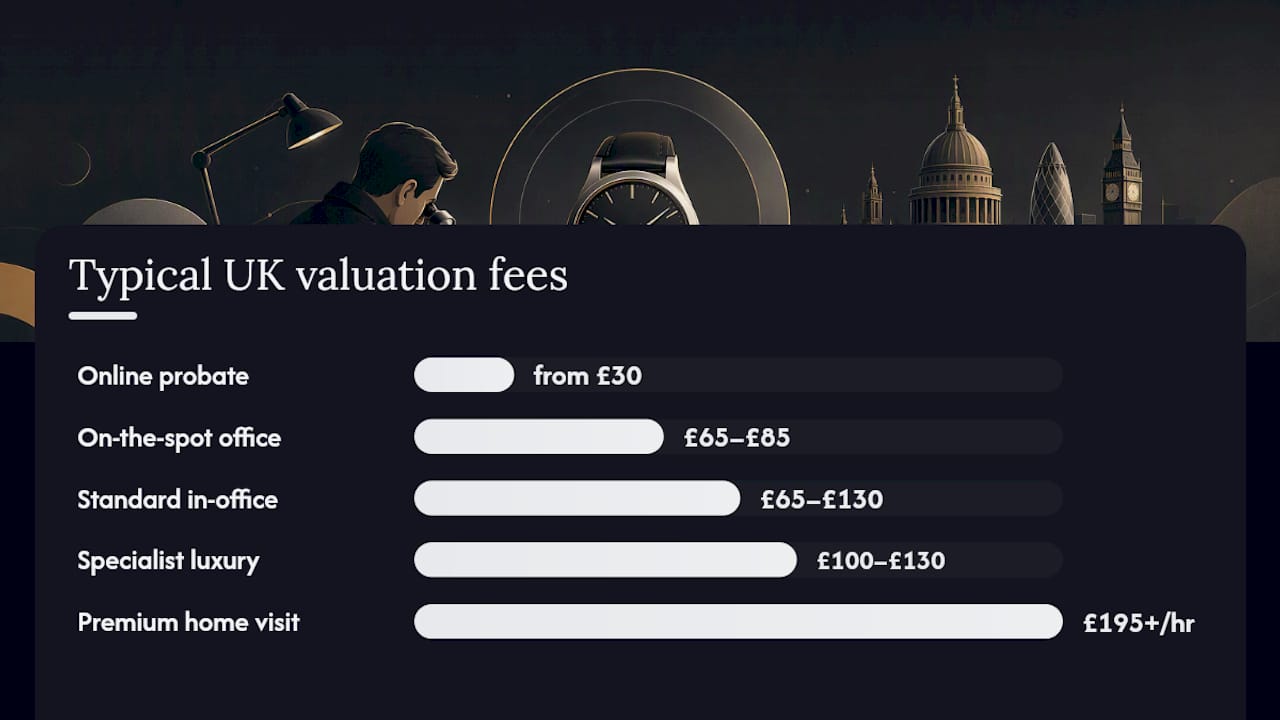
Online probate valuations: from around £30 for routine, well-documented items, submitted with photographs and paperwork.
Standard in-office or insurance valuations: typically £65–£130 per watch, with specialist services for luxury brands often landing at £100–£130.
On-the-spot office assessments: from about £65–£85 for a same-day inspection and written report.
Premium home visits or complex research: £195 per hour or more, reflecting travel, security arrangements, and the extra research needed for rare or discontinued models.
VAT is usually included in advertised prices for consumer-facing valuers, but always ask, since some quote net figures for trade or high-net-worth clients. Travel costs for home visits are often charged separately as a callout fee or mileage rate, adding a moderate cost depending on distance. If you’re bringing several watches to one appointment, many valuers reduce the per-item rate for the second and subsequent pieces because the administrative overhead (paperwork, report formatting, ID checks) is shared across the collection rather than repeated. A five-watch estate valuation, for instance, often costs considerably less per item than five separate single-watch bookings.
Some valuers will quote a capped fee for larger collections once they’ve seen photographs of what’s involved, which is worth requesting if you’re valuing an inherited collection rather than a single heirloom.
Pro Tip: Ask for a written quote before booking, and specify whether it includes VAT and how many items are covered. A vague verbal estimate over the phone is not the same as a fixed quote you can hold a valuer to.
What affects the cost: item, documentation and research required
Brand and rarity drive cost more than almost anything else. A standard steel Omega Seamaster takes a valuer minutes to research; a limited-edition Patek Philippe complication with no comparable recent sales can take hours of market research to price accurately. That research time gets billed, one way or another.
Several factors push a quote up or down:
Complexity of the movement: watches with complications (chronographs, perpetual calendars, tourbillons) need more thorough inspection than a simple three-hand watch.
Condition and authenticity checks: valuers verify serial numbers and inspect the movement, which takes longer on vintage pieces where records are patchier.
Paperwork you provide: supplying the original box, papers, and service history speeds the process considerably and can shave real money off the final bill, since the valuer isn’t reconstructing provenance from scratch.
Urgency: same-day or next-day turnaround sometimes carries a premium, particularly for home visits.
Location and travel: rural addresses or multi-item collections needing a home visit cost more than a walk-in city appointment.
Report extras: additional photographs, comparable-sales commentary, or multiple copies of the report for different recipients (insurer and executor, say) can each add a small charge.
If you’ve lost the original papers, don’t assume the valuation is impossible. It just means the valuer works harder to establish authenticity and market position, and that work shows up on the invoice.
How does the valuation purpose change the price?
The single biggest variable in what you’re quoted is not the watch. It’s who the report is for.
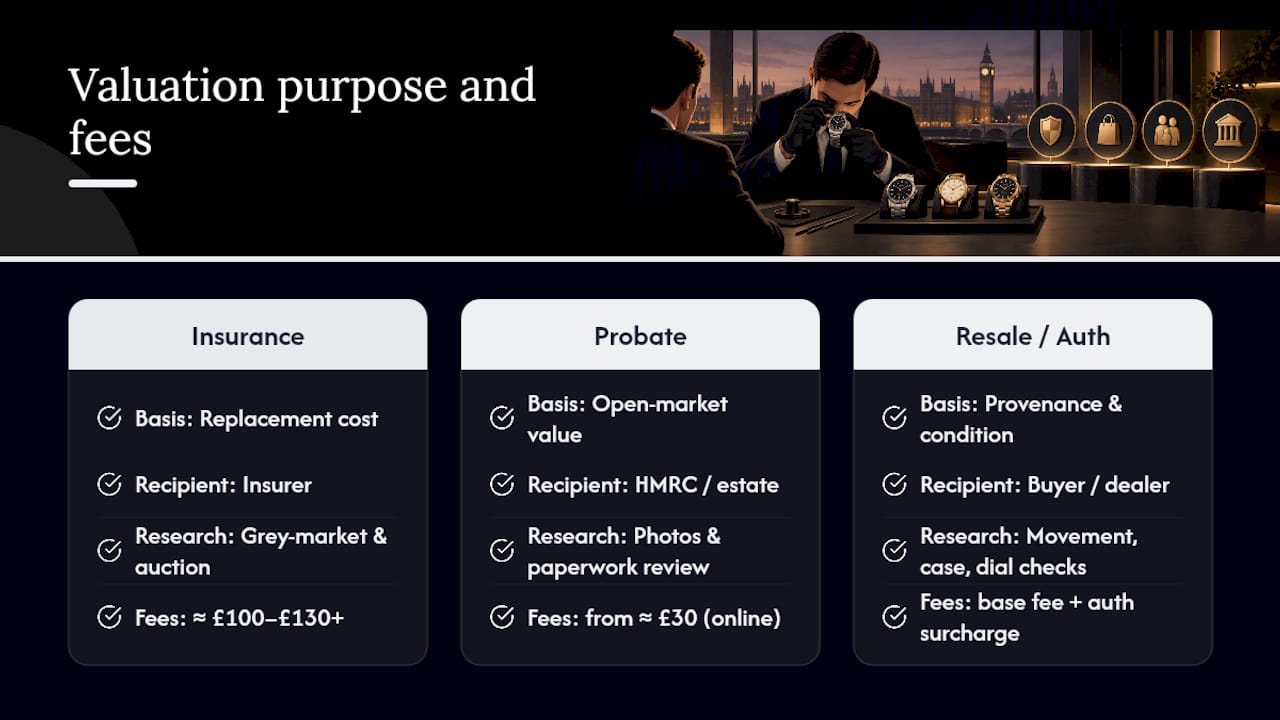
Insurance valuations assess replacement cost, essentially what it would take to buy an equivalent watch new (or as close to new as the model allows) today. For discontinued or highly sought-after Rolex and Patek Philippe references, this means the valuer has to research current grey-market and auction pricing rather than simply quoting a retail figure, which pushes fees toward the £100–£130 mark and beyond for complex pieces.
Probate valuations use open market value at the date of death, a different legal standard entirely. HMRC doesn’t require a professional valuation for every watch in an estate, but it’s sensible practice for anything valued in the mid-three figures or above, and the report must state clearly that it reflects open market value for probate purposes. This is precisely why online probate valuations can start from around £30: a large share of estates involve fairly standard pieces that don’t need exhaustive research once photographs and paperwork are submitted, and valuers price accordingly. Only a minority of complex or unusual cases justify a much larger fee.
Resale and authentication reports focus on provenance and condition rather than abstract market value, since the point is helping a buyer or dealer feel confident about what they’re purchasing. Authentication work, checking movement, case, and dial against known genuine examples, typically adds to the base fee rather than replacing it.
Always tell the valuer upfront who the report is for. An insurer, HMRC, and an auction house each expect different wording and a different valuation basis, and asking for the wrong one wastes money and time.
Online, in-office or at-home: which valuation suits you?
Delivery method changes both price and speed, and the right choice depends on the value and complexity of what you’re having assessed.
Online valuations are the cheapest and fastest route, typically £30–£65, and suit straightforward, well-documented watches. You send clear photographs of the case back, dial, movement (if you can safely access it), and any papers, and the valuer works from that. Turnaround is usually one to three days.
Office or on-the-spot valuations sit in the mid-range and give you the benefit of a valuer physically inspecting the watch there and then, catching wear or authenticity issues photographs might miss. Reports are frequently issued the same day.
Home visits cost the most, reflecting travel time, insurance, and security arrangements for transporting high-value items. These make sense for very high-value single pieces or multi-watch estates where moving everything to an office isn’t practical or safe. Turnaround depends on complexity, but expect longer than a same-day office visit if extensive research is needed.
Complex or rare pieces, regardless of delivery method, take longer because the research itself takes longer. A common steel sports watch can be valued almost instantly against known comparables; a discontinued platinum reference with no recent public sales might need several days of legitimate market digging.
How do you choose a valuer worth paying for?
Not every valuation carries equal weight with an insurer or HMRC, so credentials matter more here than in most consumer purchases.
Check for membership of recognised bodies such as the Guild of Valuers & Jewellers or the Institute of Registered Valuers (IRV), and ask directly whether your insurer recognises reports from that valuer. Some insurers maintain informal preferences, and finding out before you pay saves a second valuation later.
Request a sample report before booking. A proper valuation should show a detailed description, serial number verification, photographs, and a clear statement of the valuation basis used, whether that’s replacement cost or open market value. A report that just states a number with no supporting detail isn’t worth much to an insurer or HMRC.
Other questions worth asking upfront:
Is VAT included in the quoted price?
Is travel charged separately, and how is it calculated?
Is there a charge to reissue or amend the report later?
Does the wording explicitly state it’s HMRC-compliant for probate, if that’s your purpose?
Membership of a recognised valuation body is one of the clearest signals a valuer takes accountability seriously, since these organisations set standards their members are expected to follow.
Why a specialist watch dealer improves valuation accuracy
General jewellery valuers can price a diamond ring competently without knowing the difference between a Rolex calibre 3235 and a vintage Patek Philippe 27 cal. Watches are different: brand-specific serial number sequences, movement variations across production years, and fast-moving grey-market pricing all matter enormously for accuracy on luxury pieces.
Specialist dealers working with authenticated Swiss timepieces across brands such as Rolex, Patek Philippe, Audemars Piguet, Omega, and Cartier can provide more accurate valuations… Documented provenance, secure handling, and discreet transactions all support a valuation that actually holds up when an insurer or buyer scrutinises it…
To speed things along, clients are often asked to supply clear photographs of the case, dial and caseback, along with any box, papers, or service history, before the appointment.
What most guides get wrong about watch valuation pricing
Most pricing guides treat watch valuation as one product with one price. It isn’t. The £30 online probate quote and the £130 specialist insurance report aren’t competing prices for the same service, they’re answering entirely different questions, and comparing them head to head misleads readers into thinking one option is simply “cheaper.”
The conventional advice to “shop around for the best price” also misses the point for anything genuinely valuable. A cut-price valuation on a rare Patek Philippe that skips proper market research isn’t a bargain, it’s a liability the moment you need to claim on it or settle an estate.
What should you prioritise? State your purpose before you get a quote, not after. Insurer, HMRC, or buyer each need different wording and a different valuation basis, and getting that wrong means paying twice. Then check credentials, not just price, since a Guild-registered valuer’s £100 report will hold up under scrutiny in ways a cheaper, undocumented one won’t.
— Lewis
Get a valuation from people who actually trade these watches
Horology-kings is the alternative to a generalist valuer for anyone with a Rolex, Patek Philippe, Audemars Piguet, Omega, or Cartier: valuations backed by people who buy and sell these exact brands daily, not a jewellery counter pricing a watch the same way as a diamond ring.
If you’re considering selling afterwards, that context matters even more. Visit Sell Your Luxury Watch to request a valuation and see how the process feeds directly into a sale if you choose to go that route, with secure UK bank transfers and discreet handling throughout. Before you get in touch, gather clear photographs of the case and dial, the original box and papers if you have them, and any service history, since this is exactly what speeds up an accurate figure. If your watch turns out to need attention first, Rolex, Omega, Tag Heuer, Breitling and Cartier servicing is available from £350, and if you’re chasing something rarer than what you own, Source a Watch puts our network to work finding it. Start with a valuation request today and see exactly where your watch stands.
This article is general information, not a substitute for advice from a qualified financial advisor. Consult a qualified financial professional about your own circumstances before acting on anything here.
Sources
FAQ
How much does a watch valuation cost?
Prices generally range from around £30 for a basic online probate valuation to £130 or more for a specialist insurance valuation on a luxury watch. Home visits and complex research cost more, often charged by the hour.
Do jewellers charge for valuations in the UK?
Most professional jewellers and specialist valuers charge for watch valuations, either a flat fee or a document fee plus a per-item rate. Free valuations do exist but are usually informal estimates rather than the detailed reports insurers or HMRC expect.
How much is my watch worth in the UK?
This depends entirely on the brand, model, condition, and the purpose of the valuation, since an insurance figure and a probate figure for the same watch can differ significantly. A specialist dealer like Horology-kings, or a Guild-registered valuer, can give you an accurate figure based on current market data for your specific brand.
How much does a valuation cost in the UK?
For watches specifically, online assessments typically start from £30–£65, office visits from around £65–£85, and premium home-visit services cost considerably more. The right price depends on whether you need the report for insurance, probate, or resale.
Recommended
Comments