.png)
Why authenticity matters in watches: a guide for collectors
TL;DR:
Fake watches outnumber genuine Swiss watches and superfakes are nearly impossible to detect without expert help.
Authenticity directly influences a watch’s value, resale potential, and trust within the collector community.
Protect your collection by verifying documentation, working with trusted dealers, and conducting thorough in-person inspections.
Every year, 40 million fake watches flood the global market, produced at twice the rate of genuine timepieces. That figure alone should unsettle any collector. Yet the counterfeit crisis is not simply a problem for the naive or the unwary. Today’s so-called superfakes are manufactured with a precision that would have seemed impossible a decade ago, making authenticity more difficult to verify than ever before. For collectors investing thousands, or even hundreds of thousands, in a single piece, the stakes could not be higher. This guide explores why authenticity is the foundation of genuine collecting, and what you can do to protect yourself.
Table of Contents
Key Takeaways
Point | Details |
Counterfeits are widespread | Fake watches outnumber real ones two-to-one, making thorough checks a must for collectors. |
Authenticity protects value | Only genuine timepieces hold their market value and safeguard your reputation as a collector. |
Risks extend beyond money | Owning or buying fakes risks embarrassment, legal issues, and loss of trust in the community. |
Expert checks are vital | Superfakes require skilled inspection, so work with trusted professionals before any purchase. |
Go trusted for peace of mind | Choosing reputable dealers and robust authentication processes keeps your collection authentic and safe. |
Understanding the counterfeit crisis
The scale of fake watch production is genuinely staggering. Genuine Swiss watches number around 20 million units per year, yet counterfeit production doubles that figure. What this means in practice is that, statistically speaking, there are more fake watches in circulation than real ones. For any collector browsing pre-owned markets, online platforms, or even reputable-looking boutiques, this reality demands constant vigilance.
The most alarming development in recent years is the rise of the superfake. These are not the crude imitations you might spot in a market stall. Superfakes are manufactured using premium materials, with movement replicas that visually mimic the originals with extraordinary accuracy. Superfakes represent 10% of all counterfeit watches and are, in many cases, almost impossible to identify without professional examination.
Watch type | Annual volume | Detectability |
Genuine Swiss watches | ~20 million | Easily verified by experts |
Standard counterfeits | ~36 million | Detectable with basic checks |
Superfakes | ~4 million | Require expert inspection |
Collectors most commonly get caught out in the following ways:
Purchasing from unverified online marketplaces without checking seller credentials
Relying solely on photographs rather than physical inspection
Assuming that a box and papers guarantee authenticity
Trusting a good price as proof of legitimacy
Overlooking inconsistencies in engravings, dial printing, or case finishing
Properly authenticating luxury watches requires trained eyes and, increasingly, specialist tools. Even experienced collectors have been deceived, which is why understanding the scope of the problem is step one in any serious collector’s education. For a focused breakdown, our guide on spotting fake watches walks through the tell-tale signs that separate the real from the counterfeit.
“The counterfeit watch industry has evolved to the point where superfakes can deceive even knowledgeable buyers without laboratory-level analysis.”
This is not a crisis that affects only careless buyers. It is systemic, sophisticated, and growing.
Why authenticity directly impacts value and trust
Authenticity is not merely a matter of pride. It is the single greatest factor in determining a luxury watch’s market value, resale potential, and long-term investment return. A genuine Rolex Submariner or Patek Philippe Nautilus holds its value precisely because it carries verifiable heritage, measurable craftsmanship, and a documented chain of ownership.
For collectors, the financial implications of a fake are severe. A watch purchased as genuine but later revealed to be counterfeit is effectively worthless on the secondary market. Worse, it may never be recoverable as an asset. Reputational and financial damage from owning or unknowingly passing on fakes far outweighs any short-term saving.

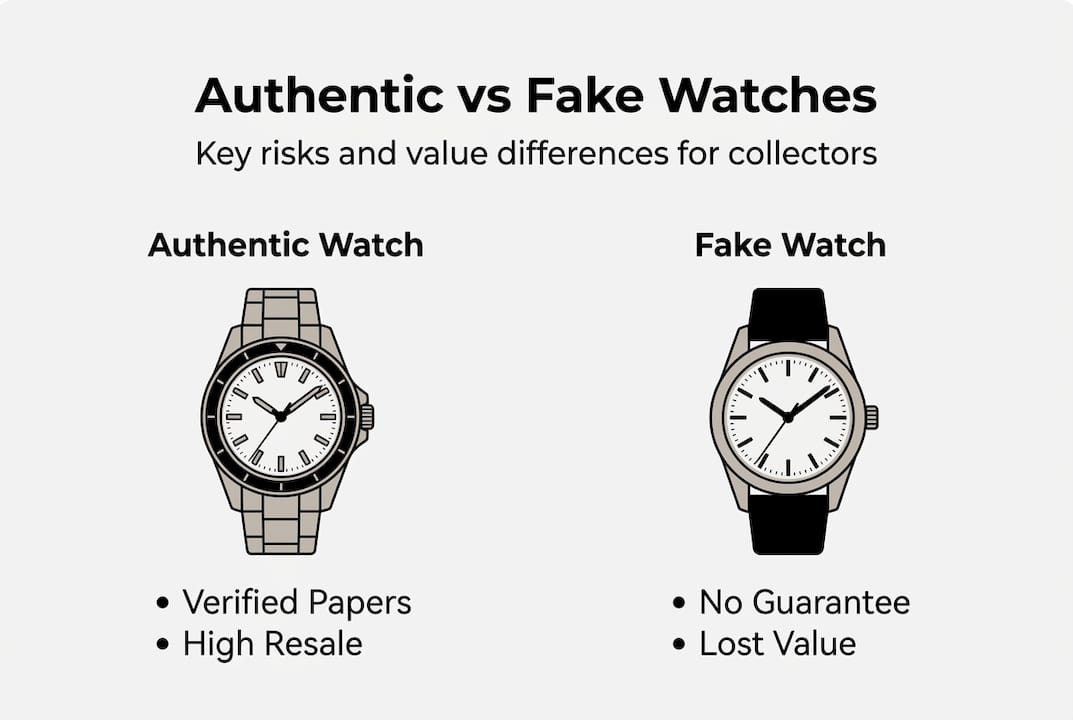
Factor | Authentic watch | Counterfeit watch |
Resale value | Strong and appreciating | Negligible or zero |
Insurance | Fully insurable | Uninsurable |
Community standing | Respected and trusted | Damaged or excluded |
Investment potential | High for rare models | None |
Legal risk | None | Possible prosecution |
Trust within the collector community is equally important. Horology is a world built on relationships, shared knowledge, and mutual respect. Presenting a fake, even unknowingly, can permanently damage your reputation among peers. Collectors talk. Dealers remember.
Key reasons authenticity underpins real value:
Authentic pieces carry verifiable serial numbers linked to manufacturer records
Genuine movements age with character and increase in collector desirability
Provenance documentation supports insurance claims and estate valuations
Certified authentic watches qualify for specialist collector’s insurance policies
Pro Tip: If you are buying a pre-owned piece as an investment, study the Rolex authenticity and investment landscape before committing. Genuine rarity commands premiums that only grow with time.
For anyone serious about building a meaningful collection, understanding watch provenance advice is non-negotiable. Provenance is not paperwork for its own sake. It is the biography of your watch, and without it, you hold an object rather than a legacy.
“A genuine timepiece carries decades of craftsmanship and history. A replica carries neither.”
The risks of replicas: beyond legal and ethical concerns
Many people assume that buying a replica is a victimless shortcut. It is not. The risks extend well beyond embarrassment, touching on serious legal, financial, and ethical territory that every collector must understand.
In the UK, selling or importing fakes is a criminal offence under the Trade Marks Act 1994. Penalties can include significant fines and even imprisonment. While personal ownership of a replica sits in a greyer area legally, any attempt to sell, gift, or pass on a fake watch carries genuine legal exposure.
Here are the key risks, in order of escalating severity:
Social embarrassment: Being identified as owning a fake by knowledgeable peers
Financial loss: Paying a premium for something with zero resale value
Insurance invalidation: Policies covering luxury watches will not pay out on counterfeits
Reputational harm: Permanent damage to your standing within the collector community
Civil liability: Being sued by a seller or buyer you have inadvertently misled
Criminal prosecution: Importation or sale of fakes under UK intellectual property law
The ethical dimension also matters. Counterfeit production frequently involves exploitative labour practices and funds criminal networks. Every purchase of a fake, however inadvertent, contributes to an industry that actively harms legitimate craftspeople and undermines the integrity of horology as a whole.
“Replicas do not just disappoint. They expose collectors to consequences that no saving is worth.”
Pro Tip: Before any significant purchase, follow a safe buying and selling protocol and always verify the seller’s credentials. The time taken is always worth it.
The safest long-term strategy is always to work with a reputable watch dealer who can provide full documentation and transparent sourcing. It is not overcaution. It is simply good collecting.
Safeguarding your collection: practical steps
Knowing the risks is not enough. The decisive question is: what do you actually do about them? Protecting your collection requires deliberate habits built into every purchase and ongoing ownership decision.
Expert inspection remains essential, particularly for high-value acquisitions. Superfakes have reached a level of sophistication where even seasoned professionals benefit from specialist tools including UV light examination, loupe inspection, and movement analysis. Never skip this step because a watch looks right at a glance.
Practical steps every collector should follow:
Request full documentation: Original box, papers, and service records should accompany any serious piece
Verify serial numbers: Cross-reference with manufacturer databases where possible
Inspect in person: Never complete a high-value purchase based solely on photographs
Use trusted platforms: Work with established dealers who offer authentication guarantees
Commission third-party checks: For rare or unusually priced pieces, independent authentication is worth every penny
Maintain service records: Regular servicing by authorised specialists creates a documented history that supports future resale
Our detailed authentication guide covers each of these steps in depth, from reading case engravings to evaluating movement quality. For rare and sought-after references, our safe sourcing guide explains how to navigate the acquisition process without exposing yourself to risk.
Pro Tip: Build a relationship with one or two dealers you genuinely trust. Knowing your source is the single most effective safeguard you have, even before any physical inspection begins.
Consistency matters most. The collectors who never get caught out are not always the most technically knowledgeable. They are the ones who have made safe practice a habit rather than an afterthought.
Why authenticity is the backbone of the collector’s journey
We have worked with collectors at every level, from first-time buyers to those building seven-figure portfolios. One thing is consistent: those who prioritise authenticity from the outset enjoy collecting far more deeply. There is a particular satisfaction in knowing that the weight on your wrist represents decades of genuine craft, traceable history, and real human ingenuity.
A convincing fake may look right under certain light. It may even impress someone who does not know better. But it never feels right to the person wearing it who knows the truth. That dissonance is real, and experienced collectors describe it immediately.
Authenticity also shapes community. The watch world is not just a market. It is a conversation spanning generations, brands, and continents. When collectors share passion and knowledge, they build on a foundation of mutual trust. Counterfeits corrode that trust at every level.
Our view is straightforward: no replica has ever added something meaningful to a collector’s journey. Understanding exploring provenance reveals that the stories behind genuine pieces are irreplaceable. The provenance of a real watch is part of what you own. No amount of superfake sophistication can replicate that.
Secure your passion with trusted expertise
If this guide has reinforced what you already suspected, the logical next step is to buy, sell, or source watches through a partner you can genuinely trust.

Horology Kings is a Hertfordshire-based specialist with deep expertise across Rolex, Patek Philippe, Audemars Piguet, Omega, and Cartier. Every piece we handle is verified, transparently documented, and sold with your confidence in mind. Whether you want to source a watch that is proving difficult to find elsewhere, or need professional watch repair and servicing to maintain what you already own, we are here to support every stage of your collecting journey. Authentic pieces deserve authentic expertise.
Frequently asked questions
What defines an authentic luxury watch?
An authentic luxury watch is a timepiece manufactured and certified by its original brand, with verifiable paperwork and traceable provenance confirming its origins and ownership history.
How prevalent are fake luxury watches in the UK market?
With 40 million fakes produced globally each year, a significant share reaches the UK market, making authenticity checks essential rather than optional for any serious collector.
Can experts always spot superfakes?
Not always. Superfakes comprise 10% of all counterfeits and are deliberately engineered to defeat casual inspection, requiring specialist tools and trained examination to identify reliably.
Is it illegal to own a replica watch in the UK?
Personal ownership exists in a legal grey area, but selling or importing fakes constitutes a criminal offence under UK intellectual property law and can result in prosecution.
What is the best way to check a watch’s authenticity before buying?
Consult a trusted specialist dealer and request independent authentication alongside full provenance documentation before committing to any purchase.
Recommended
Comments