.png)
How to build a diverse luxury watch collection: a guide
TL;DR:
Building a balanced collection begins with core watches: an everyday sports watch, a dress watch, and a GMT or chronograph.
Diversify by brand, material, and era to enhance value, resilience, and enjoyment in your collection.
Ensure authenticity, proper documentation, and secure storage to protect your investment and collection value.
Building a truly rewarding luxury watch collection is harder than it looks. The UK market offers extraordinary depth, from steel sports watches trading above retail to rare vintage Pateks quietly changing hands at auction, yet most collectors stumble by chasing individual pieces rather than thinking strategically. A well-curated collection grows in both personal meaning and financial resilience. Get it wrong and you end up with five watches that all do the same job, a drawer full of redundant chronographs, and a portfolio that is far harder to sell than you imagined. This guide walks you through everything: the essential building blocks, smart diversification, safe buying in the UK, and managing what you own.
Table of Contents
Key Takeaways
Point | Details |
Start with three essentials | Every serious collection begins with an everyday sports watch, a dress watch, and a practical complication tailored to your lifestyle. |
Diversify for stability | Spread investment across blue-chip brands, various materials, and both vintage and modern models to balance risk and potential returns. |
Buy securely and authenticate | Always use reputable UK platforms, verify provenance and papers, and employ third-party checks to protect your assets. |
Plan for ongoing costs | Factor in annual insurance, safe storage, and regular servicing so your watches retain value and remain protected. |
Build for passion and profit | Curate watches that bring personal joy as well as investment potential for a collection that rewards beyond financial returns. |
Establishing a solid foundation: the essential first three watches
With a sense of the collection’s overall value, it’s crucial to understand which core watches deserve a place in your box first. Most seasoned collectors, when asked to distil their experience into a single framework, arrive at the same answer: three distinct categories before anything else. A core collection should begin with a versatile everyday or sports watch, a dress watch, and a chronograph or GMT. These three types cover every wrist occasion and ensure you are never reaching for a watch that feels wrong for the moment.
The everyday sports watch is your workhorse. Think Rolex Submariner, Omega Seamaster Professional, or an IWC Aquatimer. These are robust, water-resistant, and socially appropriate almost everywhere in the UK, from a client lunch to a weekend walk in the Chilterns. Price entry points range from roughly £4,000 for a pre-owned Omega to £9,000 and above for a used Submariner, with new or unworn examples commanding premiums.
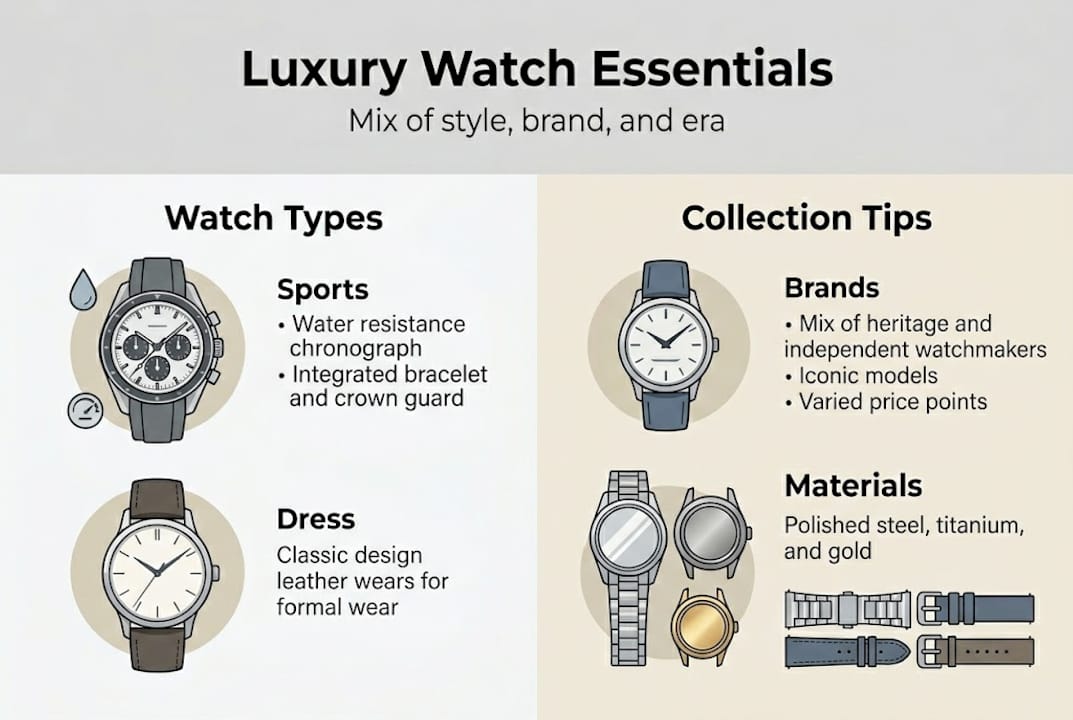
The dress watch is the quiet statement. A Patek Philippe Calatrava, a Jaeger-LeCoultre Master Ultra Thin, or a Cartier Santos dress variant all qualify. Slim cases, restrained dials, and leather straps are the grammar here. These pieces can also be among the most collectible, with certain references holding their value exceptionally well on the UK secondary market.
The complication or GMT adds technical interest and practical travel utility. A Rolex GMT-Master II covers both, while a Breitling Navitimer or an AP Royal Oak Chronograph pushes firmly into enthusiast territory. Before selecting any of these, consider your investable timepieces research carefully, as some complications hold value far better than others.
Category | Entry-level example | Blue-chip example | Approx. price range |
Everyday/sports | Omega Seamaster 300M | Rolex Submariner | £4,000 to £12,000 |
Dress | Longines Master | Patek Philippe Calatrava | £1,500 to £35,000+ |
Complication/GMT | Seiko Astron GPS | AP Royal Oak Chronograph | £3,000 to £40,000+ |
Assess your lifestyle honestly: a collector who rarely wears a suit may prioritise a second sports piece over a pure dress watch
Avoid buying two watches with overlapping functions in your first five purchases
Consult a reputable luxury watch buying guide before committing to blue-chip references
Pro Tip: Starting slowly and filling each functional category deliberately teaches you what you genuinely like, rather than what looks appealing on a forum at midnight.
Diversifying for strength: brands, materials, and eras
After locking down your core trio, the next step is layering in diversity to reinforce both value and enjoyment. A collection that consists entirely of Rolex sports models in steel, while undeniably desirable, carries concentrated risk. If steel sport watch premiums compress, as they did briefly in 2022 and 2023, your entire portfolio moves in lockstep.
Blue-chip brands such as Rolex, Patek Philippe, and Audemars Piguet have outperformed traditional asset classes in certain periods, but are still best diversified across different houses. Mixing a Rolex with an Omega or a Vacheron Constantin adds resilience, since each brand responds differently to market cycles, collector trends, and currency fluctuations.
Material diversity matters more than many collectors realise. Steel remains the most liquid in most categories, trading quickly and broadly on the UK secondary market. Gold, whether yellow, rose, or white, tends to attract a different buyer demographic and can outperform in specific reference categories, particularly vintage Patek. Titanium, increasingly used by Hublot, IWC, and AP, offers lightness and scratch resistance but a somewhat narrower resale audience. Refer to watch valuation basics to understand how materials affect appraisal values.

Vintage versus modern is perhaps the most debated axis in collecting. Vintage pieces, typically defined as pre-1990 in most collector circles, offer historical provenance, production rarity, and aesthetic distinctiveness. They also carry servicing complexity, moisture sensitivity, and authenticity risk. Modern watches come with manufacturer warranties and clearer provenance but often sit at or above retail immediately after purchase. The lasting value in collecting argument suggests that the best-performing collections blend both.
Brand | Strong references | Approx. 5-year performance | UK entry point |
Rolex | Submariner, Daytona | Strong positive | £8,000+ |
Patek Philippe | Nautilus, Calatrava | Very strong | £15,000+ |
Audemars Piguet | Royal Oak | Strong positive | £18,000+ |
Omega | Speedmaster, Seamaster | Moderate positive | £3,500+ |
The best investment watches are rarely the flashiest; they are the references with genuine scarcity, consistent demand, and strong brand custodianship behind them.
Buying safely in the UK: authentication, provenance, and protection
With a growing collection, ensuring legitimacy and protecting value becomes ever more critical, especially in the UK. Pre-owned buyers in the UK should use escrow, third-party authentication, and platforms with robust buyer protection. The consequences of skipping these steps can be devastating, not just financially but emotionally for pieces you have come to love.
Here is a practical authentication process for any significant UK purchase:
Request full documentation upstairs: original box, warranty card, service records, and receipts. Missing paperwork can reduce resale value by 10 to 20 per cent on many references.
Check the serial number against The Watch Register, a UK database holding records of 110,000+ theft reports that provides buyers with clear vet results.
Commission a third-party inspection from a qualified watchmaker or a specialist such as Watches of Switzerland or a certified independent horologist.
Verify the seller’s credentials: reputable dealers will be registered businesses, offer clear return policies, and provide secure payment options such as UK bank transfer.
Review platform buyer protections: eBay’s Authenticity Guarantee covers watches over £500 and includes physical inspection before the item reaches you.
A watch sold without its original box and papers can command 10 to 20 per cent less than a complete set on the UK secondary market. Servicing intervals of five to seven years are standard for mechanical movements; skipped services affect both reliability and future resale.
For guidance on what to look for in a trustworthy retailer, see our advice on choosing a luxury watch dealer. Understanding your UK watch warranty basics is also essential before any high-value transaction.
Pro Tip: Never bypass third-party authentication on a vintage piece regardless of how trustworthy the seller appears. A dial that has been refinished, a movement that has been swapped, or a case that has been heavily polished can all dramatically alter the watch’s collector value, often invisibly to the untrained eye.
Ownership costs, insurance, and managing your watch portfolio
Beyond the initial outlay, maintaining and managing a growing collection requires ongoing attention to costs and security. Many collectors budget carefully for acquisitions but dramatically underestimate what happens next. Insurance, secure storage, and regular service can amount to 10 to 15 per cent of collection value annually, and loans can unlock liquidity without forcing unwanted sales.
Key ongoing costs to plan for:
Insurance: specialist watch insurance (through providers such as Layton Blackham or Hiscox) should be updated annually, or immediately after any new acquisition or significant valuation change. A standard home contents policy almost never provides adequate cover for watches exceeding £5,000 per piece.
Secure storage: a Secured by Design or insurance-rated safe is the baseline recommendation. The Met Police advise that watches stored at home should be held in a fixed safe meeting at least BS EN 14450 standard.
Servicing: mechanical movements typically need a service every five to seven years. Budget roughly £300 to £800 for an Omega service and £1,500 to £3,000 or more for a complex Patek Philippe movement.
Watch-backed lending is a growing option for UK collectors who want liquidity without selling. Specialist lenders will offer short-term loans against your collection, often at 50 to 70 per cent of appraised value, with the watch held in secure storage during the loan period. This suits collectors who anticipate a market upturn but need capital in the near term. However, mind the watch investor risks and rewards carefully, since illiquidity and interest costs can erode the benefit if the loan runs long.
For those looking to expand holdings, understanding how to approach sourcing rare UK watches can help you act decisively when the right piece appears. It is also worth comparing watch investment vs stocks as part of a broader asset allocation conversation with your financial adviser.
Pro Tip: Always update your insurance valuation after each new acquisition or after significant market price movements. A watch insured at 2021 values in 2026 could leave you severely undercompensated after a claim.
A seasoned collector’s truth: passion vs profit and the real value of timepieces
With the operational details covered, it’s time to reflect on what makes a collection truly rewarding, beyond numbers. Here is an uncomfortable truth that many investment-first collectors discover too late: once you account for insurance, servicing, opportunity cost on capital, and UK capital gains tax on profits above the annual exemption, the net return on a luxury watch collection is rarely as impressive as the headline appreciation figures suggest.
The collectors who remain in the hobby for decades, and who build genuinely impressive holdings, are almost never purely financially motivated. They buy pieces with stories, with mechanical interest, with historical weight. They wear their watches rather than locking them away, and they understand that a Rolex Submariner worn through twenty years of life has a value no spreadsheet can quantify.
That said, passion without discipline is expensive. The collectors we admire at insightful UK watch sourcing tips are those who combine genuine enthusiasm with careful reference selection, buying what they love but ensuring what they love also has a credible secondary market. Build gradually, choose pieces that fit your actual life, and treat the portfolio as a long-term passion project that happens to carry financial discipline alongside it.
Expert help for your next acquisition
If you’re ready to advance your journey beyond self-guided research, reliable professional support makes the difference between a costly mistake and a seamless acquisition. At Horology Kings, we work with UK collectors at every stage, whether you are assembling your first trio of watches, rebalancing an existing portfolio, or hunting a specific reference that rarely comes to market.

Our team in Hertfordshire offers transparent pricing, expert valuations, discreet UK bank transfer transactions, and a sourcing network built for rare and sought-after models. If there is a specific piece you have been searching for, our source a watch service puts our full network to work on your behalf. Get in touch to discuss your collection goals with someone who understands what genuinely matters in UK horology.
Frequently asked questions
How much should I budget to start building a luxury watch collection in the UK?
Expect to invest at least £5,000 to £10,000 for a solid three-watch foundation, with ongoing costs of 10 to 15 per cent yearly for insurance, service, and storage. A 3-watch foundation with everyday, dress, and sport models typically begins at £2,000 to £5,000 per piece, scaling rapidly for blue-chip brands.
Is it better to buy new or pre-owned luxury watches when building a collection?
Pre-owned offers better value and access to rare, discontinued models but carries authenticity risks; always buy from trusted sources and verify full provenance. Buying pre-owned with proper paperwork avoids the 10 to 20 per cent value loss compared to watches missing box and papers.
What makes a watch brand ‘blue chip’ for investment?
Brands like Rolex, Patek Philippe, and Audemars Piguet offer market resilience, high liquidity, and have historically shown strong appreciation in the UK and worldwide. Blue-chip brands historically outperform in value retention but should always form part of a diversified portfolio.
How do I ensure my luxury watch is authentic and not stolen?
Use UK-based platforms with third-party authentication and check serial numbers against databases like The Watch Register, which holds 110,000+ theft records for buyer peace of mind.
What ongoing costs do UK watch collectors need to consider?
You’ll need to budget for insurance, secure storage, and servicing every five to seven years. Ongoing costs like insurance and servicing can total 10 to 15 per cent of collection value annually.
Recommended
Comments