.png)
Why transparency matters in watch sales: trust and value
TL;DR:
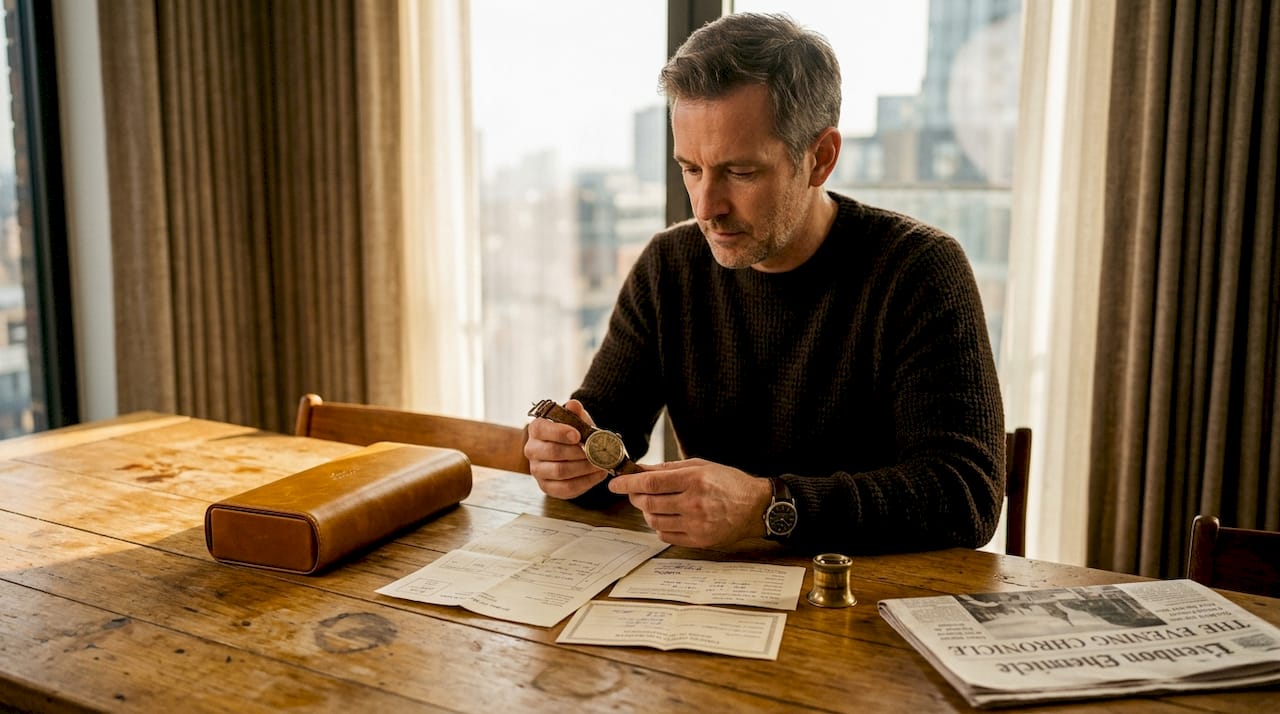
Transparency in watch sales ensures verifiable provenance, authenticity, and condition reports.
Digital tools like blockchain and NFC enhance traceability but do not replace physical inspection.
Full documentation and transparent processes significantly protect buyers, sellers, and market value.
A luxury watch can lose up to 30% of its value simply because its paperwork is incomplete. For collectors and investors operating in the UK’s pre-owned watch market, that is not a minor inconvenience; it is a serious financial risk. Transparency in watch sales covers everything from provenance and ownership history to condition reporting and pricing data. When it is absent, buyers face counterfeits, sellers face legal exposure, and the entire transaction becomes a gamble. This guide cuts through the complexity and gives you a clear framework for understanding, demanding, and benefiting from full transparency in every watch transaction you make.
Table of Contents
Key Takeaways
Point | Details |
Transparency preserves value | Complete documentation and open history can prevent a luxury watch from losing up to 30 percent of its resale value. |
Digital tools enhance trust | Blockchain and NFC improvements help, but hands-on verification remains essential for collectors. |
Fair pricing relies on data | Transparent platforms give buyers and sellers real-time pricing power for savvy investing. |
Persistent gaps remain | Without global registers and regulations, diligent due diligence is still vital before every purchase. |
Understanding transparency: why it matters in watch sales
Transparency in the luxury watch market means something specific. It is not simply about being honest. It means providing clear, verifiable evidence of a watch’s provenance (its documented history of ownership), its condition, its service records, and its authenticity. For a Rolex Submariner or a Patek Philippe Nautilus, that evidence is as important as the movement inside the case.
The risks of opacity are well documented. Without transparency, buyers are exposed to three major threats: purchasing counterfeit watches that mimic genuine references, unknowingly acquiring stolen timepieces, and becoming entangled in transactions that regulators flag for financial crime. The supply chain opacity in gold watches creates particular concern, as high-value pieces can be used to move wealth without scrutiny. These are not theoretical risks. They are active problems in the secondary market.
“Incomplete sets reduce value by 20 to 30 percent, and a lack of documentation opens the door to fakes, stolen goods, and financial crime.”
For rare and high-value timepieces, trust is the foundation of every transaction. A watch’s brand reputation and value are inseparable from its documented history. An Audemars Piguet Royal Oak with full box and papers commands a premium not just because of its mechanics, but because its story is verifiable. Remove that story, and you remove the premium.
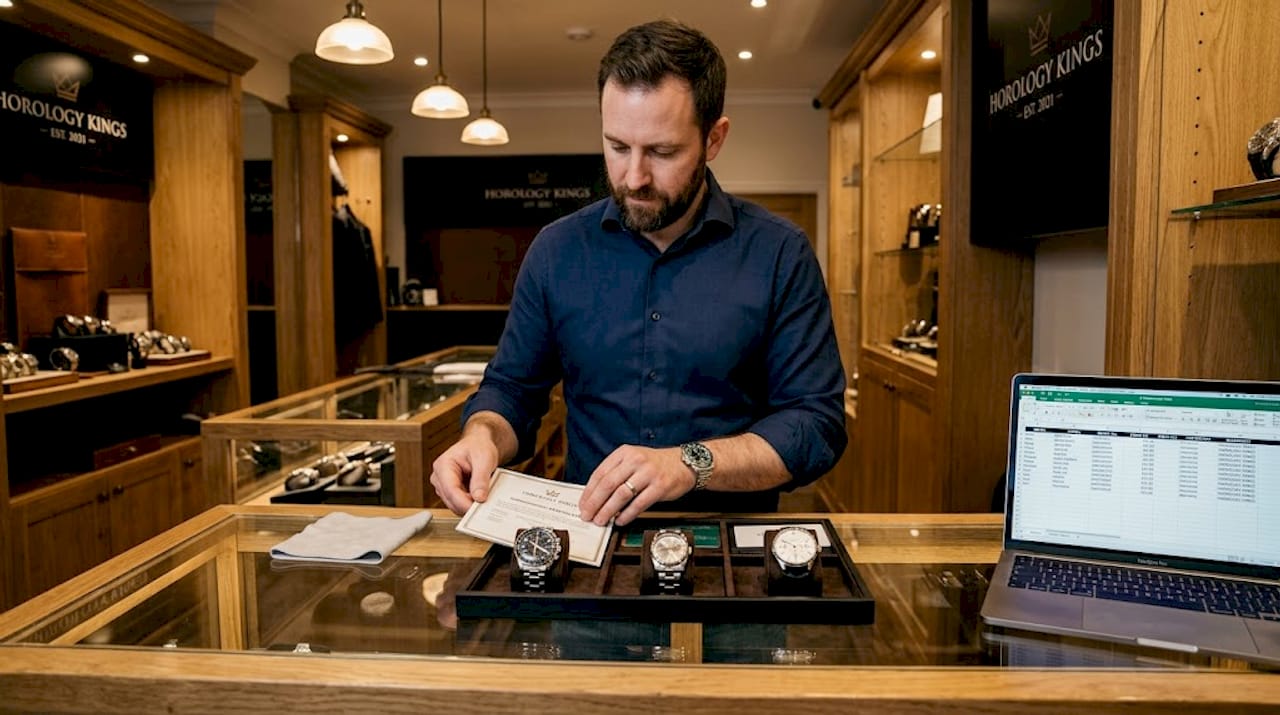
Transparency also protects sellers. A seller who cannot demonstrate clean ownership history faces reduced offers, slower sales, and potential scrutiny from buyers and insurers alike. In a market where third-party review transparency is increasingly expected, opacity signals risk rather than exclusivity.
Key risks caused by a lack of transparency include:
Purchasing a sophisticated counterfeit with no way to verify authenticity
Acquiring a watch that appears on a stolen goods register
Overpaying due to inflated or unverifiable condition claims
Facing legal complications if the watch’s ownership history is disputed
Losing resale value because future buyers cannot verify provenance
The principle is straightforward: the more verifiable information surrounds a watch, the more confidently both parties can transact. For collectors building a portfolio and investors tracking returns, that confidence is not a luxury. It is a necessity. Transparency also plays a critical role in protecting value and privacy, particularly when sellers wish to remain discreet while still providing buyers with full assurance.
How transparency protects buyers and sellers
Once transparency’s importance is clear, it is crucial to see how it tangibly alters the experience for buyers and sellers in practice.
For buyers, transparency is the primary defence against two of the secondary market’s biggest threats: counterfeits and stolen watches. A watch presented with original purchase receipt, serial number documentation, service history, and an independent authentication report is far harder to misrepresent. The authenticity of luxury goods is directly tied to the evidence available at the point of sale. Without that evidence, even experienced collectors can be deceived.
For sellers, the consequences of opacity are equally serious. Insurers base cover on documented value, so a watch without records may be significantly undervalued in the event of loss or theft. Legal exposure is real: selling a watch with disputed provenance, even unknowingly, can result in the watch being seized and the seller left without compensation. Reputation matters too, particularly for those who sell regularly within collector communities.
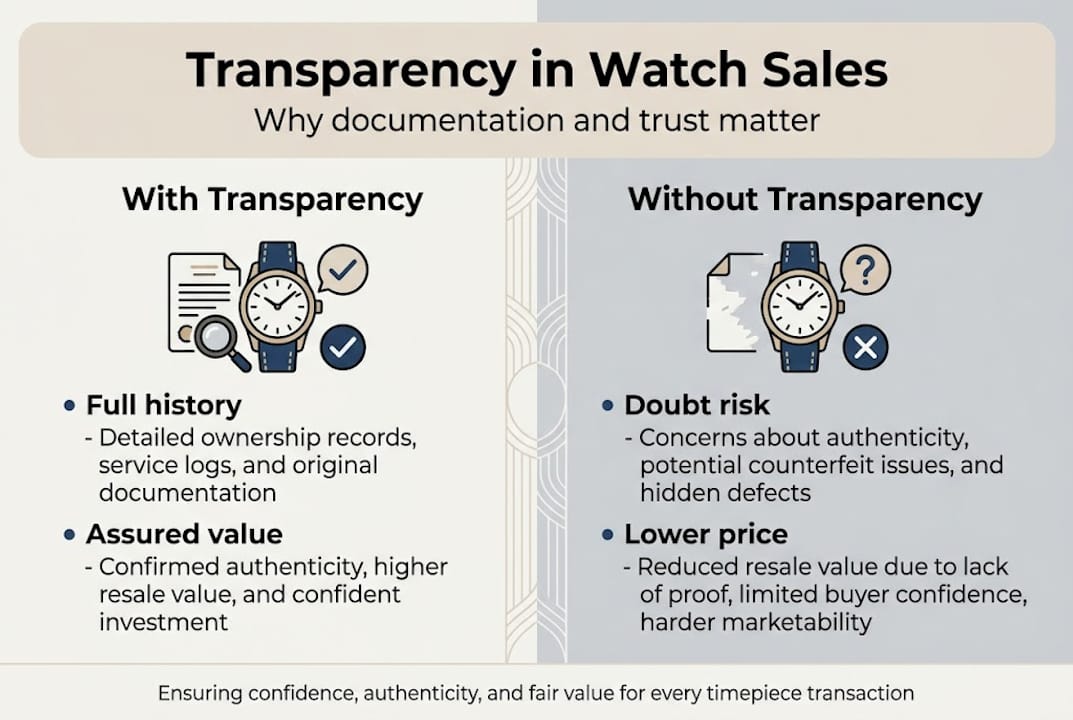
Comparison: transparent vs. opaque watch transactions
Factor | Transparent transaction | Opaque transaction |
Provenance | Fully documented | Unknown or partial |
Authenticity | Independently verified | Unverified |
Price confidence | Data-backed | Speculative |
Legal risk | Minimal | Elevated |
Resale value | Full market rate | Reduced by up to 30% |
Buyer confidence | High | Low |
The risks of inadequate transparency extend beyond individual transactions. They affect market confidence broadly, making it harder for legitimate sellers to achieve fair prices when buyers have been burned by opaque deals.
Pro Tip: Always request full documentation before engaging with a private seller. If they cannot provide at minimum the original box, papers, and a service history, treat that as a significant red flag, not a negotiating point.
Steps for due diligence in a watch purchase:
Request the original purchase receipt and certificate of authenticity
Verify the serial number against the manufacturer’s records where possible
Obtain an independent authentication report from a qualified watchmaker
Check the watch against stolen goods databases such as the Watch Register
Confirm the seller’s identity and ask for proof of ownership
Review the service history for consistency with the watch’s stated age and condition
Use a secure payment method and insist on a receipt for the transaction
Following these steps on every purchase is the foundation of safe buying and selling in the luxury watch market. For those sourcing watches safely through specialist dealers, many of these steps are handled as part of the service, which is one of the strongest arguments for working with established professionals.
Transparency tools: blockchain, NFC and digital ledgers
With risks and safeguards established, let’s look at the innovative digital tools boosting transparency in today’s marketplace.
The past five years have seen significant investment in digital provenance technology for luxury goods. Blockchain, near-field communication (NFC) chips, and digital ledger platforms are now active parts of the high-end watch ecosystem. Each addresses a different layer of the transparency problem.
Blockchain creates an immutable (unchangeable) record of a watch’s history. Every ownership transfer, service event, and authentication check can be logged on a decentralised ledger that no single party controls. This makes it extremely difficult to fabricate a watch’s history retroactively. Several platforms now offer blockchain-backed certificates that travel with the watch across its lifetime.
NFC chips are small electronic tags embedded in a watch or its documentation. A buyer can scan the chip with a smartphone to instantly retrieve verified ownership and authenticity data. Some brands are integrating these directly into packaging and service cards.
Digital provenance platforms aggregate data from manufacturers, authorised dealers, and service centres to build a comprehensive ownership record. These platforms are particularly useful for watch authentication when physical documentation has been lost or damaged.
Digital transparency tools by brand type:
Brand category | Digital tools in use | Physical validation still required? |
Rolex | Serial database, service records | Yes |
Patek Philippe | Extract of the archives | Yes |
Audemars Piguet | Digital passport (AP House) | Yes |
Omega | NFC-enabled warranty cards | Yes |
Cartier | Digital certificates of authenticity | Yes |
Key technologies and their roles:
Blockchain certificates: Immutable ownership and service records
NFC chips: Instant scan-to-verify authentication
Digital ledgers: Aggregated provenance across the supply chain
Online serial databases: Cross-reference tools for buyers
Platform pricing data: Live market values from verified sales
However, as digital provenance tools evolve, physical inspection remains essential. A blockchain certificate cannot detect a replaced movement or a refinished case. Technology adds a layer of confidence; it does not replace expert eyes and hands.
Pro Tip: When acquiring a rare or high-value piece, specifically ask whether a blockchain-backed certificate or digital provenance record exists. If it does, verify it independently rather than taking the seller’s word for its contents.
Market pricing and value: how transparency empowers investors
Beyond authentication, transparent data is also transforming how collectors and investors value and trade high-end watches.
Pricing in the pre-owned watch market was historically opaque. Dealers held information advantages, and private buyers had little way to verify whether an asking price was fair. That has changed substantially. Platforms now publish live transaction data, auction results, and reference-specific pricing that any buyer can access before entering a negotiation.
This pricing transparency has two important effects. First, it reduces the information gap between professional dealers and private buyers, creating a fairer market. Second, it increases liquidity, meaning watches are easier to buy and sell at accurate prices because both parties can agree on value quickly.
The watch valuation process benefits directly from this data. A collector considering selling a Rolex Daytona can now cross-reference recent sales of the same reference in comparable condition before accepting an offer. That knowledge is protective.
Statistic: Missing documentation reduces value by 20 to 30 percent, a figure that represents thousands of pounds on a high-value reference.
Transparency benefits for investors:
Fair pricing: Live market data removes guesswork and prevents overpaying
Faster sales: Fully documented watches sell more quickly at better prices
Portfolio strategy: Accurate valuations support informed buying and selling decisions
Reduced risk: Verified provenance protects against acquiring problematic pieces
Stronger negotiating position: Data-backed offers are harder to dismiss
One important nuance: platforms’ pricing data works best for liquid references, those with high trading volumes and consistent demand. For rare or limited-production pieces, market data is thinner and valuations require more specialist input. Investors focused on scarce references should work with experts who have direct market access rather than relying solely on published data.
Challenges and the future: shortfalls and opportunities in transparency
Even with improved tools, there are transparency limits and ongoing challenges the industry must overcome.
The most significant structural problem is the absence of a global ownership register for luxury watches. Unlike property or vehicles, watches have no mandatory registration system. A stolen Patek Philippe can cross borders and change hands multiple times with no central authority tracking its movement. As noted in compliance research, no central ownership database increases the risk of money laundering through high-value goods.
“Without a central database, the secondary market remains vulnerable to the circulation of stolen and fraudulently represented timepieces.”
Key challenges UK collectors face today:
Unregulated secondary market: No mandatory disclosure requirements for private sales
Modified watches: Aftermarket parts or case refinishing that alters originality without disclosure
Incomplete archives: Older watches may have no surviving manufacturer records
Cross-border complexity: Watches acquired abroad may lack UK-compatible documentation
Fake documentation: Sophisticated counterfeiters now produce convincing paperwork alongside replica movements
The future, however, is more encouraging. Manufacturers are investing in digital passports that follow watches from production through every subsequent sale. Industry bodies are pushing for standardised documentation requirements. Trusted dealer networks, including specialist platforms with transparent selling processes, are raising the bar by making full documentation a condition of every transaction rather than an optional extra.
The collectors and investors who will benefit most are those who engage now with transparent processes, build relationships with verified dealers, and treat documentation as a core part of every acquisition strategy.
Our perspective: what true transparency means for collectors and sellers
Taking all these factors into account, here is our own hard-won insight into transparency in watch sales.
The industry conversation around transparency often focuses on documents and technology. Box and papers. Blockchain certificates. NFC chips. These matter, but they are not the whole picture.
In our experience, the most reliable indicator of a trustworthy transaction is the process the seller follows, not just the paperwork they produce. A seller who welcomes questions, provides independent authentication, and explains the watch’s history without prompting is demonstrating something no certificate can replicate: genuine accountability.
Smart investors understand this. They use transparency not just as a filter for individual purchases, but as a tool for building long-term networks. A dealer or seller who operates transparently once will almost certainly do so again. That consistency is worth more than any single document.
Watch for red flags: reluctance to provide serial numbers before payment, pressure to transact quickly, or resistance to third-party inspection. These behaviours signal opacity regardless of what paperwork is offered. Seek community advice from collector forums and peer networks, and use secure online selling platforms that enforce documentation standards.
Pro Tip: Always cross-check provenance with the seller’s reputation and peer reviews. A watch with perfect papers from an unknown seller deserves more scrutiny than a well-documented piece from a dealer with a verifiable track record.
Find your next timepiece with confidence
For collectors ready to experience fully transparent transactions, Horology Kings is your next step.
At Horology Kings, transparency is not a selling point; it is a standard. Every watch we buy and sell comes with verified provenance, honest condition reporting, and secure UK bank transfers that protect both parties. Our clients know exactly what they are acquiring and exactly what they are receiving in return. For those seeking something specific, our watch sourcing service connects you with rare and investment-grade references through our expert network, with full documentation as a condition of every acquisition. Whether you are buying, selling, or sourcing, explore our full range at Horology Kings and experience what genuinely transparent luxury watch transactions look like.
Frequently asked questions
What documents should I request when buying a pre-owned luxury watch?
Always request the original purchase receipt, certificate of authenticity, service records, and any warranty papers; missing documentation reduces value by 20 to 30 percent and limits your insurance options.
How can blockchain technology increase trust in watch sales?
Blockchain stores immutable records of provenance and ownership, making it much harder for counterfeit or stolen watches to enter the market; digital tools like blockchain and NFC are now active parts of the high-end watch ecosystem.
Why does lack of transparency reduce a watch’s resale value?
Uncertain history or missing documentation raises doubts about authenticity and legitimate ownership, which reduces resale value by up to 30 percent and narrows your pool of serious buyers.
What are the signs of a transparent watch seller?
A transparent seller provides complete documentation, open provenance, brand authentication evidence, and welcomes third-party inspections without hesitation or pressure to transact quickly.
Is digital verification alone enough to ensure a watch’s authenticity?
No; physical inspection remains essential because digital certificates cannot detect replaced movements, refinished cases, or other physical alterations that affect authenticity and value.
Recommended
Comments