.png)
What is an expert watch appraisal? A 2026 guide
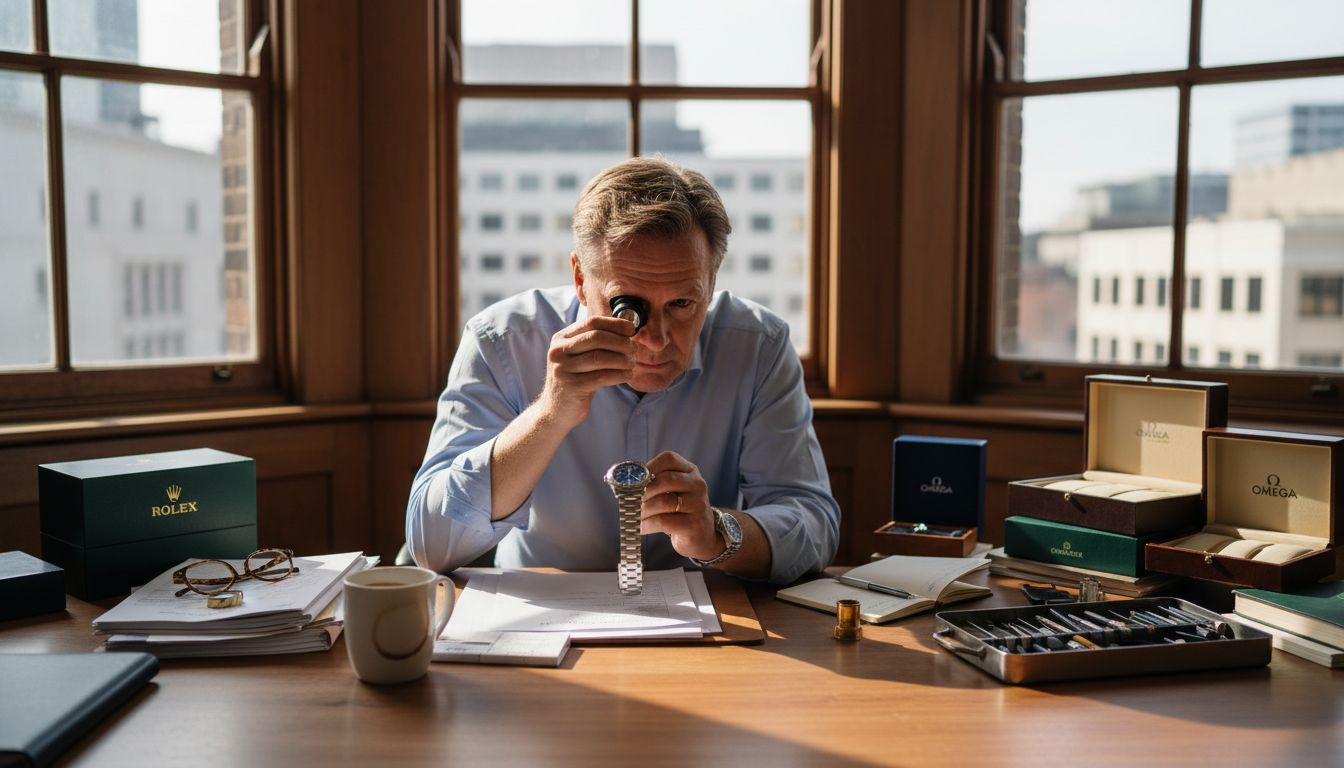
Many collectors assume an appraisal guarantees their watch’s resale price, but this is inaccurate. An expert watch appraisal delivers a detailed professional evaluation covering authenticity, condition, provenance, and market value. This guide explains why appraisals matter for collectors and investors, how experts assess timepieces, and how you can use appraisals effectively to protect your investment and make confident decisions.
Table of Contents
Key takeaways
Point | Details |
Core assessment | Appraisals evaluate authenticity, condition, provenance, and current market value systematically. |
Fraud protection | Professional appraisals significantly reduce counterfeit risks and support secure buying and selling. |
Purpose matters | Insurance, resale, and investment appraisals use different valuation criteria affecting reported values. |
Expert selection | Choosing appraisers with brand-specific knowledge and verifiable credentials maximises reliability. |
Actionable outcomes | Appraisals enable accurate insurance coverage, fair pricing negotiations, and informed investment decisions. |
Introduction to expert watch appraisals
An expert watch appraisal is a comprehensive professional evaluation that examines authenticity, condition, provenance, and market value. Unlike simple valuations, appraisals involve detailed technical inspection using scientific methods and market analysis. This rigorous process protects you from fraud and mispricing in an increasingly risky marketplace.
The luxury watch market faces growing challenges. Counterfeit watch fraud has increased 15% annually in the secondary market, making professional authentication essential. Appraisals form your first line of defence against sophisticated counterfeits that can fool even experienced collectors.
Several groups benefit most from expert appraisals:
First-time buyers seeking assurance before significant purchases
Collectors verifying provenance for rare or vintage pieces
Investors tracking asset value for portfolio management
Sellers establishing fair market prices for transactions
Insurance clients securing accurate coverage valuations
When you buy, sell, or source luxury watches, appraisals provide the foundation for confident decisions. They transform subjective opinions into documented professional assessments backed by technical analysis and market expertise. Understanding how to authenticate luxury watches before purchase complements appraisal knowledge, creating multiple layers of protection.
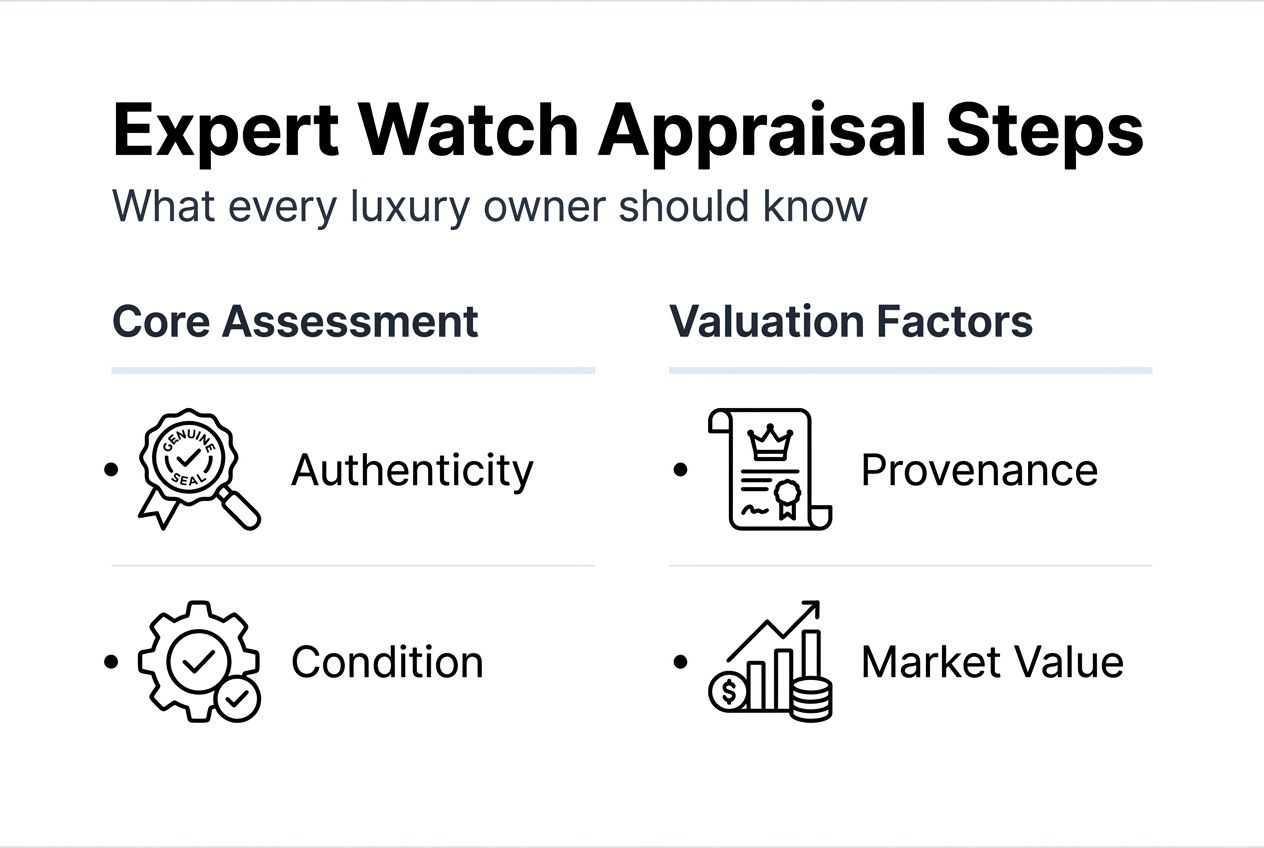
Appraisals serve distinct purposes beyond simple price estimates. They document condition for insurance claims, verify authenticity for resale, and establish provenance for collection management. Without this professional assessment, you risk overpaying, underinsuring, or unknowingly purchasing counterfeits that devastate your investment.
Core components of a professional watch appraisal
Authentication forms the appraisal’s foundation. Experts use visual magnification to examine case markings, dial printing, and movement finishing. UV light reveals anachronistic materials or aftermarket modifications invisible to the naked eye. Mechanical movement analysis confirms genuine calibres match manufacturer specifications. These scientific methods expose counterfeits that replicate surface details whilst failing internal authenticity tests.
Condition grading directly influences value, often by 30 to 40%. Appraisers assess wear patterns, scratches, and polish history to determine originality. They examine mechanical function through accuracy testing and power reserve measurement. Original components command premiums, whilst replacement parts reduce value even when functionally identical. Proper luxury watch maintenance preserves condition grades and protects long-term value.
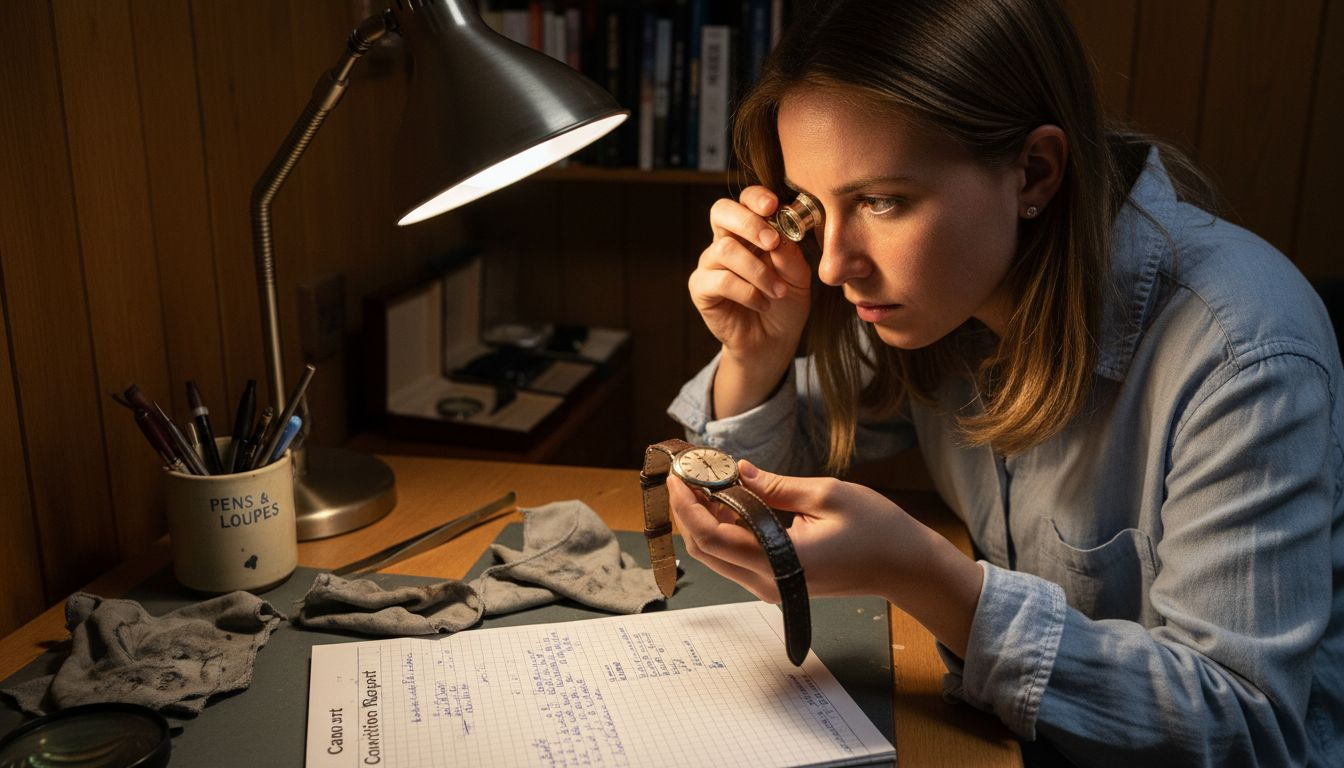
Provenance evaluation adds 10 to 15% premiums for well-documented pieces. Experts examine original boxes, papers, and warranty cards that establish ownership history. Service records from authorised centres demonstrate proper care and confirm authenticity. Previous ownership by notable collectors or celebrities can multiply values beyond standard market rates. Complete documentation transforms ordinary watches into historically significant timepieces.
Market valuation requires current data analysis. Appraisers study recent auction results, dealer pricing, and private sales for comparable models. They factor rarity, demand trends, and condition differences into final estimates. Rare Swiss watch values fluctuate significantly, making regular reassessment crucial for accurate valuation. Understanding genuine dive watch identification helps appraisers assess specific categories correctly.
Pro Tip: Verify your appraiser possesses brand-specific expertise and uses scientific authentication tools, not just visual inspection. Generic appraisers miss subtle details that specialists recognise immediately, potentially costing you thousands in missed counterfeits or undervaluation.
Common misconceptions about watch appraisals
Appraisal values represent expert estimates, not guaranteed resale prices. Market conditions change daily, causing actual sale prices to vary up to 20% from appraised values. Buyers and sellers negotiate based on urgency, condition interpretation, and market timing. Your appraisal provides a baseline, not a fixed price tag.
Insurance appraisals typically exceed resale appraisals by 10 to 30%. Insurance valuations factor replacement cost, including retail markups and sourcing time for discontinued models. Resale appraisals reflect current secondary market prices where buyers expect discounts from retail. Using insurance appraisals for selling creates unrealistic expectations and failed transactions.
No appraisal guarantees complete fraud immunity. Expert assessments dramatically reduce counterfeit risks but cannot eliminate sophisticated fakes that fool authentication equipment. Combining appraisals with dealer guarantees and purchase from reputable sources provides maximum protection. The Horology Kings blog offers additional guidance on avoiding common pitfalls.
Collectors often underestimate provenance impact on value. Well-documented history transforms standard models into premium pieces commanding significant premiums. Original boxes, papers, and service records prove authenticity whilst adding emotional value for collectors. Appraisals quantify these intangible factors into concrete value assessments.
Understanding appraisal limitations prevents disappointment and supports realistic planning. Appraisals provide professional opinions based on current market knowledge and technical analysis. They guide decisions without replacing your own research and due diligence. Realistic expectations ensure you use appraisals effectively rather than treating them as infallible guarantees.
Comparison of appraisal types: insurance vs resale vs investment
Insurance appraisals differ fundamentally from resale valuations in purpose and methodology. Insurance appraisals establish replacement cost for identical or equivalent pieces, factoring retail markups and sourcing difficulty. Resale appraisals reflect current secondary market demand and actual trading prices. Investment appraisals emphasise long-term appreciation potential and rarity factors.
Appraisal Type | Primary Purpose | Valuation Criteria | Typical Value Level |
Insurance | Coverage amount | Replacement cost, retail pricing | Highest (retail equivalent) |
Resale | Sale pricing | Market demand, condition | Moderate (secondary market) |
Investment | Portfolio tracking | Rarity, appreciation trends | Variable (long-term focus) |
Insurance appraisals prioritise worst-case replacement scenarios. They assume you must source an identical model through retail channels at current market prices. This approach typically yields values 10 to 30% higher than resale estimates. Insurers accept these premiums because they cover replacement difficulty and price volatility.
Resale appraisals focus on immediate market liquidity. They consider current buyer demand, competitive pricing, and condition assessment relative to available alternatives. These valuations help sellers price competitively whilst maximising returns. Understanding how to trade high-end watches complements resale appraisal knowledge.
Investment appraisals analyse long-term value trajectories. They emphasise rarity, historical significance, and appreciation patterns for investable timepieces. These appraisals guide collectors building portfolios rather than immediate buyers or sellers. They factor market cycles and collector trends into forward-looking valuations.
Selecting the appropriate appraisal type ensures you receive relevant information for your specific needs. Insurance clients require replacement cost data, sellers need market pricing, and investors seek appreciation analysis. Mismatched appraisal types generate misleading values that undermine decision quality.
Practical guidance: how to obtain and use an expert watch appraisal
Identify your appraisal purpose clearly before beginning. Insurance coverage requires replacement cost focus, whilst selling demands current market pricing. Investment tracking needs appreciation analysis and rarity assessment. Your purpose determines which appraiser type and methodology suit your needs best.
Find qualified appraisers with brand-specific expertise. Verify credentials through professional organisations and client testimonials. Specialists in Rolex, Patek Philippe, or Audemars Piguet possess deeper knowledge than generalists. Request sample reports to assess thoroughness and methodology before committing.
Provide complete provenance documentation before appraisal. Original boxes, papers, warranty cards, and service records strengthen authentication and increase valuations. Incomplete documentation forces conservative estimates that undervalue well-maintained pieces. Organise materials systematically to facilitate efficient appraisal.
Understand appraisal report components thoroughly. Review authentication methods, condition grading criteria, provenance assessment, and market valuation methodology. Question unclear sections to ensure you comprehend the basis for conclusions. Detailed reports provide maximum value for future reference and transactions.
Use appraisals strategically in negotiations and insurance applications. Share reports with potential buyers to build trust and justify pricing. Present appraisals to insurers for accurate coverage that protects your investment. Knowing how to source luxury watches safely complements appraisal use for confident purchasing.
Regular reappraisal maintains accurate valuations as markets evolve. Schedule updates every two to three years or after significant servicing. Market shifts, especially for rare models, can dramatically alter values between appraisals. Professional watch repair and servicing records support updated condition assessments.
Pro Tip: Avoid uncertified appraisers lacking verifiable credentials and brand expertise. Unqualified evaluators miss authentication details and provide unreliable valuations that cost you money through overpayment, underinsurance, or failed sales negotiations.
Explore Horology Kings for luxury watch services
Understanding expert appraisals empowers smarter watch transactions, but finding trustworthy partners matters equally. Horology Kings specialises in buying, selling, and sourcing authentic luxury timepieces from Rolex, Patek Philippe, Audemars Piguet, and other prestigious Swiss brands. Their expert team provides professional valuations and transparent transactions backed by comprehensive market knowledge.
Whether you’re purchasing your first luxury watch or expanding an established collection, accessing specialists who understand authentication and fair pricing protects your investment. Horology Kings combines technical expertise with secure UK bank transfers and discreet service for high-value transactions. Their watch sourcing service leverages industry connections to locate rare models that match your specific requirements, complementing your appraisal knowledge with practical acquisition support.
FAQ
What is the difference between an appraisal and a certificate of authenticity?
Appraisals estimate market value whilst assessing condition, provenance, and authenticity comprehensively. Certificates of authenticity confirm genuine manufacture without providing valuation or condition analysis. Appraisals offer complete documentation useful for insurance, resale, and investment decisions beyond simple authentication.
How often should I get my luxury watch appraised?
Reappraise every two to three years or after significant servicing and major market shifts. Regular updates ensure accurate insurance coverage and realistic selling expectations. Rare models experiencing rapid appreciation may require more frequent reappraisal to track value changes effectively.
Can I trust an online appraisal for my luxury watch?
Online appraisals offer convenience but lack physical examination crucial for thorough authentication and condition assessment. In-person expert appraisals provide superior accuracy, especially for high-value or rare timepieces where small details significantly impact valuation. Reserve online appraisals for preliminary estimates, not definitive valuations.
Recommended
Comments