.png)

What is watch luminescence: the collector's guide
- lewisvrichards3
- 5 hours ago
- 8 min read
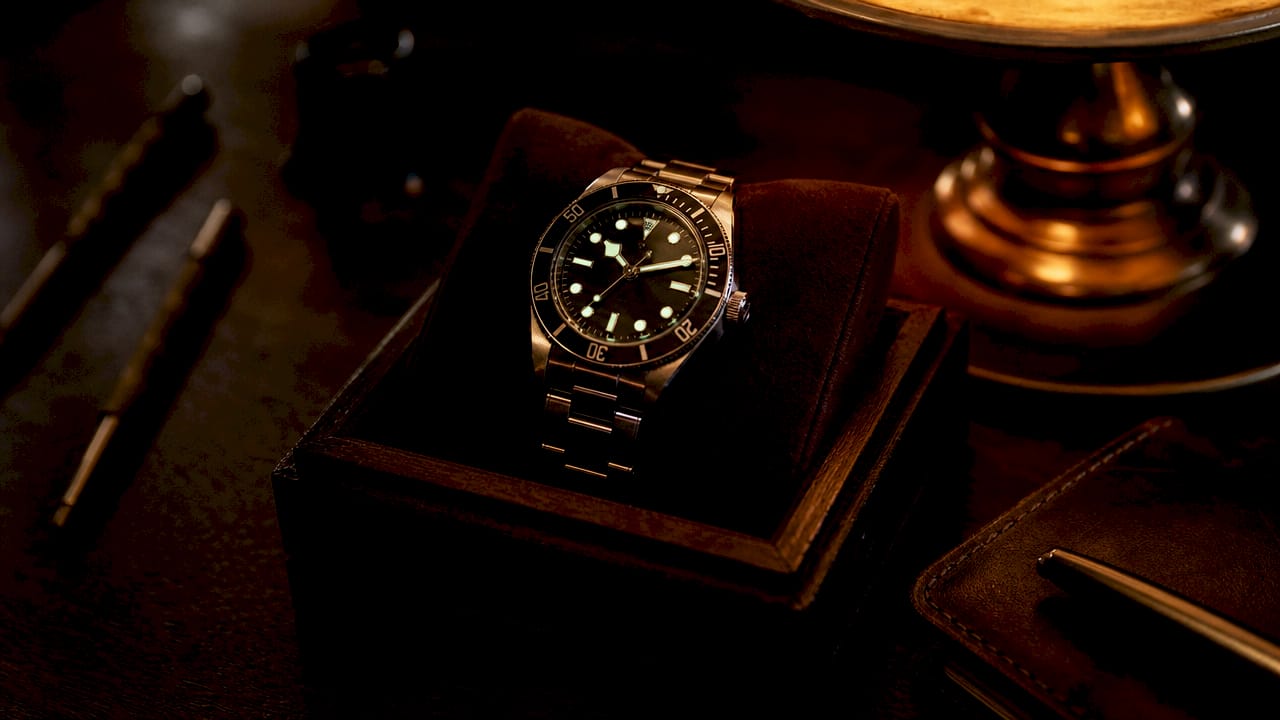
TL;DR:
Watch luminescence allows watch dials and hands to emit visible light in darkness without external power. It has evolved from a safety feature to a defining aesthetic trait influencing watch desirability and value.
Watch luminescence is the property of a watch dial, hands, or bezel to emit visible light in darkness, using materials that absorb and re-emit energy without an external power source. The industry term for this is “lume,” and it sits at the intersection of engineering and design. Brands like Rolex, IWC, and Omega have turned lume from a basic legibility tool into a defining feature of their most desirable references. Whether you are buying your first luxury timepiece or adding a grail piece to your collection, understanding watch luminescence changes how you evaluate what is on your wrist.
What is watch luminescence and why does it matter?
Watch luminescence is defined as the use of photoluminescent or radioluminescent materials applied to watch indices, hands, and dials to make them readable in low light. The practical case is obvious: a pilot reading instruments at night, a diver checking depth at 30 metres, or anyone glancing at their wrist in a dark room. Beyond function, lume has become an aesthetic signature. The blue glow of Rolex’s Chromalight or the full-body luminescence of IWC’s Ceralume® are as much about visual identity as they are about legibility.
Lume appears most commonly on hour and minute hands, hour markers, and occasionally on bezels. The quality, colour, and duration of that glow vary significantly between materials and brands. For collectors, lume quality directly affects desirability and, in some cases, resale value. A watch with original, unrestored lume in good condition commands a premium in the vintage market.
How does watch luminescence work?
The science behind lume is straightforward. Watch lume works by exciting electrons within a phosphorescent compound when exposed to light. Those electrons absorb energy and jump to a higher state. As they return to their resting state, they release that stored energy as visible light. Think of it as a rechargeable light battery: charge it with light, and it pays that energy back slowly in the dark.
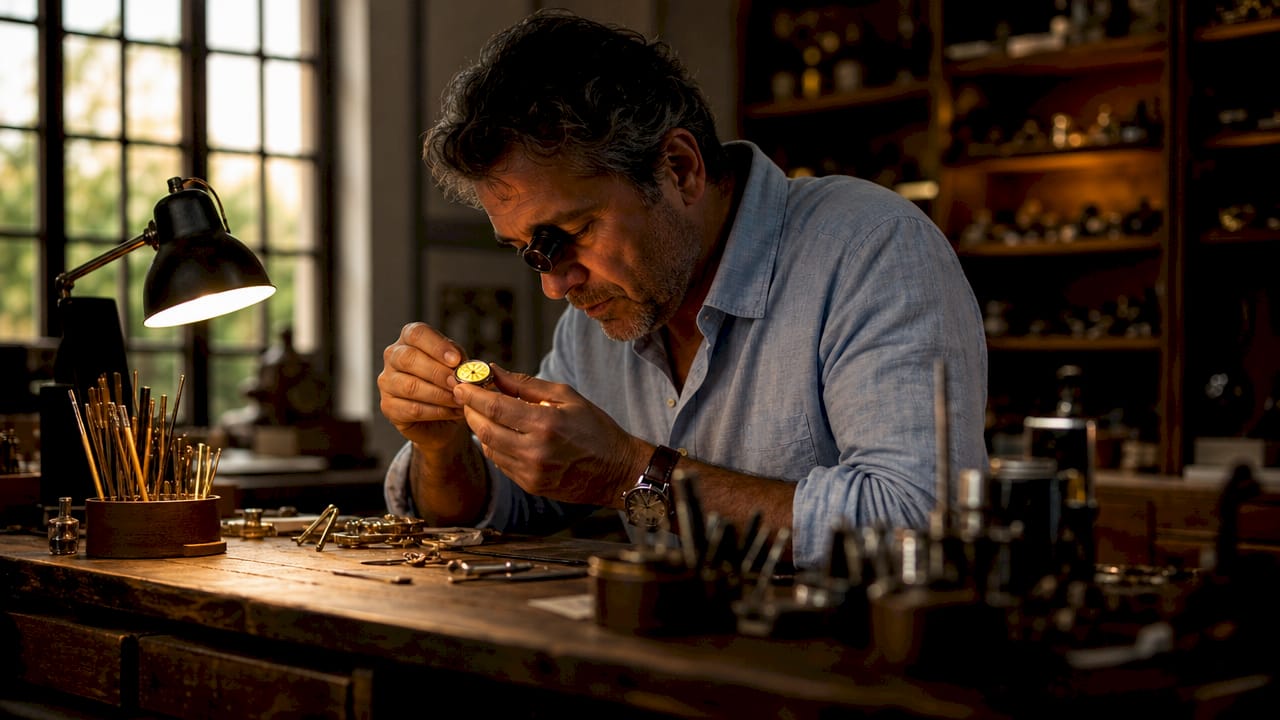
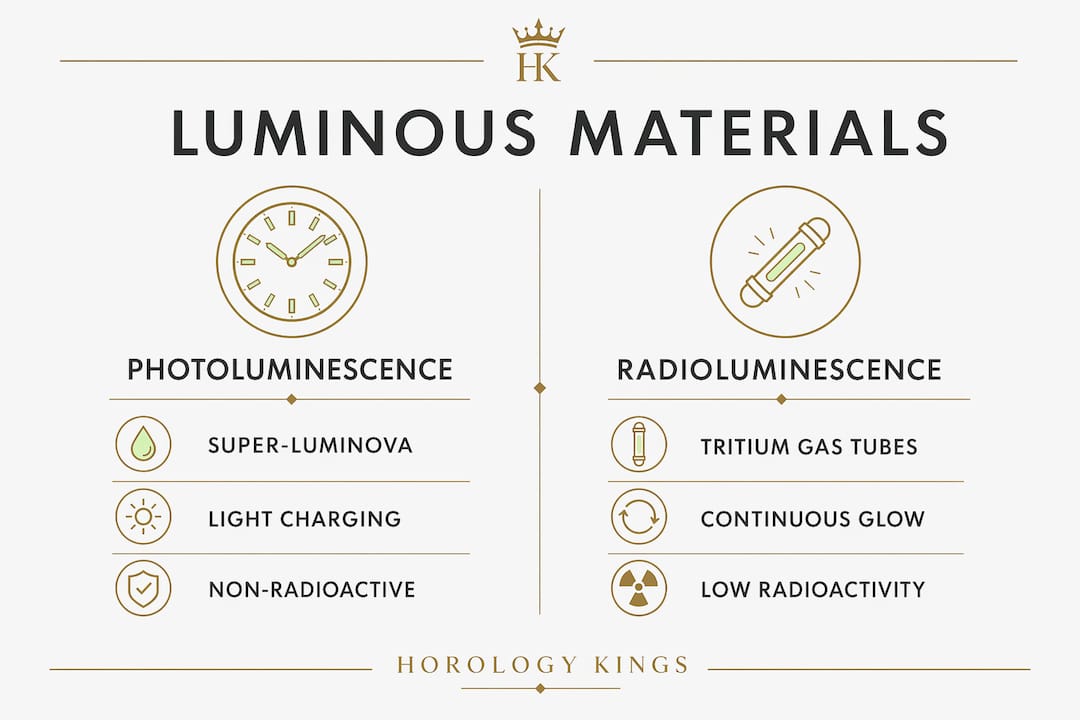
This process is called photoluminescence, and it is the mechanism behind Super-LumiNova, the most widely used lume compound in the industry today. Photoluminescent pigments like Super-LumiNova require charging by light and typically glow for 4 to 8 hours, with peak brightness in the first 30 minutes. After that first hour or two, the glow dims considerably. That is not a defect. It is physics.
Radioluminescence works differently. Instead of requiring a light source to charge, it uses a low-level radioactive material to continuously excite phosphor. Tritium gas tubes provide a continuous glow for 10 to 25 years without any light exposure at all. The tritium gas is sealed inside tiny glass tubes coated with phosphor, which glow constantly at a steady, low intensity.
Pro Tip: Charge your photoluminescent lume under direct sunlight or a UV torch for 30 to 60 seconds before entering a dark environment. Artificial indoor lighting charges lume far more slowly and produces a noticeably weaker glow.
What are the main types of luminous materials used in watches?
The watch industry has used several luminous materials over the past century, each with distinct properties, safety profiles, and performance characteristics.
Super-LumiNova is the dominant material today. Super-LumiNova is non-radioactive and non-toxic, developed in Japan, and used across the vast majority of Swiss luxury watches. It stores light from UV, natural, or artificial sources and emits it via photoluminescence. Brands apply it in different colours, with blue and green being the most common. Rolex uses a proprietary variant called Chromalight, which emits a blue glow and claims a longer duration than standard Super-LumiNova.
Tritium gas tubes (GTLS) offer a fundamentally different proposition. They glow continuously without any charging requirement. Ball Watch Company and Luminox are the best-known brands that use tritium tubes as a core feature. The tubes contain tritium gas at safe levels, and current tritium usage is limited to safe levels of approximately 25 milliCuries per watch. The trade-off is that the glow is dimmer than a freshly charged Super-LumiNova application.
Radium was the original luminous material, used widely from the early 1900s until the mid-1960s. It was phased out entirely due to its severe toxicity. Vintage watches from that era should be handled with care, and professional assessment is advisable before purchase.
Ceralume® represents the current frontier. IWC’s Ceralume® luminous ceramic technology mixes Super-LumiNova pigments with ceramic powders through a ball-milling process, creating a fully luminous watch case and dial with a glow lasting over 24 hours. The IWC Big Pilot’s Watch Perpetual Calendar Ceralume effectively presents two distinct visual expressions: one by day and one by night.
Material | Glow type | Duration | Safety | Charging needed |
Super-LumiNova | Photoluminescent | 4–8 hours | Non-toxic | Yes |
Rolex Chromalight | Photoluminescent | Extended vs standard | Non-toxic | Yes |
Tritium (GTLS) | Radioluminescent | 10–25 years | Safe (sealed) | No |
Radium | Radioluminescent | Indefinite | Toxic | No |
IWC Ceralume® | Photoluminescent ceramic | 24+ hours | Non-toxic | Yes |
Pro Tip: If you wear your watch in genuinely dark conditions regularly, such as diving or night work, tritium tube watches from Ball Watch Company or Luminox offer a reliability that photoluminescent lume simply cannot match.
How has watch luminescence evolved and shaped collectibility?
Lume history tracks closely with safety science. Radium was applied to watch dials by hand painters, many of whom were women, in the early 20th century. The health consequences were devastating. Radium was phased out by the mid-1960s, replaced first by tritium painted directly onto dials, and later by the sealed tritium tube technology that eliminated direct exposure entirely.
The shift to photoluminescent compounds in the 1990s marked a turning point. Super-LumiNova arrived as a safe, bright, and rechargeable alternative that quickly became the industry standard. From that point, brands began treating lume not just as a functional necessity but as a design element.
Several developments define the modern era of luminescent watch features:
Rolex introduced Chromalight on the Submariner and Sea-Dweller, establishing blue lume as a brand signature and a collector talking point.
IWC launched Ceralume® in 2026, embedding luminous pigments directly into the ceramic case material, making the entire watch glow rather than just the applied indices.
Ball Watch Company built its entire brand identity around tritium tube technology, using it as a core differentiator in the tool watch segment.
Omega has used Super-LumiNova across its Seamaster and Speedmaster lines, with lume plots on the Seamaster becoming a recognised collector detail.
Lume has evolved from a purely functional need for night legibility into an important aesthetic signature for luxury brands. That shift means lume quality now directly influences how collectors assess a watch’s character and value. A vintage Rolex Submariner with original, patinated lume plots is more desirable than one that has been relumed, even if the original lume no longer glows effectively. The patina tells the story of the watch’s age.
For a deeper look at how lume technology differs between vintage and modern references, the distinction matters considerably when assessing value.
How to assess and maintain watch luminescence
Lume performance is not permanent, and understanding its natural behaviour prevents misplaced disappointment. Collectors often misinterpret fading lume as poor quality. In reality, lume decay is a natural physical property of photoluminescent materials. The best lume balances initial brightness with glow longevity rather than attempting endless light output.
Practical guidance for getting the most from your watch’s lume:
Charge with intention. Sunlight and UV torches charge Super-LumiNova far more effectively than standard indoor lighting. A 30-second burst under a UV torch produces a noticeably stronger glow than an hour under office fluorescents.
Expect rapid early fade. Glow intensity drops significantly after the first hour. A watch that glows brightly for 20 minutes and then dims is performing exactly as designed.
Assess vintage lume carefully. Original lume on a vintage piece may no longer glow at all, but its condition and colour tell you about the watch’s history. Cream or tropical patina on old lume is a desirable collector trait.
Approach reluming with caution. Having a watch relumed restores function but removes originality. For investment-grade pieces, original lume, even non-functional, is almost always preferable.
Store watches away from prolonged UV exposure. Extended UV exposure does not improve lume performance and can degrade the dial over time.
For collectors managing multiple pieces, watch maintenance guidance covers lume care alongside broader servicing considerations. Understanding lume physics and limitations helps collectors appreciate lume quality and manage expectations about glow duration and brightness.
Key takeaways
Watch luminescence is a functional and aesthetic feature that separates well-specified timepieces from those that merely tell the time in daylight.
Point | Details |
Two core mechanisms | Photoluminescence requires light charging; radioluminescence (tritium) glows continuously without charging. |
Super-LumiNova dominates | It is non-toxic, non-radioactive, and used by the majority of Swiss luxury brands today. |
Lume fade is normal | Photoluminescent glow dims significantly after the first hour; this is physics, not a flaw. |
Ceralume® extends duration | IWC’s ceramic lume technology achieves a glow lasting over 24 hours, well beyond standard compounds. |
Vintage lume adds value | Original, unrestored lume on a vintage piece commands a premium regardless of whether it still glows. |
Lume is where function becomes art
I have handled hundreds of watches at Horology-kings, and lume is one of the details that separates a collector’s eye from a casual buyer’s glance. Most people notice a watch glows. Fewer understand why it glows the way it does, or why that matters.
What strikes me most is how lume has become a brand language. When you see the blue glow of a Rolex Submariner in a dark room, you know exactly what you are looking at before you read the dial. IWC’s decision to build Ceralume® into the ceramic case itself is the logical conclusion of that thinking: the entire watch becomes the luminous object, not just the hands and indices. That is a genuinely new idea in a field that does not produce many of them.
For first-time buyers, my honest advice is this: do not treat lume as a checkbox. Ask what material is used, how it charges, and whether the glow suits how you actually wear the watch. A diver needs reliable, consistent glow at depth. A dress watch collector might prefer the subtle warmth of aged original lume on a vintage piece. Neither answer is wrong. They are just different priorities.
The collectors I respect most treat lume as a functional art form. They understand that a watch with beautifully applied, well-preserved lume is telling you something about the care that went into making it. That is worth paying attention to.
— Lewis
Horology-kings and luminous watches worth owning
Horology-kings works with collectors and first-time buyers across the UK who want watches that perform as well as they look. Luminescent watch features are a key part of how we assess and present every piece in our inventory, from Rolex Submariners with Chromalight to vintage references with original patinated lume.

Whether you are looking to buy or sell a luxury watch or need help tracking down a specific reference with a particular lume specification, our team in Hertfordshire has the network and knowledge to assist. For collectors with a precise brief, our watch sourcing service is built exactly for that purpose. Every transaction is handled with full transparency and secure UK bank transfers.
FAQ
What is the difference between Super-LumiNova and tritium?
Super-LumiNova is a photoluminescent compound that requires charging by light and glows for 4 to 8 hours. Tritium gas tubes glow continuously for 10 to 25 years without any light exposure.
Is watch lume safe to wear?
Modern watch lume is completely safe. Super-LumiNova is non-radioactive and non-toxic, and tritium tubes are sealed so that radiation exposure is negligible at the levels used in watches.
Why does my watch stop glowing after an hour?
Photoluminescent lume naturally fades as electrons return to their resting state. Significant dimming after the first hour is normal behaviour, not a defect.
How do I charge my watch lume effectively?
Direct sunlight or a UV torch charges Super-LumiNova most effectively. A 30-second exposure under a UV torch produces a far stronger glow than prolonged exposure to standard indoor lighting.
Does reluming a vintage watch affect its value?
Yes. Reluming restores function but removes originality. For investment-grade vintage pieces, original lume in any condition is almost always more desirable to serious collectors than a professionally relumed dial.
Recommended
Comments