.png)
Audemars Piguet resale in 2026: which models hold value for UK sellers
Audemars Piguet watches can hold or grow in resale value, but that strength sits almost entirely with the Royal Oak family, especially Jumbo references. Most other AP lines now trade below retail after the 2024 to 2025 correction. Read the model breakdown below to see where your reference sits, then check the valuation section before you list anything.
TL;DR:
The Royal Oak Jumbo reference 15202 is the most sought-after and has weathered the resale correction better than most other AP models.
Discontinued Royal Oak references and limited editions with genuine scarcity hold premiums, unlike current models like Code 11.59, which often trade below retail.
Resale value depends heavily on factors such as rarity, condition, completeness, authenticity, and market timing, with original paperwork and unpolished cases adding significant value.
AP’s secondary market values declined by 1.3% in Q2 2025, underperforming compared to Rolex and Patek Philippe, indicating softening demand outside Royal Oak.
Accurate valuation requires specific reference data, documentation, and timing awareness, with specialist dealers and secure, documented transactions recommended over general market channels.
Table of Contents
What is happening in the Audemars Piguet secondary market right now?
How do you get an accurate valuation for your Audemars Piguet?
Where should you sell an Audemars Piguet: dealer, private sale, auction, or marketplace?
How can you improve the price you get for your Audemars Piguet?
What mistakes do dealers see most often when valuing an Audemars Piguet?
Why does authenticity protect your Audemars Piguet’s resale value?
Does previous ownership affect what your Audemars Piguet is worth?
How do economic cycles affect Audemars Piguet resale prices?
Which Audemars Piguet models hold their resale value?
Not every Audemars Piguet watch behaves the same way once it leaves the boutique. Brand-wide statistics flatten a market that is, in reality, split between a handful of references that command real premiums and a much larger group that simply track retail or sit below it. Royal Oak references, particularly the flagship Jumbo, dominate the strong end of that split. Analysis cited by Forbes shows this concentration clearly: brand-wide averages mask just how much of AP’s positive resale performance rests on Royal Oak alone.
The 15202 Jumbo is the reference collectors chase hardest. Thin, historically significant, and produced in far smaller numbers than the standard 41mm Royal Oak, it has weathered the correction better than almost anything else in the AP catalogue. The 15400, 15510, and 15500 references, the core 41mm steel Royal Oaks that succeeded the long-running 15400, remain highly liquid because demand for the shape itself never really faded, even when headline resale multiples cooled.
Move away from that core lineage and the picture changes. The Royal Oak Offshore trades far closer to retail, sometimes below it, depending on the dial and complication. It’s a bigger, louder watch with a broader production run, and the secondary market treats it accordingly. The Code 11.59 collection has struggled more than any other current AP line to build resale confidence. Despite genuine finishing upgrades over successive years, most Code 11.59 references still sit at a discount to retail, and that gap has not closed meaningfully since launch.
A few patterns worth noting when you’re placing your own watch on this spectrum:
Discontinued references almost always outperform their in-production successors once supply stops.
Limited editions only hold a premium when the print run was genuinely small and the design has lasting appeal, not simply because a piece carries a limited-edition label.
Chronograph Royal Oaks in steel occupy a middle tier: better liquidity than Offshore models, but rarely matching Jumbo pricing.
Precious metal Royal Oaks track retail more closely than steel, since gold content anchors part of the price regardless of demand.
Reference data from Loupe puts this in concrete terms: across roughly 500 tracked AP models, prices span from around $7,623 to $457,390, and the Royal Oak collection is both the most actively listed group and the one carrying the highest median prices. That spread tells you something useful before you even open a listing: knowing which side of that range your reference sits on shapes every decision that follows, from timing to pricing strategy.
What determines your watch’s resale price?
Once you know roughly where your model sits, five variables decide the actual number a buyer will pay. Work through them in order and you’ll have a realistic estimate before any dealer or auction house gets involved.
Model and reference rarity. A discontinued 15202 or an early 15400 in excellent condition will always out-price a current-production equivalent, because supply is fixed and demand keeps arriving.
Condition. Unpolished cases with sharp original edges, an untouched dial, and no visible case-back wear command a clear premium over a “well-loved” example, even when both watches are mechanically identical.
Completeness. Box, warranty card, and the original purchase receipt aren’t paperwork formalities. Buyers and dealers treat a full set as a different product category from a watch-only sale.
Authenticity and service history. A documented service history using genuine AP parts protects value; a movement that’s been touched by an unauthorised watchmaker with aftermarket components can knock thousands off a valuation, sometimes enough to drop a watch out of its expected tier entirely.
Market timing and liquidity. Even the right watch can underperform if you list it during a slow window for that specific reference, which is why liquidity data matters as much as condition.
On the completeness point specifically, research into hard-asset positioning suggests that a preserved, unpolished case paired with complete provenance typically adds more to a Royal Oak’s realised price than an otherwise identical watch with a strong service history but missing papers. Documentation and originality reinforce each other; neither substitutes for the other.
Pro Tip: Photograph your box, papers, and any service invoices before you do anything else. Dealers and private buyers alike move faster, and often offer more, when the full paper trail is visible from the first enquiry rather than promised later.
Condition grading itself follows conventions that extend well beyond watches. Collectors moving between categories, coins, guitars, watches, tend to recognise the same logic: condition grading principles built for one collectible market translate surprisingly well to another, because buyers everywhere are pricing in originality versus wear.
What is happening in the Audemars Piguet secondary market right now?
The brand-wide numbers from mid-2025 were not kind to AP. WatchPro reporting citing WatchCharts and Morgan Stanley data found Audemars Piguet secondary market values fell by 1.3% in the second quarter of 2025 alone, a steeper drop than Rolex (down 0.2%) and notably worse than Patek Philippe, which actually gained 1.1% over the same period. That gap matters: it confirms AP was not simply riding a general luxury watch correction, it underperformed its closest peers during it.
Statistic: AP secondary values fell 1.3% in Q2 2025, versus a 0.2% Rolex decline and a 1.1% Patek Philippe gain, according to WatchPro.
Underneath that brand figure, WatchCharts’ Audemars Piguet index shows the Royal Oak collection consistently outperforming the rest of the catalogue, which is the same story the model snapshot above tells from a different angle. The index also tracks liquidity metrics that matter more to a seller than a headline price: days-to-sell and inventory age.
Rising inventory age (watches sitting unsold for longer) is one of the earliest signals of softening demand for a given reference.
A widening gap between asking price and days-to-sell suggests sellers are holding out for prices the market has already moved past.
Watches with the smallest gap between “price vs retail” figures tend to sell fastest, because buyers see less room to negotiate.
Practically, this means checking a tracker before you set your asking price is no longer optional. Sites like SearchTheWatchMarket publish reference-level price-vs-retail and sell-through data that lets you sanity-check a valuation before you commit to a number. If your reference’s inventory age is climbing, it’s a signal to price competitively now rather than chase last year’s peak figure. AP’s own supply-chain moves, including its 2025 stake in the components manufacturer Inhotec, point to long-term production confidence, but that’s a manufacturing story, not a short-term price signal, and shouldn’t be read as one.
How do you get an accurate valuation for your Audemars Piguet?
Three routes exist, and each suits a different situation.
Brand or boutique service. AP will service a watch and confirm authenticity, but boutiques don’t typically offer resale valuations, since that isn’t their business model.
Specialist dealers and brokers. This is usually the fastest route to a realistic figure, because dealers price against live sales data for your exact reference, not generic brand averages.
Auction houses. Useful for genuinely rare or historically significant pieces, though estimates can swing widely and the process takes longer.
Before requesting any valuation, prepare:
Clear photographs of the case, dial, clasp, and case-back
Box, warranty card, and any original receipts
Full service history and the watchmaker or service centre used
The exact reference number, not just the model name
Fee structures vary by route. Specialist dealers and brokers, including services like Horology Kings’ valuation process, often provide a free initial estimate before any commission is discussed, while consignment through an auction house typically carries a seller’s fee taken from the final hammer price. Turnaround for a dealer valuation is usually measured in days; auction consignment can take weeks to reach sale. If you’re weighing several offers, ask each party for a written estimate rather than a verbal figure, since a written valuation is what you’ll actually negotiate against.
Where should you sell an Audemars Piguet: dealer, private sale, auction, or marketplace?
Each channel trades speed, price, and security differently, and the right choice depends on what you’re optimising for.
Specialist dealers and brokers offer the best balance of speed and certainty. You’ll typically net slightly less than a strong private sale, but payment is fast, secure, and the transaction is handled by someone who authenticates and values watches for a living.
Private sale can achieve the highest headline price, particularly for in-demand Royal Oak references, but it puts the authentication, negotiation, and payment security burden entirely on you. A detailed guide to selling privately is worth reading before you attempt it.
Auction and consignment suit rare, historically notable, or limited-edition pieces where competitive bidding can push a price beyond what a fixed-price sale would achieve, at the cost of time and seller’s commission.
Online marketplaces and peer-to-peer platforms give the widest reach but carry the highest fraud exposure. If you go this route, insist on escrow-style payment protection and never release a watch before funds have cleared through a secure UK bank transfer.
How can you improve the price you get for your Audemars Piguet?
Gather every piece of documentation you have, including box, papers, receipts, and service invoices, before you approach a single buyer.
Resist the urge to polish the case. Original finishing, even with light wear, is worth more to serious collectors than a mirror-bright case that’s lost its factory edges.
Commission proper photography and write an honest condition description. Buyers who feel misled walk away, and word travels fast in a small collector community.
Price against recent sales for your exact reference, not a general sense of “what AP watches go for,” and be ready to negotiate within a sensible band.
Think about timing. Listing during a quiet market window, or against a reference with rising inventory age, will cost you time and leverage.
Pro Tip: If your reference’s days-to-sell figure is climbing on the trackers, price a shade below the last few completed sales rather than the last asking prices you saw. Asking prices lag reality in a softening market.
What mistakes do dealers see most often when valuing an Audemars Piguet?
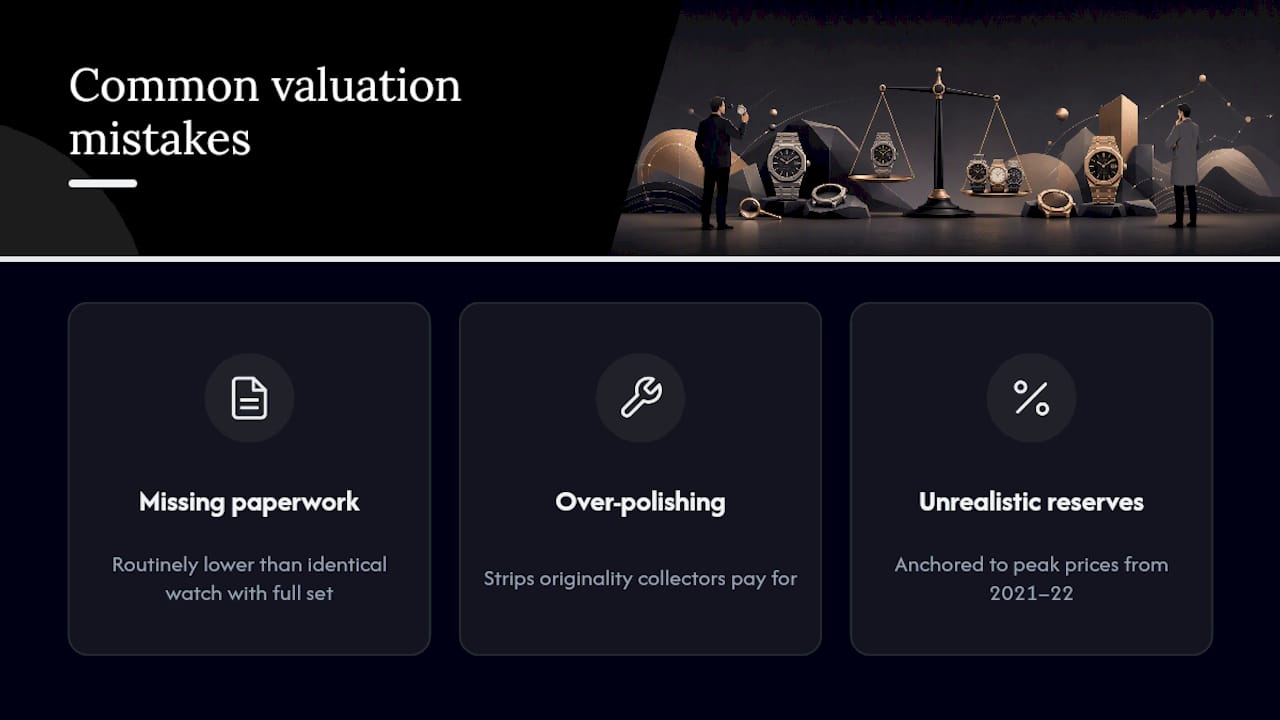
Missing paperwork is the single biggest value killer. A watch with no box or warranty card routinely values lower than an identical piece with a full set, and sellers are often surprised by how large that gap is until they see the two figures side by side. Over-polishing is the second most common issue: sellers assume a fresh-looking case adds value, when in most cases it strips originality that collectors specifically pay for. Unrealistic reserves, usually anchored to a peak-market price from 2021 or 2022, are the third recurring problem.
Any specialist you approach should authenticate a watch against AP’s own production records and offer payment through a secure, traceable method, never cash for a high-value piece. Specialist dealers typically operate as dealers in authenticated pre-owned Swiss watches, including Audemars Piguet, offering free valuations and secure bank transfers for sellers who want a discreet, verified transaction.
Why does authenticity protect your Audemars Piguet’s resale value?
Counterfeit Royal Oaks and Code 11.59 pieces have become sophisticated enough that visual inspection alone is no longer reliable, particularly for buyers purchasing outside a specialist dealer network. A watch that raises even minor authentication questions loses value immediately, regardless of how genuine it turns out to be, because buyers price in the risk of doubt itself.
This is where documentation earns its keep twice over. A full box and papers set doesn’t just support a higher price, it’s often the fastest way to clear an authenticity check, since the reference number, movement serial, and paperwork should all align without gaps. Sellers offering a watch with no documentation should expect buyers, and dealers, to ask for additional verification before committing, which slows the sale and can soften the eventual price.
Buying or selling through a specialist who authenticates against manufacturer records removes most of this friction. It’s also worth treating any deal that seems unusually cheap for the reference as a warning sign rather than a bargain; counterfeiters price to move quickly, genuine sellers rarely need to undercut the market by a wide margin. Provenance documentation practises used in adjacent collectible markets, including the way provenance is recorded and verified for fine art, follow the same underlying logic: a clear, unbroken ownership trail is what ultimately protects both buyer and seller.
Does previous ownership affect what your Audemars Piguet is worth?
Provenance matters more for Audemars Piguet than many sellers expect, though not in the way people assume. A watch’s resale value isn’t generally affected by whether it had one owner or three, but it is affected by how well that ownership history is documented and how the watch was cared for along the way.
A single-owner watch with a complete service history, purchased from an authorised dealer and serviced only by AP or an authorised centre, carries less risk for a buyer than a watch with an unclear chain of ownership, even if both are cosmetically identical. That reduced risk translates directly into a stronger negotiating position for the seller.
Celebrity or notable provenance can add a premium at auction for genuinely documented cases, but this applies to a tiny fraction of the market and shouldn’t factor into a private seller’s expectations. For the vast majority of Royal Oak and Offshore owners, the practical takeaway is simpler: keep your purchase receipt, keep your service records, and keep them together. That paper trail is your provenance, and it’s worth more to a buyer than any story you could tell about the watch.
How do economic cycles affect Audemars Piguet resale prices?
Luxury watch resale values move with broader economic conditions, but not always in the direction people expect. The speculative surge that pushed AP prices to record premiums through 2019 to 2022 was driven partly by low interest rates and excess liquidity looking for alternative assets. When that liquidity tightened, AP’s premiums came down faster than the underlying demand for the watches themselves.
Market analysts writing for Forbes frame this plainly: the “guaranteed investment” narrative around AP was a feature of that specific speculative window, not a permanent characteristic of the brand. Treating any AP watch as a reliable investment now requires model-level knowledge and a realistic holding horizon, rather than an assumption that resale value climbs automatically over time.
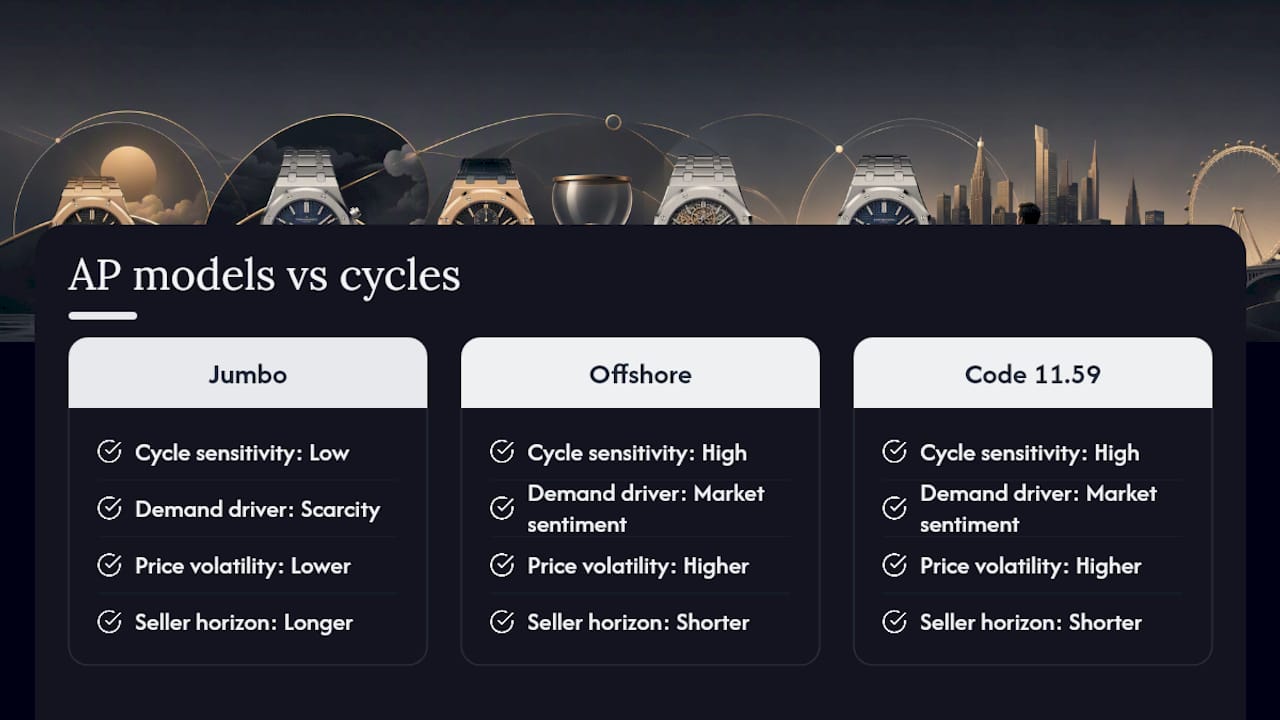
This has a practical consequence for sellers today. AP resale values, particularly outside the Royal Oak core, are more sensitive to interest rates, disposable income among collectors, and general luxury spending confidence than they were during the 2021 peak. When the wider economy tightens, discretionary luxury purchases are usually the first thing collectors delay, and that shows up in secondary market prices before it shows up anywhere else. Sellers holding a Royal Oak Jumbo have more insulation from this cycle than sellers holding an Offshore or Code 11.59, simply because Jumbo demand is driven more by scarcity than by broader market sentiment.
What tax and legal points should UK sellers consider?
Selling a personal watch in the UK generally falls under Capital Gains Tax rules, though watches are typically treated as “wasting assets” for tax purposes in most private circumstances, which can affect how any gain is assessed. Rules vary depending on how the watch was acquired, how long it was held, and whether the sale forms part of a wider pattern of trading rather than a one-off private disposal. If you’re selling a high-value piece, or several watches in a short period, it’s worth checking your position with HMRC guidance or a tax adviser rather than assuming a private sale is automatically exempt.
Legally, the main protection you need as a seller is proof of ownership and a clear, documented transaction. Keep a written record of the sale price, the buyer’s details, and the payment method, particularly for private sales where there’s no dealer paperwork to fall back on later. If you’re selling through a marketplace or to a private buyer you haven’t met before, a secure bank transfer, confirmed before the watch changes hands, protects you far more than cash or an informal payment app ever will.
None of this replaces proper advice for your specific circumstances, but it’s the baseline every seller should have covered before agreeing a price.
A model-specific market, not a brand-wide bet
The conventional pitch on Audemars Piguet, that owning any AP watch is a reliable store of value, hasn’t held up since the 2024 to 2025 correction, and treating it as still true is the biggest mistake I see sellers make. The data is clear on this point: AP fell harder than Rolex and underperformed Patek Philippe through mid-2025, and that gap traces almost entirely to weakness outside the Royal Oak lineage.
What the evidence actually supports is narrower and, frankly, more useful. If you own a Jumbo or a core 15400/15510/15500 Royal Oak, you’re holding one of the more resilient assets in the entire luxury watch category, correction or no correction. If you own an Offshore or a Code 11.59, you’re holding a genuinely excellent watch that simply isn’t behaving like an investment, and pricing your expectations against Royal Oak benchmarks will only lead to disappointment. Sellers should prioritise documentation and realistic, tracker-informed pricing over nostalgia for 2021 valuations. That’s the discipline this market now demands.
— Lewis
Get a free valuation from Horology Kings
Horology Kings gives you a route that a marketplace listing or a cold auction estimate can’t: a specialist dealer who prices your Audemars Piguet against live reference-level data, not a generic brand average, and pays out through a secure UK bank transfer rather than leaving you to manage buyer risk yourself.

Our service covers the full journey a seller actually needs: free valuations, brokerage for selling your watch, secure and discreet transactions, and a dedicated sourcing service for collectors hunting rare or discontinued references rather than selling. Starting is simple. Send photographs of your watch, including the case, dial, and any box and papers you hold, and we’ll come back with a written estimate based on current market conditions for your exact reference. If you’d rather understand your options first, our guide on what your watch is worth walks through the process before you commit to anything. Get in touch through Horology Kings to start your valuation today.
Sources
Recommended
Comments