.png)
Check the Rehaut Match: Rolex Reference Numbers for Collectors
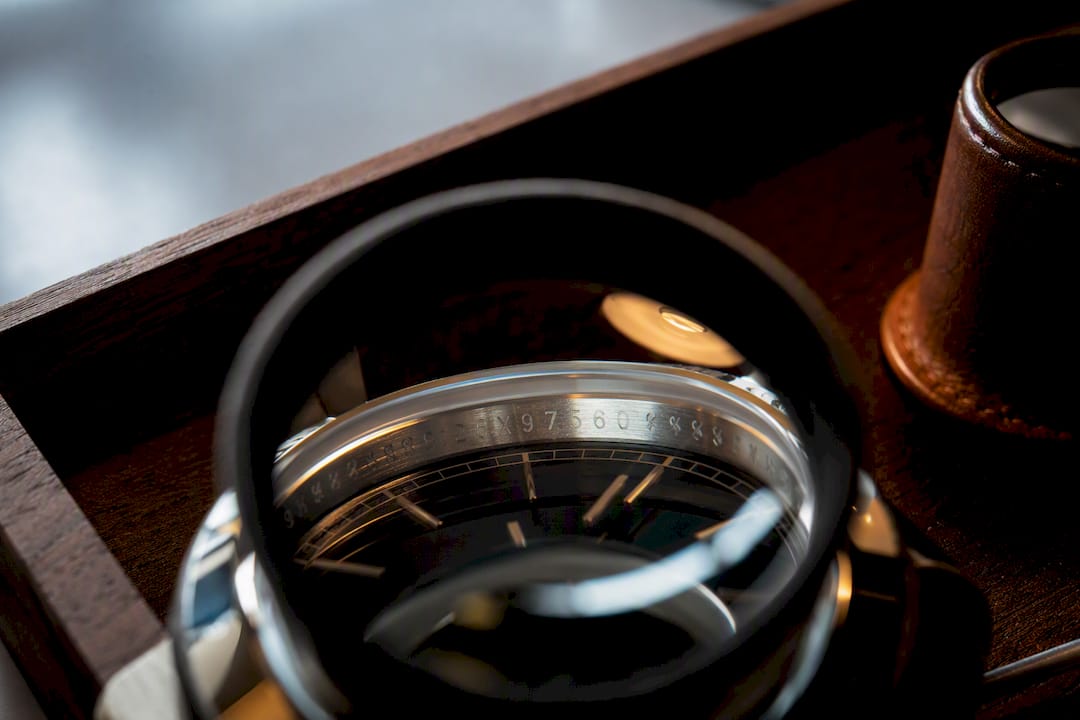
A Rolex reference number is the model’s configuration code. It identifies the family, generation, case material and any bezel or dial suffix in one string of characters. Since Rolex randomised its serial numbers around 2010, the reference has become the most reliable identifier for checking a watch’s specification, though genuinely unusual pieces still deserve a professional eye.
TL;DR:
The reference number’s leading digits indicate the Rolex model family and generation, helping to authenticate and date the watch quickly.
The final digit generally reveals the case material, with 0 for steel, 3 for two-tone Rolesor, 8 for yellow gold, and 9 for white gold or platinum variants, but exceptions apply.
Trailing letters specify bezel and crystal details, such as LN for black bezel and LV for green bezel, which can significantly affect rarity and value.
The reference number is engraved between the lugs and laser-etched on the rehaut, with the rehaut matching the case engraving as a key authenticity check.
Verifying the reference number against physical features and papers remains essential, and professional authentication is recommended for high-value or uncertain pieces.
Table of Contents
What do Rolex reference numbers actually tell you?
Every Rolex reference breaks down into three parts: leading digits, a numeric core, and often a trailing letter or two. Learn to read these blocks in sequence and you can decode almost any modern reference in under a minute.
The leading digits point to the model family and its generation. The middle and final numeric digits narrow down the case size, bracelet style and material. The trailing letters, when present, flag bezel colour, crystal type or a special dial feature. Not every reference carries a suffix, and that absence is itself informative: a bare numeric reference usually means a standard steel or precious-metal configuration with no unusual bezel.
Here’s a repeatable method for parsing any reference you encounter:
Isolate the leading block (first 2 to 3 digits) and match it against a known family, such as 116 for a Submariner-era Daytona or 126 for the current Submariner and Datejust lines.
Check the digit count. Four, five or six digits point to a rough production era, covered in the next section.
Read the final numeric digit to sanity-check the case material.
Note any trailing letters and cross-reference them against known suffix meanings.
Confirm against the physical watch (rehaut and lug engravings, papers, and dial text).
Take 116610LN: 116 marks the Submariner-Daytona generation, 610 signals the no-date Submariner in steel, and LN denotes the black Cerachrom bezel. Or 126710BLNR, the watch collectors call the “Batman”: 126 is the current GMT-Master II generation, 710 is the two-time-zone GMT configuration, and BLNR flags the blue-and-black ceramic bezel. A third example, 126234, decodes as a modern Datejust 36 in Rolesor steel and white gold with a fluted bezel, and its lack of a trailing letter reflects that the bezel style is baked into the numeric core rather than added as a suffix.
What do 4-digit, 5-digit and 6-digit references mean?
Digit count is a quick, if imperfect, way to place a watch in time. Rolex reference eras fall into three broad bands:
4-digit references — are vintage pieces, generally produced before the 1980s.
Leading digits also track generation shifts within a single family. The Submariner is the clearest example: 16610 (5-digit, produced into the 2000s) gave way to 116610 (6-digit, launched 2010) and then 126610 (current generation, launched 2020), each jump bringing a new movement, clasp or bracelet design.
Treat digit count as a guide rather than a certificate. Production runs overlap by several years at the edges of each era, and Rolex occasionally revived older reference structures for special editions. Digit count narrows the search; it doesn’t replace checking the full reference against a verified source.
Does the last digit really reveal the case material?
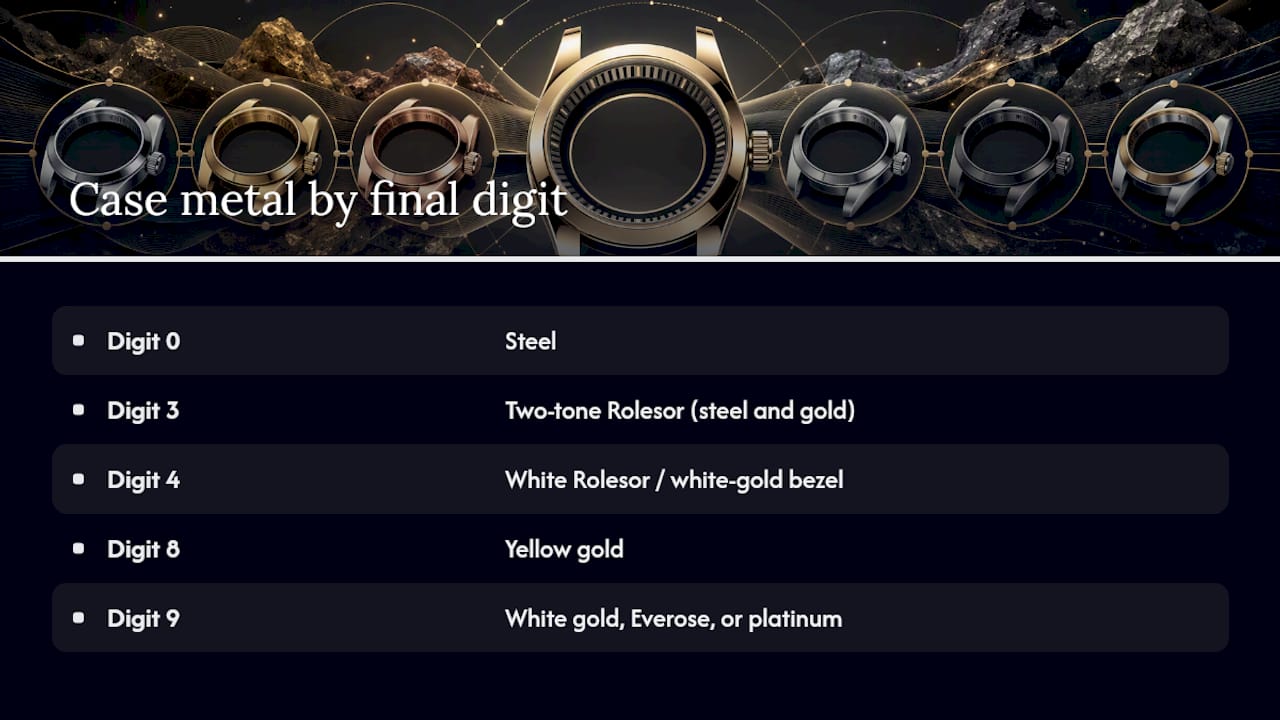
On most modern references, the final numeric digit does the heavy lifting for identifying case metal. Rolex has used this convention with reasonable consistency since the 1980s, which makes it one of the fastest sanity checks available to a buyer scanning a listing.
Quick reference: what the last digit usually means
0 = steel · 3 = two-tone Rolesor (steel and gold) · 4 = white Rolesor or white-gold bezel on a steel case · 8 = yellow gold · 9 = white gold, Everose, or platinum variants
These conventions aren’t absolute. Certain collections use their own numbering logic, and vintage references from before the 1980s don’t follow this system at all. Collectors should treat digit-to-feature mappings as working conventions rather than fixed rules, since Rolex has issued special-order pieces and shifted internal conventions between generations. Use the final digit as a first-pass check when assessing a listing or preparing a valuation, then confirm material against the physical watch and its papers before relying on it for anything financial.
What do LN, LV, BLNR and other suffix letters mean?
Trailing letters on a Rolex reference almost always describe the bezel, crystal or dial rather than the case itself. Many of these abbreviations trace back to French terms, since lunette means bezel, which explains why so many suffixes share letter roots.
LN — black bezel (from lunette noire), the most common suffix on modern Submariners and GMTs.
LV — green bezel (lunette verte), used on the “Kermit” and “Hulk” Submariners.
BLNR — blue-and-black bezel, the reference behind the GMT-Master II nicknamed “Batman”.
BLRO — blue-and-red bezel, seen on the “Pepsi” GMT-Master II.
GV — green sapphire crystal, used on select Cosmograph Daytona references.
A suffix change alters the entire meaning of a reference. 116610LN and 116610LV share the same case and movement, but one wears a black bezel and the other a green one, and that single letter shifts both rarity and resale value considerably.
One caution worth flagging: suffixes sometimes appear only in Rolex’s commercial paperwork, price lists and warranty cards rather than being engraved anywhere on the case itself. Don’t assume a missing suffix on the watch means the seller has invented it. Cross-check the description against the papers and the physical configuration instead.
Where is the reference engraved, and how do you verify it safely?
The reference number sits between the lugs at 12 o’clock, on the case flank hidden by the bracelet. The individual serial number sits in the same position at 6 o’clock. Since around 2005, Rolex has also laser-etched the reference onto the rehaut, the inner ring surrounding the dial, visible through the crystal without touching the case at all.
That rehaut engraving is your safest and most useful checkpoint, because the rehaut reference and the lug reference should always match. A mismatch is one of the clearest signs of a swapped case, a Frankenwatch build, or an aftermarket rehaut, and it’s worth walking away from a listing until that discrepancy is explained.
Follow this sequence when checking a watch in person or from photographs:
Read the rehaut reference through the crystal, no disassembly required.
Compare it against the seller’s stated reference and any papers or warranty card.
Check the dial text and bezel match what that reference should carry.
Only if you’re trained to do so, consider viewing the lug engraving; otherwise leave bracelet removal to a professional.
If anything doesn’t line up, get a specialist to inspect the case before you commit to a purchase.
Pro Tip: Removing a bracelet without proper spring-bar tools risks scratching the case or damaging the lug holes. If you need to see the lug engraving and you’re not confident doing it yourself, ask a dealer to check it rather than reaching for a butter knife.
Red flags that warrant a second opinion: a rehaut and lug mismatch, a reference that doesn’t correspond to any known Rolex catalogue entry, engraving that looks shallow or uneven compared to genuine examples, and missing or inconsistent papers for a supposedly full-set watch.
Which leading digits point to which Rolex model?
Leading digits are the fastest way to place an unfamiliar reference into a family before you dig into the specifics. The table below covers the most commonly seen starting points across current and recent Rolex lines.
This chart is representative rather than exhaustive; Rolex has reused leading digits across families at different points, so the leading block narrows your search rather than confirming it outright. Always verify the full reference, including the numeric core and any suffix, against a specialist Rolex database or a dealer before treating an identification as settled, particularly for older or unusual references you haven’t seen before.
Why professionals treat the reference as the real anchor point
Since Rolex randomised serial numbers around 2010, a serial no longer reliably tells you when a watch was made, which pushed the reference number into the role of primary configuration anchor for anyone doing this professionally. It’s the detail we check first at Horology-kings, because it holds steady even when a serial can’t be trusted for dating purposes.
We’d also add a word of caution on the physical side: prising off a bracelet to inspect the lug engraving without the right spring-bar tools risks scratching the case or damaging the lug holes, which can knock real value off an otherwise excellent watch. For anything uncertain or high-value, our valuation and authentication support exist precisely for this reason, so you don’t have to gamble a genuine piece on a DIY inspection.
Why the reference matters more than most buyers realise
Most buying guides treat the reference number as a bit of trivia, a code to translate once and forget. That undersells it. The reference is the only part of a modern Rolex that holds its meaning consistently across the watch’s life, which is precisely why it deserves more attention than the serial number gets in most casual conversations about authenticity.
The conventional advice to “check the serial” made sense before 2010. It makes far less sense now that serials carry no reliable date information. What should replace it is the habit of reading the reference block by block and checking it against the rehaut every single time, not just when something feels off.
If you take one thing from this guide, prioritise the rehaut-to-lug match before anything else. Suffix letters and material codes matter, but they’re details you correct after you’ve established the watch is genuinely what it claims to be. Get that foundation wrong and every other detail you decode is built on sand.
— Lewis
Get an expert opinion before you commit to a purchase
Decoding a reference number gets you most of the way there, but a code on a case back can’t tell you whether the movement matches the paperwork or whether a bezel has been swapped. Horology-kings backs every reading with hands-on authentication and transparent, no-obligation valuations, which is the difference between guessing at a listing and knowing what you’re actually buying.

If you’re weighing up a specific reference, our valuation service will confirm what a genuine example is worth before you buy or sell. Chasing a particular configuration you can’t find elsewhere? Our sourcing service uses an expert network to track down rare and hard-to-locate references. And if a mismatch turns up during inspection, or you’re simply not confident opening a bracelet yourself, our watch repair and servicing team can carry out safe checks and servicing on Rolex, Omega and other Swiss brands, starting from £500 for Rolex servicing. Browse our current catalogue of authenticated pre-owned watches or get in touch to start a valuation today.
Sources
Treat it as a red flag suggesting a swapped case or altered rehaut, and get the watch inspected by a specialist before proceeding with a purchase.
FAQ
How do I read a Rolex reference number?
Break it into blocks: leading digits for family and generation, the numeric core for configuration, and any trailing letters for bezel or crystal features, then confirm against the rehaut engraving.
What does the last digit in a Rolex reference mean?
It usually indicates case material, with 0 for steel, 3 for two-tone Rolesor, 8 for yellow gold and 9 for white gold, Everose or platinum, though exceptions exist on certain collections and vintage pieces.
Does a 6-digit reference mean a newer watch?
Generally yes. Six-digit references mark the current era from the mid-2000s onward, while 5-digit references cover roughly the late 1970s to early 2000s, and 4-digit references are vintage.
Where is the Rolex reference number located?
Between the lugs at 12 o’clock on the case, with the serial number at 6 o’clock, and since around 2005 also laser-etched on the rehaut behind the crystal.
Can Horology-kings verify a reference for me?
Yes. Horology-kings offers professional valuation and authentication support for buyers and sellers who need a reference and its physical configuration checked before committing to a deal.
Recommended
Comments