.png)
Collectors: Insist on a Pressure Test Certificate After Service
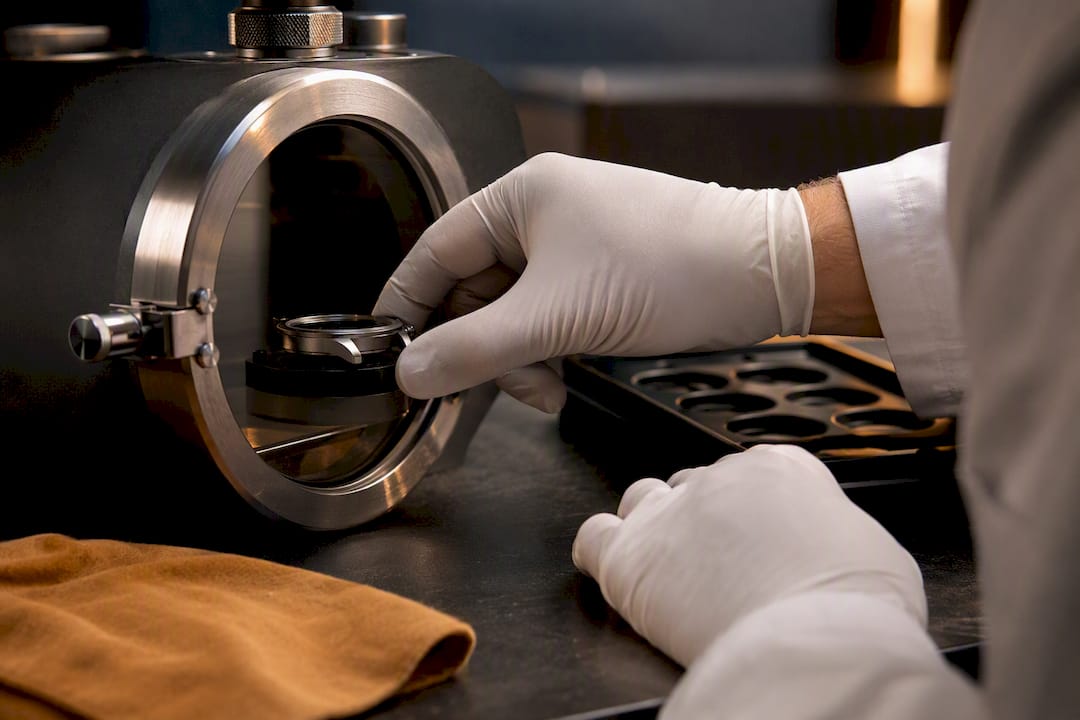
Yes, always. After any case opening, service, or repair, a pressure test is the only reliable way to confirm your watch’s seals still hold. Anything less is a guess dressed up as confidence. Before your watch leaves the workshop, ask for a pressure-test certificate or written confirmation showing the method used and the result. Without it, you have no proof your watch is safe near water.
TL;DR:
Pressure tests are essential after any open case service, impact, or exposure to moisture to ensure water resistance and seal integrity.
Dry air overpressure testing is the standard method, with wet immersion and condensation checks used if leaks are suspected or for additional verification.
Always request a detailed pressure-test certificate that documents the method, pressure value, date, technician, and outcome before leaving the workshop.
Routine testing every year for watches used near water and every two to three years for dry watches helps prevent costly water damage.
Proper aftercare, including rinsing after saltwater exposure and avoiding temperature shocks, extends the seal life and reduces the frequency of retesting.
Table of Contents
What pressure testing after service actually checks
A pressure test is a diagnostic step that confirms seal integrity, typically without exposing the movement to water at all. Dry testing measures microscopic deformation in the case under controlled air pressure, giving watchmakers a clear pass or fail result within minutes, with no risk to the movement.
The reason this matters after a service is mechanical, not theoretical. Opening a case disturbs gaskets, crown tubes, and crystal seals, and even a technician working carefully can leave a compressed O-ring or a hairline misalignment that no eye would catch. A proper service workflow replaces gaskets before reassembly, then tests the result. Skip that final check and you’re trusting the reassembly blind.
Skipping verification carries real consequences:
Moisture ingress that corrodes the movement, often invisibly, until the damage is advanced
Loss of provenance documentation that future buyers or insurers will ask for
Voided warranty cover if a fault surfaces and no test record exists
Expensive water damage repair that would have cost nothing to prevent
Dry testing, wet immersion and condensation checks explained
Workshops rarely rely on a single method. Each test answers a different question, and the best technicians combine them depending on what the watch needs.
Dry (air overpressure) testing. The watch sits in a sealed chamber where air pressure rises to match its rated depth. Sensors detect microscopic case deformation. This is the standard method for final certification because it never risks water contact.
Wet immersion diagnostics. When a dry test flags a fault, technicians move to immersion. Edox describes raising air pressure around the submerged watch and releasing it. If bubbles escape, that pinpoints exactly where the seal has failed. Devices like the Calypso wet tester are built specifically for this kind of leak-location diagnosis, letting a watchmaker replace one gasket rather than guess at several.
Condensation and thermal shock testing. The case is warmed, then a drop of cold water is placed on the crystal. If moisture is already trapped inside, the glass fogs from within. This reveals problems a dry test alone might miss.
Manufacturers use a parallel approach at production level. ISO 6425 requires an overpressure test on every individual diver’s watch, but general water-resistant watches are often verified through sample testing across a batch rather than unit by unit.
Pro Tip: If your watchmaker mentions a failed dry test, don’t panic. That’s the system working as intended, catching a problem before you find out the hard way in a swimming pool.
When your watch needs testing, and how often
Some moments make testing non-negotiable. Others are about routine discipline.
After any case opening. Servicing, battery replacement, crown or crystal repair. All of it disturbs seals, no exceptions.
After an impact. A knock against a door frame or a dropped watch can shift a gasket even if the case shows no visible damage.
After any sign of moisture. Fogging under the crystal or a sluggish date change can indicate a seal has already given way.
Before water activities. Swimming, diving, or anything beyond a splash sink or handwashing.
On a routine cycle. Roughly annually for watches worn regularly in or near water; every two to three years for watches kept mostly dry.
Diver’s watches warrant more rigorous treatment than dress watches given their intended use, which is why manufacturers hold them to individual unit testing under ISO 6425 rather than the sampling approach used for general water resistance. If you own a serious diving instrument, treat annual verification as a floor, not a ceiling.
Reading your results and the paperwork that should follow
A pass means the watch held its seal at the pressure applied during that specific test, nothing more and nothing less. It’s a snapshot, not a lifetime guarantee, which is exactly why the timing of the test (immediately after service) matters so much.
A fail changes the workflow entirely. The workshop moves to wet immersion diagnostics to locate the exact leak point, replaces the specific gasket at fault, and retests. Insist that this retest is recorded too. A fail followed by an unrecorded fix is worse than no test at all, because it creates false confidence.
Your paperwork should show:
The test method used (dry, wet, or condensation)
The pressure value or depth rating tested to
The date of the test
The technician or workshop name
An explicit pass or fail statement
Documentation matters beyond peace of mind. A documented pressure test supports resale value and buyer confidence, because a future owner or valuer can see exactly what was verified and when. Keep the certificate with your other service records.
What it costs and how long it takes
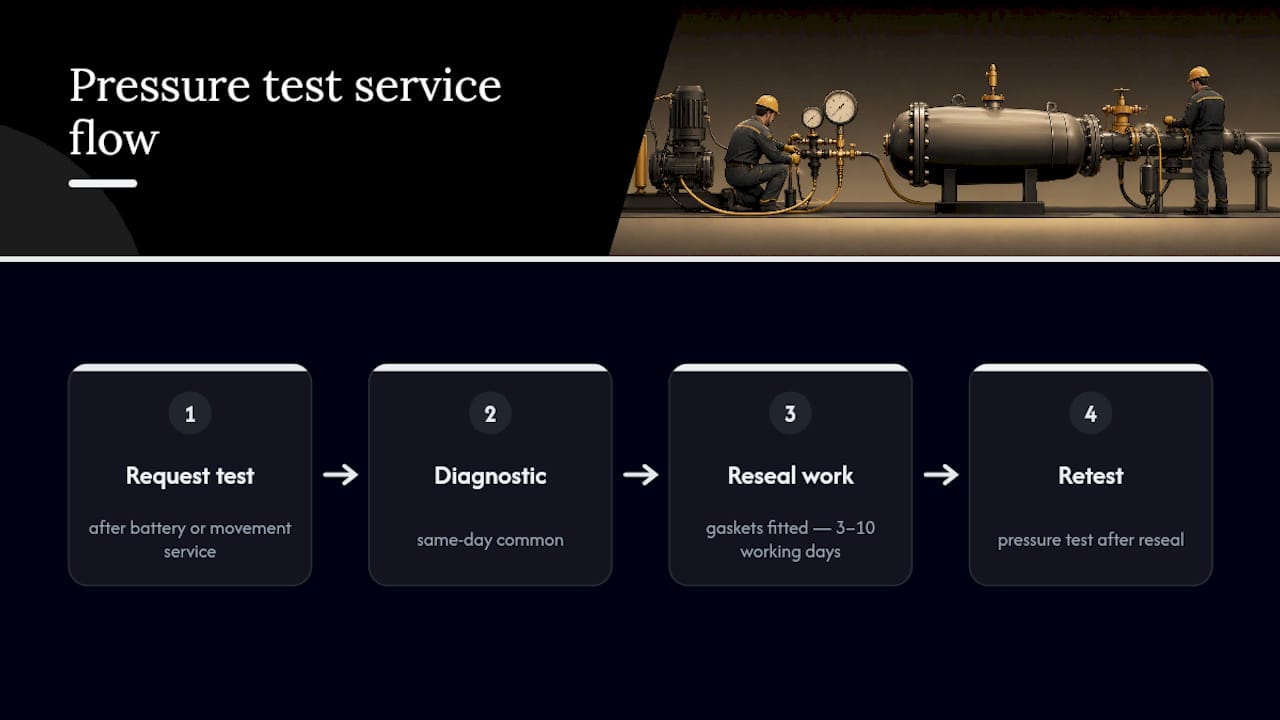
A standalone pressure test is quick and inexpensive compared with a full reseal-and-test package, since no parts need replacing if the case passes cleanly. Reseal work costs more because it includes new gasket sets and the labour to fit and verify them.
Price depends on the watch’s complexity. More seals, chronograph pushers, and screw-down crowns all add points that need checking and potentially replacing. Whether a full movement service is bundled in changes the quote significantly too.
Turnaround varies by workload. A same-day diagnostic test is common at many workshops, while a reseal-and-retest job often takes three to ten working days once gasket parts are sourced and fitted. Always ask for an itemised quote, and confirm explicitly whether pressure testing is included after a battery change, since many simple battery services skip it unless you request it.
Your checklist before collecting a serviced watch
Before you leave the workshop, work through this shortlist:
Confirm the test happened. Ask directly whether a post-service pressure test was carried out, and request the certificate on the spot.
Ask which method was used. Dry, wet, or condensation, and whether gaskets were replaced as part of the job.
Check the paperwork fields. Date, technician name, and the pressure value the watch passed at should all be present.
Watch for red flags. No documentation, vague answers about testing, reluctance to retest after a repair, or unexplained extra charges are all reasons to ask more questions before you pay.
Pro Tip: A workshop confident in its work will hand you a certificate without being asked twice. Hesitation on this point tells you more than the invoice does.
Aftercare that protects your seals between services
Good habits stretch the life of a fresh reseal and reduce how often you need retesting at all.
Check the crown and any pushers are fully closed before swimming, showering, or washing up
Rinse the case in fresh water after any exposure to salt water or chlorine
Avoid sudden temperature swings straight after immersion, such as a hot shower right after a cold swim
Keep perfume, solvents, and aftershave away from the case back and crown, as these degrade rubber seals over time
Schedule a check-up sooner than the standard interval if you swim or dive frequently
Store watches away from damp environments such as bathroom cabinets
Keep every service record and pressure-test certificate together with your ownership and provenance documents
Why this final check protects more than water resistance
Provenance is built from paperwork, and pressure test certificates are some of the most overlooked documents in a watch’s history file. At Horology-kings, reseal-and-test work is followed by documentation precisely because collectors buying pre-owned watches want proof, not assurances.
Testing intensity should match the watch. A dive watch earns aggressive, repeated verification. A dress watch worn away from water needs a lighter routine. Either way, ask your workshop exactly which test they ran, and keep the record. It’s the cheapest insurance your collection will ever have.
— Lewis
Book a reseal, pressure test and certificate with Horology-kings
Some watch workshops handle reseal-and-test work on Swiss brands including Rolex, Patek Philippe, Audemars Piguet, Omega, and Cartier, replacing worn gaskets and issuing paperwork that records the method, pressure value, and result, exactly the documentation this article has argued you should never leave a workshop without.

If your watch has been serviced elsewhere without a certificate, or you’re due a routine check before summer swimming season, get in touch through our watch repair and servicing page for a quote. Collectors looking to add a verified, documented piece to their collection can also explore our sourcing service for hard-to-find models acquired with full provenance. Every transaction runs through secure UK bank transfer, with valuations handled by specialists who understand why a certificate matters as much as the watch itself.
Sources
FAQ
Does a battery change require a pressure test?
Yes. Opening the case back to replace a battery disturbs the case seal, so a pressure test afterwards confirms the watch is still water-resistant.
How long does a pressure test take?
A standalone dry test typically produces a result within minutes, while a full reseal-and-retest job often takes three to ten working days depending on parts and workload.
What happens if my watch fails a pressure test?
The workshop moves to wet immersion diagnostics to locate the exact leak, replaces the faulty gasket, and retests the watch before returning it.
Should I ask for a certificate after every service?
Always. A pressure-test certificate showing the method, pressure value, date, and technician name protects your warranty claim and supports resale value later.
Do diver’s watches need testing more often than dress watches?
Yes. Diver’s watches are built and tested to individual ISO 6425 standards given their intended use, so annual verification is sensible, while dry-use dress watches can often wait two to three years between checks.
Recommended
Comments