.png)
Build a secure watch selling workflow: step-by-step guide
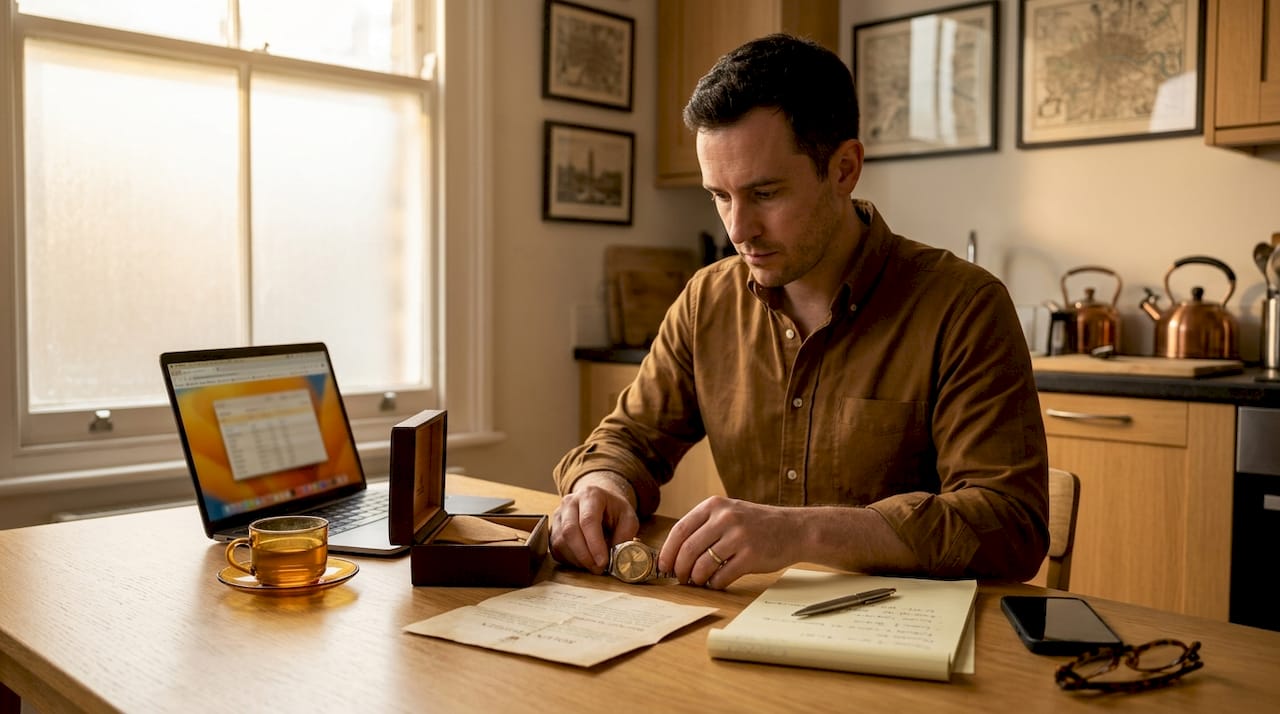
TL;DR:
A structured, security-first workflow is essential to safely sell high-value watches.
Collect all provenance documents, authenticate the watch, and choose reputable selling platforms.
Follow strict procedures during transaction, shipping, and post-sale to prevent fraud and disputes.
Picture this: a collector in London spends three years tracking down a pristine Patek Philippe Nautilus, finally sells it through an ad platform, ships it with basic postal cover, and receives a payment that bounces four days later. The watch is gone. The money never arrives. That scenario is not a cautionary tale from a decade ago; it is happening right now, and it will keep happening to sellers who treat a £30,000 transaction the same way they would sell a second-hand laptop. A structured, security-first workflow is the single most reliable way to protect your asset, your reputation, and your peace of mind.
Table of Contents
Key Takeaways
Point | Details |
Prepare thorough documentation | Having every original paper and certificate ready deters fraud and speeds up your sale. |
Follow a verified process | A structured workflow with authentication checks reduces risk and builds buyer trust. |
Insist on secure payments | Only finalise the deal after using safe payment methods and confirming cleared funds. |
Stay discreet and professional | Protect your privacy throughout the selling process with expert guidance and careful record keeping. |
What you need before you start
Good preparation is the foundation of every safe sale. The moment you decide to sell, gather every piece of documentation associated with the watch. This stage feels administrative, but it has direct financial consequences: a Rolex Submariner with full box, papers, and service records can command a premium of 15 to 30 per cent over the same reference sold without them.
The essential documents to collect are:
Original box and inner packaging (retain all foam inserts and outer sleeve where possible)
Warranty card or certificate of authenticity, with the dealer’s stamp and purchase date
Service records from authorised centres, showing dates and work completed
Original receipt or proof of purchase
Any correspondence or certificates from the manufacturer regarding special editions or bespoke commissions
Insurance documents if the watch was individually appraised and covered
Preparation of necessary documentation is crucial for a secure sale process, and sellers who shortcut this step routinely accept lower offers or encounter buyer disputes further down the line.
Once your documents are in order, address the watch itself. Clean it with a soft, lint-free cloth — never an abrasive — and photograph it in natural light from multiple angles. Capture the dial, case, caseback, bracelet clasp, and any visible wear. Honest, high-resolution images protect you legally and disqualify frivolous returns. Write a condition description that is precise: “hairline scratches on the case at 9 o’clock” is infinitely more credible to a serious buyer than “minor wear consistent with age.”
Document | Why it matters | Impact on sale value |
Box and papers | Proves provenance and authenticity | +15 to 30% premium |
Service history | Confirms mechanical reliability | Builds buyer confidence |
Purchase receipt | Verifies ownership chain | Reduces fraud disputes |
Insurance appraisal | Establishes agreed market value | Supports pricing |
Pro Tip: Before listing your watch, obtain a written valuation from a reputable specialist. It sets a defensible asking price and signals to buyers that you are a serious, informed seller.
Your choice of platform matters as much as your paperwork. A specialist dealer, a curated marketplace, or a reputable auction house all offer more structural protection than a generic classified site. Start preparing your watch for sale with that platform selection in mind, because certain buyers only frequent certain venues.
Step-by-step secure selling workflow
With your materials prepared, you can now move through each stage of the sale itself with clarity and control.
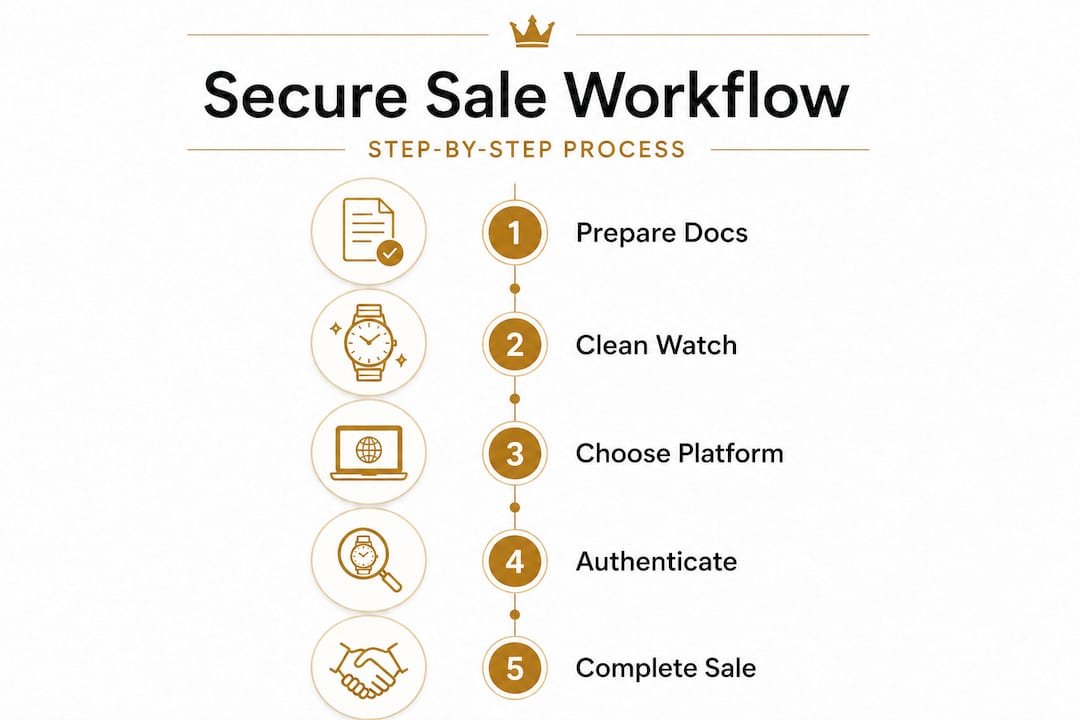
Authenticate your watch formally. Commission an independent authentication report before listing. This removes ambiguity, satisfies serious buyers immediately, and gives you documented evidence of the watch’s legitimacy.
Select your selling platform carefully. Compare options: specialist dealers, peer-to-peer luxury marketplaces, and auction houses each carry different levels of seller protection, fee structures, and audience reach.
Create a compelling, accurate listing. Use all photographs, condition notes, and documentation references. Transparency here is a selling strategy, not just a safety measure.
Vet prospective buyers before engaging. Ask questions. Request verified profiles or references. Buyers who resist reasonable identification steps are a warning sign.
Communicate exclusively through secure, traceable channels. Avoid moving conversations to personal email or messaging apps outside the platform. Keep a written record of every exchange.
Agree terms in writing before handover. Confirm the price, payment method, handover method, and timeline in a written exchange that both parties acknowledge.
Use insured, specialist courier services for shipping. Standard postal insurance caps are rarely sufficient for a watch worth tens of thousands. Use a specialist fine art and jewellery courier with declared value cover.
Confirm cleared funds before releasing the watch. For bank transfers, wait until the funds have fully cleared, not just appeared as pending.
Structured workflows combat fraud and ensure safe transactions, particularly when sellers document each step and keep copies of all communications.
Selling method | Seller protection | Typical fees | Best for |
Specialist dealer | Very high | 10 to 20% commission | Fast, secure, hassle-free |
Peer-to-peer marketplace | Moderate | 5 to 12% + payment fees | Direct sales with some oversight |
Auction house | High | 15 to 25% buyer’s premium | Rare or highly sought references |
Private classified | Low | Minimal or none | Experienced sellers only |
Pro Tip: If selling watches online securely is your preferred route, choose a platform that holds payment in escrow until both parties confirm the transaction is complete. That single feature eliminates the most common payment fraud scenario.
The comparison above shows clearly that lower fees often mean lower protection. For a watch valued above £10,000, even a 15 per cent dealer fee is modest when weighed against the financial and emotional cost of a fraudulent transaction.
Authentication and fraud prevention
With your workflow in place, rigorous authentication is your most powerful tool against fraud. The counterfeit luxury watch market is substantial: estimates suggest that replica watches account for a significant share of seized counterfeit goods globally, which means buyers in your target market are rightly cautious, and you should be too, particularly if a buyer approaches you with a watch they wish to exchange as part payment.
The key authentication steps are:
Serial and reference number verification: Cross-check the serial number on the caseback with manufacturer records. Mismatched or re-engraved serials are an immediate red flag.
Movement inspection: A qualified watchmaker should open the caseback and verify the calibre against the watch’s specifications. Replacement movements are a common fraud vector.
Dial and hands examination: Under magnification, printing irregularities, misaligned indices, or incorrect fonts are visible on counterfeits that look convincing to the naked eye.
Weight and finishing check: Genuine luxury watches have a specific heft and a depth of finishing that is very difficult to replicate economically.
Third-party certification: Services such as Rolex-authorised service centres, independent horological experts, and specialist appraisers all issue certificates that carry weight with buyers.
Use a watch authentication checklist at every stage: when you acquire the watch, when you list it, and again if a buyer requests a viewing.
A word of warning: If a buyer is rushing you, offering above your asking price without negotiation, or insisting on payment through an unverified digital wallet, those are not signs of enthusiasm. They are established fraud tactics. Legitimate buyers of high-value watches understand that due diligence takes time.
The complete luxury watch authentication guide covers red flags in granular detail, but a practical summary is this: anything that creates artificial urgency or deviates from standard, traceable payment and handover methods deserves immediate scrutiny.
Executing discreet and expert transactions
Once authentication is confirmed, the focus shifts to keeping your transaction private, professional, and protected from start to finish.
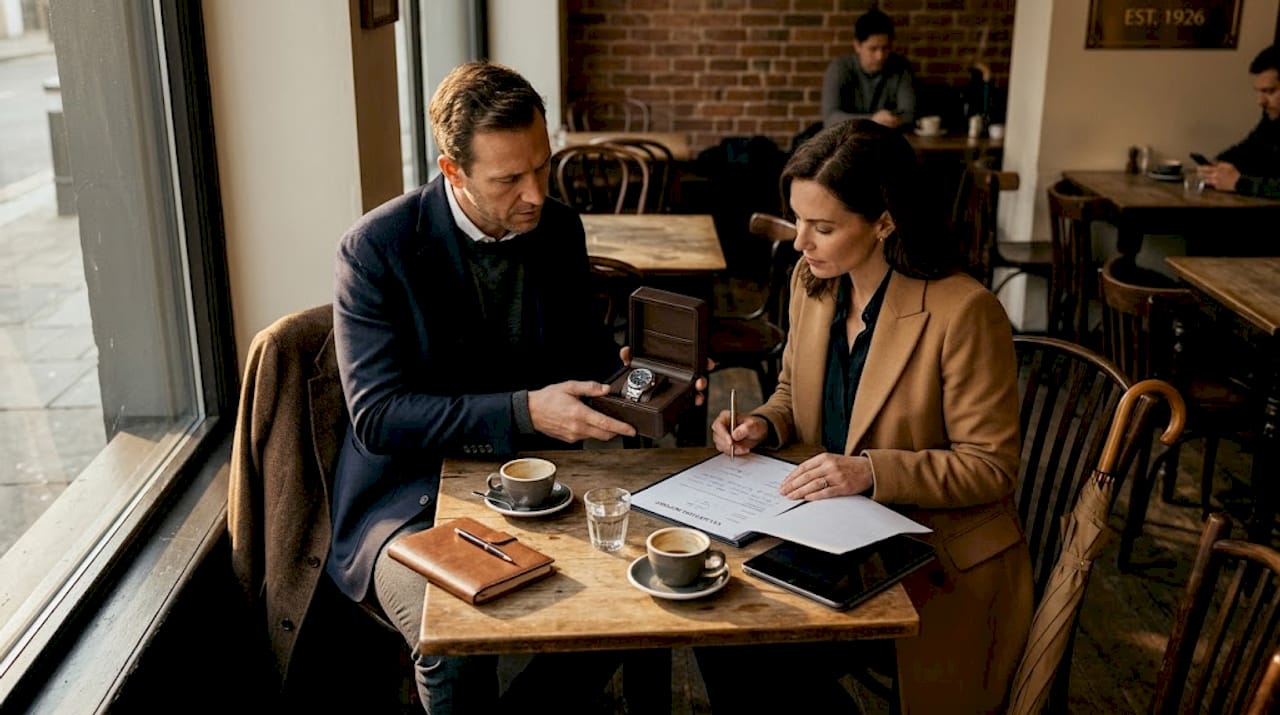
Privacy is not paranoia; it is prudent practice. Sellers of high-value watches should never publish their home address, share precise storage locations, or discuss the transaction publicly on social media. The risks are not limited to online fraud; a visible, publicised sale can attract opportunistic theft.
Key principles for a discreet transaction:
Use a neutral meeting location such as a bank branch, a solicitor’s office, or a reputable dealer’s premises for in-person handovers. Never your home.
Engage a trusted third party to oversee the exchange if you are selling privately. A dealer or solicitor acting as intermediary adds a layer of accountability.
Choose payment methods with documented protection. UK bank transfers (CHAPS or BACS) are traceable and offer recourse through your bank if fraud occurs. Cash is untraceable and should only be considered for very low-value items with appropriate anti-money-laundering checks.
Retain every record. Screenshot conversations, save payment confirmations, and file transaction documents alongside your watch’s provenance paperwork.
Research consistently shows that expert-led, discreet selling enhances both security and seller trust, particularly for watches valued above £15,000 where buyer scrutiny is highest.
A statistic worth noting: according to industry data, transactions conducted through specialist dealers or supervised third parties have significantly lower dispute and fraud rates than those arranged purely between private individuals through unregulated classifieds.
Pro Tip: When arranging a viewing at a neutral location, bring a trusted companion and inform someone of your plans. Never carry a high-value watch alone to an unfamiliar location to meet a buyer you have only communicated with online.
For guidance on staying safe selling watches, the consistent recommendation from experienced sellers is simple: treat every transaction as if it were your first. Complacency is the most common route to a costly mistake.
What to do post-sale and red flags to watch for
Completing the sale is not the end of your responsibility. The period immediately after a sale is when several fraud attempts occur, including chargebacks, disputed ownership claims, and requests to reverse payment due to manufactured “damage” claims.
Post-sale essentials:
Wait for full clearance before releasing the watch. A payment showing as “pending” is not a payment. With bank transfers, contact your bank to confirm the funds are irrevocably cleared.
Issue a signed receipt to the buyer confirming the watch’s condition at the point of handover, verified by both parties.
Keep all documentation for at least six years. This aligns with standard legal limitation periods in England and Wales and ensures you have recourse if a dispute surfaces later.
Notify your insurer that the watch has been sold, particularly if it was on a specialist policy.
Red flag alert: If a buyer contacts you after the sale claiming the watch arrived damaged when you have photographic evidence of its condition at dispatch, do not engage emotionally. Document everything, contact your courier’s insurance team, and if fraud is suspected, report it to Action Fraud (the UK’s national fraud and cybercrime reporting centre) without delay.
Following up post-sale helps prevent future issues and supports a safe, complete transfer of ownership. Sellers who skip this stage are vulnerable to challenges that proper documentation would immediately resolve.
Be equally alert to buyers who attempt to renegotiate terms after payment is initiated, request a delayed release of the watch pending a “verification process” they control, or ask you to accept an amended payment method without clear justification. Any change to agreed terms after the sale begins should prompt you to pause and seek professional advice from your dealer, solicitor, or the platform’s dispute team.
The truth about secure workflows: what collectors miss
Here is the part most articles do not say plainly enough: the majority of failed or fraudulent watch transactions are not caused by obvious scams. They are caused by sellers who do 80 per cent of the work correctly and then relax at the finish line.
We see this pattern regularly. A seller gathers their paperwork, photographs the watch beautifully, and lists it on a reputable platform. Then, under the pressure of a persuasive buyer, they accept a payment method they are unfamiliar with, release the watch before funds are confirmed, or skip the written agreement because “it felt rude to ask.” That final 20 per cent is where the risk lives.
What genuinely experienced collectors understand is that a secure workflow is not a series of boxes to tick. It is a mindset that holds firm all the way through to post-sale documentation. The discipline required is not extraordinary; it just demands consistency. The moment you make an exception, you create a vulnerability.
There is also a reputational dimension that rarely gets discussed. Sellers who operate with rigour build a word-of-mouth reputation that attracts better buyers at better prices. In the relatively small world of serious horology, your name travels. Handling a expert advice on discreet watch selling with professionalism is not just about protecting this sale; it is about ensuring the next one goes even more smoothly. A robust workflow is an investment in your standing as a trusted participant in the market, not merely a defence mechanism.
Take the next step with secure watch selling
Selling a luxury watch should be a rewarding experience, not a source of anxiety. Whether you are parting with a cherished Rolex or liquidating part of a broader collection, the process deserves professional handling at every stage.
At Horology Kings, we have built our entire service around making secure watch selling straightforward for UK sellers. From initial valuation and authentication through to discreet handover and secure UK bank transfer payment, every step is managed by specialists who understand the market and the risks. We also offer sourcing a luxury watch if you are looking to reinvest the proceeds into a specific reference. Our team handles the complexity so that you can focus on what matters most: getting the right result with complete confidence.
Frequently asked questions
What documents are essential for a secure luxury watch sale?
You should have the original box, papers, service history, and proof of ownership; documentation is crucial for establishing provenance and protecting both parties throughout the transaction.
How can I verify a potential buyer is trustworthy?
Research the platform’s verification systems, request references where possible, and only communicate through secure, traceable channels to reduce fraud risks; structured due diligence at the buyer-vetting stage prevents the majority of scam attempts.
What is the safest way to receive payment for a luxury watch?
A UK bank transfer (CHAPS) or a reputable escrow service offers the strongest protection; never release the watch until funds are fully cleared and confirmed by your bank.
What should I do if something seems suspicious during a sale?
Pause the transaction immediately, preserve all written communications, and report concerns to Action Fraud or seek advice from a specialist dealer; following up on suspicious activity promptly is far easier than recovering losses after the fact.
Recommended
Comments