.png)

Discover independent watchmakers: True craftsmanship explained
- lewisvrichards3
- May 3
- 9 min read
TL;DR:
Independent watchmakers produce highly limited, handcrafted timepieces free from corporate control.
They emphasize craftsmanship, in-house development, and direct relationships with clients.
Collectors value their rarity, unique stories, and artisanal quality over mainstream luxury brands.
Most people assume that luxury watches come exclusively from the great Swiss conglomerates. The truth is far more fascinating. A small but passionate community of independent watchmakers works in relative obscurity, producing pieces in numbers so limited they make a Patek Philippe feel mass-market. Roger Smith produces as few as two dozen handmade watches per year from his Isle of Man workshop, continuing a tradition that changed British horology forever. This guide explains what makes independent watchmakers genuinely different, why serious collectors seek them out, and how you can begin to appreciate or even acquire their work.
Table of Contents
Key Takeaways
Point | Details |
True artisanal craft | Independent watchmakers create limited pieces using traditional, hands-on methods. |
Collector appeal | Collectors value independent watches for their rarity, craftsmanship, and deeper connection to the maker. |
Different from mainstream | Independents focus on creativity, manual work, and bespoke features over mass production. |
Sourcing advice matters | Working with experienced partners helps navigate the niche world of independent watches. |
What defines an independent watchmaker?
The term gets used loosely, so let’s establish a clear definition. An independent watchmaker is an artisan or very small studio that designs, manufactures, and finishes timepieces without the financial or operational control of a major conglomerate. They are not part of the Swatch Group, LVMH, or Richemont. They answer to no parent brand. Every creative and technical decision belongs to them alone.
This independence carries real weight. It means no compromises driven by production targets or quarterly earnings. It means the watchmaker can spend six months perfecting a single finishing technique without a board of directors questioning the decision. The creative freedom is extraordinary, and it shows in the finished product.
“Independent watchmaking is strongly associated with hands-on, low-volume craftsmanship and in-house development — a return to the methods collectors regard as the true heart of horology.”
The lineage of British independent watchmaking flows directly from the late George Daniels, perhaps the most important horologist of the twentieth century. Daniels invented the co-axial escapement and made his watches almost entirely by hand, alone. His protégé Roger Smith carries that tradition forward today. These are not simply small brands; they represent a living philosophy about what a watch should be.
For collectors interested in building a diverse collection, understanding independent watchmakers is essential. Their pieces occupy a category that mainstream brands simply cannot replicate, offering something profoundly different in both character and provenance.
What draws collectors to these makers is rarely just the object. It is the story, the scarcity, and the knowledge that a single pair of skilled hands touched every component. The collectibility is inseparable from that reality.
How independent watchmakers create: The process and philosophy
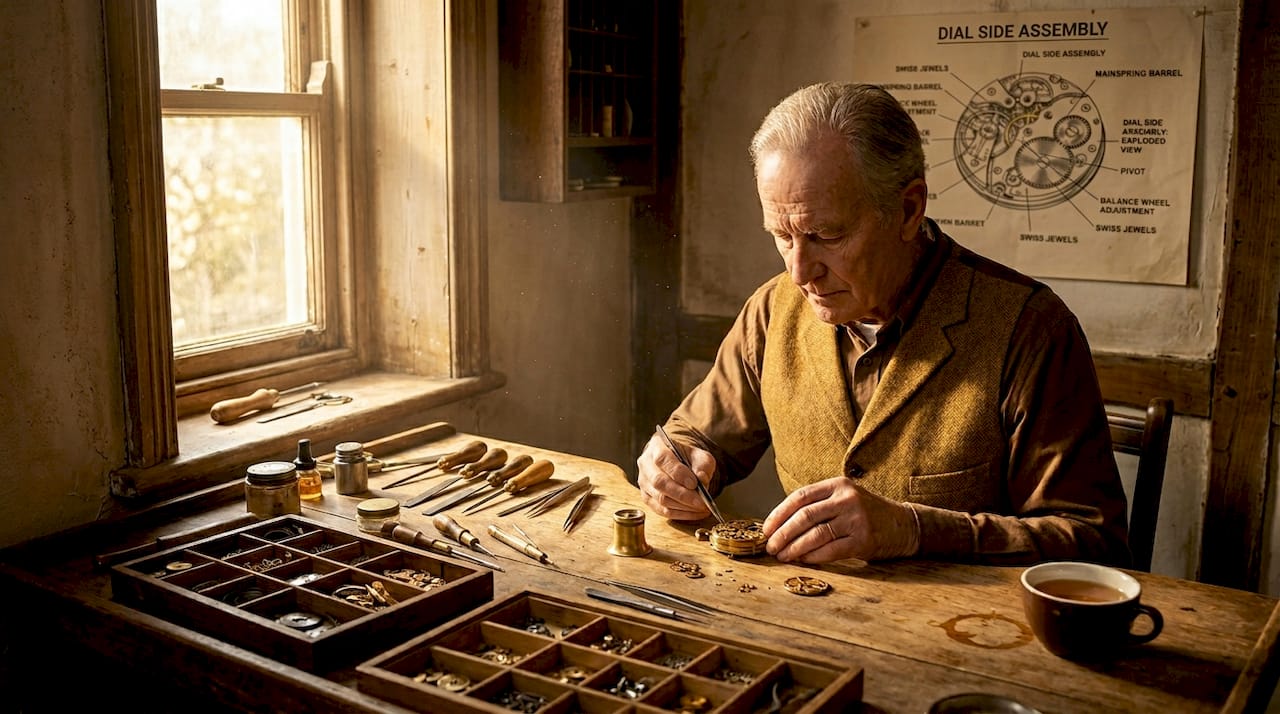
Step inside the workshop of a true independent and you enter a different world. There are no conveyor belts. No automated polishing machines humming in the background. What you find instead is silence, concentration, and an almost intimidating level of skill applied to objects you could hold in your palm.
The journey from concept to finished watch typically follows this sequence:
Design and movement architecture. The watchmaker sketches the movement layout, deciding how many components are needed, how the energy will flow, and what finishing style will define the piece. This stage alone can take months.
Raw component manufacture. Unlike brands that buy ébauches (pre-made movement blanks) from suppliers, many independents cut their own plates, wheels, and bridges from raw brass or steel. The tolerances are astonishing, often measured in microns.
Escapement development. The escapement is the heartbeat of the watch. Independents frequently develop their own, as Daniels did with his co-axial design. Roger Smith continues to refine escapement geometry with each new series.
Hand-finishing. Every surface is treated: anglage (bevelling), polishing, and decorative techniques like perlage (a circular graining) or côtes de Genève (Geneva stripes) are applied by hand using tiny tools.
Case and dial work. Many independents also make or heavily modify their cases, creating dial designs that complement the movement’s aesthetic rather than simply housing it.
Assembly and regulation. The watch is assembled, worn in, tested, and regulated by hand over several weeks before it reaches the owner.
Roger Smith runs Britain’s only fully handmade-watch business, producing approximately two dozen pieces per year. That number is not a marketing choice. It is the physical limit of what one workshop can achieve at the standard he demands.
Pro Tip: When evaluating any independent watchmaker, ask to see photographs or video of the movement before finishing. A truly independent maker will be proud to show you raw components and the progression from blank to completed calibre. Reluctance to share this detail is a warning sign.
“The philosophy is simple: a watch made entirely by one person, or a very small team, carries a kind of integrity that no production line can manufacture.”
You can find further insight into both mainstream and independent perspectives on our watchmaker insights blog, where we regularly explore the distinctions that matter to serious collectors.
The challenges are real and underappreciated. Independent watchmakers carry every risk themselves. A failed component might mean weeks of rework. A commission delayed by technical challenges cannot be solved by simply pulling from stock. The devotion required is extraordinary, which is precisely why so few succeed at this level.
Independent versus mainstream: A comparison
Understanding the contrast between independent watchmakers and the great Swiss houses helps collectors make genuinely informed decisions. The differences are not simply about price or prestige; they run far deeper.
Feature | Independent watchmaker | Mainstream luxury brand |
Annual production | Typically fewer than 100 pieces | Tens of thousands to millions |
Movement origin | Largely or entirely in-house | Often bought-in or partially outsourced |
Personalisation | Frequently available | Rarely offered |
Direct maker contact | Often possible | Virtually impossible |
Finishing quality | Almost entirely by hand | Mixed: hand and machine |
Waiting list | Sometimes years | Months or immediate |
Resale market | Specialist and emerging | Well-established and liquid |
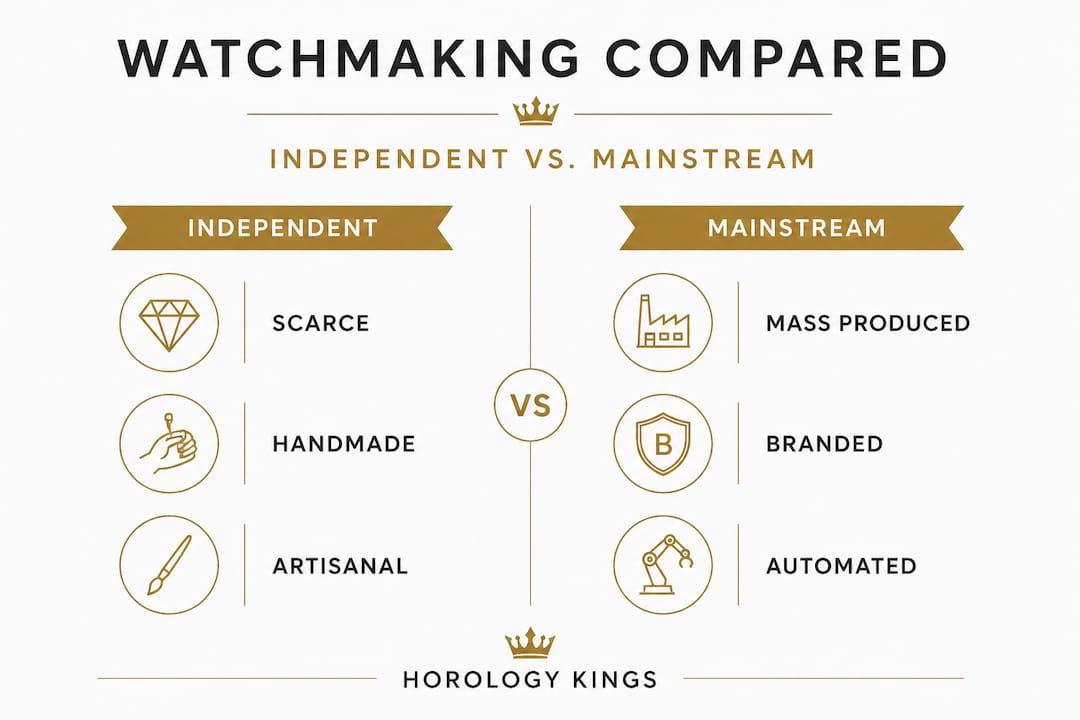
The scarcity column deserves particular attention. When collectors frame independent watchmaking as a return to traditional methods, they are responding to something real: the knowledge that their watch is one of perhaps twenty made that year, not one of twenty thousand.
Personalisation is another area where independents genuinely excel. Several makers will discuss dial colours, case metal choices, and even movement decorations directly with their clients. That level of dialogue is simply not available when purchasing from a boutique of a global brand.
Key advantages of independent pieces at a glance:
Exceptional and documented hand-finishing throughout the movement
Direct relationship with the creator or small studio
Extreme scarcity, supporting long-term desirability
Unique designs free from commercial trend pressure
Provenance that can often be traced to a single pair of hands
When approaching any significant purchase in this space, understanding secure luxury transactions is important. The secondary market for independents is less liquid than for Rolex or Patek Philippe, which means verifying provenance and dealing with reputable partners matters enormously.
For those drawn to the idea of owning something genuinely rare, limited editions explained provides a useful framework for understanding how rarity functions across the broader luxury watch market, which applies to independents in amplified form.
The investment angle is genuinely complex. Some independent pieces appreciate sharply, particularly when the maker gains wider recognition or passes away. Others remain specialist items with a relatively small pool of potential buyers. Collectors who buy purely for investment without understanding or loving the piece often regret the decision.
Why collectors choose independent watchmakers
Speak to any serious collector who owns an independent piece and you will hear the same thing: it changes how you think about watches. Fundamentally.
There are emotional reasons and practical ones. The two categories overlap in ways that make the decision both rational and deeply personal.
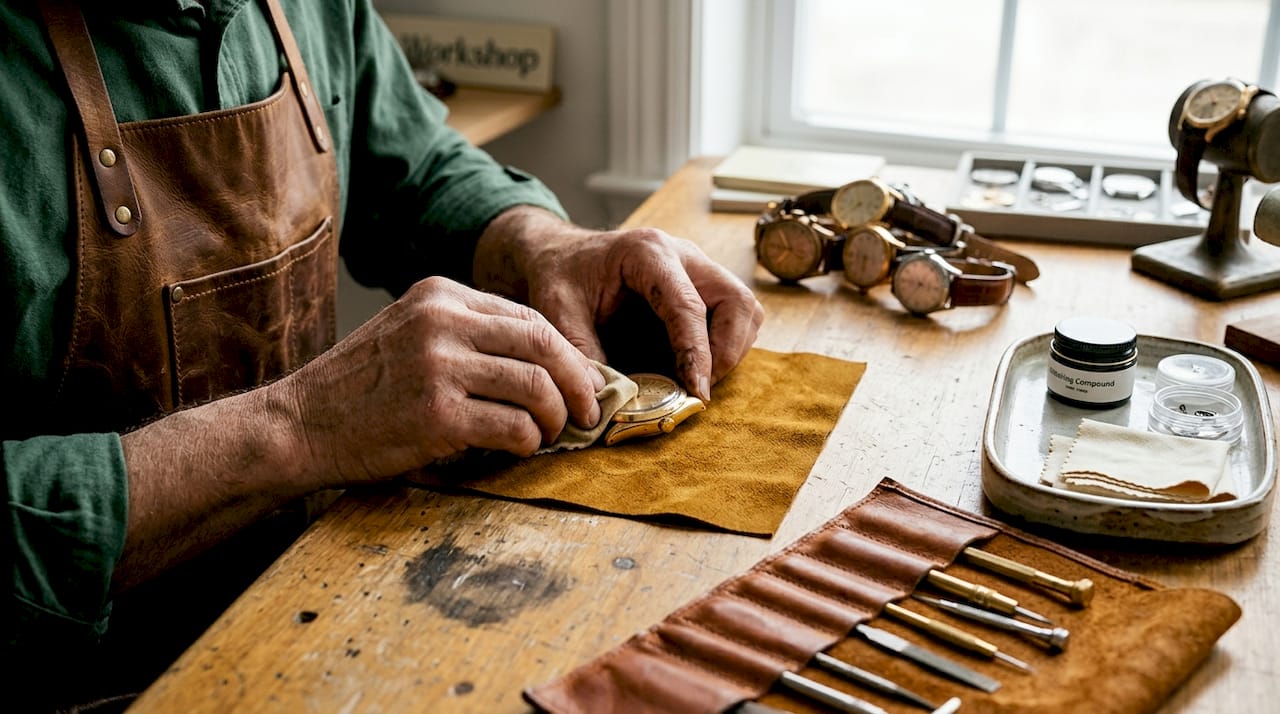
Handmade pieces produced in such limited numbers reflect a level of craftsmanship and passion that transforms the watch from an object into a relationship. Owners often know the maker’s name, their philosophy, their story. That knowledge makes wearing the piece entirely different from wearing a production luxury watch.
Here is what typically drives collectors towards independents:
Motivation | What it means in practice |
Rarity and exclusivity | Owning one of fewer than 25 made that year |
Artistic appreciation | Valuing a movement as a visual and mechanical art form |
Direct connection | Corresponding with or visiting the maker |
Story and provenance | A fully documented history from raw material to wrist |
Differentiation | Standing apart from the collector mainstream |
Pro Tip: Before committing to an independent purchase, research the maker’s training, their movement architecture, and any published reviews of their work from credible horological journals. The best independents welcome scrutiny.
For those new to sourcing these pieces, start with our guide to sourcing rare luxury watches, which covers practical strategies for finding pieces that rarely appear on open markets. Understanding current values is equally important, and our watch valuation guide will help you assess what you are actually paying for relative to comparable pieces.
Here are four practical steps for pursuing your first independent acquisition:
Research the maker’s output thoroughly before approaching them. Understand their current series, previous work, and any notable technical innovations.
Contact the studio directly where possible. Many independents are accessible in a way no mainstream brand ever could be, and a conversation reveals both character and availability.
Engage a specialist sourcing partner for secondary-market pieces. Independent watches rarely appear on open platforms and often change hands through specialist networks.
Verify condition and provenance meticulously. Because independent pieces are so rare, documentation matters intensely. Service records, original packaging, and correspondence with the maker all add value and reassurance.
The reality of collecting: Beyond the hype
Here is something the horological press rarely admits: acquiring an independent watch is often genuinely frustrating before it becomes wonderful. The waiting lists are real. Some makers are not particularly communicative. Pricing can feel opaque. And the secondary market, though improving, remains thin compared to mainstream luxury.
We have spoken with collectors who waited three years for a commission, only to find the piece needed immediate regulation upon arrival. None of them regret the experience, but none of them would describe it as straightforward either. That honesty matters.
Roger Smith’s tradition is a rare exception in the UK, illustrating the immense skill and commitment required to work at this level. Most attempts at this kind of independent watchmaking simply do not survive. The economics are brutal. The physical demands are significant. The patience required of both maker and collector is considerable.
Yet the ownership experience, once the piece arrives, is unlike anything else in horology. Owners engage with their watches differently. They read about the movement architecture. They seek service from someone who genuinely understands the calibre. They feel a responsibility to the object that comes from knowing how many hours of skilled human work went into its creation.
The scarcity that makes these pieces desirable also makes ownership feel meaningful in a way that broader luxury simply does not. When you own one of twenty watches made in a given year, you are participating in something genuinely rare. That is a responsibility as much as a pleasure.
We always recommend authenticating any luxury watch before purchase, and this is doubly important with independents. Because they are produced in such small numbers and sold through informal channels, the risk of misrepresentation, whether accidental or deliberate, deserves serious attention. Work only with partners who can provide full documentation and who welcome independent verification.
The joy of collecting at this level is not just ownership. It is the education you acquire along the way. Every independent piece teaches you something about horology you did not know before.
Discover and source your next independent timepiece
Finding an independent masterpiece requires more than a wish list. It requires trusted partnerships, specialist knowledge, and access to networks that most collectors never see.
At Horology Kings, we work with serious collectors across the UK who are ready to move beyond the mainstream. Whether you are pursuing your first independent piece or expanding an existing collection, our expertise connects you to horology buying and sourcing that goes well beyond what any open marketplace can offer. Our team understands provenance, condition, and market dynamics across both established brands and the growing world of independent makers. If you have a specific piece in mind, our dedicated source a watch service leverages an expert network to locate pieces that rarely surface publicly. Let us help you find something genuinely worth owning.
Frequently asked questions
Are independent watchmakers more expensive than mainstream luxury brands?
Independent watchmakers often command higher prices due to labour-intensive manual work, extreme rarity, and fully in-house expertise. Handmade pieces produced in limited numbers reflect the true craftsmanship collectors desire, which naturally carries a significant premium.
How can I verify the authenticity of a watch from an independent maker?
Ask for full provenance documentation, service records, and any correspondence with the studio. Many independent makers also offer direct verification, and some maintain registries of every piece they have produced.
Is investing in independent watches a good choice?
Some independent pieces appreciate substantially, particularly when makers gain recognition or their output is further restricted. However, collectors frame independent watchmaking as a return to craft first and a financial decision second; buying purely for returns without genuine appreciation is a risky approach.
What makes a watchmaker officially ‘independent’?
An independent watchmaker operates without control from major conglomerates, focusing on small-scale artisanal output with significant in-house component development. Independent watchmaking is strongly associated with hands-on, low-volume craftsmanship and a personal approach to every timepiece produced.
Recommended
Comments