.png)

Condition grading's role in watch pricing explained
- lewisvrichards3
- 3 days ago
- 8 min read
TL;DR:
Condition grading profoundly influences the resale value of luxury watches, with higher grades achieving significantly higher prices. Accurate assessment involves visual inspection, service documentation, and understanding originality, as overpolishing and component replacements decrease worth. Transparent grading supported by detailed images and records enhances buyer trust and expedites sales.
Condition grading is the structured assessment of a luxury watch’s physical and mechanical state, and it directly determines resale price. The role of condition grading in watch pricing is not a secondary consideration. It is the primary variable that separates a Rolex Submariner priced at £12,000 from an identical reference selling for £8,500. Grades such as Mint, Excellent, Good, Fair, and Poor are the industry’s shorthand for this assessment. Physical condition can shift a watch’s value by 20% to 50% compared to a baseline, making it the single most consequential factor after reference and rarity.
How is watch condition graded?
Condition grading in horology has no single universal standard. Dealers, auction houses such as Christie’s and Phillips, and specialist platforms each apply their own criteria. The labels are broadly consistent, but their application varies considerably between sellers.
The common grading labels
Mint or Unworn: No signs of wear. Often accompanied by original box, papers, and protective stickers. Extremely rare in watches more than a few years old.
Excellent: Light surface marks only, consistent with careful ownership. Case geometry remains sharp. Dial and hands are original and unmarked.
Good: Visible scratches on the case and bracelet. May show signs of light polishing. All components present and functional.
Fair: Heavier wear, possible deep scratches or dents. May have been polished. Some components could be replacements.
Poor: Significant damage, heavy polishing, or missing parts. Mechanical issues likely. Requires substantial restoration.
What assessors actually examine
Physical assessment covers the case, bezel, dial, hands, bracelet, and clasp. Assessors look for scratches, dents, corrosion, and evidence of polishing. The dial receives particular scrutiny because originality and authenticity consistently drive higher prices and demand in collector markets. A replaced dial, even with a genuine Patek Philippe part, reduces value compared to a period-correct original.
Mechanical condition matters equally. A watch that runs accurately and has a documented service history from an authorised dealer commands a measurably better appraisal. Subjective grading scales vary widely between sellers, which means a “mint” label from one dealer may correspond to “excellent” from another. True assessment requires high-resolution photography and a movement health check, not just a visual once-over.
What impact does condition have on luxury watch pricing?
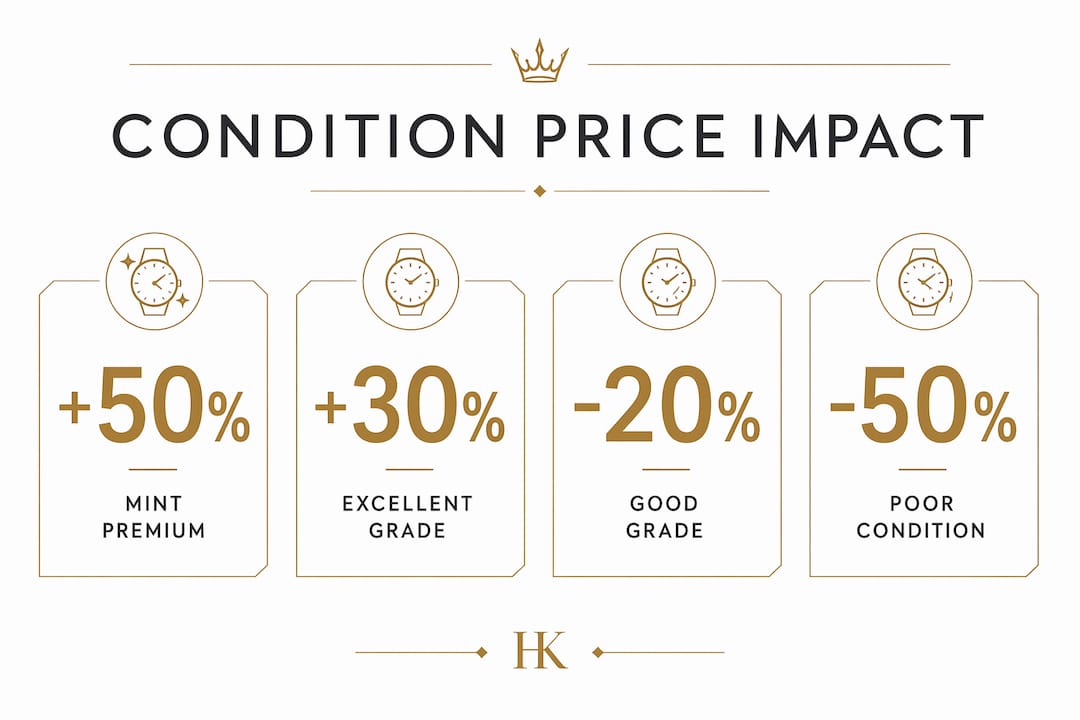
The pricing impact of condition grading is both significant and quantifiable. A watch graded “Good” can be 20–30% cheaper than the same reference in “Excellent” condition. A “Fair” grade reduces price by 35–50% compared to baseline. These are not marginal differences. On a £20,000 Audemars Piguet Royal Oak, a single grade drop from Excellent to Good represents a £4,000–£6,000 reduction in achievable sale price.
Pricing by condition: a practical reference
Condition Grade | Typical Price Adjustment vs Excellent |
Mint / Unworn | +10% to +20% premium |
Excellent | Baseline reference price |
Good | 20–30% below baseline |
Fair | 35–50% below baseline |
Poor | 50%+ below baseline, subject to restoration cost |
Documentation compounds the effect. Proof of authorised service history increases buyer and lender confidence, directly boosting achievable price. A service by a Rolex Service Centre or Omega-authorised workshop eliminates the buyer’s uncertainty about upcoming maintenance costs, which can run from £500 to £1,500 for a full movement service. Sellers who can present those records close transactions faster and at higher prices.
Visible condition issues reduce liquidity and narrow the buyer pool. A watch in poor condition does not simply sell for less. It often fails to sell at all within a reasonable timeframe, because the pool of buyers willing to take on restoration risk is small. This is why condition grading influences not just the price achieved but the speed and certainty of a transaction.
Pro Tip: When selling, always photograph your watch under natural daylight and under a loupe or macro lens. Buyers and dealers will inspect at this level regardless. Presenting honest, detailed images builds trust and reduces the chance of a price renegotiation after physical inspection.
How do originality and polishing affect grading and price?
The nuances within condition grading are where collectors and serious buyers separate themselves from casual purchasers. Two watches graded “Excellent” can differ substantially in value based on factors that a surface-level grade does not capture.
Why overpolishing destroys value
Collectors prefer factory-original geometry over an overpolished case, even when the polished watch looks superficially cleaner. Polishing softens the sharp lugs and edges that define references like the Rolex Daytona or the Patek Philippe Nautilus. Once those edges are rounded, the change is irreversible. Liquidity discounts arise when overpolished watches lose original case sharpness and geometry permanently. A knowledgeable buyer will discount an overpolished watch immediately, regardless of how bright the finish appears.
Originality of components
Period-correct parts: Collector markets prefer original, period-correct components even over new genuine replacements. A 1970s Omega Speedmaster with its original dial and hands is worth considerably more than the same watch fitted with a current-production genuine Omega dial.
Replaced crowns and pushers: Small components matter. A non-original crown on a Rolex Submariner signals to experienced buyers that the watch may have had undisclosed water damage or a rushed repair.
Bracelet originality: Matching bracelet and clasp codes to the watch’s production year is a standard check at auction. Mismatched bracelets reduce value, even when all parts are genuine.
Honest wear versus poor restoration: A watch showing consistent, age-appropriate patina on the dial and case is more desirable than one that has been improperly cleaned or restored. Collectors value authenticity and provenance over over-restored examples.
The subjectivity of labels like “mint” means buyers must look beyond the grade itself. True assessment requires cross-referencing with service records and high-resolution photographs for reliability. A grade is a starting point for negotiation, not a definitive statement of value.
What practical steps help buyers and sellers use grading effectively?
Understanding how grading affects watch prices is only useful if you act on it. Whether you are buying or selling, these steps reduce risk and improve outcomes.
Request unedited, high-resolution photographs. Ask for images of the case, dial, movement, caseback, and bracelet under strong, directional light. Edited or low-resolution images hide scratches and polishing marks that affect price.
Verify service history documentation. Ask for receipts or service cards from authorised dealers. Documented recent service by an authorised dealer commands better appraisal offers and reduces negotiation friction.
Check for polishing evidence. Examine lug edges and case flanks. Rounded edges indicate polishing. Compare reference images of the model in original condition to assess how much geometry has been lost.
Confirm component originality. Cross-reference dial, hands, crown, and bracelet against known production specifications for the reference and year. Resources such as auction house catalogues from Christie’s and Phillips provide detailed reference photography.
Price realistically as a seller. Overpricing a “Good” condition watch as “Excellent” delays the sale and damages credibility. Buyers in the collector market are experienced. Accurate grading builds trust and attracts serious offers.
Use condition reports for negotiation. Professional watch condition reports provide reliable valuation bases for resale, insurance, and lending. A formal report from a recognised specialist gives both parties a shared reference point and reduces disputes.
Pro Tip: If you are buying a watch described as “mint” without box and papers, treat the grade with scepticism. True mint condition almost always includes original packaging and documentation. Without them, the watch has almost certainly been worn and the grade is aspirational rather than accurate.
Key takeaways
Condition grading is the most controllable factor in luxury watch pricing, and understanding it precisely separates informed collectors from those who overpay or undersell.
Point | Details |
Price impact is substantial | Condition differences shift watch prices by 20–50%, representing thousands of pounds on high-value references. |
Originality outweighs cosmetic finish | Period-correct components and sharp case geometry command higher prices than polished but altered examples. |
Service history adds measurable value | Documented authorised service eliminates buyer uncertainty and directly increases achievable sale price. |
Grading labels are subjective | “Mint” and “Excellent” vary between sellers; always verify with high-resolution images and movement checks. |
Condition affects liquidity, not just price | Poor condition narrows the buyer pool significantly, slowing or preventing a sale entirely. |
Why grading is a conversation starter, not a final verdict
I have handled hundreds of luxury watches at Horology-kings, and the single most common mistake I see from both buyers and sellers is treating a condition grade as a fixed, objective fact. It is not. A grade is a starting point for a more detailed conversation about what a watch actually is and what it is actually worth.
The watches that cause the most disputes are not the ones in obviously poor condition. They are the ones graded “Excellent” that turn out to have been polished twice, fitted with a replacement crown, and serviced by an independent rather than an authorised workshop. None of those facts disqualify the watch from being a good purchase. But each one affects price, and none of them shows up in a single-word grade.
What I have learned is that the buyers who get the best value are those who understand the signs that reveal a watch’s true value beyond the label. They ask the right questions. They look at lug edges before they look at the dial. They ask for the service receipt before they ask for the price. That level of scrutiny is not paranoia. It is the standard practice of anyone who takes the collector market seriously.
Sellers benefit from the same rigour applied in reverse. Presenting a watch with honest, detailed grading and full documentation does not just protect the buyer. It protects the seller from renegotiation, disputes, and returns. Transparency is not a disadvantage in this market. It is a competitive advantage.
— Lewis
How Horology-kings supports condition-based watch buying and selling
Horology-kings is a Hertfordshire-based luxury watch specialist with deep expertise in condition assessment, valuation, and sourcing for Rolex, Patek Philippe, Audemars Piguet, Omega, and Cartier. Every watch listed through Horology-kings is assessed for condition, originality, and service history before being presented to buyers. If you are selling, the team provides honest, market-accurate valuations grounded in real condition grading. If you need a specific reference sourced with verified documentation, the watch sourcing service draws on an established expert network. For watches requiring service to maintain or restore condition and value, professional watch servicing is available from qualified specialists. Contact Horology-kings directly for a no-obligation condition assessment or pricing query.
FAQ
What does condition grading mean for a watch’s resale price?
Condition grading directly determines resale price, with differences between grades shifting value by 20–50%. A watch in “Fair” condition can sell for 35–50% less than the same reference graded “Excellent.”
Is “mint condition” a reliable grade when buying a pre-owned watch?
“Mint” is a marketing term rather than a standardised grade. Reliable assessment requires high-resolution photographs, a movement health check, and supporting documentation such as box, papers, and service records.
Does polishing a watch improve or reduce its value?
Polishing typically reduces value for collector-grade watches. It softens original case geometry irreversibly, and experienced buyers discount overpolished examples regardless of how clean the finish appears.
How much does service history affect a watch’s price?
Documented service by an authorised dealer increases buyer confidence and achievable sale price. It removes uncertainty about upcoming maintenance costs, which can reach £500–£1,500 for a full movement service.
Should i get a professional condition report before selling my watch?
A professional condition report provides a reliable, shared valuation basis for both buyer and seller. It reduces negotiation disputes and supports accurate pricing for resale, insurance, and lending purposes.
Recommended
Comments