.png)
Finding rare Patek Philippe complications: a collector's guide
TL;DR:
Rare Patek Philippe complications are defined by limited production, unique configurations, and verified provenance that exceed standard reference collections. Authentic rarity depends on detailed features such as case maker, dial variant, and factory markings, with documentation like archive extracts essential for verification. Access to these pieces primarily occurs through auction houses, specialist dealers, and private networks, with disciplined research critical for accurate identification and value preservation.
Rare Patek Philippe complications are defined by specific production limitations, unique configuration details, and verifiable provenance that place them beyond the reach of standard reference collecting. Finding Patek Philippe complications rare enough to matter requires more than knowing a reference number. The Ref. 2499 First Series in pink gold with Vichet case exists in only 4 known examples, with pricing between $3 million and $6 million. The Ref. 3448G ‘Red Dot’ leap year model is one of just 2 known white gold examples, estimated between $1 million and $1.6 million. These figures illustrate that rarity in this market is not a matter of opinion. It is a matter of documented evidence, and this guide shows you how to find and verify it.
What defines rarity in Patek Philippe complications and how to spot it
Rarity in Patek Philippe complications is not determined by reference numbers alone. Rarity depends on detailed combinations such as importer marks, dial-metal pairings, and unique factory features rather than model references. A watch can carry a well-known reference yet still be extraordinarily rare because of a specific case maker, a particular dial variant, or a hallmark applied for a specific market. British import marks, for example, add a layer of provenance that elevates value in ways a casual buyer would never notice.
Production limitations and configuration details
The Ref. 2499 First Series with Vichet case is the clearest illustration of how case makers create sub-categories of rarity within a single reference. Vichet was a Geneva-based case manufacturer whose work is identifiable by specific hallmarks and construction details. Only 4 examples of this combination in pink gold are confirmed. That figure is not an estimate. It is the result of decades of auction tracking and archival research.
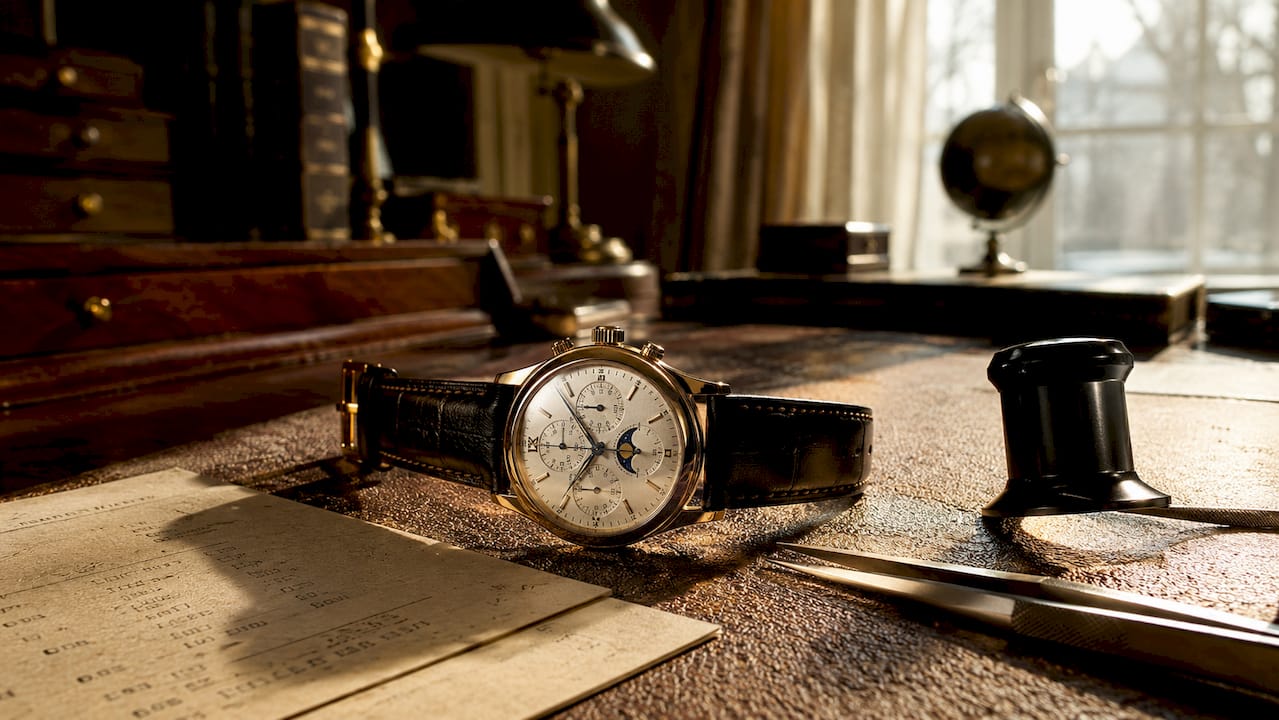
The Ref. 3448G ‘Red Dot’ demonstrates a different kind of rarity: a factory-fitted feature that most buyers overlook entirely. The red dot on the perpetual calendar dial indicates the leap year function and appears on only 2 known white gold examples. This is the type of detail that separates a serious collector from someone simply buying a prestigious name.
Non-obvious rarity factors to check
Beyond case makers and dial features, several less visible factors determine whether a piece is genuinely rare:
British import marks: Watches imported into the United Kingdom before 1974 required hallmarking by a British assay office. These marks confirm a specific market destination and add provenance.
Dial-metal pairings: Certain dial colours were produced only in specific metal cases. A cream dial in yellow gold may be common; the same dial in platinum may be unique.
Factory modifications: Some watches left the Patek Philippe manufactory with bespoke modifications for private clients or retailers. These are rarely documented outside auction catalogues.
Movement calibre variations: Early production runs of certain calibres differ from later versions in ways that affect both authenticity and value.
Pro Tip: When examining a potential acquisition, request the original extract from the Patek Philippe archives. The manufactory offers an archive extract service that confirms the original configuration of any watch produced since the late 19th century. This single document can confirm or disprove a rarity claim in minutes.
Common pitfalls include accepting a seller’s verbal description of rarity without cross-referencing auction records. A reference number alone is never sufficient. Verify every claimed feature against documented historical examples before proceeding.
How to research and verify rare Patek Philippe complications effectively
A structured research methodology is the single most reliable defence against overpaying or acquiring a problematic piece. Collectors who study watches as cohesive historical objects achieve better authenticity verification and valuation than those who rely on surface-level reference data. The difference is discipline and documentation.
Building a reference database
A structured database tracking each Patek Philippe variant reduces the risk of hype-driven or uninformed buying decisions. Spreadsheets or dedicated ledgers should record the following for every reference you follow:
Reference number and series: Note first, second, and third series distinctions where applicable.
Case material and maker: Yellow gold, pink gold, white gold, and platinum versions of the same reference can differ enormously in rarity.
Dial configuration: Colour, material, applied indices versus printed indices, and any special features such as the ‘Red Dot’.
Movement calibre: Record the specific calibre and any known variation between production years.
Provenance markers: British import marks, retailer signatures on dials, and archive extract status.
Auction history: Record hammer prices, auction house, and sale date for every documented example.
This approach transforms collecting from an instinct-driven pursuit into a verifiable discipline. When you encounter a potential acquisition, your database tells you immediately whether the configuration is consistent with known examples.
Verification checkpoints before purchase
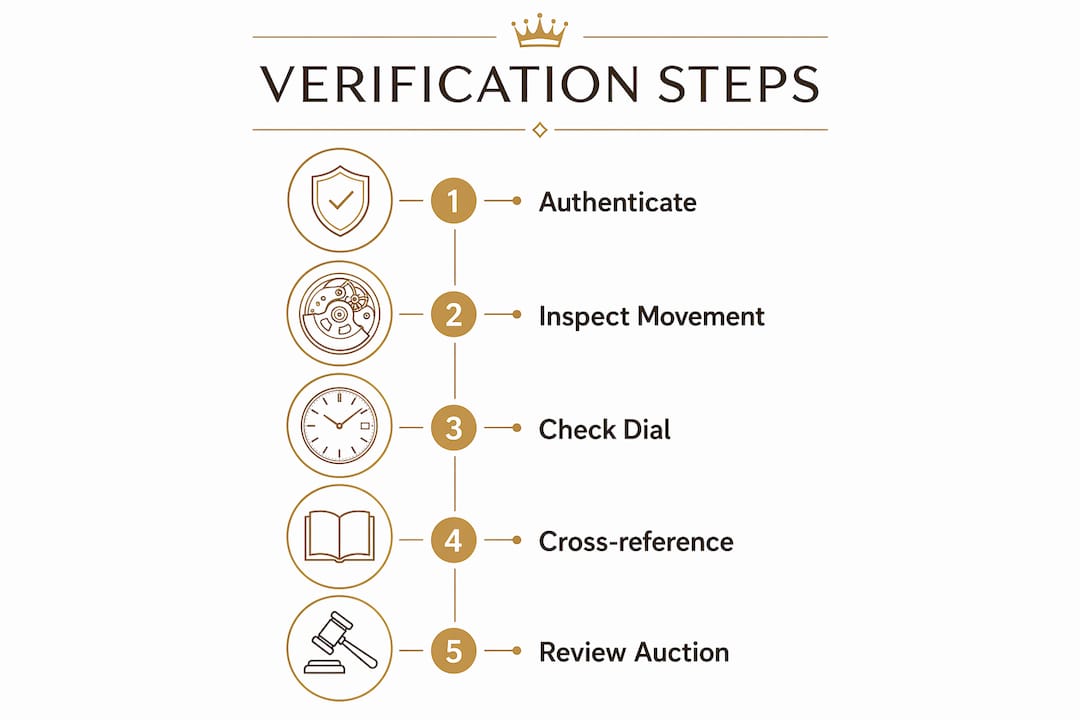
Authentication requires detailed inspection beyond surface appearance. Movement correctness and dial originality under magnification are the two most critical checkpoints.
Checkpoint | What to look for | Red flags |
Movement | Correct calibre, period-appropriate finishing | Replaced bridges, incorrect serial range |
Dial | Original lacquer, no reluming, correct printing | Uneven ageing, inconsistent font weight |
Case | Correct hallmarks, no excessive polishing | Rounded lugs, missing hallmarks |
Provenance | Archive extract, original papers | Incomplete documentation, inconsistent story |
Pro Tip: Examine the dial under 10x magnification before any purchase. Refinished dials are the most common form of alteration in the rare Patek Philippe market. Look for inconsistent font weight in the text, uneven surface texture, and any sign that the lacquer has been reapplied over the original printing.
Auction results from Phillips, Christie’s, and Sotheby’s provide the most reliable pricing benchmarks. Each major house publishes detailed lot notes that describe configuration, condition, and provenance. These notes are a free research resource that most collectors underuse.
Where to find rare Patek Philippe complications
The market for rare Patek Philippe complications concentrates in a small number of venues. Knowing where to look, and when, determines whether you access the best pieces or miss them entirely.
Auction houses
Auction houses like Phillips and Christie’s are the primary venues for accessing rare complications with documented provenance and expert vetting. Phillips in particular has established itself as the leading auction house for serious horological collecting, with dedicated watch sales in Geneva and Hong Kong. Christie’s and Sotheby’s remain significant, especially for estate pieces with long ownership histories.
The advantages of auction are transparency and documentation. Every lot is examined by specialists, and the published condition report becomes part of the piece’s permanent record. The disadvantage is competition. Exceptional pieces attract global bidding, and premiums can reach 25–30% above the hammer price.
Specialist dealers and private channels
Specialist dealers offer a different proposition. You pay a premium for convenience, authentication, and the dealer’s reputation. The risk is lower than a private sale, but the selection is narrower. Private sales, by contrast, can surface pieces that never reach auction, often at prices below market. The risk is correspondingly higher.
Source | Advantages | Risks |
Auction houses | Provenance documentation, expert vetting | High premiums, competitive bidding |
Specialist dealers | Authentication, convenience | Limited selection, higher asking prices |
Private sales | Below-market pricing, unique access | Fraud risk, limited recourse |
Geographical timing matters. Geneva sales in may and november align with the major Phillips and Christie’s auction calendars. Hong Kong sales in april and november attract Asian collectors and can produce different pricing dynamics for the same reference. London remains a strong market for pieces with British provenance, particularly those carrying import marks.
Pro Tip: Register with the major auction houses’ specialist watch departments and request advance previews. Viewing a piece in person before the sale, rather than relying solely on catalogue photographs, reveals condition details that photographs consistently obscure.
For sourcing rare complications outside the public auction market, specialist networks and trusted dealers with active sourcing services provide access to pieces that never appear publicly.
Common mistakes when acquiring rare Patek Philippe complications
The most expensive mistakes in this market are not made through ignorance of prices. They are made through overconfidence in incomplete information.
Common mistakes include focusing solely on reference numbers without considering originality, condition, or provenance. A Ref. 2499 with a refinished dial and overpolished case is not the same watch as an all-original example, regardless of the reference number on the movement.
Ignoring case condition: Overpolished cases lose the sharp angles and finishing details that define the original design. This is irreversible and significantly reduces value.
Accepting mixed components: A movement from one production year paired with a dial from another is a red flag. Period-correct matching of all components is non-negotiable for serious acquisitions.
Trusting verbal provenance: Stories about a watch’s history are not provenance. Documentation is provenance. Require archive extracts, original papers, and service records.
Chasing hype: Long-term value lies in authentic pieces with documented provenance and condition, not in whatever reference is currently attracting media attention.
“The collector who buys on discipline rather than desire will always outperform the one who buys on excitement. Rarity without authenticity is simply an expensive mistake.”
Set realistic expectations before entering any negotiation. A genuinely rare Patek Philippe complication in original condition commands a premium that reflects its scarcity. If a price seems too low for what is claimed, the claim is almost certainly wrong.
How to build a valuable collection of rare Patek Philippe complications
A collection of rare complications is built over years, not months. The collectors who achieve the most significant results treat the process as a long-term discipline rather than a series of opportunistic purchases.
Continuous education is the foundation. Study the Patek Philippe complications list reference by reference, understanding not just what each complication does but how its production history creates sub-categories of rarity. Perpetual calendars, minute repeaters, and split-seconds chronographs each have their own genealogy of rare variants.
Diversify across complication types and eras: A collection that spans perpetual calendars, tourbillons, and minute repeaters from different decades is more resilient than one concentrated in a single reference family.
Document every acquisition rigorously: Record purchase price, condition at acquisition, archive extract status, and any service history. This documentation becomes part of the piece’s provenance for the next owner.
Engage with specialist communities: Collector forums, auction house events, and specialist publications such as Patek Philippe Magazine provide intelligence that is not available through public channels.
Service pieces correctly: Rare complications must be serviced by qualified watchmakers using period-appropriate parts. Incorrect servicing can destroy originality and value simultaneously.
Pro Tip: Attend at least one major auction preview each year, even if you are not bidding. Handling documented examples in person calibrates your eye for condition and originality in ways that no photograph or written description can replicate.
For collectors interested in high-complication watches beyond Patek Philippe, the same methodological principles apply across Audemars Piguet, A. Lange and Söhne, and F.P. Journe.
Key takeaways
Finding rare Patek Philippe complications requires a methodical combination of reference knowledge, documented verification, and disciplined sourcing across trusted venues.
Point | Details |
Rarity is configuration-specific | Reference numbers alone do not define rarity; case makers, dial variants, and factory features determine true scarcity. |
Documentation is non-negotiable | Archive extracts, original papers, and auction records are the only reliable proof of provenance and configuration. |
Auction houses are the benchmark | Phillips, Christie’s, and Sotheby’s provide the most transparent pricing and condition data for rare complications. |
Condition determines value | Overpolished cases and mixed components reduce value significantly, regardless of reference rarity. |
Discipline outperforms excitement | Long-term collection value comes from authentic, documented pieces, not from chasing market trends. |
What I have learned from years of finding rare complications
The first time I encountered a Ref. 2499 First Series in the flesh, I was struck not by its size or its dial but by how ordinary it looked to the uninitiated eye. That is the point. Genuine rarity in Patek Philippe complications is almost never visible at a glance. It lives in the hallmarks, the movement finishing, the weight of the case, and the consistency of the story told by every component together.
The market has changed considerably over the past decade. Prices for documented rarities have risen sharply, and the number of buyers with serious knowledge has grown. That combination has made the market more competitive but also more transparent. Auction records are more accessible than ever, and the Patek Philippe archive extract service has become a standard expectation rather than an optional extra.
What has not changed is the advantage held by collectors who do the work. The buyer who arrives at a sale having tracked a specific reference for two years, who knows every documented example and its condition, will consistently outperform the buyer who relies on a dealer’s assurance or a catalogue description. Patience is not a passive virtue in this market. It is the most active competitive advantage available.
The pieces that have given me the most satisfaction are not always the ones that appreciated most in value. They are the ones where the research confirmed something genuinely unusual, where the archive extract matched the configuration exactly, and where every component told the same coherent story. That moment of verification is the real reward of serious collecting.
— Lewis
Source rare Patek Philippe complications with Horology-kings

Horology-kings is a Hertfordshire-based specialist with direct access to the private networks where rare Patek Philippe complications actually change hands. Whether you are searching for a specific reference, a particular dial variant, or a complication type you have been tracking for years, the Horology-kings watch sourcing service connects you with verified pieces through a process built on authentication, transparency, and secure UK transactions. Every piece sourced through Horology-kings is subject to rigorous condition and provenance review before it reaches you. Visit Horology-kings to discuss your requirements with the team directly.
FAQ
What makes a Patek Philippe complication genuinely rare?
Genuine rarity is defined by specific production combinations including case material, dial variant, case maker, and factory features, not reference numbers alone. The Ref. 2499 First Series Vichet case in pink gold, known in only 4 examples, illustrates how configuration details create extreme scarcity within a single reference.
How do I verify the authenticity of a rare Patek Philippe?
Request a Patek Philippe archive extract, which confirms the original factory configuration, and inspect the movement and dial under magnification for period-correct components. Authentication requires detailed inspection beyond surface appearance, with movement correctness and dial originality as the two critical checkpoints.
Which auction houses are best for buying rare Patek Philippe complications?
Phillips, Christie’s, and Sotheby’s are the leading venues, with Phillips particularly dominant in the dedicated watch sale category. Each publishes detailed lot notes that serve as valuable research resources even when you are not bidding.
What are the most common mistakes when collecting rare Patek Philippe watches?
The most damaging errors are focusing on reference numbers without assessing originality, accepting overpolished cases, and trusting verbal provenance without documentation. Overpolished cases or mixed-period parts reduce value significantly and cannot be reversed.
Is a Patek Philippe archive extract worth obtaining?
The archive extract is the single most reliable document confirming a watch’s original configuration and is now a standard expectation in serious transactions. It confirms case material, dial type, movement calibre, and the original delivery date, making it indispensable for any rare complication acquisition.
Recommended
Comments