.png)

What is watch grade steel? grades explained
- lewisvrichards3
- 1 day ago
- 9 min read
TL;DR:
Watch grade steel, mainly 316L and 904L, is defined by performance criteria such as corrosion resistance and finish quality used in luxury watches. Although 904L offers slightly superior corrosion resistance and brightness, most daily wearers find little practical difference between the two alloys, which vary primarily in alloy composition and manufacturing complexity. The overall quality of the finish and craftsmanship plays a more significant role in a watch’s durability and appearance than the steel grade itself.
Watch grade steel is defined as stainless steel that meets strict standards for corrosion resistance, hardness, machinability, hypoallergenic safety, and the capacity to achieve a luxury surface finish required in quality wristwatch manufacturing. The term is not an official metallurgical classification. It describes a performance threshold that separates steel fit for a Rolex or Patek Philippe case from the alloys used in kitchen appliances or structural engineering. The two grades that dominate this space are 316L and 904L, each with distinct chemical profiles and real-world trade-offs that every serious buyer should understand before spending four or five figures on a timepiece.
What is watch grade steel and why does it matter?
Watch grade steel is defined not only by alloy composition but by performance across corrosion resistance, hardness, machinability, and hypoallergenic qualities. That combination of criteria is what separates it from general-purpose stainless steel. A steel grade used in a luxury watch must resist sweat, rain, and salt water without pitting. It must machine cleanly to tolerances measured in microns. It must be safe against the skin for decades of daily wear.
The industry recognises two primary grades: 316L and 904L. Brands such as Patek Philippe, Vacheron Constantin, and Cartier build their steel cases from 316L stainless steel, the established industry standard. Rolex uses 904L, which it markets under the proprietary name Oystersteel. Understanding what separates these two grades, and what they share, gives you a far clearer picture of what you are actually buying.
Chemical composition and properties of watch steel grades
The difference between watch steel grades comes down to alloying elements: chromium, nickel, molybdenum, and in some cases copper. Each element performs a specific function in the finished alloy.
How 316l, 904l, and 304 compare
The table below sets out the key chemical and physical differences between the three grades most relevant to watchmaking.
Property | 316L | 904L | 304 |
Chromium content | 16–18% | 19–23% | 18–20% |
Nickel content | 10–14% | 23–28% | 8–10.5% |
Molybdenum content | 2–3% | 4–5% | None |
Copper content | None | 1–2% | None |
Carbon content | Below 0.03% | Below 0.02% | Below 0.08% |
Corrosion resistance | Excellent | Superior | Moderate |
Machinability | Good | Difficult | Good |
Typical watch use | Cases, bracelets | Cases, bracelets | Internal parts, budget watches |
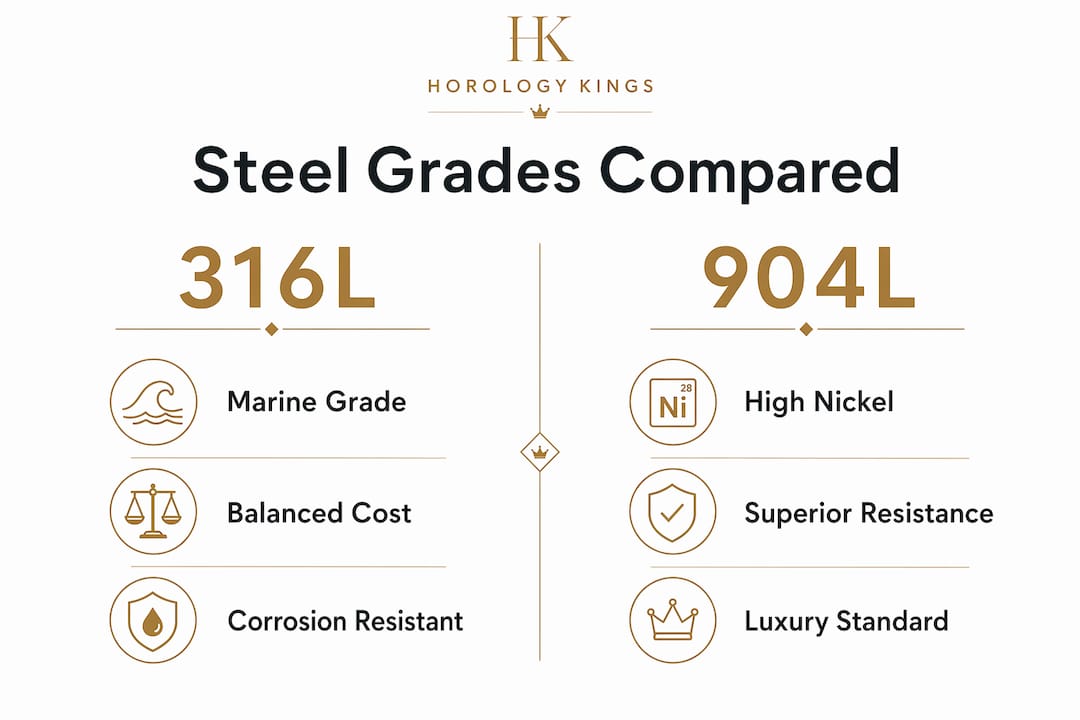
Chromium forms a passive oxide layer on the steel surface, which is the primary barrier against corrosion. Molybdenum reinforces that barrier specifically against chloride attack, which is why both 316L and 904L perform well in marine environments where 304 would pit and stain. The low carbon designation in both 316L and 904L is significant. Carbon above 0.03% can cause carbide precipitation at grain boundaries during welding or heat treatment, which weakens corrosion resistance at those points. Keeping carbon below that threshold preserves the alloy’s integrity through the manufacturing process.
316L stainless steel is preferred for its balance of corrosion resistance, machinability, and cost-effectiveness by top-tier watch brands. That balance is why it remains the dominant choice across the industry despite 904L’s superior chemistry on paper.
How manufacturing processes define watch steel quality
Raw alloy composition is only part of the story. The manufacturing process is what transforms a billet of 316L or 904L into a case worthy of a luxury watch. Two pieces of steel with identical chemical compositions can produce dramatically different results depending on how they are machined, treated, and finished.
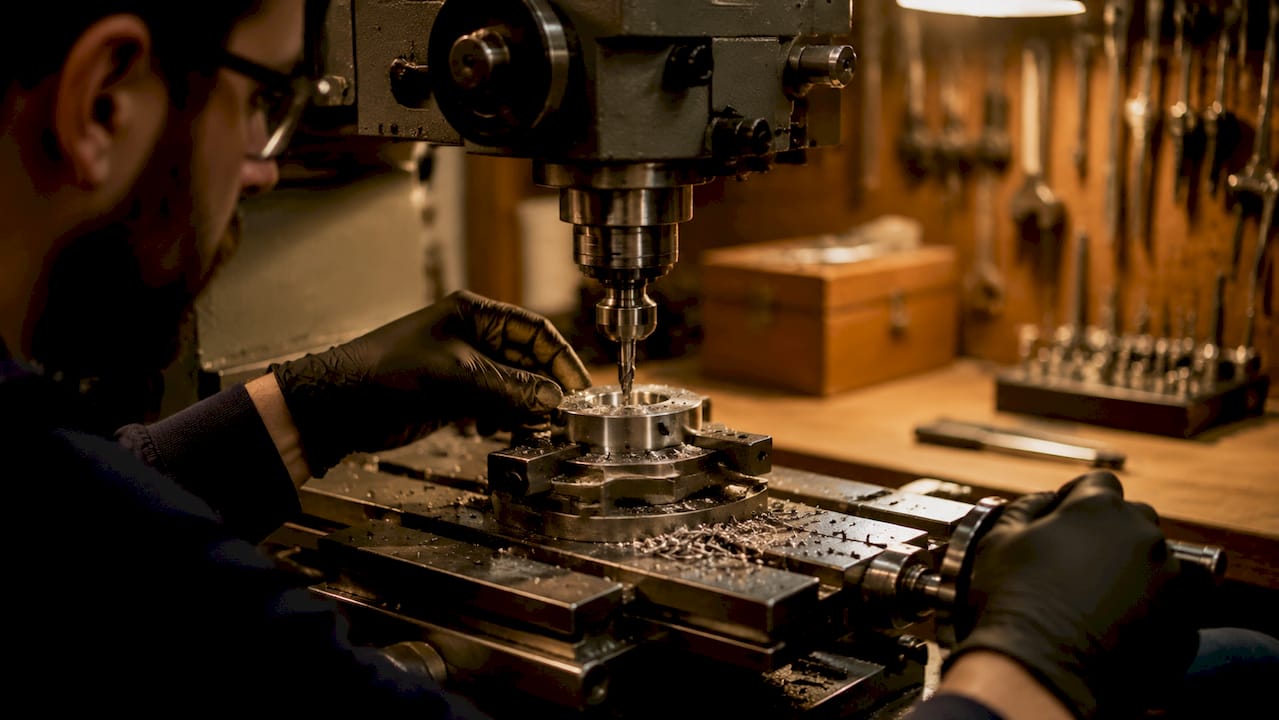
High-precision CNC machining removes material to tolerances of a few microns. That level of precision demands specialised tooling, particularly with 904L, which work-hardens rapidly during cutting and blunts standard tooling faster than 316L. This is one reason 904L components cost more to produce. The machining difficulty is not a minor inconvenience. It requires dedicated equipment, slower cutting speeds, and more frequent tool changes, all of which add to the final retail price.
Heat treatment and finishing processes contribute critically to a luxury watch’s steel quality, influencing polish and durability beyond raw alloy. The austenitic microstructure of both 316L and 904L responds well to controlled heat treatment, which relieves internal stresses introduced during machining and stabilises the grain structure. That stability is what allows polishers to achieve the mirror-like surfaces seen on a Rolex Submariner bezel or a Cartier Santos case.
Surface finishing involves multiple stages: rough grinding, intermediate polishing, and final buffing. Brushed and polished surfaces require different abrasive sequences. A single case may carry both finishes simultaneously, which demands masking and careful hand work. The result is not just aesthetic. A well-polished surface has fewer micro-pits where corrosion can initiate, making finishing a functional step as much as a cosmetic one.
Pro Tip: When assessing a pre-owned steel watch, examine the case edges under good light. Sharp, well-defined transitions between brushed and polished surfaces indicate careful finishing. Over-polished edges that have lost their geometry suggest heavy buffing, which removes metal and can affect both value and water resistance.
316l vs 904l steel: what actually differs for watch owners?
For most buyers, the practical difference between 316L and 904L is smaller than the marketing suggests. Rolex’s branding of 904L as Oystersteel has created a perception that 904L is categorically superior, but in everyday wear the distinction is minimal for the vast majority of owners.
Here is where the differences genuinely matter:
316L Stainless Steel
Excellent corrosion resistance against sweat, rain, and occasional sea water exposure
Easier to machine, which keeps production costs lower
Nickel content of 10–14% makes it generally safer for people with mild nickel sensitivity
Used by Patek Philippe, Vacheron Constantin, and Cartier without compromise to quality
Achieves superb surface finishes across brushed and polished applications
904L Stainless Steel
Superior resistance to pitting in aggressive environments such as prolonged salt water or acidic chemical exposure
Higher nickel content of 23–28% poses a greater risk for wearers with severe nickel allergies
More difficult and costly to machine, contributing to higher retail prices
Takes a slightly brighter polish due to higher alloy content, though the difference is subtle
Adopted exclusively by Rolex across its entire steel range since 2003
The honest assessment is this: no single steel grade fits all purposes, and the choice involves trade-offs between corrosion resistance, machinability, cost, and wearer sensitivity. If you spend significant time in the ocean or work in corrosive environments, 904L offers a genuine advantage. If you wear your watch in normal daily conditions, 316L performs at the same level for all practical purposes.
Pro Tip: If you have a known nickel allergy, check the specific alloy before purchasing. A Rolex in 904L carries nearly twice the nickel content of a Patek Philippe in 316L. For sensitive skin, 316L surgical-grade steel is the safer choice, and it is worth consulting your dermatologist before committing to a high-nickel alloy.
What other materials are used alongside watch grade steel?
Steel dominates the luxury watch market, but it is not the only option. Understanding the alternatives helps you read product listings accurately and make informed comparisons.
Material | Grade / Type | Key Properties | Typical Use |
316L Stainless Steel | Marine grade | Corrosion resistant, hypoallergenic, machinable | Luxury watch cases and bracelets |
904L Stainless Steel | High alloy | Superior pitting resistance, bright polish | Rolex cases and bracelets |
304 Stainless Steel | Standard grade | Lower corrosion resistance, no molybdenum | Budget watches, internal components |
Titanium Grade 5 | Ti-6Al-4V | Lightweight, strong, corrosion resistant | Sport and tool watches |
304 stainless steel is widely produced but susceptible to pitting and corrosion over time when exposed to sweat and salt. You will find it in budget watches and in internal structural components where surface exposure is not a concern. It is not a watch grade material for cases or bracelets intended for daily skin contact.
Titanium Grade 5 (Ti-6Al-4V) is an aerospace alloy that combines titanium with aluminium and vanadium to increase strength, heat resistance, and corrosion resistance. It is harder than 316L and roughly 40% lighter, which makes it the preferred choice for sport and diving watches where wrist fatigue matters. Brands such as Omega and IWC use Grade 5 titanium in specific collections. The trade-off is a greyer, more matte appearance that does not achieve the same mirror polish as 316L or 904L.
Some manufacturers use proprietary alloys. Rolex’s Rolesor combines steel and gold in the same case. Tudor uses its own steel formulations for certain models. These niche materials serve specific design or marketing purposes, but they do not represent a meaningful metallurgical advance over the established watch steel grades for most buyers.
For collectors focused on watch case materials, the practical hierarchy is straightforward. 904L and 316L are the benchmark for luxury steel watches. Titanium suits buyers who prioritise weight reduction. Everything else is either a budget compromise or a design choice.
Key takeaways
Watch grade steel quality is determined by alloy composition, manufacturing precision, and surface finishing working together, not by any single factor in isolation.
Point | Details |
316L is the industry standard | Patek Philippe, Vacheron Constantin, and Cartier all use 316L without sacrificing quality. |
904L offers marginal gains for most wearers | Superior pitting resistance matters mainly in extreme or prolonged corrosive environments. |
Finishing defines perceived quality | Heat treatment and polishing affect durability and appearance as much as the alloy itself. |
Nickel content affects skin safety | 904L carries nearly twice the nickel of 316L, which matters for buyers with allergies. |
304 steel is not watch grade for cases | Without molybdenum, 304 lacks the corrosion resistance required for skin-contact components. |
Steel grade matters less than you think
I have handled hundreds of luxury steel watches over the years, and the question I get most often from buyers is some version of: “Is 904L really better?” My honest answer is that it depends entirely on how you wear your watch.
The metallurgy is real. 904L does resist pitting more effectively in aggressive environments. But the gap between 316L and 904L in a normal British climate, worn on a wrist that sees the occasional swim or rain shower, is essentially zero in practice. What I notice far more is the quality of finishing. A beautifully finished 316L case from Patek Philippe or Cartier looks and feels more refined than a poorly finished 904L piece from a lesser manufacturer. The alloy is the foundation. The craftsmanship is the building.
The area where I do urge buyers to pay close attention is nickel sensitivity. I have seen clients develop reactions to 904L watches after years of trouble-free wear with 316L pieces. The higher nickel content in 904L is not a theoretical concern. If you have any history of metal sensitivity, get tested before committing to a Rolex or any other 904L watch. A watch authentication checklist will confirm the materials in any piece you are considering buying.
The watch steel market is not standing still either. Ceramic composites, carbon fibre, and proprietary alloys are appearing more frequently in mid-range and luxury collections. But for the foreseeable future, 316L and 904L remain the benchmarks. When a brand tells you their steel is special, ask which grade it is and how it is finished. Those two questions will tell you more than any marketing copy.
— Lewis
Explore steel-cased luxury watches at Horology-kings

Horology-kings stocks a curated selection of pre-owned luxury watches crafted from both 316L and 904L stainless steel, sourced from brands including Rolex, Patek Philippe, Audemars Piguet, Omega, and Cartier. Every piece is verified for authenticity and material integrity before listing. If you are searching for a specific reference or need guidance on which steel grade suits your lifestyle and skin type, the Horology-kings team offers personal sourcing assistance backed by an expert network across the UK and beyond. Browse the full collection or source a specific watch through the dedicated sourcing service. Visit Horology-kings to explore available timepieces and speak directly with the team.
FAQ
What is the difference between 316l and 904l steel?
316L contains 10–14% nickel and 2–3% molybdenum, while 904L contains 23–28% nickel and 4–5% molybdenum, giving it superior corrosion resistance but at higher cost and machining difficulty. For most daily wear conditions, both grades perform comparably.
Is 316l steel safe for sensitive skin?
316L stainless steel is used in surgical implants and food processing, making it one of the most hypoallergenic metals available for skin contact. Buyers with severe nickel allergies should still consult a dermatologist, as 316L does contain nickel.
Why does rolex use 904l instead of 316l?
Rolex adopted 904L across its entire steel range and markets it as Oystersteel, citing superior corrosion resistance. The practical advantage is most relevant in extreme environments; for everyday wear, the difference over 316L is negligible for most owners.
What is 304 steel and is it used in luxury watches?
304 stainless steel lacks molybdenum, which makes it susceptible to pitting from sweat and salt over time. It appears in budget watches and internal components but is not considered watch grade for cases or bracelets in luxury horology.
Does steel grade affect a watch’s resale value?
Steel grade alone has a limited effect on resale value compared to brand, reference, condition, and provenance. A well-maintained 316L Patek Philippe will command far more than a poorly finished 904L watch from an unknown maker. For guidance on protecting your investment, reviewing luxury watch maintenance tips is a practical starting point.
Recommended
Comments