.png)

Famous watch innovations: the breakthroughs that changed horology
- lewisvrichards3
- Jun 28
- 8 min read
TL;DR:
Famous watch innovations include the Rolex Oyster case, which established water resistance, and the Ulysse Nardin Freak’s silicon escapement, reducing friction and magnetic interference. These breakthroughs solved real industry problems and became industry standards through engineering and iterative development rather than pure invention.
Famous watch innovations are technological and design breakthroughs that transformed the wristwatch from a fragile novelty into a durable, precise, and mechanically complex instrument. The Rolex Oyster case of 1926 stands as the single most consequential leap in wristwatch durability. The Ulysse Nardin Freak’s silicon escapement, introduced in 2001, rewrote the rules of mechanical movement design. Understanding these milestones is the foundation of serious horology knowledge, and this list covers the breakthroughs every enthusiast should know.
1. Famous watch innovations: the Rolex Oyster case and hermetic sealing
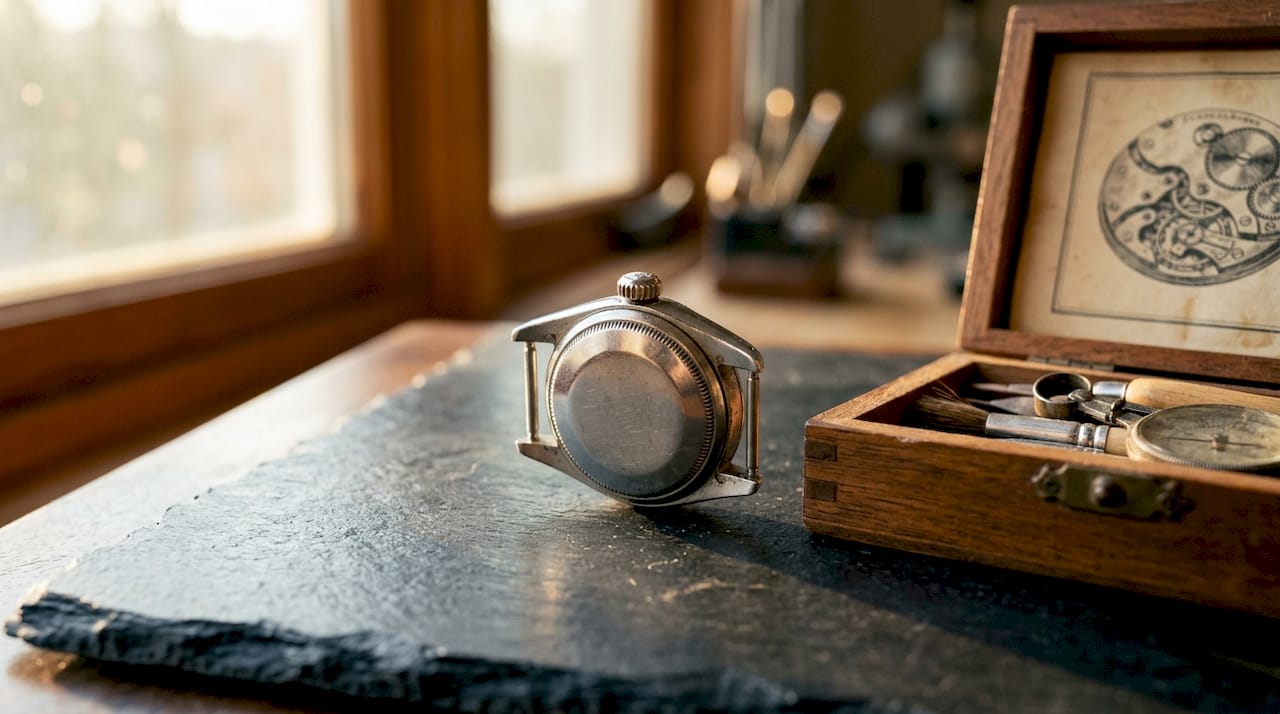
The 1926 Rolex Oyster case solved the most persistent problem in early wristwatch design: water and dust ingress. Its patented hermetic sealing combined a screw-down crown, screw-down caseback, and a threaded bezel to create a fully enclosed environment for the movement. Before this, wristwatches were fragile dress accessories, not instruments for daily life.
The Oyster’s impact went beyond waterproofing. A sealed case meant the movement was protected from humidity, which is one of the primary causes of chronometric drift. Rolex demonstrated this publicly in 1927 when swimmer Mercedes Gleitze wore an Oyster across the English Channel. The watch survived intact, and the stunt made headlines worldwide.
The Oyster case also set the template for how watch cases are engineered today. Screw-down crowns, threaded casebacks, and gasket-sealed bezels are now standard across the industry. Every diver’s watch produced since owes its architecture to this single invention.
Pro Tip: When buying a pre-owned Rolex Oyster, always check that the crown screws down fully. A worn crown thread is the most common point of water ingress on an otherwise sound case.
2. The Rolex Perpetual rotor and self-winding movements
The Oyster case solved external threats. The Perpetual rotor, patented in 1931, solved the problem of power delivery from within. A free-moving rotor spins with the wearer’s wrist motion and continuously winds the mainspring, eliminating the need for manual winding entirely.
This mattered for precision as much as convenience. A mainspring at constant tension delivers more consistent power to the escapement. More consistent power means more stable timekeeping. The Perpetual rotor turned the Oyster from a durable case into a complete chronometric system.
The combination of hermetic sealing and automatic winding defined what a modern wristwatch should be. Patek Philippe later refined the micro-rotor concept, but Rolex’s industrial realisation of the self-winding mechanism at scale remains the benchmark for how engineering concepts become lasting standards.
3. How Ulysse Nardin Freak pioneered silicon escapements
The Ulysse Nardin Freak, launched in 2001, is the watch that brought silicon into serious mechanical horology. Silicon is lighter than steel, requires no lubrication, and is immune to magnetic interference. The Freak used silicon for its escapement components, reducing friction at the most wear-prone point in any mechanical movement.
Traditional lever escapements rely on lubricating oils that degrade over time. As oils thin or congeal, the escapement loses efficiency and accuracy drifts. Silicon components eliminate this degradation cycle entirely. The Freak’s Dual Direct Escapement removed the lever from the equation, allowing the escape wheel to act directly on the balance wheel.
Successive Freak models pushed further. Diamond coatings were added to reduce surface wear on silicon parts. Multi-escapement systems appeared in later references. Each generation treated the Freak as a working laboratory rather than a finished product.
Pro Tip: Silicon movements generally require less frequent servicing than traditional metal escapements. If you are evaluating a watch with silicon components, factor this into the long-term ownership cost.
The Grinder winding system, introduced in later Freak references, doubles winding efficiency compared to conventional rotors. This solved the power delivery challenge that comes with complex, high-complication movements. The Freak series remains the most concentrated example of material science applied to watchmaking.
4. Multi-axis tourbillon mechanisms and gravitational correction
The tourbillon was invented by Abraham-Louis Breguet in 1801 to counteract the effect of gravity on a pocket watch held vertically. The original design rotated the escapement and balance wheel in a single cage, averaging out positional errors over one rotation. It was a brilliant solution for its era.
Modern triple-axis tourbillons go far beyond Breguet’s original concept. The Master Hybris Inventiva Calibre 178 by Jaeger-LeCoultre achieves 98% positional coverage by rotating three titanium cages simultaneously across the X, Y, and Z axes. Each cage rotates at a different interval, meaning the movement is almost never in the same gravitational position twice.
Tourbillon type | Axes of rotation | Positional coverage |
Single-axis (Breguet original) | 1 | Limited to vertical positions |
Dual-axis | 2 | Improved multi-plane correction |
Triple-axis (Calibre 178) | 3 | 98% positional coverage |
The practical gain in a wristwatch is debated among horologists, since a wristwatch moves constantly anyway. The engineering achievement, however, is undeniable. Triple-axis tourbillons represent the apex of mechanical watch craftsmanship and set the standard for high horology complications.
5. The Jaeger-LeCoultre Reverso and the reversible case
The Jaeger-LeCoultre Reverso, introduced in 1931, solved a specific problem with an elegant mechanical answer. British Army officers playing polo in India needed a watch that could survive the sport’s impacts without a shattered crystal. Rather than strengthening the glass, the engineers flipped the dial entirely.
The Reverso’s case slides along a rail and rotates 180 degrees, presenting a plain metal back to the world during play. When the game ends, the case flips back to reveal the dial. The mechanism is entirely mechanical, with no springs or latches beyond the sliding rail itself.
This is a masterclass in conceptual engineering. The Reverso turned a mechanical constraint into a functional and iconic design feature. The caseback later became a canvas for engravings and second dials, adding a layer of personalisation that no other watch architecture offers. The Reverso remains in production today, largely unchanged in its core mechanism.
6. Zenith El Primero and the integrated chronograph
The Zenith El Primero, launched in 1969, was the first fully integrated automatic chronograph movement. Integration means the chronograph mechanism shares the same baseplate and gear train as the main timekeeping movement, rather than sitting as a separate module on top. This integrated architecture is more reliable and thinner than modular designs.
The El Primero also ran at 36,000 vibrations per hour, a high beat rate that allowed the chronograph to measure time to one tenth of a second. Most chronographs of the era measured only to one fifth of a second. That extra precision made the El Primero the movement of choice for serious timing applications.
The El Primero’s influence extends beyond Zenith. Rolex used the El Primero calibre as the base for its Daytona movement for over a decade, modifying it to run at a lower beat rate. The El Primero’s integrated chronograph design set a reliability and precision benchmark that still shapes chronograph architecture today.
7. Anti-magnetic technology and the Rolex Milgauss
Magnetism is the hidden enemy of mechanical watches. When a movement’s steel components become magnetised, the hairspring coils stick together and the watch gains time rapidly. The problem grew acute in the mid-20th century as physicists, engineers, and medical staff worked near powerful magnetic fields daily.
Rolex developed the Milgauss in 1956 specifically for this environment. The watch could withstand magnetic fields up to 1,000 gauss, achieved through a soft iron inner cage that shields the movement from external magnetic interference. The Milgauss was tested at CERN and adopted by researchers who needed reliable timekeeping in high-field environments.
Anti-magnetic technology has since become a broader industry concern. Several manufacturers now use silicon hairsprings, which are inherently non-magnetic, as a modern solution to the same problem the Milgauss addressed mechanically. The Milgauss established that watch technology breakthroughs often emerge from specific professional demands rather than abstract engineering ambition.
8. Silicon’s wider adoption and iterative material innovation
Silicon’s journey into watchmaking required overcoming real engineering obstacles. The material is brittle under mechanical stress, and early prototypes fractured during testing. Overcoming silicon’s brittleness required extensive prototyping and new manufacturing techniques before the components became industrially viable.
This pattern repeats throughout horological history. The tourbillon took decades to move from Breguet’s patent to widespread production. The micro-rotor required multiple generations of refinement before Patek Philippe made it commercially reliable. Innovation in watchmaking is almost always iterative, not sudden.
Silicon is now used by Patek Philippe, Rolex, and several other major manufacturers for hairsprings and escapement components. The material’s adoption across the industry validates Ulysse Nardin’s original gamble. What began as a single watch brand’s experiment is now a foundational watchmaking technique across Swiss horology.
Key takeaways
The most enduring watch innovations share one trait: they solved a real problem with a mechanical answer that proved durable enough to become an industry standard.
Point | Details |
Rolex Oyster case (1926) | Hermetic sealing with screw-down components set the template for all modern wristwatch cases. |
Ulysse Nardin Freak (2001) | Silicon escapements eliminated lubrication degradation and magnetic interference in mechanical movements. |
Triple-axis tourbillon | Jaeger-LeCoultre’s Calibre 178 achieves 98% positional coverage, the apex of gravitational error correction. |
Zenith El Primero (1969) | The first integrated automatic chronograph set a reliability and precision standard still used today. |
Iterative innovation | Most horological breakthroughs are refinements of existing concepts, not entirely new inventions. |
Why these innovations matter more than most people realise
The conventional view is that watch innovation means inventing something entirely new. My experience tells a different story. The most consequential advances in horology have almost always been the industrial realisation of ideas that already existed on paper or in prototype form.
Rolex did not invent waterproofing. Earlier makers had experimented with sealed cases. What Rolex did was engineer a solution that worked reliably at scale, market it with a public demonstration, and build a manufacturing process that could reproduce it consistently. That is a different skill set from pure invention, and arguably a harder one.
The same logic applies to silicon. Ulysse Nardin did not discover the material’s properties. The challenge was making components that survived real-world mechanical stress across thousands of production units. The iterative prototyping required to get there is where the genuine innovation lived.
What excites me most about the current era is the convergence of silicon components, multi-axis tourbillons, and anti-magnetic architectures into movements that are simultaneously more accurate and less maintenance-intensive than anything produced before. The art and science of horology has never been more technically sophisticated. Collectors who understand this history appreciate their watches on a level that goes well beyond aesthetics.
— Lewis
Horology-kings: where innovation meets ownership
The watches discussed here are not museum pieces. Many are available on the secondary market, and owning one is a tangible way to engage with horological history.

Horology-kings is a specialist luxury watch dealer based in Hertfordshire, offering a curated selection of pre-owned timepieces from Rolex, Patek Philippe, Audemars Piguet, Omega, and Cartier. Whether you want to buy or sell a watch or need help locating a specific reference, the team combines expert knowledge with a transparent, secure transaction process. For collectors who already own a piece of horological history, the watch repair and servicing team keeps movements performing as their makers intended. If you are searching for a specific model, the sourcing service draws on an expert network to find it.
FAQ
What are famous watch innovations?
Famous watch innovations are technological and design breakthroughs that fundamentally changed how wristwatches are built, worn, and relied upon. Key examples include the Rolex Oyster case, the Ulysse Nardin Freak’s silicon escapement, and the Zenith El Primero integrated chronograph.
What did the Rolex Oyster case change?
The 1926 Rolex Oyster case introduced hermetic sealing via a screw-down crown and caseback, solving water and dust ingress. It established the durability standards that all modern wristwatch cases follow.
Why is silicon important in watchmaking?
Silicon components eliminate the need for lubricating oils in the escapement, which degrade over time and cause accuracy drift. Silicon is also non-magnetic, addressing one of the most common causes of mechanical watch failure.
What is a tourbillon and why does it matter?
A tourbillon rotates the escapement and balance wheel to average out gravitational positional errors. Modern triple-axis versions, such as Jaeger-LeCoultre’s Calibre 178, achieve 98% positional coverage and represent the highest level of mechanical watchmaking.
What was the Zenith El Primero’s key contribution?
The El Primero was the first fully integrated automatic chronograph, running at 36,000 vibrations per hour for one-tenth-of-a-second precision. Its integrated architecture set a reliability benchmark that still defines high-performance chronograph design.
Recommended
Comments