.png)

What does 'full set' mean when buying a luxury watch?
- lewisvrichards3
- 1 day ago
- 7 min read
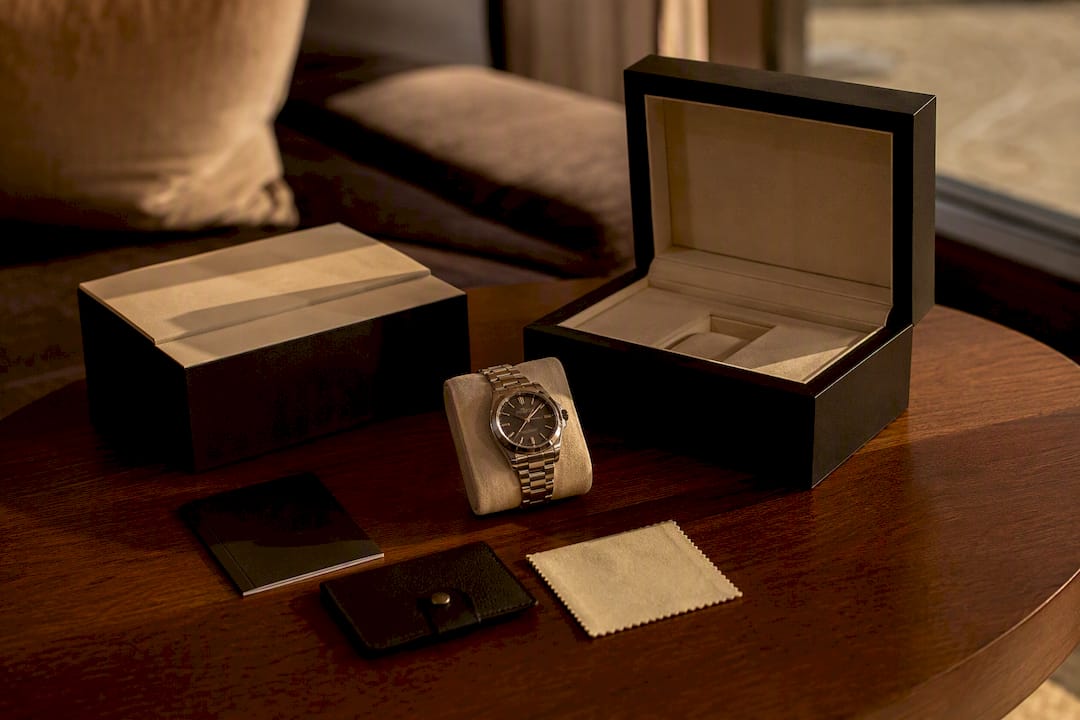
A full set is the watch plus every original accessory and piece of documentation that left the boutique with it on day one, not just the watch on its own. It’s a term about completeness, not condition, and it doesn’t automatically prove who owned the watch before you. What actually counts as “complete” shifts depending on the brand, the era it was made, and even the market it was sold into, so the phrase means something slightly different on a 1970s Omega than it does on a current-production Rolex. The Watch Rabbit Hole’s glossary treats this as the standard reference definition, and it’s the one Horology-kings works to when assessing a set.
A full set covers the watch, boxes, papers, and every accessory issued with it originally
“Full set” describes what came in the box, not the watch’s condition or its ownership history
Expect variation by brand, production year, and the country the watch was first sold in
Key Takeaways
A full set watch means the timepiece plus its complete original box, papers, and accessories, and its value depends on documentary coherence, not just condition.
Point | Details |
Full set defines completeness | It describes the accompanying package, not the watch’s condition or ownership history. |
Core items are non-negotiable | Outer box, inner box, warranty card, and manual form the baseline for any genuine full set. |
Terms aren’t interchangeable | “Box and papers” is narrower than “full set”; “watch only” carries no documentation trail at all. |
Premiums concentrate on vintage and limited pieces | Coherent full sets matter most where numbered certificates or original bills of sale confirm identity. |
Horology-kings verifies before listing | Serial matching, valuations, and secure UK transfers reduce risk when a set is claimed as complete. |
Table of Contents
Full set watch meaning: the components collectors expect
Every full set has a core that rarely changes, and then a longer list of extras that depends entirely on the reference in question. The core, across nearly every major Swiss brand, runs to four items: the outer travel box, the inner presentation box, the warranty card or paper, and the instruction manual. Miss any one of these and most dealers will already start qualifying the listing as “box and papers” rather than a genuine full set.
Beyond that core sit the items that separate a merely complete watch from a properly documented one:
Hang tags (often several, covering the movement, the water resistance, and the bracelet)
Spare bracelet links
Bezel protectors and plastic case film
Fabric or leather pouches, sometimes a secondary travel case
Adjustment tools, screwdrivers, or a bracelet sizing pin
Chronometer certification booklets, where the movement carries COSC certification
Numbered certificates for limited editions
The Watch Rabbit Hole’s breakdown of full-set components notes that several of these accessories are era-specific or reference-specific, so a 1990s Daytona and a current Speedmaster won’t share an identical checklist even within the same brand. A chronometer booklet, for instance, only applies to movements that actually carry that certification, so its absence on a non-chronometer reference isn’t a red flag at all.
Pro Tip: Before you assume anything is missing, check whether that item was ever issued for that specific reference. A booklet or tag that never existed for a given model can’t be “missing” from the set.
Full set vs box and papers vs watch only: what sellers actually mean
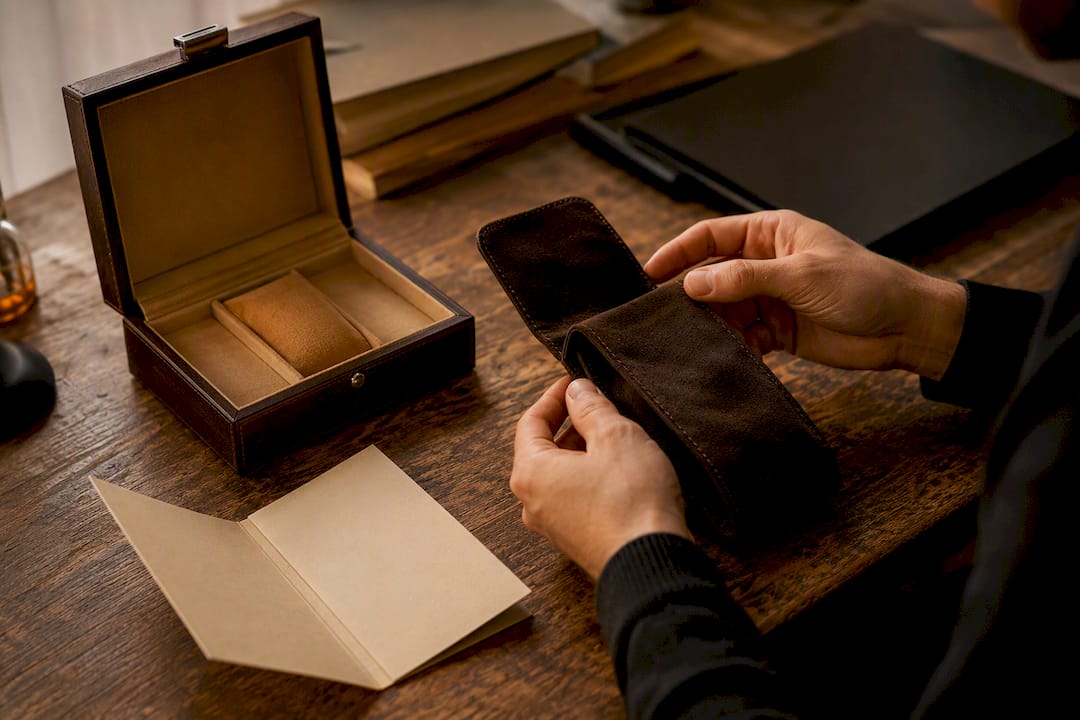
Listing shorthand causes more disputes than almost anything else in the secondary market, largely because sellers use these terms loosely. “Box and papers” is the narrower, more common phrase, usually meaning just the boxes plus the warranty card or manual, without the fuller run of tags, tools, and accessories a true full set implies. DrWatch’s terminology glossary treats “box and papers” and “full set” as related but distinct terms, and that distinction genuinely affects what you should be prepared to pay.
“Watch only” and “head only” go the other way entirely: no box, no papers, sometimes not even a bracelet if the watch is quoted “head only”. Buying watch-only isn’t inherently risky, but it does shift more of the authentication burden onto the case and movement themselves, since you lose the documentary trail.
Ask exactly which items are included, itemised, not just “full set” as a label
Request photos of the warranty card and caseback together, not separately
Clarify whether “papers” means the original warranty or a later service document
Why a full set matters for provenance and resale value
A coherent full set does real work for a buyer’s confidence, because matching boxes, cards, and accessories give you a documented trail rather than a case number and a story. Chrono24’s reporting on collector demand for full sets points out that completeness strengthens buyer confidence and can produce a genuine resale premium, particularly on limited editions and vintage references where the accompanying certificate or numbered card is part of what makes the piece identifiable at all.
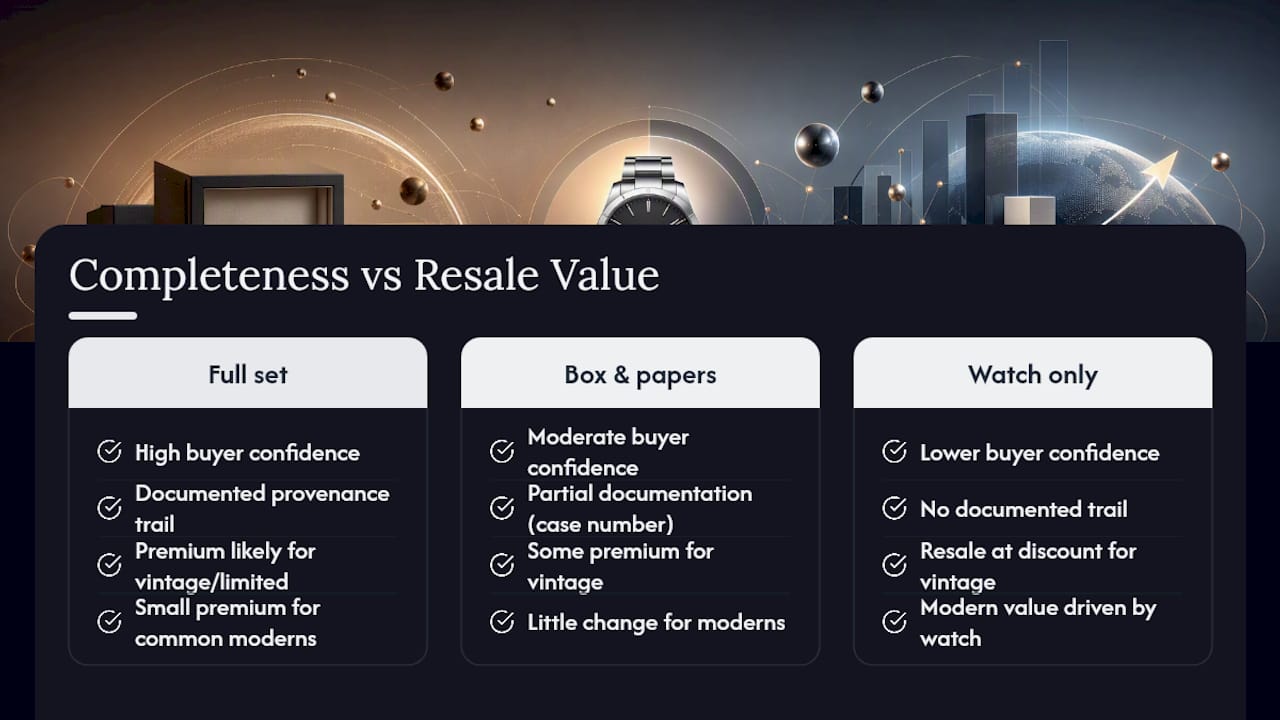
That premium isn’t universal, though. A heavily produced modern reference with plentiful supply won’t move much in price between full set and box-and-papers condition, because the watch itself, not the packaging, drives most of the value. Vintage pieces and limited runs behave differently: a numbered certificate or an original bill of sale can be the difference between a watch that’s merely old and one that’s provably what it claims to be.
Pro Tip: On vintage pieces, prioritise a matching warranty card and caseback over pristine boxes. Cardboard degrades and gets swapped; serial numbers are far harder to fake convincingly.
How do you verify a full set is genuine and coherent?
Confirming a set is real and consistent takes a systematic pass through several checkpoints, not a single glance at the box.
Match the reference and serial numbers. Cross-check the number on the warranty card, the manual (where printed), and the caseback. Any mismatch is worth walking away from until explained.
Request an archive extract. Manufacturers including Rolex and Patek Philippe can issue extracts confirming original configuration, sale date, and sometimes the original retailer.
Check era-appropriate packaging. A box style, font, or language on the warranty card should match when that reference was actually produced; a card printed in the wrong language for its claimed market of origin is a warning sign.
Distinguish service papers from original warranty. A service invoice from an authorised centre confirms recent work, not original ownership. It’s a useful supplement, never a substitute for the original card.
Photograph serials side by side rather than relying on memory
Cross-reference reference numbers against published brand catalogues
Treat mismatched fonts or spelling on documents as a reason to ask more questions, not to walk immediately
Can you recover a missing box, papers, or accessories?
Some gaps are fixable, others really aren’t. Generic or reference-correct boxes, booklets, and hang tags do circulate through secondary suppliers and specialist forums, and a careful buyer can often rebuild a passable set for common references. The caveat is that a reconstructed box is not an original one, and most experienced buyers will ask directly whether a set is original-to-the-watch or assembled afterwards.
What you can’t credibly replace is the original warranty card carrying that watch’s specific serial number. Chrono24’s collector reporting notes that archive extracts and service papers are useful substitutes but usually don’t fully replace the value collectors place on the original purchase documents.
Secondary suppliers can source correct-era boxes and manuals, but always disclose they’re not original to the watch
Original warranty cards with matching serials cannot be meaningfully replaced
An archive extract or service history is acceptable supporting evidence, though it typically comes with a modest value gap against a true original set
How Horology-kings handles full-set watches
Assessing whether a claimed full set genuinely holds together is exactly the kind of work Horology-kings does before any watch reaches its curated catalogue. Every piece goes through authentication and an expert valuation that checks serials, documentation, and accessory coherence before a price is agreed, and payment runs through secure UK bank transfers rather than informal arrangements.
Authentication and valuation cover the watch, its papers, and every accessory claimed with it
Sourcing services can locate specific full-set references for clients hunting a particular configuration
Servicing and paperwork support are available when a set needs documentation brought up to date
Working with a specialist dealer removes most of the guesswork a private sale carries, because someone with reference-level knowledge has already done the matching for you.
When completeness matters more than condition
Chasing a perfect full set can lead you to overlook the watch itself, and that’s the trade-off worth thinking about honestly. On a rare vintage reference or a limited edition, I’d insist on documentation, because that’s where the certificate genuinely is the value. On a well-worn, frequently produced modern piece, I’d rather see honest wear and a sound movement than a pristine box that’s done nothing but sit in a drawer. If you’re unsure which situation you’re in, that’s exactly the judgement call Horology-kings makes for clients every week.
— Lewis
Buying, selling, or sourcing a full-set watch with confidence
Full-set claims are only as good as the person checking them, and that’s where Horology-kings does the heavy lifting other private sales simply can’t offer. Every watch that reaches the catalogue has been authenticated against its papers and accessories first, so you’re never left guessing whether a warranty card actually belongs to the case in front of you.

Horology-kings provides expert valuations, secure UK bank transfers, and a dedicated sourcing service for buyers chasing a specific full-set reference that isn’t sitting on the open market. If you’re selling, the same authentication process protects your price by proving your set is genuine before a buyer ever asks. Ready to find a specific full-set model or get a set properly valued? Source a watch through Horology-kings and start the conversation today.
Sources
Recommended
Comments