.png)
One Step Sellers Miss: Insurance Valuation vs Sale Value

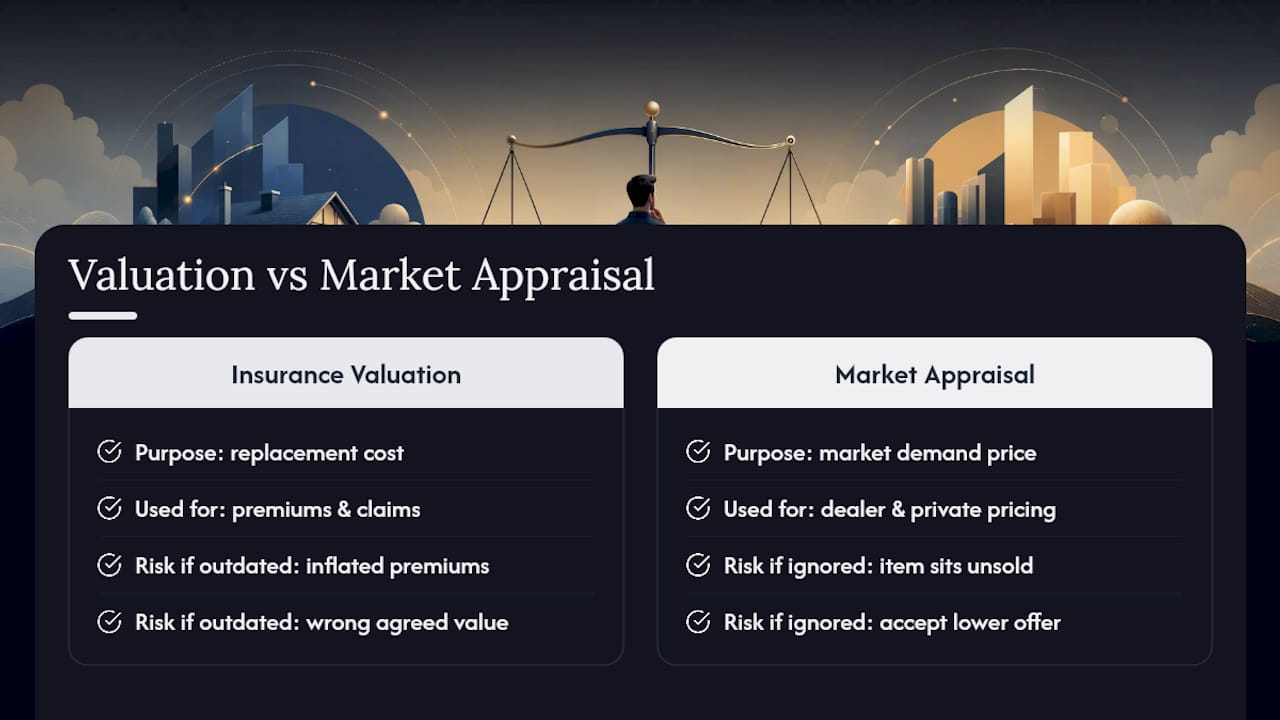
No, an insurance replacement valuation is not the same as the amount you will typically receive when you sell an item. Replacement valuations exist to fund a like-for-like new purchase if your watch or jewellery is lost, stolen, or damaged. Sale value is what a buyer will actually pay today, once commissions, condition, and market demand have been factored in.
TL;DR:
Insurance replacement value covers the cost to buy a new item today, not what you will likely receive when selling it in the secondary market.
Sale value depends on current demand, provenance, condition, and sale route, often leading to a significantly lower actual selling price than insurance estimates.
Outdated insurance valuations should be considered a ceiling, not a floor, for sale pricing or claim settlement purposes.
Regularly updating your market appraisal before listing or claiming helps prevent over- or under-insuring and avoids seller disappointment.
Documentation like original boxes, papers, and service records can narrow or eliminate the gap between insurance and sale figures, while relying solely on your insurer’s valuation can be misleading.
Table of Contents
What is an insurance valuation, exactly?
An insurance valuation is a figure your insurer uses to calculate premiums and settle claims. It is not designed to predict what a buyer would pay you. There are three main types, and knowing which one sits on your policy changes everything about how a claim, or a sale, will actually play out.
Replacement value (also called replacement cost) estimates what it would cost to buy an identical or equivalent new item today, typically including current retail pricing and VAT.
Actual cash value (ACV) starts from replacement cost but deducts depreciation for age, wear, and obsolescence, so ACV payouts land lower than replacement cost figures.
Agreed value is a fixed sum negotiated in advance between you and the insurer, often used for rare watches or jewellery where open-market pricing is volatile or thin.
Insurers use these mechanisms for one reason: to restore you to your pre-loss position, either by paying for a genuine replacement or by honouring a pre-agreed figure. None of the three is built to answer the question “what could I sell this for?” That is a market question, and it has a market answer. A reinstatement or agreed value clause can also dictate exactly how a payout is calculated after a loss, which is worth checking before you assume your cover works the way you think it does.
What does sale value actually mean?
Sale value is the price a willing buyer will pay a willing seller today, minus whatever it costs you to get the item into that buyer’s hands. Accountants call this the net selling price, defined formally as the amount obtainable from an arm’s-length transaction between knowledgeable parties, less the costs directly attributable to disposal. In plain terms: gross price minus fees equals what actually lands in your account.
Several factors push that figure up or down independently of your insurance certificate:
Buyer demand for the specific reference or model, not the category in general.
Provenance, original box and papers, and a documented service history.
Condition, including any refurbishment or repair work still outstanding.
Which sale route you choose, since a dealer, an auction house, and a private buyer all price differently.
Costs that eat into net proceeds include auction or dealer commissions, marketplace buyer and seller fees, authentication charges, servicing, postage and insurance in transit, and in some cases VAT treatment on the transaction. Collins Dictionary puts it simply: sale value is what something would make if it were sold, and that “would make” always sits below the gross retail figure once those deductions are applied.
Insurance valuation vs sale value: where the numbers actually diverge
The gap between these two figures is not a pricing error. It is baked into what each figure is designed to do.
Replacement value answers “what would it cost to buy new today, including tax?” Sale value answers “what will a buyer pay me now, after everyone takes their cut?” Those are structurally different questions, and here is where the mismatch typically shows up:
Taxes and retail margins sit inside replacement figures but never appear in your pocket from a sale.
Commissions and discounts reduce sale proceeds but are absent from any replacement estimate.
Depreciation is ignored by replacement value, factored heavily into ACV, and central to what a secondary-market buyer will offer.
Market timing affects sale value constantly. A model in high demand this year can soften within eighteen months if supply catches up.
A Rolex insured for its full retail replacement cost, including VAT and dealer margin, will often fetch less on resale unless it is a discontinued or waitlisted reference commanding a premium. A vintage Patek Philippe with full box and papers might buck that trend entirely, selling above its insurance figure because collector demand for original documentation is intense.
Pro tip: If your insurance certificate is more than two or three years old, treat its figure as a ceiling for premium purposes only, never as a floor for what you’ll get at sale.
How to use your insurance valuation when preparing to sell
Your insurance certificate is a useful starting point for a sale, not a pricing tool. Here is the sequence that actually works.
Pull your current policy schedule and check the valuation date. Anything older than two years is likely stale.
Commission a fresh market appraisal from a specialist dealer or accredited valuer rather than relying on the insurance figure. Dealers who warn against treating insurance certificates as market prices consistently see disappointed sellers who skipped this step.
Research recent sold prices for your exact reference, not the model family in general. A Submariner Date and a discontinued Submariner No Date can sell worlds apart.
Choose your sale route deliberately. Auction houses suit rare or provenance-heavy pieces; a dealer offers speed and certainty; private sale can maximise price but takes longer and carries more risk.
Set your asking price against recent sold comparables, not your insurance figure. A common rule of thumb is pricing 10 to 15% above your realistic net target to leave room for negotiation.
Full documentation matters more than most sellers expect. Original box, papers, service records, and any receipts showing recent servicing can lift a sale price meaningfully, because buyers pay a premium for reduced uncertainty. A watch that needs a service before sale is worth getting quoted before you list it. Sometimes the servicing cost is easily recovered in the final price; sometimes it is not, and knowing that in advance protects your margin either way.
An honest look at where sellers get caught out
Sellers come to us assuming their insurance certificate is a fair guide to what we’ll offer. It rarely is, and the gap catches out even experienced collectors.
Timing matters as much as the watch itself. If a model is trending upward, holding out for a retail-adjacent private sale can pay off. If demand has cooled, accepting a fair dealer offer now often beats waiting months for a private buyer who may never materialise.
What a valuation gap means for claims and selling decisions
A mismatch between your insurance figure and real sale value has consequences of disappointment at the point of sale. On the claims side, an outdated valuation risks two separate problems: paying premiums calculated against an inflated figure, or discovering at claim time that your agreed or stated value clause no longer reflects what the watch is genuinely worth. Regular appraisals reduce the risk of both over-insuring and under-insuring, which is exactly the position you want to avoid before either a claim or a sale.
On the selling side, the discrepancy shapes decisions in ways sellers do not always anticipate. Someone who anchors their asking price to an insurance figure often overprices the item, watches it sit unsold for months, and eventually accepts a lower offer than they would have secured with realistic pricing from day one. Others undersell because they assume ACV depreciation applies to a private sale the way it applies to a claims payout, when in fact a well-documented, in-demand piece can outperform its depreciated insurance figure entirely.
The practical implication is straightforward: use your insurance valuation for insurance purposes, and commission a separate market appraisal before making any pricing or claims decision. Treating one figure as a substitute for the other is the single most common cause of seller frustration, and it is entirely avoidable with one extra step before you list or claim.
How insurance valuation shapes your premiums and cover limits
Your stated valuation is not just a number attached to your certificate. It directly sets both what you pay and what you’re covered for if something goes wrong. A higher declared replacement value means a higher premium, since the insurer is underwriting a larger potential payout. That sounds obvious, but the practical trap is subtler: many owners overinsure out of caution, then pay years of inflated premiums on a figure that no longer matches current retail pricing once a model has fallen in value.
The reverse risk is more serious. If your cover limit hasn’t kept pace with rising retail prices for a model that has appreciated, you could be significantly underinsured at the exact moment you need the policy to perform. Standard insurance can leave high-value items exposed when valuations aren’t reviewed regularly, and this exposure compounds silently until a claim forces the issue.
Agreed value policies sidestep some of this uncertainty by fixing the payout figure in advance, removing the depreciation argument at claim time. But an agreed value is only as good as its last update. A figure agreed three years ago on a watch that has since seen a waiting list emerge, or a model discontinued, may no longer reflect what it would genuinely cost to replace. Reviewing your policy schedule and valuation clauses annually, or whenever a model’s market position shifts noticeably, keeps both your premium and your cover limit honest.
Legal and regulatory points worth knowing
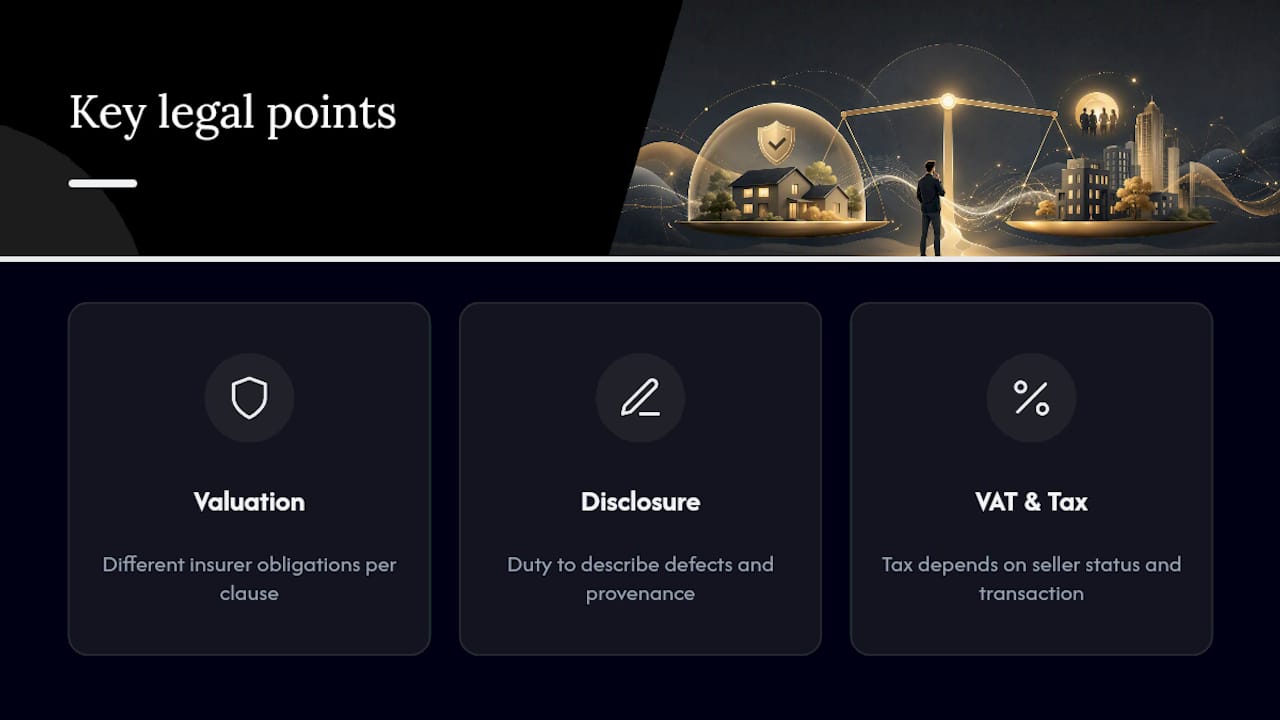
Insurance contracts are legal documents, and the valuation clause within them carries real weight if a claim is disputed. The distinction between agreed value, actual cash value, and reinstatement value clauses isn’t just semantic. Each one creates a different contractual obligation on the insurer, and courts and ombudsman decisions in insurance disputes generally hold insurers to whichever clause the policy actually states, not to what a policyholder assumed it meant.
This matters at the point of sale too. If you’re selling privately, you have a duty to describe the item honestly, including any known defects, prior repairs, or authentication concerns. Misrepresenting condition or provenance to inflate a sale price can expose you to a claim of misrepresentation from the buyer, entirely separate from anything to do with your insurer.
VAT treatment is another area sellers overlook. Whether VAT applies to a sale, and whether it can be reclaimed or must be accounted for, depends on your status as a seller and the nature of the transaction. This is not a one-size-fits-all rule, and getting it wrong on a high-value watch sale can be costly. If you’re selling as part of a business activity rather than a private disposal, the tax position changes materially, and it is worth checking your specific circumstances with a qualified adviser before finalising a sale, rather than assuming the same rules that apply to your insurance premium apply to your sale proceeds.
Our take: stop treating your insurance certificate as a price tag
The conventional advice tells sellers to “get a valuation” and leaves it there, as though one document could serve two entirely different purposes. It cannot. The research is consistent on this: insurers price for replacement, markets price for demand, and conflating the two is where most seller disappointment originates.
What gets underrated is how much documentation moves the needle. A full service history and original papers can close much of the gap between insurance and sale figures, sometimes eliminating it entirely for the right reference. What gets overrated is the insurance certificate itself as a selling tool. It was never built for that job, and asking it to do so sets unrealistic expectations before a single conversation with a buyer happens.
If you take one thing from this: commission a current market appraisal before you price anything for sale, not before you renew your policy. The order matters more than most sellers realise, and getting it backwards is the single most avoidable mistake in this entire process.
— Lewis
How Horology Kings can help you value and sell with confidence
If you’re weighing up whether to sell, Horology Kings offers professional market valuations that go beyond what an insurance certificate can tell you, drawing on live secondary-market pricing rather than retail replacement figures.

Our valuation process looks at your exact reference, condition, box and papers, and service history to give you a realistic figure grounded in what buyers are actually paying right now. Before you get in touch, gather your original documentation, any service records, and your current insurance schedule. It speeds up the process and often improves the figure we can offer. Every sale is handled discreetly, with secure bank transfers and full transparency at each stage, so there’s no pressure and no guesswork about where the money goes or when. If you’d rather explore what your watch might realistically be worth before committing to a sale, that’s a sensible first step, and one we’re happy to walk you through with no obligation attached.
Sources
For deeper detail on valuation clauses and net selling price concepts referenced above, see Investopedia’s explanation of valuation clauses and PwC’s viewpoint on IAS 36 net selling price.
FAQ
Should I insure for market value or agreed value?
For rare or high-demand watches and collectibles, an agreed value clause is usually safer, since it fixes your payout in advance and avoids depreciation disputes at claim time.
Is it better to insure for market or retail value?
Retail replacement value is generally the right basis for insurance, since it covers what you’d actually pay to replace the item new; market value is what you’d realistically get if you sold it, which is typically lower.
How do I value my item for insurance purposes?
Commission a professional appraisal from an accredited valuer who assesses current retail replacement cost, including VAT, rather than relying on an old receipt or a previous certificate.
What is the difference between agreed value and market value?
Agreed value is a fixed sum negotiated with your insurer in advance and paid regardless of market movement, while market value fluctuates with demand and is reduced by depreciation and selling costs at the point of a genuine sale.
Can Horology Kings tell me what my watch is worth before I insure or sell it?
Yes, Horology Kings provides market appraisals based on current secondary-market pricing, which can inform both your insurance valuation discussion and your realistic sale expectations.
Recommended
Comments