.png)
Luxury watch size guide: find your perfect fit
TL;DR:
Choosing the right luxury watch size depends more on lug-to-lug measurement and wrist shape than just case diameter. A well-fitting watch aligns with your wrist’s actual dimensions, ensuring comfort and aesthetic harmony. Accurate wrist measurement and understanding how design elements influence fit are essential for selecting a watch that looks and feels right daily.
Choosing the right size luxury watch sounds straightforward until you realise that the number stamped on every spec sheet, the case diameter, tells only half the story. A poorly fitted watch on your wrist is distracting regardless of its pedigree. This luxury watch size guide exists to fix that. It covers every dimension that matters, from lug-to-lug length and case thickness through to how your wrist shape affects the way a watch actually sits and feels. By the end, you will have a clear, practical framework for choosing a timepiece that looks right and wears comfortably every single day.
Table of Contents
Key takeaways
Point | Details |
Diameter is just the starting point | Lug-to-lug length predicts real comfort far better than case diameter alone. |
Wrist shape matters as much as size | Flatter wrists can carry larger lug-to-lug measurements without overhang or discomfort. |
Standard sizing ranges exist | Men’s watches typically run 38mm to 46mm; women’s from 26mm to 36mm in diameter. |
Use the measurement stack method | Filter by diameter, apply your lug-to-lug comfort range, then confirm bracelet fit in person. |
Visual cues affect perceived size | Dial colour and bezel width can make a watch appear larger or smaller than its physical dimensions suggest. |
1. Why diameter is not the whole luxury watch size guide
Most people walk into a watch purchase thinking exclusively about case diameter. A 40mm Rolex sounds the same as a 40mm Patek Philippe until you put both on your wrist. 41mm and 42mm watches can wear very differently depending on lug length and design, which makes diameter a headline spec rather than a reliable comfort predictor.
The case diameter measures the width of the case across the dial, ignoring how far the lugs extend up and down your wrist. That vertical measurement, the lug-to-lug, is where fit is actually decided. Two watches sharing a 40mm diameter can have lug-to-lug measurements of 46mm and 52mm respectively, and they will feel like entirely different objects on your arm.
Understanding this distinction is the foundation of every solid luxury watch fitting guide. Once you stop fixating on diameter and start reading the full spec sheet, your purchase decisions become far more predictable.
2. The four measurements that actually determine fit
A genuinely useful luxury watch size guide must address four dimensions, not one.
Case diameter is the width measured straight across the middle of the case, crown excluded. It is a useful first filter for establishing the visual scale you want on your wrist, but it stops there.
Lug-to-lug length is the distance from the tip of one lug to the tip of the opposing lug. This is the measurement that crosses your wrist and determines whether the watch stays within your skin or overhangs the edges. Lug-to-lug determines real wrist footprint and comfort in a way that diameter simply cannot. For a 6.75-inch wrist, 45mm to 50mm lug-to-lug is the sweet spot, with anything over 52mm to 53mm beginning to overhang.
Case thickness dictates how a watch profiles on the wrist. A slim 8mm dress watch disappears under a shirt cuff. A 14mm sports watch announces itself under anything. Thickness also influences how secure and stable a watch feels in motion.
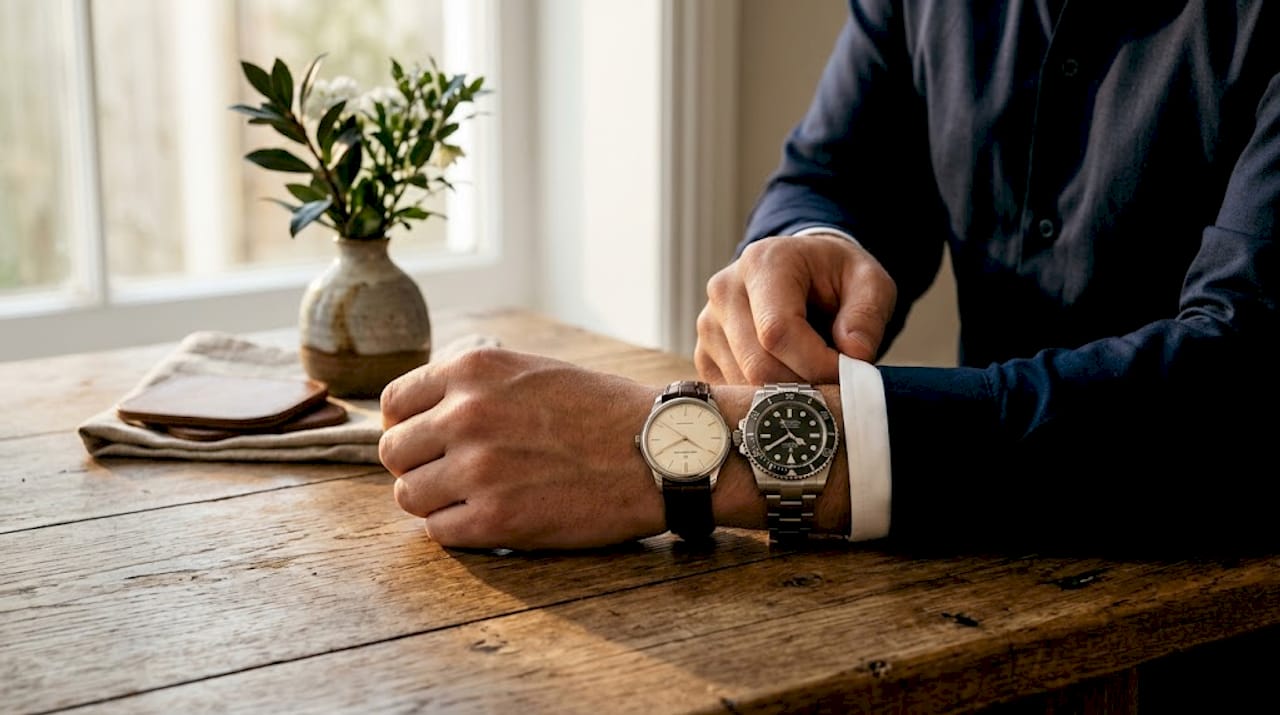
Lug design and shape rounds out the picture. Downward-sloping lugs improve comfort and reduce overhang by curving the watch closer to the wrist’s surface. Straight or flat lugs extend the footprint and increase the chance of the case lifting off the skin. Dress watches tend to use longer, elegant lugs for a refined silhouette, while tool watches favour shorter, downward-sloping lugs for a snug, locked-in feel.
Pro Tip: When reviewing specs online, always search for the lug-to-lug measurement separately. Many brands list only diameter on their product pages. The lug-to-lug is almost always available in independent reviews and collector forums.
3. How to measure your wrist accurately
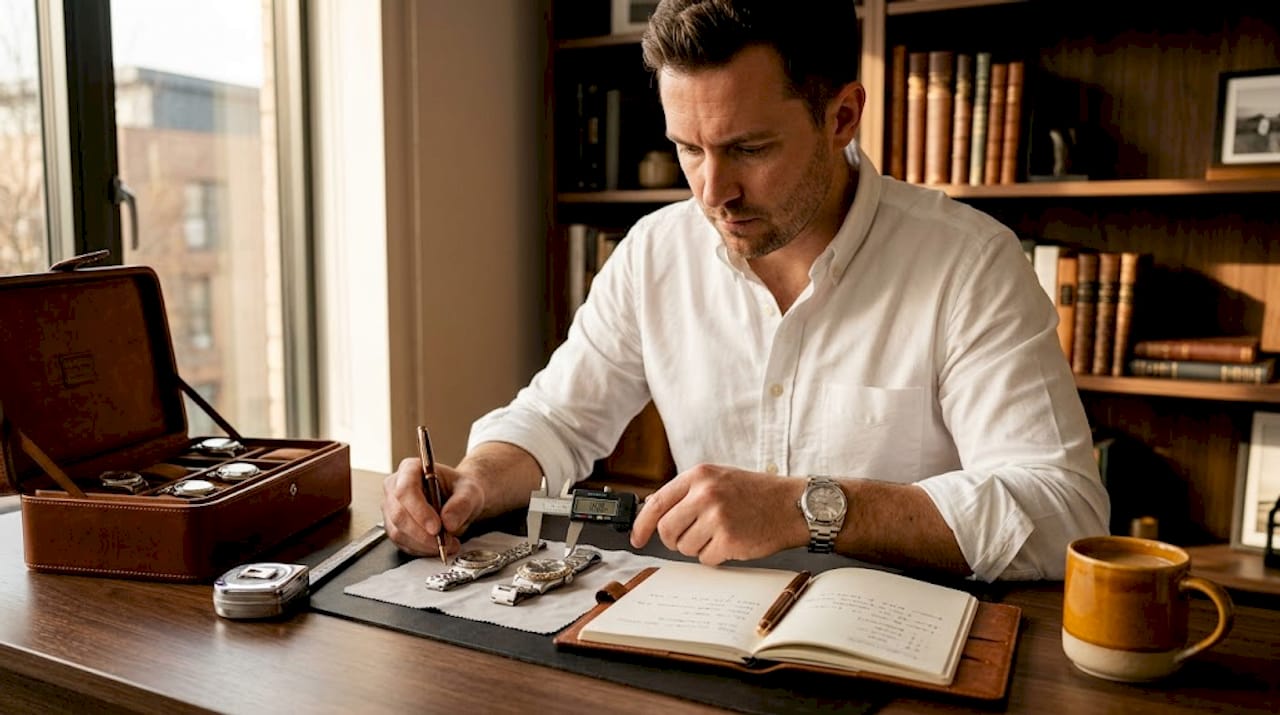
Getting your measurements right before buying transforms the process of choosing watch size from guesswork into a reliable system. Here is how to do it properly.
Measure your wrist circumference. Wrap a flexible tailor’s tape snugly around your wrist just above the wrist bone, where a watch would naturally sit. Note the measurement in millimetres. If you do not have a tape measure, a strip of paper wrapped around the wrist and measured against a ruler works perfectly well.
Assess your wrist shape from above. Look straight down at your wrist. A flatter, broader wrist profile provides more surface area for the watch to sit on. A rounder, narrower wrist has less flat surface, which means watches can appear larger and shift more on the wrist.
Assess your wrist shape from the side. A rounder wrist causes the watch case to bow upwards in the centre, reducing contact with the skin and sometimes creating a visually inflated impression of size. Rounder wrists cause watches to appear larger and move more; flatter wrists accommodate larger lug-to-lug dimensions comfortably.
Cross-reference your circumference with typical lug-to-lug ranges. Wrists under 165mm (around 6.5 inches) tend to suit a lug-to-lug of 42mm to 47mm. Wrists between 165mm and 178mm (6.5 to 7 inches) typically wear 46mm to 50mm comfortably. Wrists over 178mm can often support lug-to-lug measurements up to 52mm without overhang.
Repeat measurements at different times of day. Wrists can vary slightly in circumference between morning and evening due to fluid retention and temperature. Taking two or three readings gives you a reliable average to work from.
Pro Tip: Measure your wrist from directly above and then from the side separately. The two angles together tell you far more about how a watch will wear than a single circumference figure alone.
4. Standard luxury watch dimensions: what the market offers
Knowing typical luxury watch dimensions helps you interpret spec sheets and filter options sensibly before you handle anything in person. Men’s watch diameters typically range from 38mm to 46mm, with 42mm representing the most popular choice across current collections. Women’s watches generally sit between 26mm and 36mm, though the boundaries have loosened considerably as unisex sizing has grown in popularity.
Some of the most celebrated models sit slightly outside these conventions. The Audemars Piguet Royal Oak 15500 measures 41mm in diameter but carries a lug-to-lug of around 48mm, making it wear compactly for its presence. The Rolex Submariner sits at 41mm with a lug-to-lug of approximately 47mm, which is why it fits such a wide range of wrist sizes. The Patek Philippe Nautilus 5711 measures 40mm in diameter but wears slightly larger due to its integrated bracelet and broad case shape.
Key size benchmarks across popular categories include:
Dress watches (men’s): 36mm to 40mm diameter, 44mm to 48mm lug-to-lug, 7mm to 9mm thickness
Sports watches (men’s): 40mm to 44mm diameter, 46mm to 52mm lug-to-lug, 11mm to 14mm thickness
Pilot and field watches: 38mm to 42mm diameter, often with crown guards that add perceived bulk
Women’s dress watches: 28mm to 34mm diameter, 38mm to 44mm lug-to-lug
Unisex contemporary watches: 36mm to 39mm diameter, increasingly popular across genders
5. Side-by-side comparison: same diameter, different wrist experience
This is where most buyers get caught out. Two watches sharing a 40mm case diameter can wear radically differently, and a simple comparison table illustrates why.
Watch | Diameter | Lug-to-lug | Thickness | Wearing character |
Rolex Datejust 41 | 41mm | ~47mm | 12mm | Compact and secure; fits most wrists cleanly |
IWC Portugieser 40 | 40mm | ~48mm | 10.7mm | Elegant and slim; feels larger due to longer lugs |
Audemars Piguet Royal Oak 15500 | 41mm | ~48mm | 9.8mm | Thin profile and integrated design minimise perceived bulk |
Jaeger-LeCoultre Reverso Duoface | 28.8mm x 47mm | ~53mm | 9.2mm | Rectangular design wears larger than the width implies |
The Reverso example is instructive. Its case width is modest, yet the lug span gives it real wrist presence because square and rectangular watches occupy wrist real estate in both height and width. That is a consideration easily missed when reading only diameter figures.
Integrated bracelet watches deserve a separate note. The Royal Oak’s effective lug-to-lug extends from the nominal 48mm to approximately 56.7mm in practice because the stiff first bracelet links do not drop immediately from the case. The watch effectively starts wrapping your wrist further out than a conventional lug would. This is worth accounting for, particularly when buying online without trying the piece first.
Visual weight factors also influence perceived size independent of the physical dimensions. Lighter dials appear larger; dark or heavily textured dials reduce apparent size. A broad, polished bezel adds visual weight and can make even a 38mm case read as substantial on the wrist.
6. Situational tips and watch size recommendations by wrist type
Good luxury watch sizing tips are only useful when applied to your actual situation. Here is a practical breakdown.
Wrists under 6.5 inches: Prioritise watches with a lug-to-lug under 47mm. A 38mm to 40mm diameter with downward-curving lugs will sit cleanly without overhang. Thinner profiles, around 9mm to 11mm, keep the aesthetic proportionate.
Wrists between 6.5 and 7 inches: The widest range of options opens up here. Lug-to-lug between 46mm and 50mm covers most sports and dress watches comfortably. The 40mm to 42mm diameter range is well matched to this category.
Wrists over 7 inches: Lug-to-lug up to 52mm is workable, particularly on flatter wrists. Sports watches in the 42mm to 44mm range wear well. Be cautious with integrated bracelet watches, as their effective footprint can push past comfortable limits unexpectedly.
For dress occasions, thinner profiles and smaller diameters create an elegant result under a shirt cuff. For tool watches, a snugger lug-to-lug fit reduces movement during activity and feels more secure. When buying online, use the measurement stack approach: filter by diameter first, apply your lug-to-lug comfort range second, then confirm bracelet sizing against your wrist measurement if you can handle the piece in person at any point before purchase. Pairing the right strap material with your chosen watch also affects comfort and perceived fit. A thorough strap material comparison can be just as important as the case dimensions when building a watch for daily wear.
Pro Tip: Print a paper template of the lug-to-lug measurement you are considering and hold it against your wrist before buying. It takes two minutes and eliminates a surprisingly large amount of sizing doubt, especially when shopping remotely.
My honest take on watch sizing myths
I have spent years handling luxury watches and watching buyers make the same mistake. They walk in with a diameter in mind, they say “I only wear 40mm watches,” and they try nothing else. Then they put on a 39mm piece with a 50mm lug-to-lug and it overhangs, or they try a 42mm watch with downward-sloping lugs and it fits better than anything they own.
The diameter obsession comes from online forums and spec sheets, not from wrists. It is a shorthand that sounds authoritative but ignores wrist shape measurement, which is genuinely the variable that creates comfort or discomfort. I have seen people with 6.5-inch wrists wear a 44mm sports watch beautifully because their wrist was flat and the lugs curved down. I have seen people with 7-inch wrists struggle with a 42mm piece because their wrist was rounded and the watch rocked.
My advice is to go into any watch purchase knowing your lug-to-lug sweet spot first, then use diameter as a secondary filter. A UK buyer’s guide to acquiring luxury watches will tell you about provenance and pricing, but your own wrist measurements should be the first document you consult. Build a collection where pieces serve different occasions and sizes serve different moods. A slim 38mm dress watch and a 42mm sports piece are not competing. They are completing each other.
— Lewis
Find your perfect size with Horology Kings

At Horology-kings, based in Hertfordshire, we work with buyers who want more than a transaction. Every piece in our collection comes with full spec details including lug-to-lug measurements, because we know how much that number matters when you are buying remotely. Whether you are looking for a specific Rolex, Patek Philippe, Audemars Piguet, or Omega, our team can help you find a watch that fits your wrist as well as your collection. You can browse and buy luxury watches directly through our platform, or use our watch sourcing service if you have a specific reference in mind. Sizing guidance is part of every conversation.
FAQ
What is the most important watch size measurement for comfort?
Lug-to-lug length is the most predictive measurement for comfort and fit. It determines how far the watch extends across your wrist, making it more relevant than case diameter alone.
What watch size should I buy for a 6.75-inch wrist?
A lug-to-lug measurement of 45mm to 50mm is the sweet spot for a 6.75-inch wrist. A diameter of 40mm to 42mm typically pairs well with this range.
How do I measure my wrist for a luxury watch?
Wrap a flexible tape measure around your wrist just above the wrist bone and record the measurement in millimetres. Combine this with an assessment of your wrist shape, flat versus rounded, to accurately identify your ideal lug-to-lug range.
Do integrated bracelet watches wear larger than their specs suggest?
Yes. Integrated bracelet watches extend their effective lug-to-lug because the stiff first links do not curve immediately away from the case, adding several millimetres to the real wrist footprint beyond the nominal measurement.
What is a good size chart for luxury watches for men?
Men’s watches generally range from 38mm to 46mm in diameter, with 42mm being the most popular. For lug-to-lug, 45mm to 50mm suits most men’s wrists in the 6.5 to 7 inch range.
Recommended
Comments