.png)
Why documentation matters for watches in 2026
TL;DR:
Proper watch documentation establishes a verifiable history that photos alone cannot provide, especially amid AI-generated fraud in 2026. Comprehensive records like receipts, warranty cards, service invoices, and serial number photos strengthen authenticity, trust, and resale value. Maintaining organized, physical, and digital records safeguards provenance and enhances long-term collection value.
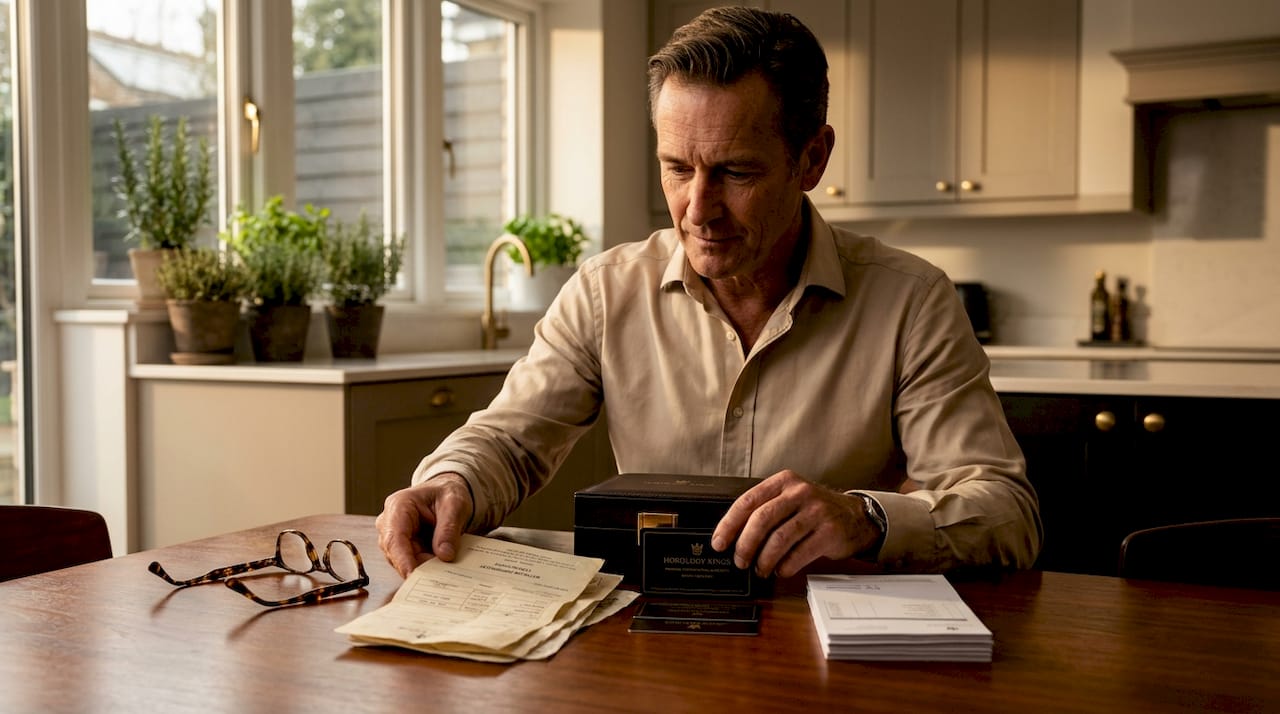
Many collectors assume a clear photograph is enough to prove a watch’s authenticity. In 2026, that assumption is genuinely dangerous. The rise of AI-generated images and deepfake listings has made visual evidence alone unreliable, and understanding why documentation matters for watches has never been more pressing. Proper paperwork, known in the trade as “papers” or provenance records, creates a verifiable chain of custody that photographs simply cannot replicate. This guide covers the key documents every collector should hold, how they combat fraud, and why they directly affect what your watch is worth.
Table of Contents
Key takeaways
Point | Details |
Papers prove more than photos | Original receipts, warranty cards, and serial records verify identity in ways images cannot. |
Service records affect pricing | Detailed, recent servicing invoices increase buyer confidence and can command resale premiums. |
Modern fraud requires layered proof | Deepfake risks in 2026 mean collectors must combine paperwork, serial cross-checks, and live verification. |
Organisation protects long-term value | Structured physical and digital records preserve provenance and support heirloom status over time. |
Full sets attract better buyers | Watches presented with box, papers, and certificates consistently achieve stronger secondary market prices. |
Why documentation matters for watches
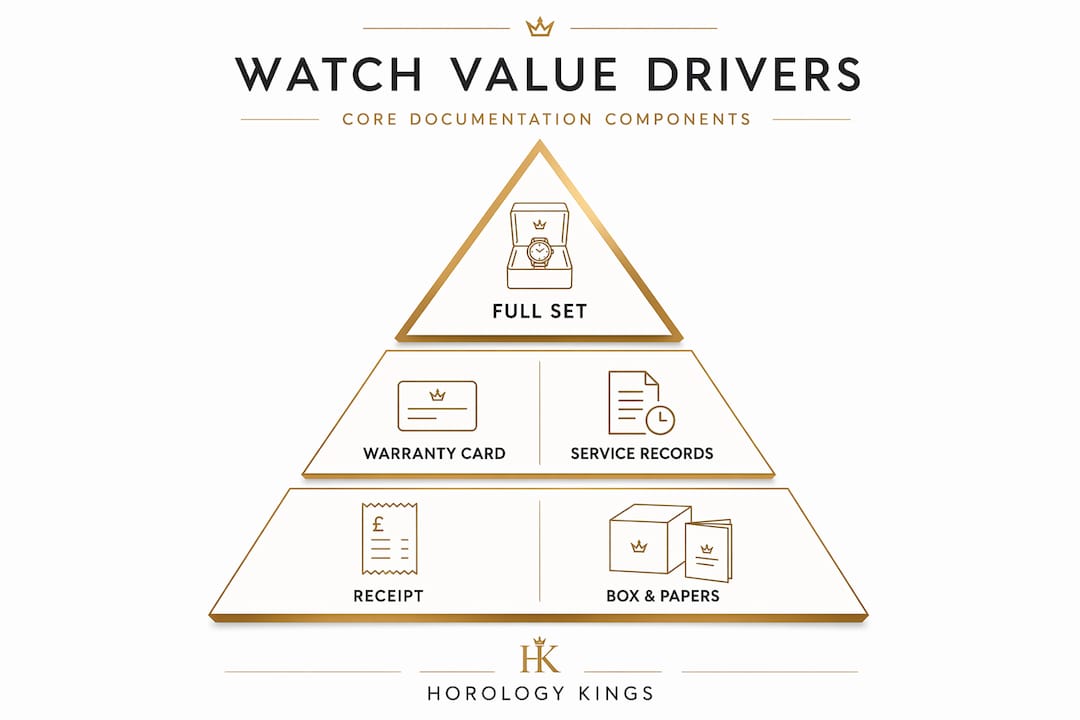
The industry term for the body of paperwork accompanying a luxury watch is “provenance documentation.” It is the collective record that proves what a watch is, where it has been, and what has been done to it. Understanding the importance of watch documentation starts with knowing exactly what that bundle should contain.
At minimum, a well-documented luxury watch should include the following:
Original sales receipt or invoice. This establishes the first point of sale, the date of purchase, and the retailer. For brands like Rolex or Patek Philippe, an authorised dealer receipt carries significant weight.
Warranty card or certificate. Ideally stamped and dated by the selling boutique, this links the specific serial number to its retail origin.
Service records. Detailed invoices from authorised service centres or reputable independents, listing work performed, parts replaced, and dates of service.
Authentication or exhibition certificates. For limited editions or historically significant pieces, these documents can dramatically increase value.
Box, manuals, and accessories. The benefits of watch manuals and original packaging go beyond aesthetics. They confirm the watch was sold through legitimate channels and has been stored with care.
Photographs of serial numbers. High-resolution images of caseback and movement engravings that cross-reference the physical watch with its paperwork.
Together, these records form what researchers describe as a complete provenance documentation pack: identity through serial numbers, chronology through sale and service dates, and integrity through records of work performed. Each layer reinforces the others, building a picture no single document could create alone.
The value of watch records is particularly clear when you consider what their absence signals to a buyer. A Rolex Submariner without papers is not simply “papers missing.” It is a watch whose entire history is unverifiable, and buyers price that uncertainty accordingly.
Combating modern fraud with documentation
The threat environment for watch collectors has shifted sharply. Images alone are insufficient to verify authenticity in 2026, as AI-generated counterfeit content has become sophisticated enough to fool casual inspection. A convincing photograph of a genuine Patek Philippe dial can now be produced without a real watch ever being present. This is not a future risk. It is happening in active marketplace listings today.
Effective authentication now requires a layered approach:
Serial number cross-check. Verify the serial number visible on the case against manufacturer records, service documents, and the warranty card. All three should agree. Any discrepancy is a serious flag.
Live video verification. Request a real-time video call where the seller demonstrates the watch functioning, shows the caseback engraving, and matches it to the paperwork in real time.
Forensic photo analysis. Look for inconsistencies in lighting, shadow direction, and reflection that may indicate composite imagery. Forensic photo analysis combined with paper cross-checks is now standard practice among serious collectors.
Third-party authentication. Use a trusted independent authenticator or escrow service before funds change hands. Escrow services and multi-factor verification have become the expected standard in 2026 for transactions above five figures.
Chain of custody review. Ask for a chronological account of ownership, ideally supported by documentation at each stage. The more complete the chain, the harder it is to fabricate.
Documentation transforms visual claims into verifiable chains that prevent paying premiums for fakes. A photograph is a snapshot. Paperwork is a history.
Pro Tip: When reviewing a watch listing remotely, ask the seller to photograph the serial number alongside today’s newspaper or a handwritten note with the date. This simple step makes retroactive image fraud significantly harder to execute.
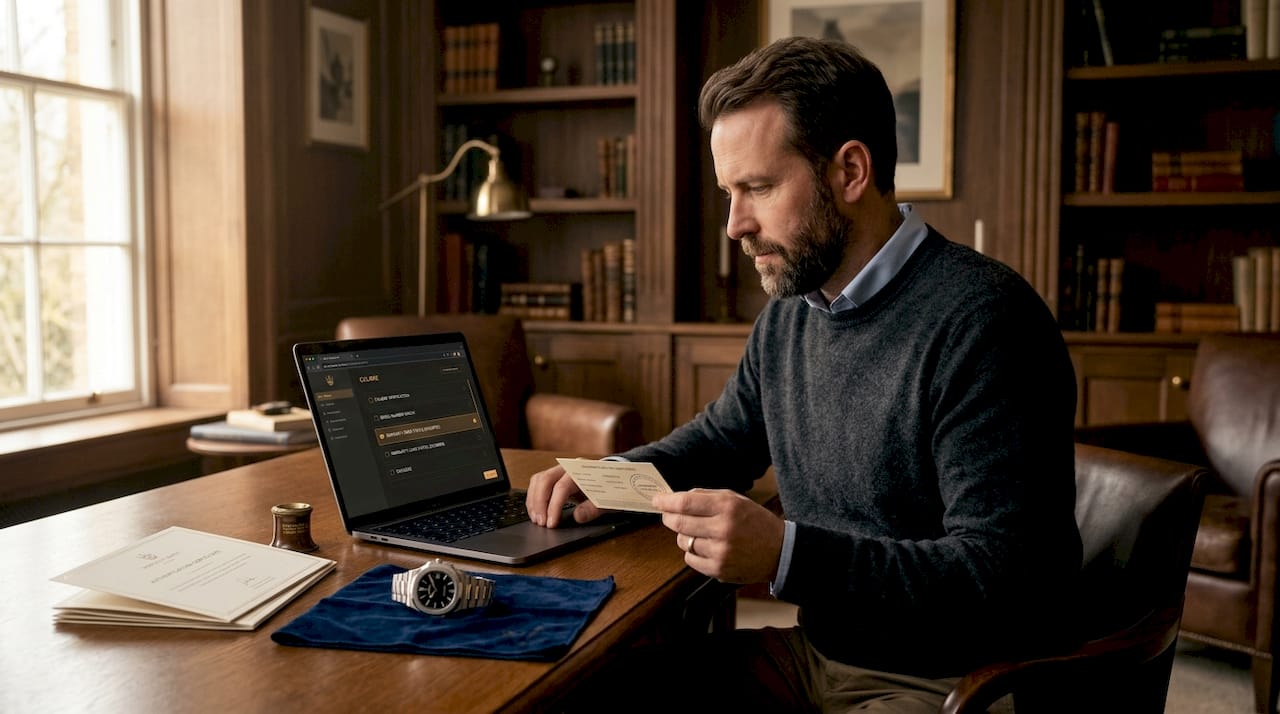
The watch authentication checklist published by Horology-kings covers the full verification process in detail, and it is worth reviewing before any significant purchase.
Service records and their effect on value
Service history is the most underestimated component of watch documentation among new collectors, and the most valued by experienced buyers. A watch that has been professionally maintained is not just mechanically healthier. It is a watch the buyer does not need to worry about.
The distinction between useful and unhelpful service records matters here:
A vague entry saying “serviced 2019” with no accompanying invoice tells a buyer almost nothing. It does not confirm what was done, who did it, or whether original parts were used.
A detailed invoice from an authorised service centre listing movement disassembly, ultrasonic cleaning, oiling, regulation to within three seconds per day, a pressure test result, and any parts replaced is genuinely reassuring. Clear, recent service documentation prevents a watch from being treated as a project requiring immediate expenditure.
Buyers also pay close attention to what service records reveal about cosmetic work. Over-polishing without documentation is a significant collector concern, particularly for sports models where sharp case edges are part of the appeal. A service record that explicitly notes “no case polishing performed” is a positive statement of originality, not just an absence of concern.
Pro Tip: When you collect a watch from a service centre, always ask for a printed, signed invoice. If they offer only a digital receipt, request that it be emailed to you in PDF format immediately and save it alongside the physical papers. A well-maintained service history is one of the most straightforward ways to protect resale value.
The impact on pricing is real. Detailed service records can boost trade-in value materially, particularly when the documentation includes timing results and pressure tests. Buyers are not simply paying for a serviced watch. They are paying for certainty.
Organising your watch’s documentation
Knowing what to include in watch documentation is only half the task. The other half is organising and preserving it so that it remains useful years or even decades later.
The table below compares the two main approaches collectors use:
Method | Advantages | Considerations |
Physical leather notebook | Durable, tactile, credible to buyers, keeps originals together | Risk of loss or damage without backups |
Digital app or cloud storage | Searchable, shareable, backed up automatically | Less credible without physical originals; tech dependency |
Combined approach | Best of both worlds; physical originals with digital copies | Requires consistent upkeep across two systems |
Physical leather notebooks have become popular among serious collectors for good reason. They are durable, they cannot be hacked, and they carry a tangible credibility that a screenshot never will. The recommended practice is to use a physical log as the primary record and digital backups as insurance.
When you make an entry, record the date, the work performed, the name and location of the technician, and their signature where possible. Add high-quality photographs of any serial number engravings, and photograph the watch alongside its papers at each service. These images complement the written record and make the package far harder to dispute.
For insurance and estate purposes, the value of watch records grows significantly when they travel safely with the watch. Keep originals in a fireproof document wallet inside your safe. Send high-quality scans to a trusted cloud backup. If you are selling or consigning a watch, present the documentation as a cohesive package, neatly organised and clearly labelled.
Documentation, trust, and the secondary market
Every layer of documentation a watch carries reduces the friction involved in selling it. Watches with full sets of box, papers, and certificates consistently achieve stronger prices on the secondary market, and the reason is straightforward: documentation confirms provenance, deters fraud, and appeals to collectors seeking completeness.
Beyond the financial case, there is a longer view worth taking. A watch with a complete, well-maintained record is an heirloom. It tells a story. A Rolex that passes from parent to child with thirty years of service records, original papers, and photographs at each chapter of its life carries a weight of meaning that no unpapered watch can replicate.
“Collecting proper documentation is increasingly seen as protecting the hobby and the investment simultaneously. Provenance improves trust and resale, while also preserving emotional and heirloom significance.” The watch collector’s notebook
Raising the standard for documentation is not just good practice for individual collectors. It raises the bar for the entire secondary market. When buyers routinely expect papers, service records, and serial cross-checks, it becomes harder for fraudulent listings to survive. Collectors who insist on documentation standards are, in a meaningful sense, protecting the market they participate in.
My perspective on documentation in collecting
I’ve worked closely with watch buyers and sellers for long enough to have seen the same mistake repeated many times. A collector acquires a beautiful piece, wears it for a decade, sends it for service, loses the original receipt somewhere in a house move, and then faces a deflated offer when it comes time to sell. The watch is genuine. The movement is perfect. But without papers, it cannot prove what it is.
What I’ve learned is that documentation gaps rarely feel significant when you are buying a watch. They feel enormous when you are selling one. The emotional attachment you have to a piece does not transfer to a buyer who has never met it before. What transfers is paperwork.
I also think the conventional wisdom that “the watch speaks for itself” has aged badly. In 2026, wristwatch provenance is not optional supplementary material. It is the foundation of a credible transaction. The collectors I have seen build genuinely valuable collections treat documentation with the same discipline they apply to condition. They file receipts immediately, log service visits as a matter of course, and keep backup scans without being asked. Their watches sell faster and for more money. The connection is not coincidental.
My practical advice is this: treat every document that comes with a watch as irreplaceable, because it is. Start a record on the day you acquire a piece, even if it is a simple handwritten note with the date and source. That habit, maintained over years, pays dividends you will appreciate when the time comes to pass the watch on.
— Lewis
How Horology-kings helps protect your investment

At Horology-kings, every watch we buy, sell, or source is assessed with provenance and authenticity at the centre of the process. We check serial numbers against accompanying paperwork, review service histories, and apply the same layered verification standards described in this article. If you are looking to source a specific watch, our expert network helps locate genuine pieces with documented histories, not just attractive photographs. For collectors who want to keep their service records in order, our watch repair and servicing team provides detailed, signed invoices with every job, so your documentation stays complete. Get in touch to discuss your collection or a specific piece you have in mind.
FAQ
Why are watch papers so important for resale?
Watch papers link a specific serial number to its retail origin, confirming the watch was sold through legitimate channels. Without them, buyers cannot independently verify the watch’s identity, and that uncertainty directly reduces the price they are willing to pay.
What should I include in a watch’s documentation pack?
A thorough pack includes the original sales receipt, warranty card, service invoices with parts and work described, box and manual, and high-resolution photographs of all serial number engravings. Together these cover identity, chronology, and the integrity of work performed.
Can photographs replace physical paperwork for authentication?
No. Images alone are insufficient in 2026 due to the sophistication of AI-generated imagery. Physical paperwork with matching serials and a verifiable chain of custody is required to confirm authenticity beyond reasonable doubt.
How do service records affect a watch’s value?
Detailed, recent service documentation that lists specific work performed, parts replaced, and timing results gives buyers confidence in the mechanical health of a watch. Vague or missing records increase uncertainty and reduce the price buyers are prepared to offer.
Is a digital backup of watch papers sufficient?
Digital backups are useful for insurance and quick reference, but physical originals carry far greater credibility with serious buyers. The recommended approach is to maintain physical originals in secure storage alongside digital copies as a precaution against loss or damage.
Recommended
Comments