.png)
What Is Patek Philippe Certification? 65+ Criteria Explained

Many collectors assume Patek Philippe’s certification mirrors standard industry benchmarks like COSC or the Geneva Seal. It doesn’t. The brand’s proprietary Patek Philippe Seal enforces over 65 rigorous criteria covering the entire watch, not just the movement. This guide reveals what makes this certification uniquely demanding and why it matters for your investment decisions.
Table of Contents
Key Takeaways
Point | Details |
Proprietary Standard | The Patek Philippe Seal covers 65+ quality criteria across workmanship, precision, reliability, and lifetime service commitments. |
Extreme Accuracy | Movements must achieve -1/+2 seconds daily accuracy, exceeding COSC chronometer standards of -4/+6 seconds. |
Whole Watch Certification | Unlike Geneva Seal or COSC, the Patek Philippe Seal applies to the entire finished watch including case and exterior elements. |
Lifetime Service Guarantee | Patek Philippe commits to servicing any watch manufactured since 1839, ensuring long term value preservation. |
Authentication Best Practice | Combine Seal verification with serial numbers, archive extracts, and professional appraisal for secure purchase confidence. |
Introduction to Patek Philippe Certification
Patek Philippe stands alone as the last family owned Swiss luxury watch manufacturer. This independence shapes every decision, including how the brand certifies quality. In 2009, Patek Philippe replaced its reliance on external certifications by launching its own proprietary Seal. The Patek Philippe Seal was introduced in 2009 to surpass the Geneva Seal, reflecting Patek Philippe’s belief that it had exceeded existing certification standards.
This move wasn’t about marketing. The brand wanted a certification that matched its exacting standards across every dimension of watchmaking. Unlike previous seals that focused solely on movements, the Patek Philippe Seal evaluates the complete timepiece. This holistic approach reflects the company’s core philosophy that every component matters equally.
The Seal’s foundation rests on a remarkable service promise. Patek Philippe guarantees service, repair, or restoration of any watch it has manufactured since 1839, reinforcing the Seal’s commitment to longevity. This lifetime warranty isn’t theoretical. The brand maintains extensive archives and component inventories to honor this pledge. For collectors seeking investable Patek Philippe watches, this service commitment directly impacts long term value retention.
Key elements distinguishing the Seal include:
Comprehensive scope covering movements, cases, dials, and finishing
Stringent precision standards exceeding industry chronometer requirements
Documented service commitment backed by 185 years of continuous operation
Regular criteria updates ensuring standards evolve with technological advances
The Patek Philippe official site provides detailed technical specifications for each certified model. Understanding the history of Patek Philippe Seal helps collectors appreciate why this certification commands premium valuations in secondary markets.
Understanding the Patek Philippe Seal
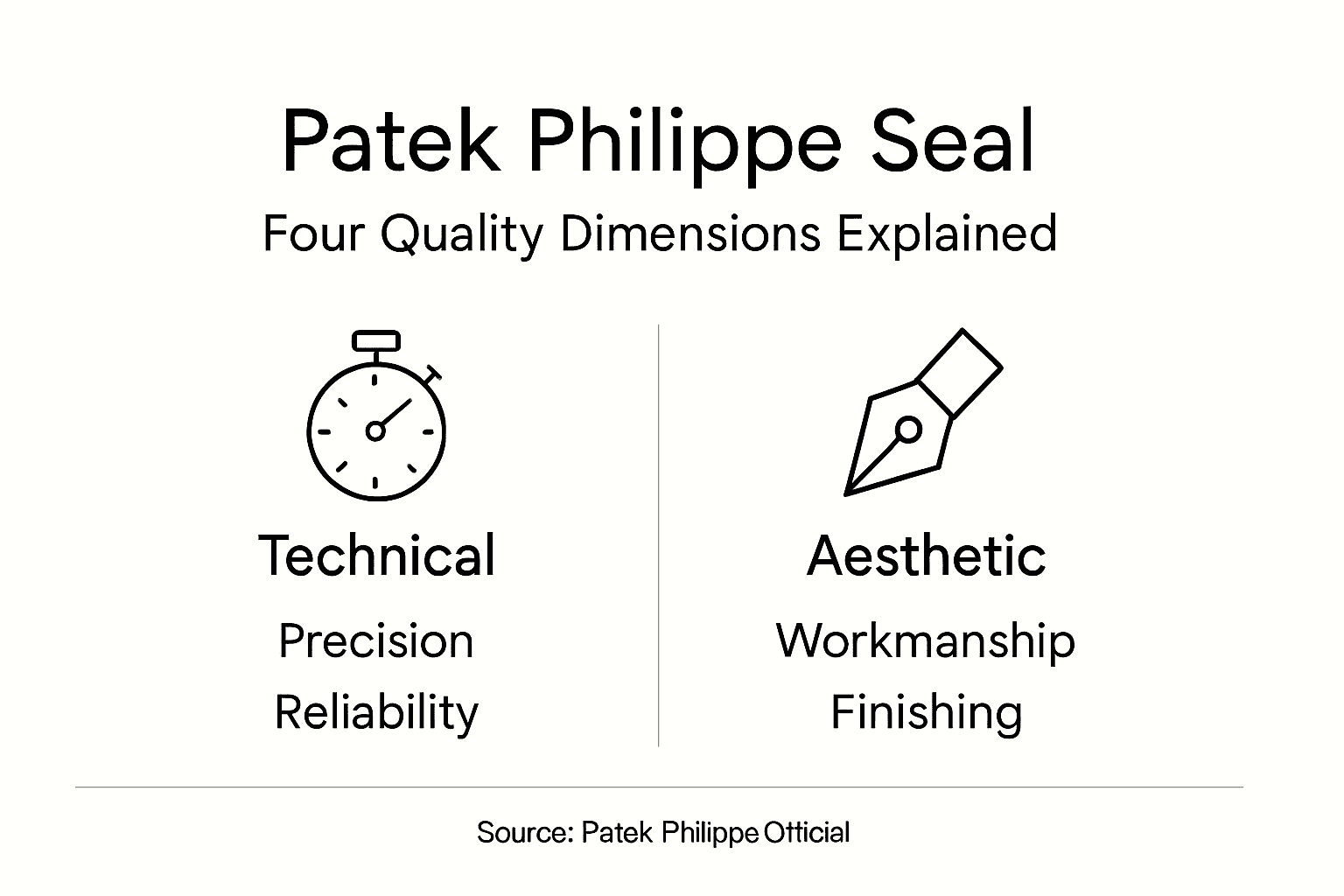
The Patek Philippe Seal encompasses four interconnected quality dimensions. The Patek Philippe Seal defines over 65 quality criteria across four categories including workmanship, precision, reliability, and service commitment. Each category contains specific technical requirements that every certified watch must satisfy before leaving the manufacture.
Workmanship standards begin with hand finishing techniques applied to movement components. Beveling, polishing, and decoration must meet exacting aesthetic benchmarks. These finishing touches extend beyond internal mechanisms to external case elements, dial details, and bracelet construction. Master craftsmen spend years perfecting these skills, ensuring visual perfection matches mechanical excellence.

Precision represents perhaps the most measurable certification element. The Patek Philippe Seal requires watch movements to maintain an extreme rate accuracy tolerance of -1/+2 seconds per day. This specification dramatically exceeds standard chronometer certification, which permits deviations up to six seconds daily. Such extreme accuracy demands meticulous adjustment across multiple positions and temperature ranges.
Seal Precision Standard: -1/+2 seconds per day across all positions and temperature ranges, tested over minimum 14 days.
Reliability testing subjects each watch to rigorous durability assessments. Components face stress tests simulating decades of wear. Water resistance verification, shock absorption evaluation, and long term power reserve stability all receive systematic scrutiny. Only watches demonstrating flawless performance under these conditions earn certification.
The service dimension guarantees perpetual maintenance access. Patek Philippe commits resources to preserve every certified watch indefinitely. This includes maintaining component inventories, training specialized watchmakers, and documenting production specifications. When choosing certified Patek Philippe pieces, this service guarantee provides tangible financial protection.
Critical Seal criteria include:
Movement decoration with traditional Genevan techniques
Case finishing meeting jewelry grade polishing standards
Functional testing across extreme temperature ranges
Long term rate stability verified through extended observation periods
The detailed Seal criteria from Patek Philippe reveals how comprehensive this certification truly is. Every aspect receives equal attention, creating timepieces that satisfy both mechanical and aesthetic perfection.
Comparison with Other Certifications
Understanding how the Patek Philippe Seal differs from other watch certifications clarifies its unique value proposition. Three major certification systems exist in luxury watchmaking, each serving different purposes. The distinctions matter significantly when evaluating authentication and investment potential.
Unlike the Geneva Seal, which covers only movements, the Patek Philippe Seal applies to the entire finished watch, including case and exterior elements. The Geneva Seal historically focused on movement origin and basic finishing standards. While prestigious, it examined only internal mechanisms, ignoring case quality, dial execution, and overall assembly standards.
COSC certification represents the industry standard for chronometer designation. COSC tests movements independently before casing, verifying accuracy within -4/+6 seconds daily. Many luxury brands pursue COSC certification as baseline quality proof. However, COSC examines neither finishing quality nor post assembly performance. A COSC certified movement might lose accuracy once installed in its case.
Certification | Scope | Precision Standard | Service Guarantee | Finishing Requirements |
Patek Philippe Seal | Entire watch | -1/+2 sec/day | Lifetime since 1839 | 65+ comprehensive criteria |
Geneva Seal | Movement only | Not specified | None | Basic decoration standards |
COSC Chronometer | Movement only | -4/+6 sec/day | None | Not evaluated |
The Patek Philippe Seal integrates workmanship, precision, reliability, and service into one unified standard. This holistic approach means certification guarantees complete watch quality, not isolated component performance. For collectors prioritizing long term value, this comprehensive evaluation provides superior confidence.
Key differentiation factors include:
Testing methodology evaluating assembled watches versus isolated movements
Accuracy tolerances three times stricter than chronometer standards
Service commitments backed by contractual lifetime maintenance guarantees
Aesthetic requirements covering every visible and hidden surface
The Seal remains proprietary to Patek Philippe, reflecting standards the brand considers non negotiable. Other manufacturers cannot achieve Seal certification, even if they meet technical specifications. This exclusivity reinforces the certification’s role as a brand quality promise rather than independent third party validation.
Collectors researching authentication methods for luxury watches benefit from understanding these distinctions. The detailed certification comparison by Time+Tide Watches explores practical implications for purchasing decisions.
Authentication and Documentation Linked to Certification
Verifying a Patek Philippe watch’s authenticity requires combining multiple documentation sources with physical inspection. The Seal itself provides quality assurance, but confirming legitimate certification demands additional verification steps. Serial numbers represent the first authentication layer.
Every Patek Philippe timepiece carries unique serial numbers on the case and movement. These numbers correspond to production records maintained in Geneva archives. Cross referencing serial numbers with documented production dates, specifications, and original configurations helps verify authenticity. However, serial numbers alone cannot confirm certification status or detect sophisticated counterfeits.
Certificates and archive extracts serve different authentication purposes. Original certificates accompany new watches, documenting initial sale details and specifications. Archive extracts, obtainable for older pieces, confirm production information based on factory records. Differences between certificates, archive extracts, and their authenticity guarantees highlight need for combined verification methods.
Neither document type guarantees authenticity independently. Counterfeiters produce convincing fake certificates that deceive inexperienced buyers. Altered or mismatched documentation frequently appears in grey market transactions. Sophisticated forgeries replicate official paperwork formats, watermarks, and security features with alarming accuracy.
Authentication best practices for certified Patek Philippe watches:
Cross verify serial numbers against multiple independent databases
Obtain archive extracts directly from Patek Philippe when possible
Commission professional appraisal from certified watchmakers familiar with Seal criteria
Examine physical Seal markings on case back and movement for consistency
Pro Tip: Always request original purchase documentation and service records when acquiring pre owned Patek Philippe watches. Complete provenance chains dramatically reduce counterfeit risk and support accurate valuation.
The vintage market presents particular authentication challenges. Older watches predating the 2009 Seal introduction lack this certification but may still represent genuine Patek Philippe pieces. Understanding these historical distinctions prevents false authenticity conclusions. Our complete authentication guide addresses these nuanced scenarios comprehensively.
Cautious collectors combine Seal presence with serial verification and expert assessment. This multi angle approach provides maximum protection against sophisticated fraud. The authentication documentation cautions resource explains common documentation pitfalls in detail.
Misconceptions and Common Challenges in Understanding Patek Philippe Certification
Several persistent misconceptions cloud collector understanding of Patek Philippe certification. Addressing these misunderstandings prevents costly authentication errors and supports informed acquisition decisions. The most prevalent confusion concerns certification equivalency.
Many assume the Patek Philippe Seal equals the Geneva Seal. These certifications differ fundamentally in scope, standards, and implications. The Geneva Seal historically certified movement origin and basic finishing within Geneva canton. The Patek Philippe Seal replaced this external certification with proprietary standards covering entire watches. Conflating these certifications leads to inaccurate authenticity assessments.
Another common error treats certification as sole authenticity proof. Common misconceptions include confusing the Geneva Seal with the Patek Philippe Seal or assuming certification alone guarantees authenticity without other checks. Physical Seal markings can be forged. Documentation can be falsified. Provenance records can be fabricated. Relying exclusively on certification presence without comprehensive verification invites fraud.
The vintage market introduces additional complexity. Watches manufactured before 2009 lack Patek Philippe Seal certification by definition. This absence doesn’t indicate inferior quality or questionable authenticity. These timepieces may carry Geneva Seal certification or no formal certification while remaining genuine Patek Philippe products. Understanding these historical distinctions prevents false negative conclusions.
Document authenticity represents another challenge area. Sophisticated counterfeiters produce convincing fake certificates, archive extracts, and service records. These forgeries replicate official formats, incorporate accurate serial numbers from genuine watches, and include plausible production details. Detecting fraudulent documentation requires expert knowledge and direct factory verification when possible.
Common certification misconceptions include:
Seal equivalency errors treating all luxury watch certifications as interchangeable
Over reliance on documentation accepting papers at face value without verification
Vintage authentication confusion expecting modern certification on historical pieces
Counterfeit detection failures underestimating sophistication of fake Seal markings
Pro Tip: Commission authentication from specialists holding direct Patek Philippe training credentials. Independent watchmakers lacking factory authorization may miss subtle counterfeit indicators despite genuine expertise.
Educated buyers avoid these pitfalls by maintaining healthy skepticism and insisting on comprehensive verification. The expert insights on watch certifications provide ongoing education about evolving fraud techniques. Understanding common certification misconceptions helps collectors recognize red flags during acquisition due diligence.
Maintaining Certification Standards: Servicing and Watchmaker Training
Patek Philippe’s certification quality depends on exceptional watchmaker expertise and rigorous ongoing training. The brand invests heavily in developing specialized skills required to service Seal certified timepieces. This commitment ensures certification standards persist throughout each watch’s lifetime.
The Patek Philippe training program requires watchmakers to train 10 to 12 years to fully understand servicing and repairs, underscoring the brand’s dedication to maintaining certified standards. This extensive education covers movement mechanics, hand finishing techniques, case restoration, and quality verification protocols. Graduates become custodians of certification integrity.
Training begins with fundamental horological principles before advancing to Patek Philippe specific complications. Students master traditional finishing techniques including anglage, polissage, and perlage. They learn to recognize authentic components, detect unauthorized modifications, and restore watches to original specifications. Only after demonstrating comprehensive mastery do trainees receive authorization to service Seal certified pieces.
The lifetime service guarantee represents certification’s most tangible benefit. Patek Philippe commits to servicing, repairing, or restoring any watch manufactured since 1839. This pledge requires maintaining extensive component inventories, preserving historical production records, and training specialists in obsolete calibers. Few luxury brands offer comparable long term support.
Certification criteria evolve alongside technological capabilities. Updates to the Patek Philippe Seal criteria were announced in 2024, reflecting ongoing improvements to maintain industry leading standards in craftsmanship and technical performance. These refinements address advancing materials science, improved precision measurement tools, and enhanced finishing techniques.
Key servicing and training elements include:
Decade long apprenticeships ensuring comprehensive skill development
Component authenticity verification protecting against counterfeit part installation
Historical caliber expertise enabling service for century old movements
Regular criteria updates incorporating technological and methodological advances
Authorized service centers worldwide maintain Seal standards through factory oversight and regular auditor visits. This distributed network ensures collectors access qualified servicing regardless of location. However, only factory trained technicians possess credentials to perform warranty covered repairs on certified watches.
Collectors benefit from understanding these service capabilities when evaluating long term ownership costs. The servicing and repair insights explore practical maintenance considerations. Direct information about Patek Philippe watchmaker training and 2024 Seal criteria updates reveals ongoing quality commitments.
Using Patek Philippe Certification to Make Informed Investment Decisions
The Patek Philippe Seal provides valuable signals for investment oriented collectors, but certification alone doesn’t guarantee sound acquisitions. Smart buyers integrate Seal verification with comprehensive due diligence covering provenance, condition, and market dynamics. This multifaceted approach supports confident purchasing and profitable resale.
Seal presence enhances perceived value in secondary markets. Collectors recognize certified pieces demonstrate verified quality across all certification dimensions. This recognition translates to pricing premiums compared to non certified alternatives. However, condition, rarity, and provenance influence value equally. A poorly maintained certified watch may underperform an excellent condition non certified piece.
Combining certification with documented service history creates powerful authentication evidence. Complete maintenance records demonstrate proper care, confirm genuine part replacements, and verify continued Seal compliance. When selling certified watches, comprehensive documentation justifies premium asking prices and accelerates buyer confidence.
Professional authentication remains essential despite certification presence. Sophisticated counterfeiters replicate Seal markings with increasing accuracy. Third party experts trained in detection techniques identify subtle inconsistencies invisible to untrained observers. This professional verification protects against expensive authentication failures.
Investment decision best practices include:
Verify Seal authenticity through multiple independent sources before purchase
Maintain complete service records documenting all authorized maintenance
Commission pre purchase inspections from certified Patek Philippe specialists
Research model specific market dynamics beyond general certification value
Pro Tip: Request recent service documentation showing Seal recertification after maintenance. Factory service reports confirm continued compliance with all 65+ certification criteria, validating the watch maintains original standards.
Market appreciation for certified pieces varies by model, complication, and production era. Limited edition certified watches typically command stronger premiums than mass produced certified models. Understanding these nuances prevents overpaying based solely on certification presence. The selling certified watches resource explains valuation factors comprehensively.
Long term value preservation depends on maintaining certification standards throughout ownership. Unauthorized modifications, non genuine part replacements, or improper servicing can void Seal status. Once lost, recertification requires factory restoration potentially costing thousands of pounds. Protecting certification integrity preserves maximum resale value.
Explore Certified Luxury Watches with Horology Kings
Navigating Patek Philippe certification complexities requires expert guidance and trusted acquisition channels. Horology Kings specializes in sourcing, authenticating, and servicing certified luxury timepieces for discerning collectors. Our expertise helps you make confident decisions whether acquiring your first certified Patek Philippe or expanding an established collection.
Our authentication process combines physical inspection with documentation verification and factory record cross referencing. We examine Seal markings, serial numbers, movement finishing, and case details to confirm genuine certification. This comprehensive approach protects you from sophisticated counterfeits flooding secondary markets. When you source authentic Patek Philippe watches through our network, certification authenticity comes guaranteed.
Maintaining your certified timepieces preserves their value and ensures continued Seal compliance. Our professional watch servicing and repair follows factory protocols using genuine components. We document all maintenance work, creating service records that support future valuations. Whether you need routine maintenance or complex restoration, our specialists protect your investment.
Frequently Asked Questions
How can I verify my Patek Philippe watch carries authentic Seal certification?
Verify Seal authenticity by examining case back engravings, checking movement finishing against official criteria, and cross referencing serial numbers with Patek Philippe archives. Commission professional authentication from factory trained specialists who recognize subtle counterfeit indicators. Combine physical inspection with documentation verification for maximum confidence.
What makes the Patek Philippe Seal different from COSC chronometer certification?
The Patek Philippe Seal certifies the entire finished watch including case and exterior elements, while COSC tests only movements before casing. Seal precision standards of -1/+2 seconds daily exceed COSC’s -4/+6 second tolerance. Additionally, the Seal includes lifetime service guarantees and comprehensive finishing requirements absent from COSC certification.
Do all Patek Philippe watches carry Seal certification?
No. Patek Philippe introduced its proprietary Seal in 2009. Watches manufactured before this date may carry Geneva Seal certification or no formal certification while remaining authentic. Some modern complications receive individual certification approaches. Absence of Seal certification on vintage pieces doesn’t indicate inferior quality or questionable authenticity.
Does Patek Philippe Seal certification guarantee my watch is genuine?
Seal presence indicates quality standards were met during manufacture, but physical markings can be counterfeited. Sophisticated forgers replicate Seal engravings and documentation with increasing accuracy. Always combine Seal verification with professional authentication, serial number validation, and provenance research. No single indicator guarantees authenticity independently.
How does Seal certification affect my watch’s resale value?
Seal certification typically commands premium valuations in secondary markets due to verified quality and lifetime service guarantees. However, condition, rarity, provenance, and market demand influence value equally. Maintain complete service records documenting Seal compliance to maximize resale prices. Poorly maintained certified pieces may underperform excellent condition non certified alternatives.
What happens if my certified Patek Philippe requires service?
Patek Philippe guarantees service for all watches manufactured since 1839. Authorized service centers perform maintenance using genuine components following factory protocols. After service, your watch receives recertification confirming continued Seal compliance. Maintain all service documentation as proof of proper care and continued certification status for future buyers.
Recommended
Comments