.png)

PVD vs DLC coating: which finish should you choose?
- lewisvrichards3
- 3 hours ago
- 12 min read
Choose DLC for sliding, high-wear mechanical contacts where friction and hardness are the primary concerns. Choose PVD when decorative colour range, substrate flexibility, or cost control matter more. Both coatings are validated against ISO 9227 Neutral Salt Spray testing, and Oerlikon Balzers’ BALINIT range remains the benchmark for understanding how each performs under real industrial conditions.
The single biggest technical reason to choose each:
DLC: coefficients of friction as low as approximately 0.08 up to 0.2 (versus roughly 0.3 to 0.6 for typical PVD nitrides), combined with hardness that frequently exceeds most decorative PVD films, makes it the correct choice for sliding contacts and low-lubrication environments.
PVD: a colour palette spanning gold, bronze, black, gunmetal, and beyond, combined with lower process temperatures and broader substrate compatibility, makes it the practical choice for decorative watch finishing and multi-material assemblies.
Key takeaways
DLC is the correct choice for sliding, high-wear mechanical contacts; PVD is the practical choice for decorative watch finishing where colour range, substrate flexibility, and cost control matter.
Point | Details |
Choose DLC for friction-critical parts | DLC friction coefficients of 0.08–0.2 make it the right choice for sliding contacts and low-lubrication environments. |
Choose PVD for decorative finishing | PVD offers 30+ colour options and broader substrate compatibility at lower cost than DLC. |
Request ISO 9227 NSS data | For corrosion-sensitive applications, insist on documented NSS test hours; 500 hours minimum for decorative watch PVD. |
H/E ratio beats raw thickness | Wear resistance correlates with the hardness-to-modulus ratio, not coating thickness alone; ask for both figures. |
Aftermarket recoating affects value | Any recoating modifies a watch’s authentication status; prioritise OEM-finished examples for collector or investment pieces. |
Table of Contents
How do PVD and DLC compare at a glance?
Dimension | PVD (typical nitrides) | DLC |
Hardness | 1,500–3,500 HV (TiN/CrN range) | 2,000–8,000 HV (ta-C variants) |
Coefficient of friction | 0.3–0.6 | 0.08–0.2 |
Corrosion resistance (NSS) | 500–2,000 hours (high-quality systems) | Good, but substrate prep is critical |
Appearance options | 30+ colours and finishes | Dark grey to black only |
Typical thickness | 0.2–5 µm | 0.5–5 µm |
Process temperature | 150–500 °C (variant-dependent) | 150–250 °C (PACVD) |
Substrate compatibility | Metals, some engineering plastics | Metals; adhesion-sensitive on some alloys |
Cost (relative) | Lower for decorative applications | Higher; reserved for performance-critical parts |
Repairability | Recoatable; prep quality is decisive | Complex; specialist process required |
For decorative watch finishing, PVD is usually the better choice. For sliding or rotating precision components, DLC is typically preferred.
What is PVD and why does it matter for watches?
Physical Vapour Deposition is not a single process but a family of vacuum-based techniques that deposit thin films by converting a solid target material into vapour, which then condenses onto the substrate. The three principal variants are sputtering, thermal evaporation, and High-Power Impulse Magnetron Sputtering (HiPIMS). A 2018 MDPI review confirms that HiPIMS and related plasma-enhanced methods (PEMS) improve film density and adhesion compared with conventional sputtering, while keeping process temperatures below those of Chemical Vapour Deposition (CVD).
Common PVD chemistries and their visual results
The coating chemistry determines both colour and mechanical performance:
TiN (Titanium Nitride): gold-coloured, hardness around 2,000–2,500 HV, widely used for decorative and light-wear applications.
ZrN (Zirconium Nitride): pale gold to champagne tones, good corrosion resistance, popular in watch finishing.
CrN (Chromium Nitride): silver-grey, excellent corrosion resistance, often chosen for stainless steel substrates.
TiCN (Titanium Carbonitride): bronze to gunmetal, higher hardness than TiN, used where moderate wear resistance is needed alongside decorative appeal.
Black PVD (typically TiAlN or CrN variants): achieves the dark finishes seen on sports watches, though true black requires careful chemistry selection.
PVD runs at temperatures low enough to avoid tempering most watch-grade steels and titanium alloys, which is a practical advantage over CVD. Surface preparation before deposition is decisive: a poorly cleaned or mechanically stressed substrate will compromise adhesion regardless of the coating chemistry chosen. A well-specified PVD system does not simply peel like paint; longevity is a function of surface activation, interlayer bonding, and process consistency. Adhesion and wear are commonly assessed using Tabor abrasion tests and NSS salt-spray exposure, though no single universal decorative-PVD standard exists, which means you should always request specific test results from your supplier.
What is DLC and what makes it different?
Diamond-Like Carbon is an amorphous carbon film that contains a mixture of sp² (graphite-like) and sp³ (diamond-like) carbon bonds. The ratio of those bonds determines the film’s properties. Two principal variants matter in practice:
ta-C (tetrahedral amorphous carbon): very high sp³ content, hardness reaching 6,000–8,000 HV in some formulations, extremely low friction, but more brittle and demanding to deposit.
a-C:H (hydrogenated amorphous carbon): lower hardness (typically 1,500–3,500 HV), better toughness, and easier to apply to complex geometries; the most common variant in watch and precision-engineering applications.
How DLC is deposited
The dominant deposition route for watch and precision components is Plasma-Assisted CVD (PACVD), sometimes combined with a PVD interlayer for adhesion. Oerlikon Balzers’ BALINIT DLC is applied via PACVD and is specifically positioned for severe sliding and high-speed wear applications, with film thicknesses typically in the 0.5–5 µm range. Process temperatures for PACVD are generally 150–250 °C, low enough to protect hardened steel components from tempering.
Key properties that distinguish DLC from standard PVD nitrides:
Coefficient of friction typically 0.08–0.2 in dry sliding conditions, compared with 0.3–0.6 for most PVD nitrides.
Hardness in the upper variants (ta-C) substantially exceeds TiN or CrN.
Colour is effectively limited to dark grey and black; there is no gold, bronze, or silver DLC.
Cost per component is higher than decorative PVD, reflecting the more complex deposition chemistry and longer process cycles.
Adhesion on some aluminium alloys and non-ferrous substrates can be problematic without a carefully chosen interlayer.
Head-to-head technical comparison of PVD and DLC
Hardness and test methods
Hardness for both coating families is measured by nanoindentation (typically reported in GPa or converted to Vickers HV). Standard PVD nitrides such as TiN sit in the 1,500–2,500 HV range; CrN is slightly lower. DLC a-C:H films commonly reach 1,500–3,500 HV, while ta-C variants can exceed 6,000 HV. The practical implication is that the hardest DLC films are significantly harder than the hardest conventional PVD nitrides, though that advantage is only relevant when the application actually demands it.
Coefficient of friction and sliding wear
Providence Metallizing’s technical breakdown documents DLC friction coefficients of roughly 0.08–0.2 against steel counterparts, compared with 0.3–0.6 for typical PVD nitride films. For a watch movement component or a precision bearing surface, that difference is substantial. For a decorative case exterior that never contacts another sliding surface, it is irrelevant.
Corrosion resistance
High-quality decorative PVD systems can achieve 500–2,000 hours of NSS exposure under ISO 9227 controlled laboratory conditions. DLC films also offer good corrosion resistance, but performance depends heavily on film density and the absence of pinholes. Because DLC is typically thinner and deposited on a wider range of substrates, substrate preparation and interlayer selection are especially critical.
The H/E ratio: a better selection metric than thickness alone
A 2020 MDPI review demonstrates that wear resistance correlates with the ratio of hardness (H) to Young’s modulus (E) in many coating systems, but the relationship is not universal. A high H/E ratio indicates a coating that is hard relative to its stiffness, which tends to resist plastic deformation under load. Selecting a coating purely on maximum hardness or maximum thickness ignores this relationship and can lead to brittle failure. Substrate properties and operating conditions must be considered alongside the H/E figure.
Thickness and tolerance preservation
Both coating families are deposited in the 0.2–5 µm range, which is thin enough to preserve dimensional tolerances on watch components. This is one of the key advantages of both PVD and DLC over electroplating, which typically deposits at 5–25 µm and can affect fit on precision parts.
Pro Tip: When requesting a quote for watch-component coating, ask the supplier to confirm the coating thickness to ±0.5 µm and to provide the H/E ratio alongside raw hardness figures. A supplier who cannot provide both is unlikely to be running a tightly controlled process.
The table below summarises the key numeric comparisons:
Parameter | PVD nitrides | DLC (a-C:H) | DLC (ta-C) |
Hardness (HV) | 1,500–3,500 | 1,500–3,500 | 6,000–8,000 |
Coefficient of friction | 0.3–0.6 | 0.08–0.2 | 0.08–0.2 |
Typical thickness (µm) | 0.2–5 | 0.5–3 | 0.5–2 |
NSS corrosion (hours) | 500–2,000 | Good (substrate-dependent) | Good (substrate-dependent) |
Process temperature (°C) | 150–500 | 150–250 | 150–250 |
How do PVD and DLC perform on watch cases and bracelets?
How black finishes age in practice
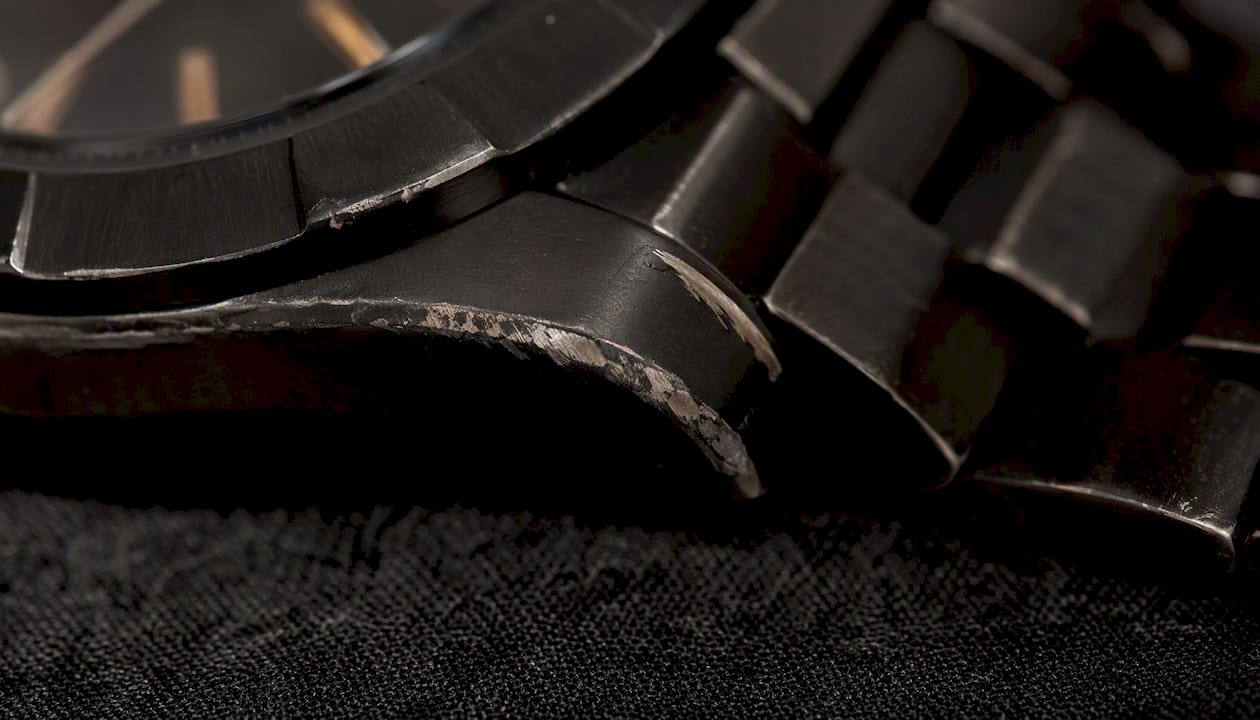
Decorative black PVD and true DLC black look similar fresh from the coater. Over months of regular wear, black PVD on case edges and bracelet links may show wear through to the base metal at high-contact points, partly because the coating is relatively thin and the underlying steel or titanium has a different colour. DLC black, being harder, resists this edge wear more effectively. The trade-off is that DLC is more difficult to recoat and, on a collector’s piece, any recoating introduces questions about authenticity.
OEM finishes versus aftermarket recoating
Rolex and other Swiss manufacturers use proprietary vacuum-deposition processes for certain models, with substrate preparation and quality controls that aftermarket coaters cannot easily replicate. As Diamond Source NYC notes, third-party aftermarket ‘PVD’ or ‘DLC’ claims do not automatically equal an OEM process and can affect authentication and resale value. For a collector, an aftermarket recoat on a Rolex or Patek Philippe is a modification that most serious buyers will discount, regardless of how well the coating itself is applied.
Recoating a watch with an aftermarket PVD or DLC finish changes its authentication status. For any watch with collector or investment value, the question is not whether the new coating looks good — it is whether the watch can still be authenticated as unmodified. In most cases, it cannot.
Practical servicing notes
Recoating entails stripping the existing finish, re-polishing or re-brushing the substrate to the original surface specification, applying the new coating, and then inspecting for adhesion and colour consistency. Each step carries risk. Incorrect surface preparation is the most common cause of early coating failure. For a luxury watch under regular service, a competent watchmaker will advise whether the original finish can be preserved through careful polishing rather than full recoating.
Red flags when a supplier describes a PVD or DLC finish:
No ISO 9227 NSS test data or adhesion test results available.
Vague thickness claims (“ultra-thin” or “micron-level” without a specific figure).
No mention of surface pretreatment steps before deposition.
Inability to distinguish between decorative PVD and functional DLC when asked directly.
No post-deposition inspection report.
When does industry choose DLC or specialised PVD?
Applications where DLC is typically specified
DLC is the correct choice when friction and wear are the dominant failure modes:
Piston rings and cylinder liners: low friction under high load and temperature, with minimal lubrication.
Surgical and dental instruments: biocompatibility, low friction, and resistance to sterilisation cycles.
Precision bearing races and screw spindles: where adhesive wear between sliding surfaces would otherwise limit service life.
Pump components and fuel-injection parts: corrosion resistance combined with low friction in aggressive media.
Where specialised PVD is preferred
Advanced PVD variants, including Oerlikon Balzers’ BALINIT range, are chosen when the geometry is complex, the substrate mix is varied, or the load profile favours a tougher (rather than harder) film. BALINIT C, for example, is a tungsten carbide/carbon coating that combines low friction with good load-bearing capacity, making it suitable for high-load bearings and gear contacts where ta-C DLC would be too brittle.
Process economics also drive the choice. PVD is well-suited to high-volume decorative production because batch sizes are larger and cycle times are shorter. DLC, particularly PACVD, is reserved for performance-critical components where the cost premium is justified by the improvement in service life.
How to choose between PVD and DLC: a practical checklist
Work through these questions in order before contacting a coater or watchmaker.
What is the primary function of the coating? If decorative, PVD is almost always the right starting point. If wear or friction reduction, move to step 2.
Is sliding or rotating contact involved? If yes, DLC is likely the better choice. If the surface only contacts air and occasional handling, PVD is sufficient.
What is the substrate material? Confirm the coater can achieve adequate adhesion on your specific alloy. Some aluminium alloys and non-ferrous metals require specialist interlayers for DLC.
What is the budget and turnaround requirement? DLC typically costs more and requires longer process cycles. If cost or speed is a constraint, a well-specified PVD system may deliver acceptable performance.
Can the supplier provide test evidence? This is non-negotiable.
Tests and standards to request
ISO 9227 NSS salt-spray results: ask for the number of hours tested and the pass/fail criterion. For decorative watch PVD, 500 hours minimum is a reasonable baseline; 1,000 hours or more indicates a well-controlled process.
Adhesion test method and result: the SVC technical overview on decorative PVD confirms there is no single universal standard, so ask specifically which adhesion test was used (cross-cut tape test, scratch test, or Rockwell indentation) and what the acceptance criterion was.
Hardness and H/E ratio: nanoindentation results in GPa, with the Young’s modulus figure so you can calculate the H/E ratio yourself.
Coating thickness: confirmed by cross-section SEM or calibrated ball-crater measurement, to ±0.5 µm.
Questions to ask your coater or watchmaker
What surface pretreatment steps do you carry out before deposition, and how do you verify cleanliness?
What masking do you apply to protect threads, seals, and movement-contact surfaces?
Do you carry out a post-deposition inspection, and can I see the report?
Have you coated this substrate and geometry before? Can you provide a reference sample?
How Horology-kings approaches PVD and DLC for UK clients
At Horology-kings, every decision about finishing and coating is made with one priority: preserving the authenticity and value of the timepiece. Our certified horologists assess each watch individually before recommending any surface treatment.
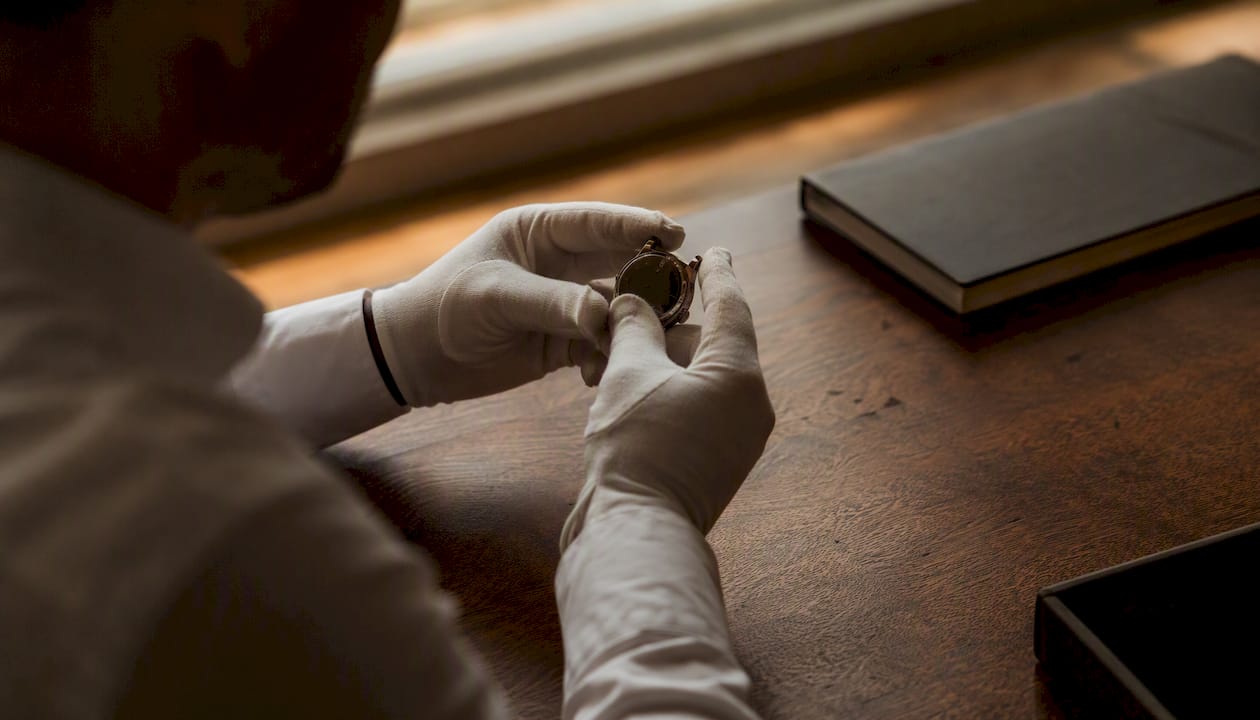
For decorative finishing on pre-owned luxury watches, we work exclusively with suppliers who can provide ISO 9227 NSS test data and documented surface-preparation procedures. We do not recommend aftermarket recoating for watches with collector or investment value, because the modification affects authentication status and, in most cases, reduces resale value.
Key proof points from our servicing approach:
All finishing work is carried out by certified horologists with direct experience of Swiss OEM surface specifications.
We distinguish clearly between cosmetic polishing (which preserves the original finish) and full recoating (which constitutes a modification).
For clients sourcing a watch with a black finish, we verify whether the coating is an OEM vacuum-deposition process or an aftermarket application during authentication, using visual inspection under magnification and, where necessary, referral to the manufacturer’s service records.
We advise against aftermarket DLC recoating on any watch where the original finish is part of the model’s specification, as recoating a genuine DLC finish is technically more complex and may affect the watch’s authentication status.
For clients who do require professional finishing, typical UK turnaround for decorative PVD work on a watch case and bracelet runs from two to four weeks, depending on the complexity of the geometry and the supplier’s current capacity. DLC treatments, where appropriate, typically require longer lead times given the specialist PACVD process involved. Cost ranges vary by supplier and component complexity; we provide indicative guidance during the initial consultation.
When sourcing watches with black or dark finishes, Horology-kings recommends prioritising OEM-finished examples over aftermarket recoats. The difference in long-term value retention is consistent and material.

If you are considering a watch with a PVD or DLC finish, or if you need professional advice on finishing and watch servicing in the UK, contact Horology-kings for a no-obligation consultation. We source and authenticate luxury watches across the UK, with a particular focus on Swiss OEM specifications.
The case for precision over convention
There is a persistent assumption in watch circles that DLC is simply “better” than PVD, full stop. It is not. DLC is a specialised film that solves a specific problem: friction and adhesive wear in sliding contacts. For a watch case exterior that never slides against another surface under load, the hardness advantage of ta-C DLC is largely academic. What matters for a decorative finish is adhesion quality, surface preparation, and NSS corrosion performance — all of which a well-specified PVD system can deliver at lower cost and with a far wider choice of colours.
The advice that frustrates me most is the blanket recommendation to “always choose DLC for a black watch.” Black PVD, properly applied with correct substrate preparation, performs well on case exteriors for years of regular wear. The edge wear that gives black PVD a bad reputation almost always traces back to inadequate surface preparation or a coater cutting corners on process control, not an inherent deficiency in the coating chemistry.
What collectors and engineers should actually prioritise is the supplier’s process discipline: documented pretreatment steps, confirmed coating thickness, and ISO 9227 NSS test data. A DLC coating from a careless supplier will fail faster than a PVD coating from a rigorous one. The coating family matters less than the process behind it.
For collectors specifically, the aftermarket recoating question deserves more caution than it typically receives. The moment a watch is recoated, its authentication status changes. For a Rolex or Patek Philippe with a black finish, that change has a direct and measurable effect on resale value. The right answer, in most cases, is to source an OEM-finished example rather than to modify what you already own.
Sources
The following sources were used in this article. Standards and peer-reviewed reviews are noted separately from supplier and industry literature.
Standards and peer-reviewed sources:
Supplier and industry literature:
Recommended
Comments