.png)
Sell a Watch Legally in the UK: 5 Steps to a Safe, Compliant Sale

Selling a watch in the UK is legal for private sellers in almost every case, but the process has real legal edges worth knowing before you list it. Gather your ownership documents first, then expect identity checks if you approach a high-value dealer, and check whether HMRC treats your sale as a personal disposal or something closer to trading. The rest of this guide walks through routes, paperwork, tax and the step-by-step process in detail.
TL;DR:
Selling a watch through a reputable dealer or broker ensures faster payment and built-in compliance, with identity checks mandatory for high-value transactions.
Proper documentation, including receipts, box, papers, and photographs, significantly increases offers and reduces delays in the sale process.
Private sales carry higher risks of fraud and liability, as the seller must verify the buyer and manage all paperwork independently.
HMRC generally does not tax personal watch sales unless the activity resembles trading or the watch was claimed as a business expense.
Proper handling of personal data and adherence to AML regulations are crucial, especially for dealers, to prevent legal issues and ensure transaction security.
Table of Contents
Which routes let you sell a watch legally in the UK?
Four routes cover almost every legitimate sale: a specialist dealer, a broker, an auction house, or a private buyer found through a marketplace or word of mouth. Each treats compliance, price and payment timing differently, and the right choice depends on what you value most, speed, price, or peace of mind.
Selling through a dealer or broker is usually the fastest way to get secure payment. Reputable dealers run identity checks as a matter of course, so the transaction is documented from the start, and funds typically arrive by bank transfer within days rather than weeks. A resource like Horology-kings’s guide to choosing a specialist dealer explains how authentication and valuation work in practice.
Auction houses can secure a stronger price for rare or historically significant pieces, particularly limited editions with collector demand. The trade-off is time. Cataloguing, marketing and the sale itself can take weeks or months, and commission fees usually bite into the final return.
Private sales occasionally net the highest price because there’s no dealer margin or auction fee, but the risk sits entirely with you. You’re responsible for verifying the buyer, protecting yourself from chargeback fraud, and managing your own paperwork trail:
Dealers and brokers: fast, compliant, lower fraud exposure
Auction houses: potentially higher price for rare pieces, slower, fee-heavy
Private sale: potentially higher net return, but you carry the fraud and liability risk
What documents and photos do you need before selling?
Buyers, whether a dealer, auction house or private individual, will want proof that the watch is genuinely yours and genuinely what you say it is. Missing paperwork doesn’t make a sale illegal, but it drags down the offer and slows everything else.
Original receipt or invoice from the point of purchase, ideally showing the retailer, date and serial number.
Box and papers, including the warranty card, if you still have them; completeness materially affects dealer offers.
Service history, particularly a recent authorised service receipt, which reassures buyers the movement has been properly maintained.
Clear photographs: the full watch from multiple angles, the case back showing the serial number, close-ups of the dial and bracelet, and any visible wear or damage.
If the watch was a gift rather than a direct purchase, the paper trail looks slightly different. Horology-kings’s guide to selling a gifted Rolex covers what documentation stands in for a receipt you never personally held.
Do dealers have to check your ID when you sell a watch?
Yes, and this catches a lot of first-time sellers off guard. High-value dealers in the UK are bound by anti-money laundering law, not internal policy, so the checks aren’t optional on their end.
Under regulation 19 of the Money Laundering, Terrorist Financing and Transfer of Funds Regulations 2017, dealers must carry out customer due diligence on relevant transactions, verify who they’re dealing with, and retain records of that verification. This isn’t bureaucratic friction for its own sake, it’s the mechanism that keeps stolen watches and laundered cash out of the legitimate market.
The threshold that matters:
The statutory trigger for high-value dealer registration is €10,000 in cash transactions. In practice, many UK dealers apply a lower bar, often around £7,000, to stay clear of exchange-rate movement and to build a consistent compliance habit rather than a currency-dependent one.
Expect to show photo ID and proof of address for higher-value sales, even in cash-free transactions
Some dealers verify identity below the statutory threshold as standard practice
If a watch can’t be satisfactorily verified, or something about the transaction looks suspicious, a compliant dealer will pause the sale, retain the item, and notify the police rather than proceed
Will you pay Capital Gains Tax on selling your watch?
Almost certainly not, if this is a single, personal sale. HMRC classes most watches as wasting assets, items with a predictable useful life of 50 years or less, and gains on wasting assets are generally exempt from Capital Gains Tax. A watch you’ve owned and worn is treated the same way as a car or a boat in tax terms: sell it for more than you paid, and there’s typically nothing to declare.
The exemption has real limits, though, and it’s worth knowing where they sit:
Business use: if you claimed capital allowances on the watch through a business, the wasting asset exemption falls away and normal capital gains rules apply instead.
Trading patterns: HMRC uses the “badges of trade” test, frequency of sales, motive, organisation, and how the activity is financed, to decide whether what looks like a personal disposal is actually a trading business. Buy and sell watches repeatedly with profit as the clear intent, and HMRC can tax that as income rather than a one-off capital gain.
Record keeping: even when a sale is exempt, keep the receipt, correspondence and bank transfer confirmation. If HMRC ever queries a pattern of sales, that paper trail is your defence.
Alto Accounting’s breakdown of watch sale tax rules gives further worked examples of where the exemption holds and where it doesn’t. If you’re selling multiple watches a year, or you’ve ever claimed a watch as a business expense, it’s worth ten minutes with an accountant before you list anything. That conversation costs far less than an unexpected tax bill.
Why do dealer offers differ from insurance or retail values?
Because they’re pricing entirely different things. Your insurance valuation reflects the cost of replacing the watch new, at retail, right now. A dealer’s offer reflects what they can realistically resell it for, minus their margin, minus the risk they’re taking on.
What actually moves the number:
Condition and originality, unpolished cases and original parts consistently outperform “well-loved” examples
Current demand for that specific model and reference
How quickly the dealer expects to resell it (liquidity)
Completeness: box, papers, and service history
Authentication and any servicing costs the dealer will need to absorb
This is the valuation gap, and it’s completely normal rather than a sign you’re being short-changed. Industry guidance on selling watches online confirms dealer offers are built around current market demand and resale cost, not the number on your insurance schedule.
Pro Tip: Get the watch serviced by an authorised centre before you seek offers, not after. A documented recent service can lift multiple quotes at once, and it costs far less than the gap it usually closes.
How do you sell a watch step by step, safely and legally?
Selling well isn’t complicated, but skipping a step tends to cost you money, time, or both. Work through this order and you’ll avoid the mistakes that catch out first-time sellers.
Prepare your paperwork and photos. Pull together the receipt, box, papers and service history, and take clear photographs of the case back serial, dial and bracelet. Get a rough sense of current market value for your reference and model.
Compare at least two offers. Approach two or more reputable dealers or brokers, or check a recent auction result for a comparable piece, before you commit to anything.
Complete verification. Provide ID when asked; this is a legal requirement for the dealer, not a personal accusation. Agree payment by bank transfer, or insured escrow for private sales, rather than cash or informal transfer apps.
Get it in writing. A written receipt confirming the sale, price and date protects both sides, and confirms your record for tax purposes if it’s ever needed.
Keep your records afterwards. File the sale confirmation and bank transfer proof, and follow up on transferring any remaining warranty to the new owner where that applies.
Horology-kings’s guide to selling a Rolex quickly and safely sets out realistic timelines for each stage, useful if you’re weighing a fast sale against holding out for the best price.
Pro Tip: Never let a buyer rush you past the verification step. A genuine buyer, private or trade, will always wait for proper checks; anyone pushing you to skip them is the clearest red flag in the whole process.
What if a watch turns out to be stolen after you’ve sold it?
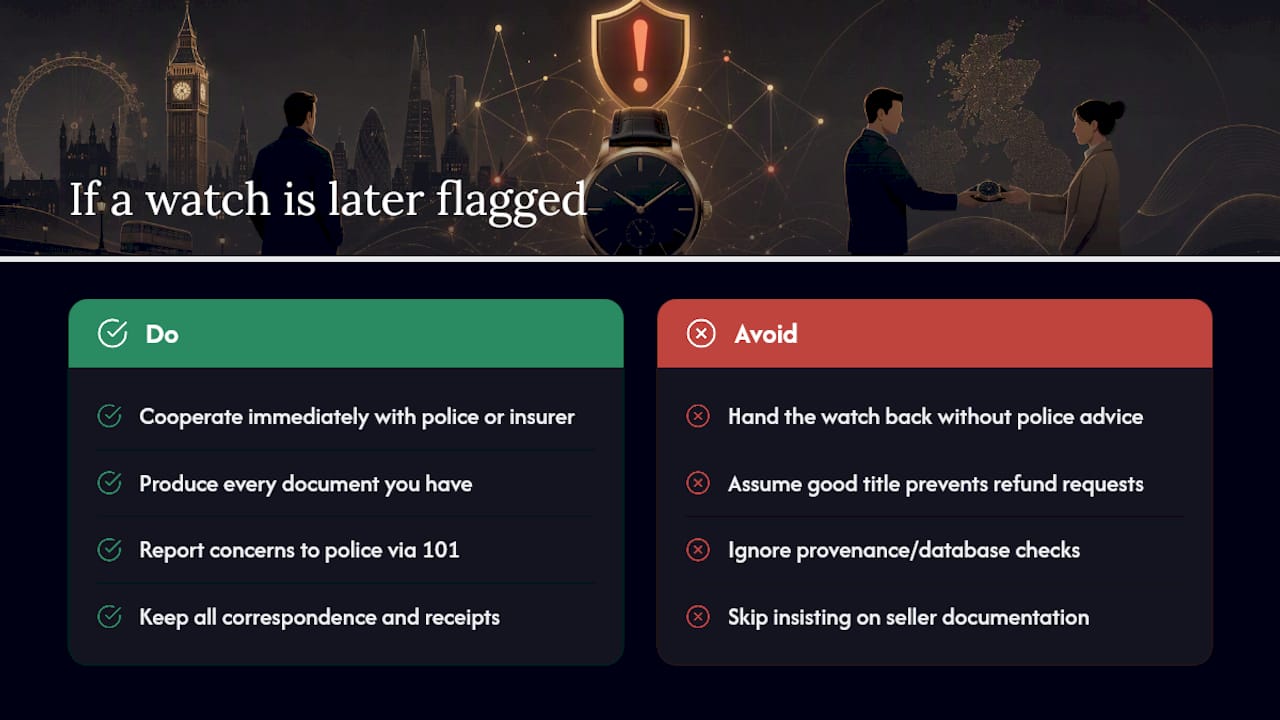
This is rarer than sellers fear, but it does happen, usually when a watch was stolen some years before it reached you and only surfaces on a police database later. If you’re contacted by police, a dealer, or an insurer querying provenance, cooperate immediately and produce every document you have: the original receipt, any prior sale confirmation, and correspondence with the seller you bought it from.
Reputable dealers build this scenario into their process. If a watch’s provenance can’t be verified, or a database check flags it, compliant dealers will retain the item and notify the police rather than complete the transaction or hand it back. That’s not the dealer accusing you of anything, it’s the same regulatory duty covered under the AML rules above.
If you sold privately and the buyer later discovers the watch was reported stolen before it reached you, you may be asked to refund the purchase price even though you acted in good faith. Under English law, a seller generally cannot pass better title than they held, meaning a buyer who unknowingly purchases stolen goods can lose the watch to its original owner regardless of what they paid. This is precisely why keeping your own purchase documentation, and insisting on it from anyone you buy from, matters as much when you’re buying as when you’re selling.
Report any concern to your local police force via 101, and keep every piece of correspondence. If the watch was sold through a dealer, they will have their own compliance file, which usually speeds up any investigation considerably.
What buyer protection laws apply to watch sales?
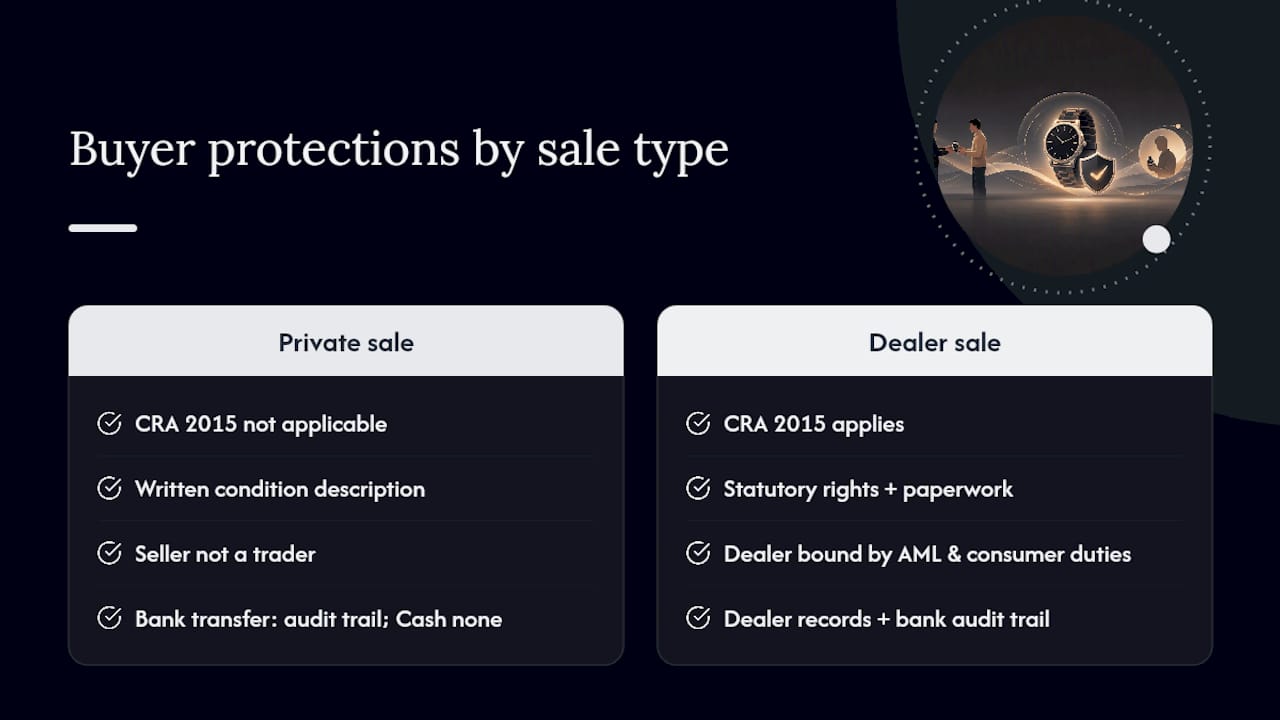
The protections that apply depend heavily on who you’re selling to and how the transaction is structured. Sell as a private individual to another private individual, and the Consumer Rights Act 2015 largely doesn’t apply, that legislation governs sales by traders to consumers, not person-to-person deals.
Sell through, or to, a business, and different rules kick in. If you buy from a dealer, goods must be as described, of satisfactory quality and fit for purpose under the Act. If a dealer buys from you, they’re still bound by their own AML and consumer-facing obligations even though you, as the seller, aren’t a “trader” in that transaction.
For private sales, the practical protection is contractual rather than statutory: a clear written description of the watch’s condition, agreed before money changes hands, is what you’d rely on if a dispute arose later. This is one of the strongest arguments for selling through a dealer or broker rather than privately, the paperwork and description standards are already built into the process, rather than something you have to construct yourself.
Payment method also affects your practical protection. Bank transfers leave a clear audit trail on both sides; cash leaves none. If a private sale goes wrong, a documented bank transfer is often the difference between resolving a dispute and having no evidence at all.
Do you need different documents as a private seller versus a dealer?
Private sellers and dealers face genuinely different documentary burdens, and conflating the two is where a lot of confusion starts.
As a private seller, your obligation is straightforward: prove you own the watch and prove it is what you claim. That means the receipt, box, papers, service history and photographs covered earlier. You have no licensing requirement and no AML registration duty, because those obligations attach to businesses, not individuals selling their own possessions.
Dealers carry a heavier load. A business buying and selling watches as trade must register as a high-value dealer where the statutory thresholds apply, maintain due diligence records on every relevant transaction, and in some London boroughs, register locally as a second-hand goods dealer with licence details displayed. If you’re an individual who has started buying and selling watches regularly enough that it looks like a business, this is exactly the point where HMRC’s badges of trade test and dealer-level obligations start to matter to you too.
The practical takeaway: a one-off sale of your own watch needs proof of ownership and nothing more. Repeated trading needs proper registration, and pretending otherwise risks both regulatory and tax consequences.
How should you handle personal data when selling a watch?
Selling a watch inevitably means exchanging personal information, your name, address, bank details, sometimes ID documents, and the same in reverse if you’re buying. Handling that data carelessly is a separate risk from the sale itself.
Only share ID and bank details with a verified party, whether that’s a registered dealer completing legally required checks or a private buyer you’ve independently confirmed is genuine. Never send photographs of ID documents over unsecured channels like social media messaging, and be cautious of any buyer who asks for more personal information than the transaction genuinely requires.
Dealers handling your data as part of AML compliance are themselves bound by UK GDPR obligations, meaning they must hold your details securely, use them only for the stated purpose, and delete them once retention requirements lapse. If you’re asked to hand over ID, it’s reasonable to ask how long the dealer retains it and how it’s stored. A dealer confident in its own compliance will answer that without hesitation.
If you’re selling privately, keep your own records secure too. A spreadsheet of buyer names and bank details left on a shared device or unencrypted cloud folder is a data protection risk you’ve created yourself, not one imposed by regulation.
What a specialist dealer actually does behind the scenes
A credible dealer’s process runs in a fixed order for good reason: valuation first, authentication second, identity and AML checks third, then payment and documentation. Skip a step and you’ve either underpriced the watch or exposed the transaction to risk that proper sequencing would have caught.
Authentication matters as much for the dealer as the seller, cross-checking movement numbers, case references and finishing details against known genuine examples protects both parties from an honest mistake or a deliberate deception further up the chain. The authentication principles used across collectible markets follow a similar logic to watches, provenance and physical inspection together, not one or the other.
What a specialist route buys you over a private sale isn’t just speed. It’s a documented, compliant chain from valuation through to a secure bank transfer, with every step recorded in case a question ever arises later. That’s a meaningfully different risk profile from a cash handshake with a stranger.
— Lewis
Get a secure valuation from Horology Kings
If everything above has made private sale feel like more risk than it’s worth, that’s the trade-off dealers exist to remove. A specialist dealer offers secure valuations, discreet buying and UK bank transfers, built around compliance standards, so you’re not left managing ID checks, provenance disputes or payment risk on your own.

Expect a straightforward process: send details and photographs for an initial valuation, provide ID for the required checks, and once terms are agreed, receive payment by secure bank transfer with full documentation retained on both sides. If your watch needs a service before sale to strengthen the offer, Horology-kings’s repair and servicing team can handle that first. Ready to see what your watch is worth? Get a free valuation and find out where you stand before you commit to any route.
This article is general information, not a substitute for advice from a qualified financial advisor. Consult a qualified financial professional about your own circumstances before acting on anything here.
Sources
Recommended
Comments