.png)
The role of expert networks in watch sourcing
TL;DR:
Expert networks connect collectors with insider market knowledge, dealer relationships, and authentication experts to secure rare watches beyond public channels. They leverage primary intelligence, detailed authentication workflows, and long-term relationships to improve sourcing outcomes and mitigate counterfeit risks. Engaging a reputable specialist early enhances access, trust, and success in acquiring sought-after luxury timepieces.
Expert networks in watch sourcing are defined as structured intermediary services that connect collectors with industry insiders, authenticated supply channels, and proprietary market intelligence unavailable through standard retail routes. For anyone pursuing a Rolex Daytona, Patek Philippe Nautilus, or Audemars Piguet Royal Oak, the difference between securing the right piece and spending years on a waitlist often comes down to who you know and how well they know the market. The role of expert networks in watch sourcing has grown considerably as brands tighten distribution and counterfeit sophistication increases. This guide explains precisely how these networks function and what collectors gain by using them.
How do expert networks secure access to limited edition watches?
Authorised dealer supply for high-demand references operates through closed allocation models, not open retail shelves. Brands distribute sought-after pieces via closed-door allocations, customer pre-sales, lotteries, and order windows. A collector walking into a boutique cold has almost no chance of leaving with a steel sports watch. The entire system is built on relationships, purchase history, and dealer discretion.
Expert networks understand this architecture in detail. Rather than simply submitting a reference request on a collector’s behalf, a skilled sourcing intermediary translates the collector’s preferences into a dealer brief that aligns with the criteria dealers actually use when deciding who receives an allocation. Allocation decisions depend on factors including purchase history across multiple categories, relational standing with staff, and demonstrated commitment to the brand. An expert network positions the collector within that framework rather than outside it.
The distribution picture is shifting further. Audemars Piguet is moving away from multi-brand retail and selling directly to consumers over a multi-year timeline. This tightening increases the value of sourcing intermediaries who already hold established dealer relationships. When fewer authorised retail touchpoints exist, the collector without a network connection loses access entirely.
Expert networks maintain active relationships with authorised dealers across multiple brands and markets
They track allocation windows and timing intelligence that is not publicly announced
They position collector profiles to match dealer screening criteria, not just reference wish lists
They surface pre-owned inventory from private sellers before pieces reach public listing platforms
Pro Tip: When engaging a sourcing specialist, provide a full purchase history across all watch brands, not just the reference you want. Dealers weigh cross-brand commitment when making allocation decisions, and your network representative needs the full picture to advocate effectively.
What authentication challenges do collectors face?
Counterfeit watches have reached a level of sophistication that makes visual inspection alone unreliable. Around 80% of inspected watches now require further testing beyond initial examination, compared to roughly 20% historically. One in ten traded Rolex watches offered by a leading pre-owned specialist were found to be fakes. That statistic means the private buyer relying on photographs and a cursory in-person check is operating with unacceptable risk.
Expert networks address this through multi-tier authentication workflows that most private buyers cannot replicate. The process goes well beyond surface appearance. A rigorous inspection involves:
Movement inspection by a qualified watchmaker, checking calibre authenticity, service history, and component originality
Serial and reference cross-referencing against manufacturer databases and known stolen watch registries
Case and dial examination under magnification for printing quality, finishing consistency, and material authenticity
Documentation verification, including box, papers, and service records where present
Provenance tracing to establish ownership history and confirm the piece has not been reported stolen or involved in a dispute
This multi-step authentication workflow is what separates a professional sourcing network from a private transaction. The collector buying through a reputable expert network receives a watch that has passed each stage of this process. The collector buying privately receives a watch that passed the seller’s interest in disclosing problems.
Access to trusted watchmakers and independent authentication specialists is itself a function of network depth. Horology-kings, for example, draws on established relationships with qualified horological professionals to conduct inspections that go beyond what any individual buyer could arrange independently. For collectors considering a purchase, the authentication checklist for luxury watches published by Horology-kings outlines exactly what a thorough inspection should cover.
How do expert networks provide market intelligence beyond public data?
Expert networks deliver primary, practitioner-level intelligence that no search engine or forum thread can replicate. The distinction matters enormously in watch sourcing. Public information tells you what a reference sold for at auction last month. An expert network tells you which dealer is about to receive an allocation, which private seller is motivated, and which references are quietly accumulating demand ahead of a price correction.
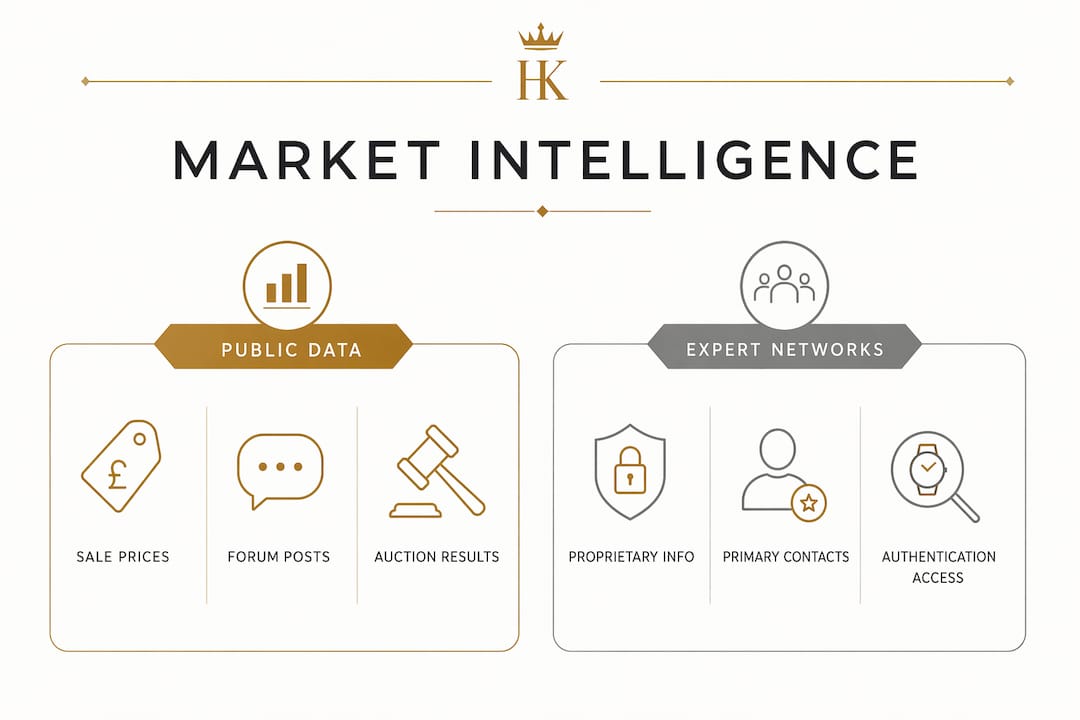
Information type | Public sources | Expert networks |
Recent sale prices | Available via auction records | Available, plus context on condition and provenance |
Allocation timing | Not available | Accessible through dealer relationships |
Brand distribution strategy | Press releases only | Operational intelligence from inside the trade |
Counterfeit risk by reference | General forum discussion | Specific, tested intelligence from authentication specialists |
Private seller inventory | Listed platforms only | Pre-listing access through trusted contacts |
This intelligence advantage compounds over time. AI-assisted matching within expert network platforms now allows collectors to be connected with specialists whose knowledge precisely matches the reference or brand in question. Rather than a generic consultation, the collector speaks with someone who has handled that specific calibre, worked with that particular dealer, or tracked that reference’s market behaviour for years.
Pro Tip: Ask your sourcing specialist not just whether a watch is available, but why it is available. A motivated private seller, an estate piece, and a dealer overstock each carry different risk and opportunity profiles. The answer shapes your negotiating position.
What practical steps improve watch sourcing outcomes?
Collectors who get the most from expert networks approach the relationship with preparation and clarity. Vague briefs produce vague results. The following practices consistently improve sourcing outcomes.
Define the brief precisely. Specify reference number, case size, dial variant, year range, condition expectations, and budget ceiling. A sourcing specialist working with a precise brief can match inventory far more effectively than one chasing a general category.
Choose specialists with verifiable track records. Look for sourcing services that can demonstrate completed transactions, provide references from past clients, and operate transparently on fees. The watch sourcing services guide from Horology-kings explains what a credible sourcing operation looks like in practice.
Engage before the market moves. The collectors who secure the best pieces are those who brief their network ahead of demand spikes, not after a reference appears on every forum. Tighter brand distribution amplifies information asymmetry, meaning early access through trusted channels is increasingly the only access.
Interpret authentication reports critically. A professional sourcing network provides documentation of the authentication process, not just a conclusion. Ask to see the inspection notes, the watchmaker’s report, and the database checks. A credible network welcomes this scrutiny.
Balance primary and secondary market options. Some references are best sourced through authorised dealer channels; others are more efficiently found in the pre-owned market. Expert networks operate across both, and the right adviser will tell you honestly which route suits your target piece. For collectors sourcing a Rolex safely in the UK, the secure sourcing guide from Horology-kings covers both routes in detail.
The underlying principle is that expert networks function best as long-term relationships, not one-off transactions. A sourcing specialist who understands your collection, your preferences, and your risk tolerance over time will consistently outperform a cold search.
Key takeaways
Expert networks are the most effective tool for sourcing rare luxury watches because they combine proprietary allocation access, rigorous authentication, and primary market intelligence that no public channel provides.
Point | Details |
Allocation access | Expert networks position collectors within dealer screening criteria, not just on waiting lists. |
Authentication rigour | Multi-step inspection workflows catch fakes that visual checks miss, protecting high-value purchases. |
Primary intelligence | Practitioner-level knowledge on allocation timing and brand strategy precedes public market data. |
Distribution shifts | As brands like Audemars Piguet tighten direct sales, network relationships become the primary access route. |
Relationship value | Long-term engagement with a sourcing specialist consistently outperforms one-off transaction approaches. |
What I have learned about trust in watch sourcing
The watch market rewards patience and punishes shortcuts. I have seen collectors spend significant sums on pieces that looked perfect in photographs and turned out to be sophisticated fakes. I have also seen collectors secure references they had been chasing for years, not because they got lucky, but because they had invested in the right relationships over time.
The conventional view is that expert networks are a luxury for institutional buyers, hedge funds, and large-scale investors. That view is wrong for watch collectors. The same principles apply. Experts validate assumptions and stress-test risks that standard data cannot reveal. In a market where one in ten traded Rolex watches may be counterfeit and where allocation decisions hinge on human factors like rapport and commitment, that validation is not optional for serious collectors.
What I find most underappreciated is the human dimension of allocation. Inside watch allocation decisions, rapport and demonstrated commitment occasionally outweigh pure purchase history. A sourcing specialist who has cultivated genuine relationships with dealer staff over years carries influence that no amount of money spent in a boutique can replicate overnight. That is the real currency of expert networks in this market, and it is not something you can build quickly on your own.
My advice to any serious collector is to engage a reputable sourcing specialist before you need one, not when you are already frustrated by failed attempts. The relationship compounds in your favour over time.
— Lewis
Source rare watches with Horology-kings
Horology-kings is a Hertfordshire-based luxury watch dealer with an established expert network spanning authorised dealers, trusted private sellers, and independent authentication specialists across the UK. For collectors seeking a specific Rolex, Patek Philippe, Audemars Piguet, Omega, or Cartier reference, the sourcing service translates your brief into direct market action. Every piece sourced through Horology-kings passes a rigorous multi-step authentication process before it reaches you. Whether you are pursuing a steel sports watch or a complicated dress piece, the team at Horology-kings holds the relationships and market intelligence to find it. Submit your brief through the dedicated source a watch page and let the network work for you.
FAQ
What is the role of expert networks in watch sourcing?
Expert networks connect collectors with industry insiders, authorised dealer relationships, and authentication specialists to source rare and high-demand watches through channels unavailable to the general public. They translate collector briefs into targeted sourcing activity across both primary and secondary markets.
How do expert networks help with counterfeit watches?
Expert networks employ multi-step authentication workflows including movement inspection, serial cross-referencing, and documentation verification. With around 80% of inspected watches now requiring further testing, this rigour is the primary defence against sophisticated fakes.
Why is allocation access harder without an expert network?
High-demand watches are distributed through closed dealer allocation systems based on purchase history, relational standing, and dealer discretion. Expert networks position collectors within these criteria rather than leaving them to approach dealers without context or standing.
How do expert networks differ from standard watch dealers?
Standard dealers sell from existing stock. Expert networks actively source specific references on a collector’s behalf, drawing on proprietary market intelligence, dealer relationships, and pre-listing inventory access that standard retail cannot offer.
Is using an expert network worth it for pre-owned watches?
Yes. The pre-owned market carries the highest counterfeit risk and the greatest information asymmetry. Expert networks surface inventory before public listing and apply authentication standards that protect buyers from the significant financial and reputational risks of purchasing a fake.
Recommended
Comments