.png)

What is a grey market watch? Collector's guide 2026
- lewisvrichards3
- Jun 11
- 9 min read

TL;DR:
A grey market watch is a genuine luxury timepiece sold outside an authorized dealer network, often due to supply-demand imbalances. Buying one involves understanding warranty limitations, documentation importance, and authentication procedures, as it carries both savings and risks. The grey market’s growth is driven by brand restrictions and technological shifts, influencing future resale and service options for collectors.
A grey market watch is an authentic, brand-new luxury timepiece sold outside a manufacturer’s official authorised dealer network, without being counterfeit, stolen, or illegal. The term “grey market” is the industry’s informal label; the more precise phrase used by trade professionals is “parallel import” or “unauthorised parallel trade.” Rolex, Patek Philippe, and Audemars Piguet are the brands most frequently associated with this channel, largely because their authorised supply cannot meet global demand. The global grey market for luxury watches is valued at $12 billion in 2026, a figure that reflects not a fringe activity but a structurally embedded alternative to retail. That scale matters: it means grey market timepieces are not an obscure curiosity but a mainstream purchasing route that every serious collector needs to understand.
What is a grey market watch and how does it differ from a fake?
The single most important distinction in this space is between grey market and counterfeit. A grey market watch is genuine. It left the manufacturer’s factory as an authentic product, carries real movements, and bears legitimate serial numbers. What makes it “grey” is the route it took to reach you, not its physical composition. Grey denotes lack of authorisation, not illegality, and buying one carries no legal risk for the purchaser in the United Kingdom.
A counterfeit watch is a deliberate forgery, illegal to sell and often illegal to import. A grey market piece is none of those things. The confusion between the two categories costs collectors money and confidence, which is why understanding the difference is the foundation of any informed purchasing decision.
How does the grey market watch supply chain work?
Grey market watches come from three main sources: authorised dealers offloading excess stock, parallel importers exploiting price differences between countries, and private sellers reselling pieces they acquired through official channels. Each route is distinct, and each carries different implications for the buyer.
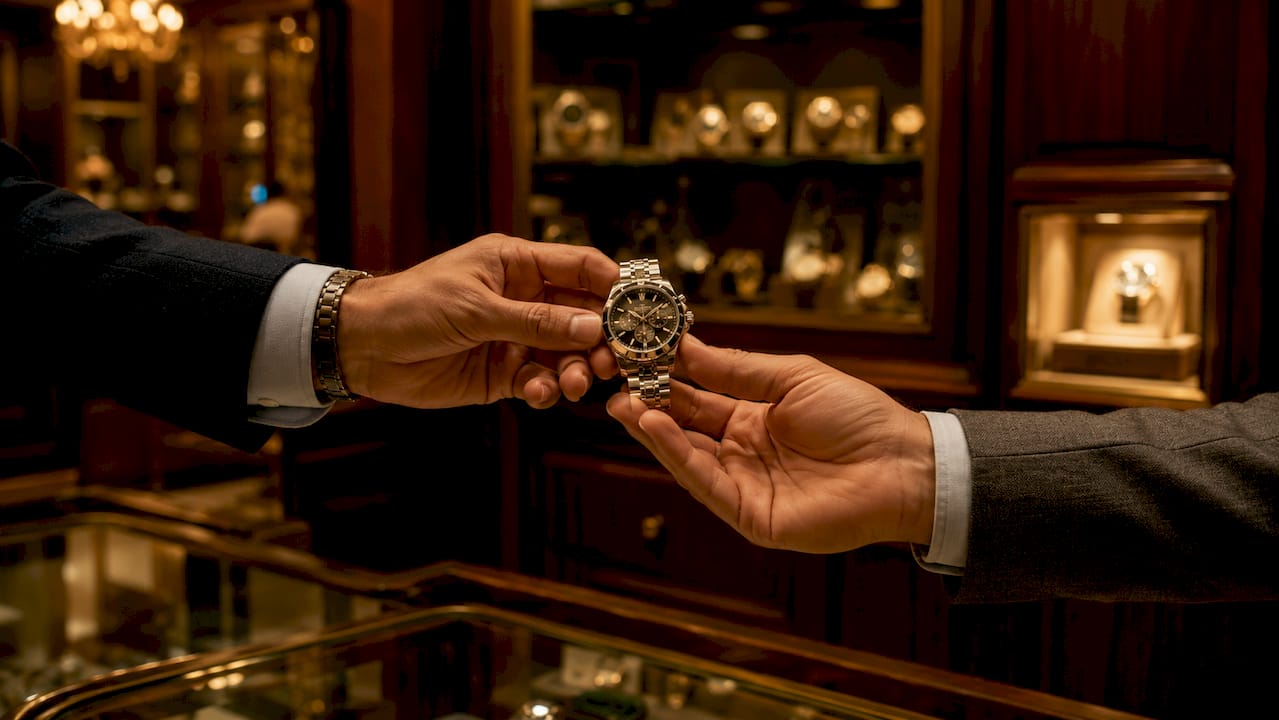
Authorised dealers are the most surprising source. A Rolex or Omega retailer in a lower-demand market may receive an allocation they cannot sell at full retail. Rather than return stock, some quietly supply grey dealers. To protect themselves from brand penalties or loss of their dealership contract, these dealers remove or blank warranty card information before the watch changes hands. This is why so many grey market pieces arrive with incomplete documentation.
Parallel importers operate on geographic arbitrage. A Patek Philippe reference priced significantly lower in Hong Kong or Singapore than in London represents a profit opportunity once currency movements and import duties are factored in. Importers buy in the cheaper market and sell in the more expensive one, entirely legally, but outside the brand’s controlled distribution system.
Pro Tip: When buying grey market timepieces, always ask the seller to confirm the country of original sale. This tells you which warranty terms originally applied and helps you assess whether the price reflects genuine arbitrage savings or something more concerning.
Brands view this supply chain as a direct challenge to their distribution control, yet struggle to stop its growth because global supply and demand imbalances are structural, not temporary. Rolex’s multi-year waitlists at authorised dealers are themselves a driver of grey market premiums, not a deterrent to them.
What are the advantages and risks of buying grey market watches?
The case for buying grey market is real, but so are the risks. Neither side of the argument should be dismissed.
Factor | Grey market | Authorised dealer |
Price | Often lower for less popular models; premiums possible on scarce references | Fixed retail price, no negotiation |
Availability | Immediate stock on hard-to-source models | Waitlists of months or years for popular references |
Warranty | No manufacturer warranty; seller warranty only | Full manufacturer warranty |
Documentation | Often incomplete or altered | Complete box, papers, and warranty card |
Resale value | Reduced by 15–25% without full set | Maximum resale value retained |
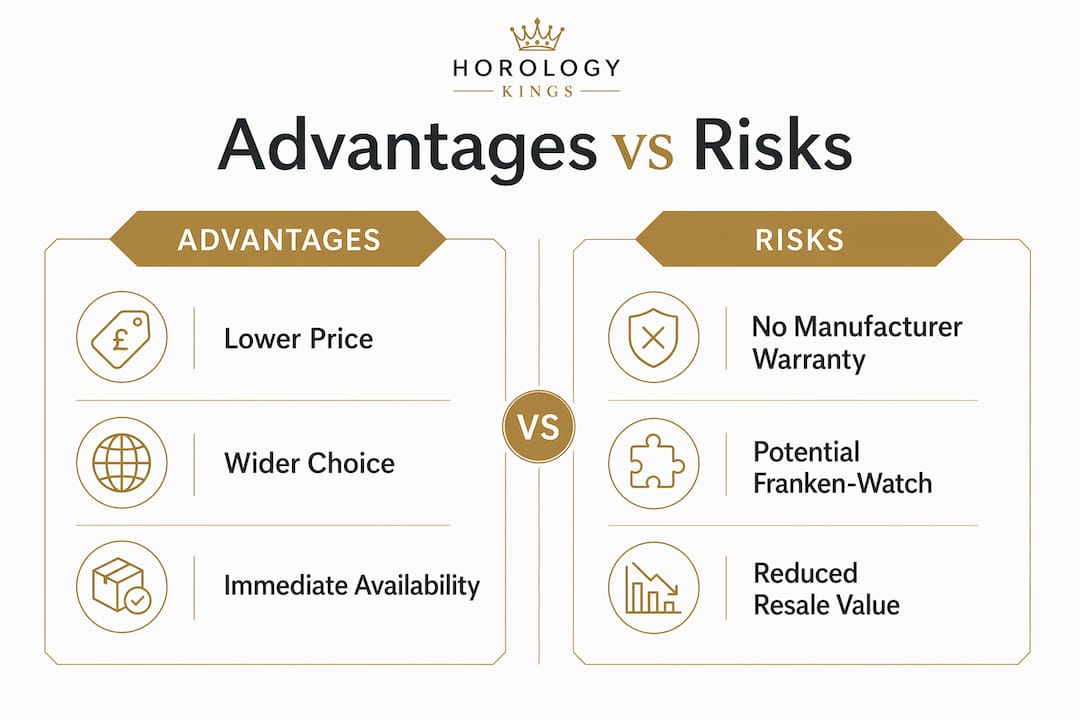
Pricing is the most nuanced element. Not all grey market watches are discounted; a Rolex Daytona or Patek Philippe Nautilus can command a significant premium above retail because authorised dealers simply will not sell them to walk-in customers. For these references, the grey market is not a discount channel. It is the only channel.
For less hyped models, genuine savings of 10 to 20 per cent below retail are achievable. The trade-off is warranty coverage. Manufacturers honour warranty only on authorised dealer purchases, which means a mechanical fault in year one becomes your financial problem, not the brand’s.
The risk of a “franken-watch” is also real. This is a watch assembled from genuine parts of different references, sometimes different production years, to create a piece that appears complete but is not original. Frankenwatches are not counterfeits in the legal sense, but they are misrepresented goods. Authentication is the only defence.
Pro Tip: Request a full movement inspection from an independent watchmaker before completing any grey market purchase. A qualified technician can identify replaced components, service history gaps, and movement inconsistencies that photographs will never reveal.
How to authenticate and verify a grey market watch purchase
Authentication is not optional when buying grey market timepieces. It is the single step that separates an informed collector from an expensive mistake. Our complete authentication guide covers this in full, but the core process follows a clear sequence.
Verify the serial number. Cross-reference the serial number on the case back and movement against the brand’s production records. Rolex, Patek Philippe, and Audemars Piguet all maintain records that authorised service centres can access. A mismatch between case and movement serials is an immediate red flag.
Inspect physical finishing. Authentic luxury watches have finishing standards that are extraordinarily difficult to replicate. Examine brushed and polished surfaces under magnification. Rolex’s Oyster case, for example, has a specific transition between brushed and polished surfaces that counterfeiters consistently fail to reproduce accurately.
Examine the dial and hands. Printing quality, lume application, and hand alignment are all indicators of authenticity. On a genuine Patek Philippe, the printing on the dial is precise to a degree that requires specialist equipment to appreciate.
Check the movement. For watches with exhibition case backs, inspect the movement directly. For sealed cases, an independent watchmaker can open the case back. Rolex movements have specific finishing, engravings, and component layouts that are well documented.
Use a reputable verification service. Organisations such as the Watch Register in the UK maintain databases of stolen timepieces. Running a serial number through their records adds a layer of due diligence that protects you legally and financially.
Emerging technologies are beginning to change this process. Brands are exploring blockchain-based digital passports to trace provenance and potentially flag grey market serial numbers in real time. This is not yet mainstream, but it signals the direction of travel. Concepts like blockchain provenance tracking are already being applied in luxury fashion and will migrate to horology within the next few years.
How does buying grey market affect warranty, servicing, and resale?
The practical consequences of buying outside the authorised network extend well beyond the initial purchase. Three areas require careful consideration: warranty, servicing, and long-term resale value.
On warranty, the position is unambiguous. Manufacturers limit coverage to authorised dealer sales, full stop. A grey market Omega Seamaster or Cartier Santos purchased in 2026 carries no Omega or Cartier warranty regardless of how new it is. Some grey dealers offer their own warranty, typically 12 to 24 months, but this is only as strong as the dealer’s financial stability and willingness to honour it.
Servicing presents a subtler challenge. Most brands will service grey market watches at their official service centres, though some have policies that flag or restrict grey serial numbers. The more significant issue is cost. Without warranty coverage, a service that would be free within the first two years of an authorised purchase becomes a full-cost repair. Rolex service costs for a Submariner, for example, run to several hundred pounds even for routine work. Our watch servicing page provides current guidance on independent servicing options that do not require brand authorisation.
On resale, the numbers are clear. Missing original documentation reduces resale value by 15 to 25 per cent even when the watch itself is entirely authentic. The secondary market for grey market pieces is narrower, attracting buyers who prioritise the watch over its paperwork. That is a legitimate market, but it is a smaller one, and it places a premium on original documentation that grey market buyers often cannot provide.
Strategies to mitigate these risks include retaining every document the seller provides, obtaining an independent condition report at purchase, and budgeting for out-of-warranty service costs from day one.
What does the future hold for the grey market watch ecosystem?
The grey market is not going away, but it is changing. The most significant development is the accelerating adoption of digital provenance tools by major brands. Blockchain-based digital passports are being developed to create immutable records of a watch’s journey from manufacture to sale. If implemented at scale, these systems could allow brands to identify grey market pieces at the point of service or resale and apply different treatment accordingly.
The practical implication for collectors is significant. A watch purchased grey today may face service restrictions or reduced brand support in five to ten years if digital passport systems become the industry standard. Buyers who understand this trajectory can factor it into their purchasing decisions now rather than being surprised later.
“Careful buyers can find rare, desirable watches on the grey market that are impossible or prohibitively priced at retail — if willing to accept the warranty limitations.” Fratello Watches
Brand strategies are also hardening. Rolex, Patek Philippe, and Audemars Piguet are all tightening their authorised dealer agreements and investing in supply chain monitoring. The effect is to make it harder for authorised dealers to leak stock to grey channels without detection. Over time, this may reduce the volume of grey market inventory from dealer sources, pushing prices up and availability down. For collectors, the window of opportunity that the current grey market represents may be narrower in 2030 than it is today.
Key takeaways
Grey market watches are authentic luxury timepieces sold outside official channels, and understanding the warranty, documentation, and resale implications is the difference between a smart acquisition and a costly one.
Point | Details |
Definition is precise | Grey market means unauthorised sale, not counterfeit or illegal; the watch is genuine. |
Warranty is not transferable | Manufacturers cover only authorised dealer purchases; budget for out-of-warranty service costs. |
Documentation affects resale | Missing papers reduce resale value by 15 to 25 per cent; retain every document provided. |
Authentication is non-negotiable | Verify serial numbers, inspect the movement, and use a reputable verification service before buying. |
Digital passports are coming | Blockchain provenance tools may restrict grey market service access within the next decade. |
The grey market from where I stand
I have handled hundreds of grey market pieces over the years at Horology Kings, and the pattern I see most often is this: buyers underestimate the documentation problem and overestimate the price saving. A collector who saves £800 on a grey market Omega and then discovers the resale value is £1,200 lower than a full-set equivalent has not made a shrewd purchase. They have made an expensive one.
That said, I have genuine respect for the grey market as a mechanism. It is the reason a collector in Birmingham can acquire a Patek Philippe reference that no authorised dealer in the UK will sell them, regardless of their relationship or budget. The authorised network is not a meritocracy. The grey market, for all its imperfections, is closer to one.
My advice to anyone considering a grey market purchase is to treat authentication as the first cost, not an afterthought. Spend the money on an independent inspection before you commit. Know exactly which documents are present and which are missing. And be honest with yourself about whether you are buying to wear or to sell, because the answer changes the calculus entirely.
The collectors who do best in this space are not the ones chasing the lowest price. They are the ones who understand what they are buying, why it is priced as it is, and what it will cost to own over time. That knowledge is available to anyone willing to seek it out.
— Lewis
Source your next watch with confidence

At Horology-Kings, based in Hertfordshire, we specialise in sourcing, authenticating, and selling luxury watches from brands including Rolex, Patek Philippe, Audemars Piguet, Omega, and Cartier. Every piece we handle is independently verified, with full transparency on provenance and documentation status. Whether you are looking to source a specific reference or need professional servicing for a watch purchased outside the authorised network, our team provides the expertise and security that grey market buying demands. Visit Horology Kings to explore our current inventory or speak directly with our specialists about your next acquisition.
FAQ
What is a grey market watch in simple terms?
A grey market watch is a genuine, authentic luxury timepiece sold outside the brand’s official authorised dealer network. It is not a fake or a stolen watch; it is simply sold through an unofficial channel.
Are grey market watches legal to buy in the UK?
Yes. Purchasing a grey market watch is entirely legal in the United Kingdom. The “grey” designation refers to the absence of brand authorisation, not any breach of law.
Do grey market watches come with a warranty?
Manufacturers do not honour warranty on grey market purchases. Some grey dealers offer their own limited warranty, but this is not equivalent to the manufacturer’s coverage.
How much does missing documentation affect resale value?
Incomplete documentation reduces resale value by 15 to 25 per cent even when the watch is fully authentic. Original box, papers, and warranty cards are significant factors in the secondary market.
Can I get a grey market watch serviced at an official brand service centre?
Most brands will service grey market watches at their official centres, though policies vary and some flag grey serial numbers. Independent watchmakers offer a reliable alternative without brand restrictions.
Recommended
Comments