.png)

What is a GMT watch? A collector's guide
- lewisvrichards3
- 23 hours ago
- 9 min read

TL;DR:
A GMT watch features a 24-hour hand that displays a second time zone, eliminating AM/PM confusion for travelers and professionals. It can have a fixed or rotating bezel to track a third zone, with movement types like Traveller or Caller GMT suited to different needs. Historically developed for aviation, GMT watches combine mechanical complexity and utility, making them highly valued by collectors and users alike.
A GMT watch is a mechanical timepiece designed to display at least two time zones simultaneously using an additional 24-hour hand. That single extra hand is what separates a GMT complication from a standard three-hand watch, and it is the reason pilots, international businesspeople, and serious collectors have prized these pieces for decades. The GMT hand completes one full rotation every 24 hours, read against a 24-hour scale on the dial or bezel, eliminating the AM/PM guesswork that plagues anyone tracking time across continents. Brands such as Rolex, Longines, and Tudor have built some of their most celebrated references around this complication, and understanding how it works makes the difference between wearing a GMT watch and truly using one.
How does a GMT watch work?
A GMT watch functions by running a fourth hand, the GMT hand, on the same movement as the standard hour and minute hands, but geared to complete one rotation every 24 hours rather than twelve. The standard hour and minute hands show local time in the conventional way. The GMT hand points to a 24-hour scale, printed either on the inner chapter ring of the dial, the rehaut, or on a rotating bezel, to indicate a second time zone.

Reading the second time zone is straightforward once you understand the scale. At 12 on a 24-hour scale, it is noon. At 24 (or 0), it is midnight. This format means you can see at a glance whether your reference city is in the middle of the night or the middle of the afternoon, without performing mental arithmetic. The 24-hour scale is the feature that removes AM/PM ambiguity entirely.
The GMT hand itself is usually visually distinct from the standard hour hand to prevent misreading. Manufacturers differentiate it through colour, a contrasting lume pip, or a distinctive arrowhead tip. On the Rolex GMT-Master II, for example, the Mercedes-style hour hand and the arrow-tipped GMT hand are immediately distinguishable even in low light.
Pro Tip: When you first pick up a GMT watch, identify the GMT hand before anything else. Look for the hand with an arrow tip or a different colour from the standard hour hand. Once you have located it, reading the second time zone against the 24-hour scale becomes second nature within minutes.
Key features to look for when examining a GMT watch:
A fourth hand, typically arrow-tipped or distinctively coloured, completing one rotation per 24 hours
A 24-hour scale on the dial, rehaut, or bezel
Standard hour and minute hands for local time
Clear visual differentiation between the local hour hand and the GMT hand
Optional: a rotating bezel for tracking a third time zone
What are the two main types of GMT movement?
Two main functional types of GMT watch exist: the Traveller GMT (also called True GMT) and the Caller GMT. The distinction lies in which hand can be independently adjusted, and it has a significant practical impact on how you use the watch day to day.
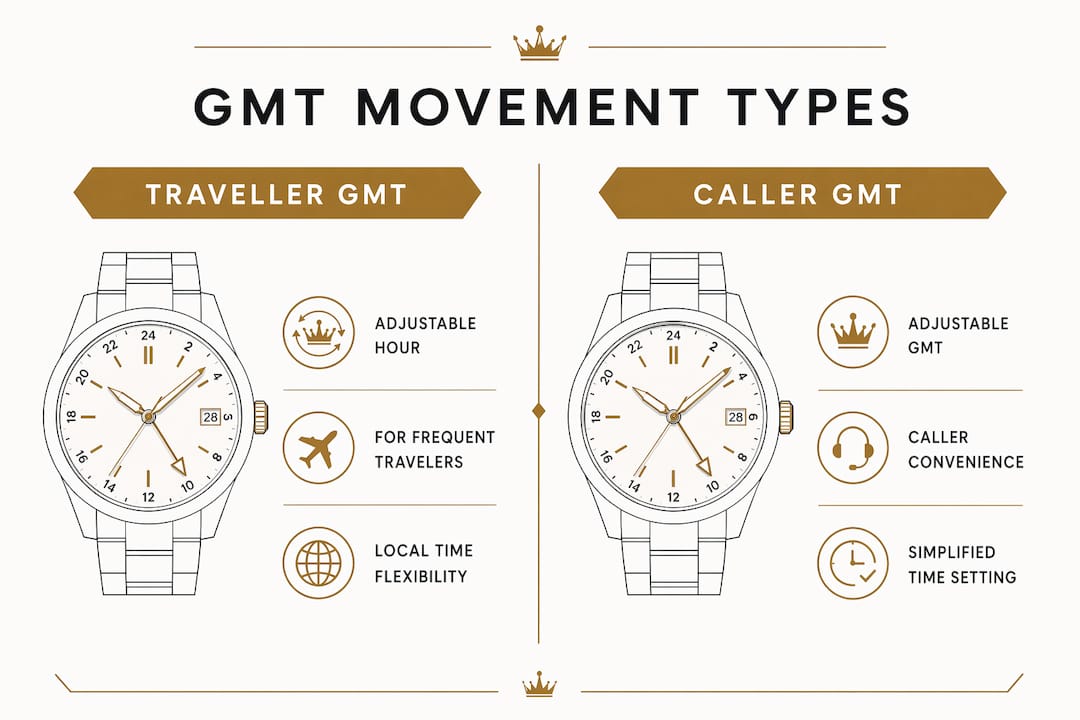
A Traveller GMT allows the local hour hand to be jumped forward or backward in one-hour increments without stopping the minutes or seconds. This means a frequent flyer can land in a new time zone, adjust the local hour hand to match local time, and the GMT hand continues tracking the home reference time uninterrupted. The movement examples associated with this design include the Rolex calibre 3285 and the Seiko NH34, both of which allow this independent local-hand adjustment.
A Caller GMT works differently. The GMT hand itself is the independently adjustable hand, while the local hour hand is fixed to the standard timekeeping train. This suits someone who works from a fixed location but needs to monitor a colleague or client in another time zone. The Miyota 9075 is a widely used Caller GMT movement found in several mid-range watches.
Feature | Traveller GMT | Caller GMT |
Independently adjustable hand | Local hour hand | GMT hand |
Hands stopped during adjustment | No | No |
Best suited to | Frequent travellers crossing zones | Fixed-location users monitoring a second zone |
Example movements | Rolex cal. 3285, Seiko NH34 | Miyota 9075 |
Setting complexity | Moderate | Simple |
Pro Tip: If you cross time zones more than four times a year, a Traveller GMT is worth the premium. If you simply need to keep an eye on New York while working in London, a Caller GMT does the job at a lower price point without any functional compromise.
Movement design directly affects the user experience, and choosing the wrong type for your lifestyle is one of the most common mistakes first-time GMT buyers make.
How does a rotating bezel enable a third time zone?
Some GMT watches go further than two time zones by pairing the GMT hand with a rotating 24-hour bezel. The mechanics are elegant. The GMT hand tracks a fixed reference time, typically UTC or home time. The rotating bezel, marked with a 24-hour scale, can be turned to align any city’s UTC offset with the GMT hand’s position, effectively displaying a third time zone without adding another hand to the dial.
Understanding bezel types is worth your time if you are seriously considering a GMT purchase. A fixed 24-hour bezel limits the watch to two zones. A bi-directional rotating bezel with a 24-hour scale opens up the third-zone capability. The Rolex GMT-Master II uses a bi-directional ceramic bezel for exactly this purpose, and it is one reason the reference has remained the benchmark for the complication since 1955.
Practical advantages of the rotating bezel for GMT use:
Track a third time zone without adding dial complexity
Rotate the bezel to any UTC offset for instant reference
Useful for travellers with layovers in intermediate time zones
Allows quick recalculation when crossing the International Date Line
Adds a tactile, mechanical interaction that fixed-bezel watches cannot offer
Pro Tip: When using a rotating bezel to track a third zone, always note your bezel position before adjusting it. A small piece of tape on the case back with the offset written on it sounds low-tech, but experienced travellers use exactly this trick during multi-leg journeys.
The practical capability of tracking a third zone depends entirely on whether the bezel rotates. Fixed bezels limit the watch to two zones without additional mental calculation, so confirm bezel type before purchasing if third-zone tracking matters to you.
Why does GMT matter in watchmaking history?
GMT stands for Greenwich Mean Time, the time at the Prime Meridian, which runs through the Royal Observatory in Greenwich, London. Greenwich was designated the world’s zero-degrees longitude reference point at the International Meridian Conference in 1884, and GMT became the global reference for timekeeping. UTC replaced GMT as the technical international standard in 1972, but the term GMT persisted in watchmaking because it was already embedded in the vocabulary of pilots, navigators, and the watches built for them.
“The GMT complication was born from necessity. Pilots flying transatlantic routes in the 1950s needed to track both local time and Zulu Time, the military term for UTC, simultaneously. Rolex developed the GMT-Master in 1955 in collaboration with Pan American World Airways for exactly this purpose. That heritage is not marketing copy. It is the reason the complication exists at all.”
The term Zulu Time, still used in aviation and military contexts, refers to UTC+0 and is functionally identical to what a GMT watch tracks as its reference time. Dual Time is another term you will encounter, though it typically describes a simpler complication where a second time zone is shown via a sub-dial rather than a dedicated fourth hand. The distinction matters to collectors because a true GMT complication with a 24-hour hand is mechanically more involved than a dual-time sub-dial.
GMT watches originated in aviation, but their appeal has expanded far beyond the cockpit. Today they sit at the intersection of mechanical artistry and genuine utility, which is precisely why they attract both working professionals and serious collectors.
What are the real benefits of owning a GMT watch?
The core practical benefit of a GMT watch is reading two or more time zones without any mental conversion. For anyone who regularly communicates across time zones, that instant clarity has real value. A glance at the wrist tells you whether your contact in Singapore is asleep or at their desk, without reaching for a phone.
Beyond pure function, GMT watches appeal to collectors for several reasons that go beyond utility:
Travel utility: Adjust local time on arrival without losing track of home time, particularly valuable on short trips where resetting the watch entirely would be disorienting
Business use: Monitor a second financial market or international office in real time without a second device
AM/PM clarity: The 24-hour format makes it impossible to confuse 3am with 3pm when reading the reference time zone
Mechanical complexity: A GMT complication adds meaningful engineering to a movement, which collectors recognise and value
Aesthetic distinction: The additional hand and 24-hour scale give GMT dials a layered, purposeful look that standard three-hand watches cannot replicate
Collector appeal: References like the Rolex GMT-Master II “Pepsi” and the Rolex GMT-Master II “Batgirl” carry significant secondary market value and cultural weight
GMT watches also frequently appear with additional complications. The Longines Spirit Zulu Time pairs the GMT function with a date and a clean, legible dial. Some manufacturers combine GMT with a chronograph or moonphase, though purists often argue that a clean GMT dial is more useful in practice than a heavily complicated one.
The 24-hour scale provides clarity between AM and PM without second-guessing, and that single feature justifies the complication for anyone who has ever miscalculated a time zone call.
Key takeaways
A GMT watch is defined by its 24-hour hand, which tracks a second time zone against a 24-hour scale, eliminating AM/PM confusion and making it the most practically useful complication for travellers and global professionals.
Point | Details |
Core function | A GMT hand completes one rotation every 24 hours, reading against a 24-hour scale to show a second time zone. |
Two movement types | Traveller GMT suits frequent travellers; Caller GMT suits those monitoring a fixed second zone from home. |
Rotating bezel advantage | A bi-directional 24-hour bezel enables tracking of a third time zone without additional hands on the dial. |
Historical origin | The complication originated in 1950s aviation, developed for pilots tracking local and Zulu Time simultaneously. |
Collector value | GMT references from Rolex and others carry strong secondary market demand alongside genuine mechanical appeal. |
Why GMT watches reward the collector who actually uses them
Most newcomers to GMT watches spend the first few weeks confused about which hand does what. That confusion is not a design flaw. It is a sign that the watch is doing something genuinely complex, and it passes quickly once you commit to reading the dial correctly.
What I find underappreciated is the difference between owning a GMT watch and understanding its movement type. I have spoken with collectors who spent considerable money on a Caller GMT and then complained it was inconvenient for travel. It was not inconvenient. It was the wrong tool for their specific use case. Choosing between a Traveller and a Caller GMT is the single most important decision when buying into this complication, and most buyers skip it entirely.
The mechanical appeal of a GMT movement is also worth acknowledging honestly. Adding an independently adjustable hand to a movement without disrupting the timekeeping train is a non-trivial engineering achievement. When you adjust the local hour hand on a Traveller GMT and feel that clean, positive click, you are interacting with decades of refinement. That tactile quality is part of why these watches hold their value so well on the secondary market.
My practical advice: wear your GMT watch for a full week before judging it. Track a real second time zone, someone you actually call or a market you actually follow. The complication reveals its value through use, not through reading about it.
— Lewis
Find your next GMT watch with Horology-kings

Horology-kings, based in Hertfordshire, specialises in buying, selling, and sourcing luxury timepieces including some of the most sought-after GMT references on the market. Whether you are looking for a Rolex GMT-Master II Pepsi or need help sourcing a specific reference through our expert network, the team at Horology-kings handles every transaction with full transparency and secure UK bank transfers. For collectors whose GMT watch needs servicing or regulation, the watch repair service covers complex movements with the care they deserve. Visit Horology-kings to browse the current selection or speak directly with the team about sourcing your ideal piece.
FAQ
What does GMT stand for on a watch?
GMT stands for Greenwich Mean Time, the time at the Prime Meridian in Greenwich, London. On a watch, it refers to the complication that displays a second time zone using a dedicated 24-hour hand.
How does a GMT watch differ from a standard watch?
A standard watch shows local time with two or three hands. A GMT watch adds a fourth hand that completes one rotation every 24 hours, allowing the wearer to read a second time zone simultaneously without mental conversion.
What is the difference between a Traveller and a Caller GMT?
A Traveller GMT allows the local hour hand to be adjusted independently in one-hour increments, making it ideal for frequent travellers. A Caller GMT adjusts the GMT hand independently, better suited to those monitoring a fixed second time zone from home.
Can a GMT watch show three time zones?
Yes, provided the watch has a rotating 24-hour bezel. By aligning the bezel with a third UTC offset, the wearer can track three zones using the local hands, the GMT hand, and the bezel scale together.
Which brands make the most respected GMT watches?
Rolex, with the GMT-Master II, is the benchmark reference for the complication. Longines, Tudor, and Omega also produce well-regarded GMT watches across a range of price points, each with distinct movement and bezel configurations.
Recommended
Comments