.png)

Timegrapher results explained: rate, amplitude and beat error
- lewisvrichards3
- 6 days ago
- 11 min read
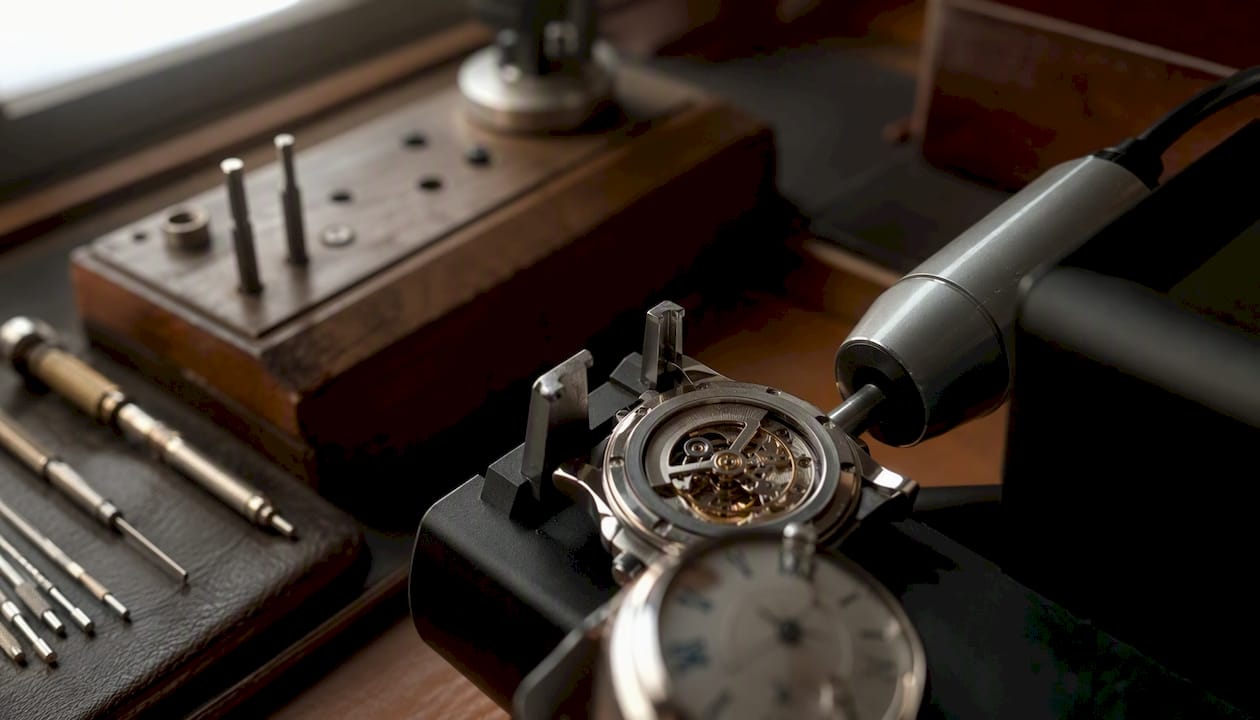
Three numbers tell you almost everything a timegrapher can reveal about a mechanical watch: rate (measured in seconds per day), amplitude (measured in degrees) and beat error (measured in milliseconds). Together, they answer three separate questions, not one. Rate tells you how accurate the watch is. Amplitude tells you how healthy the movement is. Beat error tells you how symmetrical the balance wheel’s swing is.
Read them in isolation and you’ll misdiagnose a watch. A movement can run to within a second a day and still have a mainspring on its last legs. What matters is reading all three together, and remembering that a single reading is a snapshot, not a verdict. Positions change results, temperature changes results, and even the same watch on the same machine will vary run to run. Averaging multiple positions is standard practice among watchmakers for good reason, as measurement guides consistently note.
Before you touch a regulation lever or reach for a demagnetiser, do this:
Wind the watch fully (or note the power reserve) and measure in at least two positions.
If the rate is unusually fast or the trace looks erratic and scattered, demagnetise first and re-test
If amplitude is low or falling across repeat readings, track the trend and book a service rather than reacting to one number.
Key Takeaways
Timegrapher accuracy depends on reading rate, amplitude and beat error together across multiple positions rather than trusting any single measurement.
Point | Details |
Three numbers, three questions | Rate shows accuracy, amplitude shows movement health, beat error shows balance symmetry. |
Amplitude is the real health check | Below 200° at full wind strongly suggests the movement needs servicing. |
Don’t chase zero beat error | Low beat error values are fine; over-adjusting risks damaging the hairspring or escapement. |
Average, don’t react | Test in multiple positions and track trends over time, not one isolated reading. |
Lift angle must be correct | Wrong lift angle or VPH input distorts amplitude even on a healthy movement. |
Table of Contents
How to read timegrapher results at a glance
A cheat sheet won’t replace judgement, but it gives you a fast filter for a listing, an auction lot, or a watch you already own.
Rate is what most buyers fixate on, yet it’s the least diagnostic of the three numbers on its own. A watch running at minus 3 seconds a day tells you nothing about why it’s running that way. A reasonable margin of error broadly acceptable for modern in-service mechanical watches exists, with more stringent criteria for COSC-certified movements
Amplitude is the real health indicator. Healthy movements at full wind typically show amplitude in the region of 270 to 315 degrees. A drop below a low amplitude threshold strongly suggests a movement that needs servicing, whether from dried lubrication, worn pivots, or a weakening mainspring.
Beat error tells you how evenly the balance swings between its two directions. Very low beat error values are excellent, low-to-moderate beat errors are acceptable, and high beat errors are worth addressing at service.
Metric | Good range | Action if outside range |
Rate | Within ±10 s/d (±4 to +6 s/d for COSC) | Check position variance; regulate if consistent offset |
Amplitude | 270° to 315° at full wind | Amplitude readings below a certain threshold suggest a service is needed |
Beat error | Low beat error values | High beat error values, address at next service |
Two caveats matter here. Different calibres have different “normal” amplitudes; a small vintage dress watch movement will never swing as wide as a modern automatic with a full barrel. And if the lift angle is set incorrectly on the timing machine, the amplitude figure it displays will be wrong regardless of how healthy the movement actually is.
How to take reliable timegrapher measurements
Sloppy setup produces numbers that look precise but mean nothing. Follow a consistent protocol and your readings become genuinely comparable, watch to watch and month to month.
Work in a quiet, temperature-stable room. Vibration from a nearby fridge or a draughty window will introduce noise into the trace.
Wind the watch fully, or note the power reserve state if you’re deliberately testing a partially-wound watch, since amplitude naturally drops as the mainspring unwinds.
Set the correct beat rate (VPH). Most timegraphers auto-detect this, but always verify it against the movement’s published frequency. Getting VPH wrong corrupts every derived figure, amplitude especially.
Enter the correct lift angle for the calibre. This isn’t a cosmetic setting. The lift angle is what the machine uses to convert timing pulses into a degree figure, so an unknown or guessed lift angle makes the amplitude reading unreliable even if the rate looks sound.
Adjust microphone sensitivity until you get a clean, sharp trace rather than a fuzzy or double-ticking line.
Test in multiple positions. The traditional six-position protocol (dial up, dial down, crown up, crown down, crown left, crown right) reveals positional variance that a single flat-on-the-bench reading will never show you.
Run each position for at least 30 to 60 seconds and repeat if the numbers jump around, then work from the average rather than a single pass.
If the trace looks noisy or chaotic even in a quiet room, check that the watch is sitting still and that the microphone is making direct contact with the caseback, not resting loosely nearby. If automatic beat-rate detection keeps failing, the movement may have an unusual or non-standard frequency, so check the reference documentation for that calibre rather than trusting the auto-detect.
Pro Tip: Keep a simple log of rate, amplitude and beat error for each position, dated, every time you test a watch. A single reading tells you where a watch stands today; three or four readings over a few months tell you where it’s heading, which is the number that actually matters for a mechanical movement.
What do rate, amplitude and beat error actually mean?
Rate: accuracy, but not the whole story
Rate is simply how many seconds a day the watch gains or loses relative to true time. A consistent offset, say a steady minus 5 seconds a day across every position, usually points to a regulation issue that’s straightforward to correct. Erratic rate that swings wildly between positions or between runs is a different animal entirely, and it usually traces back to low amplitude, a magnetised hairspring, or a bent balance staff rather than anything a regulation adjustment can fix.
This is the trap many first-time timegrapher users fall into. They see a bad rate number and reach straight for the regulator, when the rate is often a symptom of a problem sitting somewhere else in the escapement.
Amplitude: the movement’s vital signs
Amplitude measures how far the balance wheel swings in each direction, and it’s the closest thing a timegrapher offers to a health check. High amplitude generally means a strong mainspring, clean lubrication and low friction throughout the going train. As amplitude falls, so does the reliability of everything downstream of it, including rate and beat error.
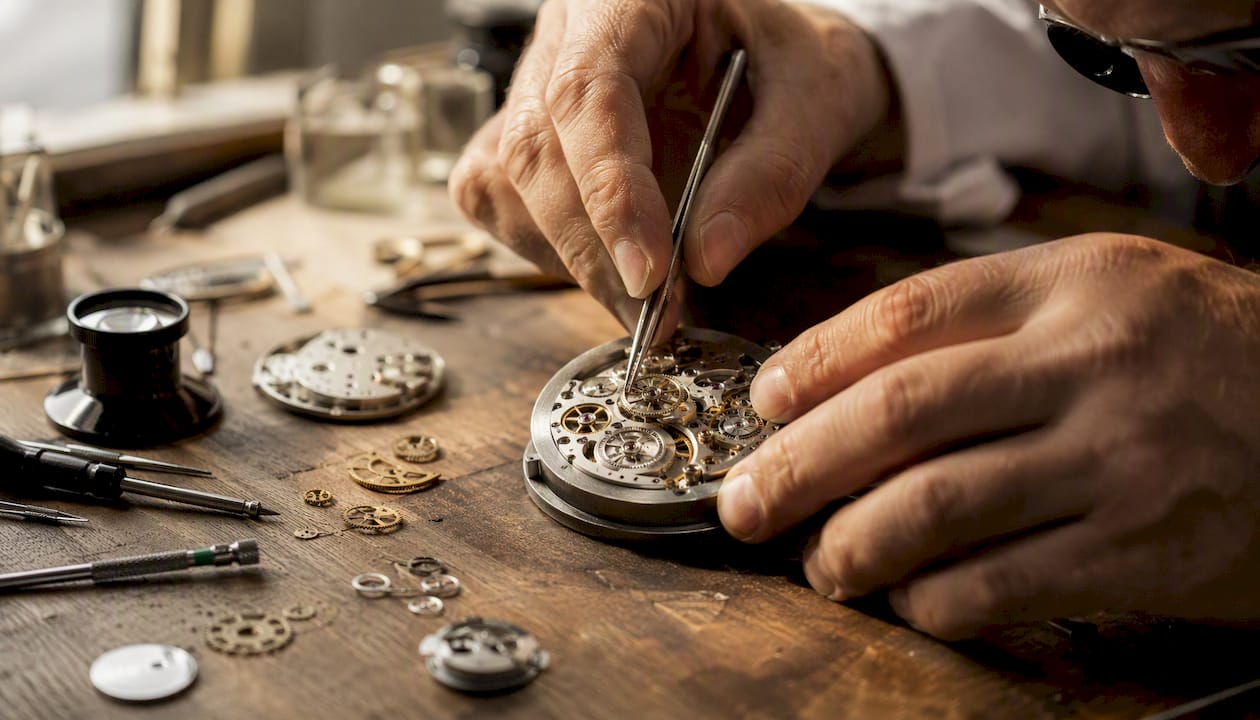
There’s a ceiling as well as a floor worth knowing. Amplitude above roughly 315 to 320 degrees on some calibres risks “rebanking” or “knocking”, where the impulse jewel strikes the opposite side of the fork slot, which is itself a sign of an over-energetic mainspring or incorrect assembly rather than something to celebrate. Below 200 degrees, as covered above, service becomes the near-universal recommendation because the movement is running on borrowed energy.
Beat error: symmetry, not perfection
Beat error measures the difference in time between the balance’s swing in one direction versus the other. It’s caused by a mechanical asymmetry, usually in how the hairspring’s collet is positioned relative to the balance staff. A small beat error is completely normal and, crucially, not something to obsess over.
Small beat errors are a normal characteristic of a healthy mechanical movement, and over-adjusting in pursuit of a perfect 0.0 ms reading can actually harm the hairspring or escapement rather than improve performance.
Chasing zero is one of the most common mistakes enthusiasts make once they own a timegrapher. A beat error under 0.6 milliseconds rarely has any perceptible effect on how the watch performs, and correcting anything above that typically requires repositioning the hairspring collet, which is watchmaker’s work, not a DIY adjustment made through the case back.
The real skill, and this is worth internalising before you look at another reading, is treating rate, amplitude and beat error as one combined signal and watching how that signal trends over weeks rather than reacting to any single test. A single good number surrounded by two mediocre ones still tells you something is off.
What does the timing graph actually show you?
The paper strip, or its digital equivalent on modern software, plots two lines representing the tick and the tock of the escapement. A healthy movement shows two straight, parallel, horizontal lines with minimal scatter.
Sloping lines mean the rate is drifting during the test, often from temperature change or the mainspring gradually losing tension.
Diverging lines that spread apart usually indicate a genuine and significant rate difference between positions rather than a measurement fault.
Scattered, fuzzy traces point to microphone placement issues or excessive ambient noise before you assume anything is wrong with the movement itself.
A faint third or “triplet” line running alongside the main two can be an artefact of the machine’s own detection algorithm rather than a real mechanical signature, so don’t over-read it without a second opinion.
Pro Tip: If a trace looks wrong, reposition the sensor and re-test before assuming the worst. A surprising number of “faulty movement” readings turn out to be a microphone sitting at a slight angle on the caseback.
Common reading combinations and what they mean
Certain patterns recur often enough that experienced collectors read them almost instinctively. Here’s the shorthand.
Rate | Amplitude | Beat error | Likely cause | Recommended action |
Consistent offset | Good (270°+) | Low | Simple regulation issue | Regulate; safe to attempt with training |
Any | Below 200° | Any | Worn or dry movement | Book a service |
Wildly erratic, jumps between tests | Erratic or dropping suddenly | Any | Magnetism | Demagnetise, then re-test |
Very high | Above 320° on some calibres | Any | Over-energetic mainspring, rebanking risk | Have a watchmaker check assembly |
Stable | Good | High beat error values | Hairspring collet asymmetry | Watchmaker adjustment at service |
The diagnostic order matters:
Rule out magnetism first if the rate looks chaotic, because it’s the cheapest and fastest fix.
Check amplitude next, since a low reading overrides almost every other conclusion you might draw.
Only look at fine regulation and beat error once amplitude is confirmed healthy across positions.
Three traps catch out even experienced enthusiasts. Testing in a single position and treating that as gospel is the most common. Chasing a perfect 0.0 millisecond beat error is the second, and it can do real damage. The third is ignoring lift-angle errors, which quietly distort amplitude while everything else on the display looks perfectly plausible.
What should you actually do with a bad reading?
Work through this in order rather than jumping straight to the most drastic option.
Re-wind and re-test. A low reading on a partially wound watch tells you nothing about the movement’s true condition.
Demagnetise if the rate is erratic or unusually fast, then test again immediately. This resolves a surprising proportion of “sudden bad rate” complaints and costs nothing.
Test across multiple positions before concluding anything, since a single dial-up reading can look fine while crown-down readings reveal a real problem.
Attempt minor regulation only if you’ve had training, and only after amplitude and beat error both look sound. Regulation adjusts rate; it does nothing for a tired mainspring or worn pivots.
A few cautions worth respecting. Don’t run a watch repeatedly for testing purposes if amplitude sits under 200 degrees; you risk running dry components under stress rather than diagnosing the problem. Never assume a quick regulation has “fixed” a watch that’s actually showing low amplitude, since you’ve masked a symptom rather than addressed the cause. And when in doubt, photograph the timegrapher display, note the position, date and winding state, and keep that record for whoever eventually services the watch.
Stop testing if amplitude reads under 200° repeatedly.
Never force a regulation adjustment against resistance.
Keep dated records of every test for future comparison.
When should you book a professional service?
A proper overhaul strips the movement completely: full disassembly, ultrasonic cleaning of every component, inspection under magnification for wear and pivot damage, replacement or repolishing of worn parts, reassembly with correctly measured lubrication, and final regulation checked across positions. Many authorities suggest a full service at regular intervals, commonly around every few years, though usage, movement type and storage conditions all shift that interval.
When you book one, ask for the following on your work order so you can compare quotes properly and confirm what was actually done:
Positional timing results, before and after service
Confirmation of demagnetisation as part of the process
A written timing sheet showing final rate, amplitude and beat error
An itemised list of any parts replaced
Requesting these documents protects you if you sell the watch later, since buyers increasingly value a documented service history.
Horology-kings offers professional servicing and valuation carried out to these standards, alongside our watch repair and servicing work for collectors who want a documented, positional timing sheet rather than a vague “serviced” label.
Diagnose it right, then decide whether it needs work
Reading rate, amplitude and beat error together tells you more about a mechanical watch’s condition than any single number ever will, and multiple positional averages beat a single test every time.
Whether you’re evaluating a private-sale watch or checking one you already own, the numbers only mean something once you’ve confirmed the setup was correct and the readings were taken across positions rather than off a single, possibly misleading pass. If a watch shows low amplitude alongside erratic rate, no amount of regulation will fix what’s actually a service issue, and understanding how the movement itself functions makes that distinction far easier to spot before you commit to a purchase or a repair bill.
If your own timegrapher testing points to a service, or you’re weighing up a private sale and want a second opinion on the numbers, Horology-kings can arrange a professional valuation and servicing appointment, with full positional timing sheets provided as standard.
What most collectors get wrong about timegrapher testing
The conventional advice treats a timegrapher reading like a school exam mark: pass or fail, one attempt, done. That’s the wrong mental model. A watch is a mechanical system under constant thermal and gravitational stress, and a single reading captures one instant of a variable performance.
What’s genuinely underrated is positional testing. Most private sellers, and plenty of dealers, will show you a single dial-up reading because it’s usually the flattest and most flattering position. Ask for crown-down and crown-left readings before you trust a rate figure at all.
What’s overrated is beat error precision. I’ve seen more amateur damage caused by enthusiasts chasing a perfect 0.0 millisecond reading than by any other single cause of self-inflicted movement wear. Leave anything under 0.6 milliseconds alone.
If you take one thing from this: log your readings, date them, and watch the trend. A movement that drops from 280 to 240 degrees of amplitude over six months is telling you something a single snapshot never could.
Frequently asked questions
What is a good timegrapher reading for a modern mechanical watch? Rate within roughly ±10 seconds a day, amplitude between 270° and 315° at full wind, and beat error under 0.6 milliseconds together indicate a healthy, well-regulated movement.
Why does my watch show different results in different positions? Gravity affects the balance wheel differently depending on orientation, so small rate and amplitude variations between positions are normal. Large swings usually point to a mechanical issue rather than measurement error.
Can I trust a single timegrapher reading when buying a used watch? Not fully. A snapshot can miss positional variance, and readings taken on a partially wound watch will show artificially low amplitude. Ask for readings across at least two or three positions.
Does a fast or erratic rate always mean magnetism? Not always, but it’s the first thing to rule out because demagnetising takes seconds and costs nothing. If the rate stays erratic after demagnetising, low amplitude or a mechanical fault is more likely.
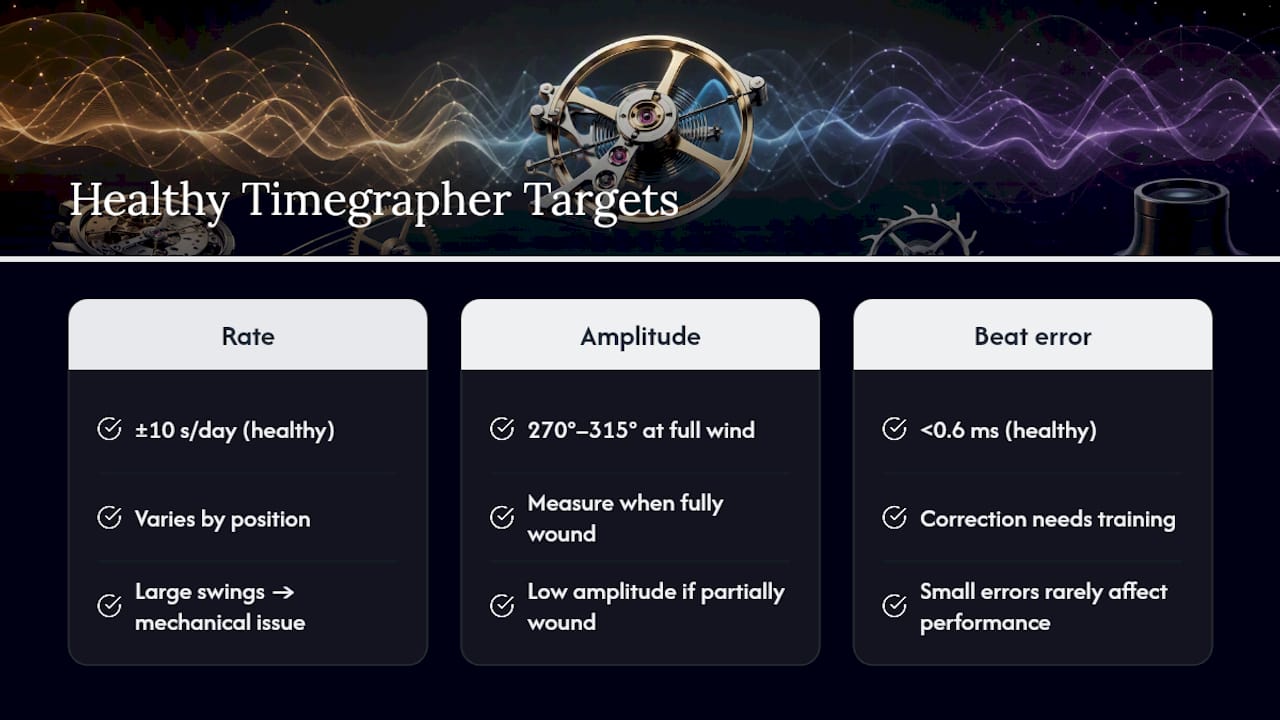
Should I try to fix beat error myself? Only with proper training. Beat error correction usually means repositioning the hairspring collet, a delicate job best left to a watchmaker, especially since small beat errors rarely affect real-world performance.
Sources
Recommended
Comments