.png)
Top high-complication watches for serious collectors
TL;DR:
Top high-complication watches are revered for their engineering mastery and rarity, showcasing human ingenuity within small cases.
Evaluating these timepieces involves analyzing the number and complexity of complications, component quality, acoustic performance, and scarcity, with brands like Patek Philippe and Vacheron Constantin leading.
Few categories in horology command the reverence that top high-complication watches do. These are not merely timepieces. They are mechanical arguments for what human ingenuity can achieve within a case smaller than a pocket. For the serious collector, understanding what distinguishes the truly great from the merely expensive requires a framework grounded in engineering, rarity, and craftsmanship. This article profiles the most extraordinary complicated watches ever made, evaluates them side by side, and offers practical guidance for those looking to acquire one with purpose.
Table of Contents
Key takeaways
Point | Details |
Complications defined | A complication is any function beyond basic timekeeping; high-complication watches stack multiple advanced functions simultaneously. |
Component density matters | The finest movements exceed 1,000 individual components, requiring years of hand-finishing and assembly. |
Rarity drives value | Production volumes for grande sonnerie watches can be as low as two pieces per year per model, reinforcing investment appeal. |
Size is a trade-off | Cases often reach 42–45mm or larger to accommodate mechanical density, affecting everyday wearability. |
Acquisition requires strategy | Sourcing the rarest pieces demands access to specialist dealers, auction houses, and trusted networks. |
What makes the top high-complication watches truly exceptional
Before profiling individual watches, collectors benefit from a clear vocabulary for evaluating them. A “complication” in watchmaking refers to any function beyond displaying hours and minutes. A simple date is a complication. A perpetual calendar, a minute repeater, or a tourbillon represents a far higher order of complexity.
The distinction between a moderately complicated watch and a grand complication is not just quantitative. It is qualitative. True high-complication watches layer functions that interact mechanically, meaning the mechanisms must communicate with one another without conflict. A perpetual calendar that also drives a rattrapante chronograph and a minute repeater is not three complications placed side by side. It is three systems that must coexist within a single, calibrated architecture.
Key criteria collectors should assess include:
Number and type of complications: Tourbillons, perpetual calendars, minute repeaters, sonneries, equation of time, and sky charts each represent distinct engineering challenges.
Component count: Modern movements can exceed 1,000 parts, making assembly and regulation an art form in itself.
Finishing quality: Geneva stripes, bevelling, perlage, and hand-polished steel are indicators of time invested per component.
Acoustic quality: For chiming watches, the tone, resonance, and clarity of the strike mechanism matter as much as the mechanism itself.
Production scarcity: Only around ten brands globally produce Grande Sonnerie watches, often completing just two per year for a given reference.
Pro Tip: When evaluating a high-complication watch, ask the dealer or auction house for documentation of regulation tests. The most serious makers subject finished movements to multi-week timing trials across multiple positions.
1. Patek Philippe Calibre 89
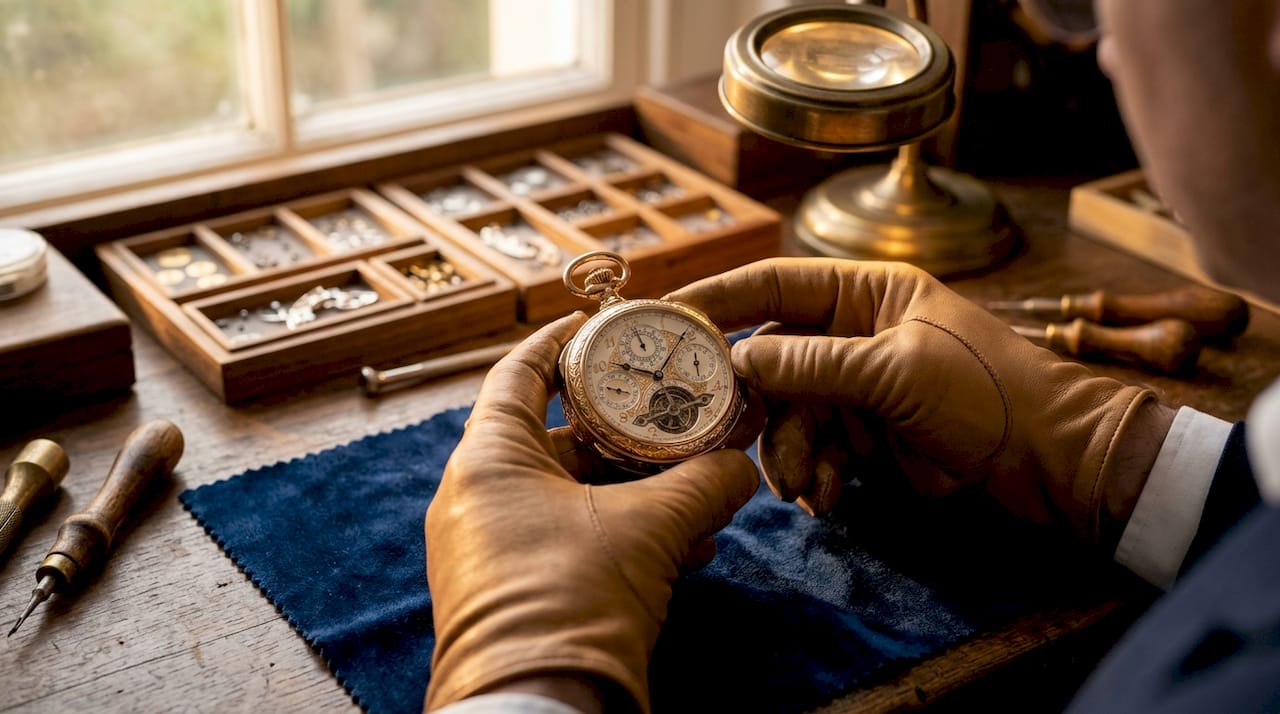
Produced in 1989 to commemorate Patek Philippe’s 150th anniversary, the Calibre 89 remains the standard against which all grand complications are measured. It houses 33 complications, 1,728 components, and 126 jewels within a five-layer pocket watch case. Its functions include a star chart for the Geneva sky, a tourbillon, a secular perpetual calendar, and a Westminster chime. Four examples were made in different case metals. At auction, a Patek Philippe Ref. 2523 once sold for $10.2 million, and the Calibre 89 occupies an even higher tier in collector esteem.
2. Vacheron Constantin Berkley grand complication
Completed in 2015 after a reported eight years of development, the Berkley grand complication holds the record for a pocket watch with 63 complications. It incorporates over 2,800 components and functions including a perpetual Gregorian and Hebrew calendar, an equation of time, a Westminster and Whittington chime, and a thermometer. Commissioned by an American collector, it is technically the most complicated watch ever made by any definition. Its existence is a reminder that when resources and ambition align, watchmaking has no ceiling.
3. Jaeger-LeCoultre Hybris Mechanica 11
Jaeger-LeCoultre’s Hybris Mechanica 11 packs 11 complications into a wristwatch case, including a flying tourbillon, a minute repeater with cathedral gong, a perpetual calendar, and a secular perpetual. Its Calibre 381 movement runs at 21,600 vibrations per hour, with a 50-hour power reserve. What distinguishes it from simpler grand complications is the integration philosophy. Every complication was designed from the ground up to share components where possible, reducing wear points and improving longevity.
4. Jaeger-LeCoultre Duomètre Héliotourbillon Perpetual
This watch represents one of the most technically credible approaches to precision in modern horology. Its Calibre 388 features separate gear trains for timekeeping and complications, preventing the energy drain of complications from affecting the regulator. Its triple-axis tourbillon rotates on three planes simultaneously, and the perpetual calendar requires no correction until 2100. The Duomètre concept itself was a landmark. Sharing energy between complications and the timekeeping train without allowing cross-contamination is a problem most watchmakers simply accept rather than solve.
Pro Tip: The Duomètre’s split power system is one of the most under-appreciated innovations of the last two decades. Collectors focused purely on complication count often miss that precision architecture is a complication in its own right.
5. Audemars Piguet 150e Héritage pocket watch
Created to mark the brand’s 150th anniversary, this pocket watch houses 1,140 components and 47 total functions, including 30 complications. Its centrepiece is an independent Universal Calendar that reconciles solar, lunar, and lunisolar cycles simultaneously. Housed in a 50mm platinum case, it illustrates the physical realities of ultra-complexity. High-complication cases often reach 42–45mm in diameter, and pocket watch format allows the density required for functions of this order.
6. Vacheron Constantin Les Cabinotiers Solaria
Among wristwatches specifically, the Les Cabinotiers Solaria currently leads the field. It packs 41 complications into a single wristwatch case, including an equation of time, a star chart, civil and religious calendars, a tourbillon, and a grand sonnerie. Vacheron’s Les Cabinotiers atelier produces pieces on commission for individual clients. Each Solaria is effectively unique, making it the definition of exclusive watch complications at the wrist.
7. Blancpain grande double sonnerie 15GSQ
The 15GSQ is described by Blancpain as the most complex watch the brand has ever made. Its movement contains 1,053 parts and combines a grande and petite sonnerie, a minute repeater, a tourbillon, and a perpetual calendar. Critically, it offers two selectable melodies and a sophisticated silent regulator for acoustic control. Grande sonnerie watches exemplify the intersection of mechanical science and musical art, and Blancpain’s 15GSQ is the most fully realised example in recent production. Production is limited to single digits per year.
8. Patek Philippe Sky Moon Tourbillon
The Sky Moon Tourbillon is Patek Philippe’s most complicated wristwatch in current production. Its double-face architecture displays a minute repeater, tourbillon, and perpetual calendar on the front dial, while the reverse reveals a celestial chart of the northern hemisphere sky, with sidereal time and the phases and orbit of the moon. The piece sold for nearly $4.2 million at auction, reflecting both its technical prestige and the enduring strength of the Patek Philippe name. It remains one of the most recognisable luxury complicated watches ever created.
9. A. Lange & Söhne Grand Complication
Lange produced only six examples of this watch between 2013 and its retirement, making it one of the rarest grand complications from a German manufacture. It combines a minute repeater, a perpetual calendar with a rattrapante chronograph, and a moon phase display. The movement is regulated in six positions and hand-finished to Lange’s characteristically exacting standard, with a three-quarter plate in German silver and blued screws throughout. For collectors who prioritise watch value that is grounded in finishing quality as much as complication count, the Lange Grand Complication is a compelling argument.
10. F.P. Journe Sonnerie Souveraine
Independent watchmakers occupy a distinct position in the world of high-end mechanical watches, and F.P. Journe’s Sonnerie Souveraine is the finest example from the independent sector. It features a grande and petite sonnerie, minute repeater, alarm, and perpetual calendar, all driven by a separate barrel dedicated exclusively to the striking train. This architectural decision preserves striking power independently of the timekeeping energy. Journe produces very few per year, and waiting lists routinely exceed a decade for serious complications from this maison.
Comparing the best: features and specifications at a glance
Watch | Key complications | Components | Case size | Est. price |
Patek Philippe Calibre 89 | 33 complications, tourbillon, chime | 1,728 | 88.2mm (pocket) | £5m+ |
Vacheron Berkley GC | 63 complications, perpetual calendars | 2,800+ | 98mm (pocket) | Commission |
Vacheron Solaria | 41 complications, sonnerie, tourbillon | N/A | 47mm | Commission |
Blancpain 15GSQ | Sonnerie, tourbillon, perpetual calendar | 1,053 | 44mm | £750,000+ |
Patek Sky Moon Tourbillon | Tourbillon, repeater, celestial chart | 686 | 42.8mm | £2m+ |
A. Lange Grand Complication | Repeater, rattrapante, perpetual cal. | 876 | 50mm | £2.5m+ |
JLC Hybris Mechanica 11 | 11 complications, flying tourbillon | N/A | 43.5mm | £900,000+ |
JLC Duomètre Héliotourbillon | Triple-axis tourbillon, perpetual cal. | N/A | 45mm | £300,000+ |
AP 150e Héritage | 30 complications, universal calendar | 1,140 | 50mm (pocket) | Commission |
F.P. Journe Sonnerie Souveraine | Sonnerie, repeater, perpetual cal. | N/A | 42mm | £400,000+ |
For pure investment potential, the Patek Philippe names carry the most consistent secondary market performance. Complicated watches from this manufacture have risen to mainstream artistic and investment status, sought by institutions as well as individuals. For horological prestige and technical originality, the JLC Duomètre and F.P. Journe Sonnerie Souveraine reward collectors with discernment beyond brand recognition.
How to choose the right high-complication watch
The most common mistake collectors make is optimising for complication count rather than complication relevance. A minute repeater that chimes beautifully will be used and appreciated daily. A secular perpetual calendar that will not need adjustment until the year 2100 is more of a philosophical statement than a functional benefit for most wearers.
Practical guidance for the acquisition process:
Define your purpose. Investment, daily wear, display, or horological study each demand different priorities.
Budget realistically. Entry-level grand complications from serious manufactures begin around £80,000. The upper limit is effectively boundless.
Consider wearability. Ultra-complex watches demand ergonomic consideration as the size required to house numerous components can limit comfort.
Use trusted acquisition channels. Auction houses, authorised dealers, and specialist secondary market brokers each offer different advantages. For rare pieces, a sourcing specialist with an established network is often the most efficient route.
Plan for servicing. Movements of this complexity require specialist care. Budget for a service every five to eight years, and keep the watch clean between services to protect the case and crystal.
Pro Tip: For safe buying and selling of grand complications, always request movement photographs and, where possible, an in-person or video demonstration of striking functions before committing. A repeater that does not perform beautifully is not worth the asking price.
My perspective: what the market misses about high-complication watches
I’ve spent years working closely with collectors who arrive fixated on the watches that appear most often in auction coverage. The Patek Philippe names, the Lange pieces. That focus is not wrong. But in my experience, it creates a blind spot around the independent and smaller manufacture complications that are genuinely more interesting from an engineering perspective.
What I’ve found is that the investment case for complicated watches is strongest when technical innovation and brand prestige coincide. But the emotional case, the reason people actually wear these things, belongs more often to a F.P. Journe or a Jaeger-LeCoultre Duomètre than to a watch bought primarily as an asset.
The trend I’m watching closely is miniaturisation. The biggest constraint on wristwatch complications has always been physical volume. As brands develop thinner, denser movements, we will see wristwatches reaching pocket watch levels of complexity without the case sizes that currently limit wearability. That shift will reshape the collector market considerably. The brands investing in movement architecture now, rather than simply adding complications to existing platforms, are the ones worth following.
— Lewis
Find your next grand complication with Horology-kings

At Horology-kings, we specialise in sourcing, buying, and selling the most extraordinary timepieces for collectors who know exactly what they are looking for. Whether you are seeking a specific reference from Patek Philippe, Audemars Piguet, or an independent manufacture, our expert network gives you access to pieces that rarely appear in public listings. You can explore our current inventory or use our dedicated watch sourcing service to commission a search for a specific complication or reference. For existing pieces requiring specialist attention, our watch servicing team handles intricate movements with the care they demand.
FAQ
What qualifies as a high-complication watch?
A high-complication watch includes multiple advanced functions beyond basic timekeeping, typically combining at least three significant complications such as a tourbillon, perpetual calendar, and minute repeater within a single movement.
Which is the most complicated watch ever made?
The Vacheron Constantin Berkley Grand Complication holds the record with 63 complications and over 2,800 components, making it the most intricate wristwatch or pocket watch ever produced by any manufacture.
Are high-complication watches a good investment?
The strongest performers at auction, including examples from Patek Philippe, have consistently exceeded £2 million, with total auction results reflecting watches’ rise as investment-grade assets comparable to fine art.
How often do complicated movements need servicing?
Most specialist watchmakers recommend a service interval of five to eight years for grand complication movements, though the precise interval depends on usage, storage conditions, and the specific complications present.
Where can I buy a rare high-complication watch in the UK?
Specialist dealers such as Horology-kings offer sourcing services tailored to collector requests, providing access to rare and high-complication references through an expert network across the UK and internationally.
Recommended
Comments