.png)
Watch authentication checklist: Protect your luxury investment
TL;DR:
Authenticating luxury watches requires analyzing movement, finishing, dial details, and documentation.
Professional inspection and cross-referencing with brand records are essential for high-value or complex pieces.
Relying solely on packaging, certificates, or market instinct risks falling for sophisticated counterfeits.
The counterfeit luxury watch market has never been more dangerous. Skilled forgers now produce replicas so convincing that they can deceive buyers who have handled genuine pieces for years. For collectors and investors in the UK, where a single timepiece can represent tens or even hundreds of thousands of pounds, the consequences of buying a fake extend well beyond disappointment. They represent a serious financial loss and a blow to your reputation within the hobby. This article gives you an evidence-based, practical authentication framework covering movement inspection, documentation, and when to call in the professionals.
Table of Contents
Key Takeaways
Point | Details |
Movement check limits | A smooth sweep may look genuine but is not enough to confirm authenticity on its own. |
Value of documentation | Proper papers support authenticity, but always verify certificates and numbers carefully. |
Expert inspection vital | Professional authentication and database checks are the most reliable way to confirm your investment is real. |
Avoid shortcuts | Don’t rely on single quick checks; work through the full checklist for high-value timepieces. |
Essential criteria for authenticating a luxury watch
With the stakes clearly defined, start by learning which criteria truly matter when you examine any high-value timepiece. Authentication is not a single test. It is a layered process, and the most confident conclusions come from combining multiple signals rather than relying on any one indicator.
The movement is often the first thing people examine. A genuine Swiss mechanical movement should sweep continuously rather than tick in discrete steps. However, movement behaviour such as a mechanical sweep versus a quartz tick is a commonly used early triage signal but is not definitive, because high-quality counterfeits can mimic sweep characteristics. Treat it as a starting point, not a conclusion.
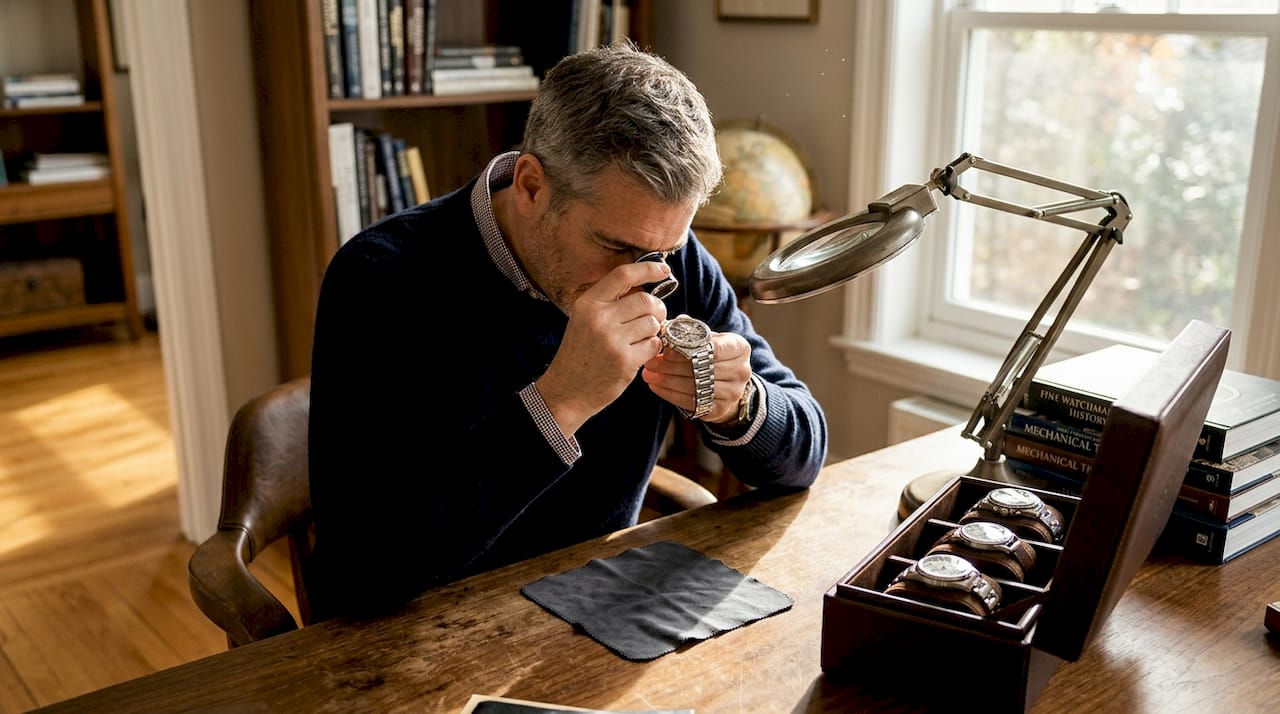
Materials and finishing reveal far more. A genuine Rolex Submariner or Patek Philippe Nautilus is finished to an extraordinary standard. Brushed surfaces are uniformly satin. Polished surfaces are mirror-sharp. When examined through a 10x loupe, a hallmark of dedicated collectors, the edges between different surface textures on a genuine piece are crisp and precise. On counterfeits, these transitions are often blurry, uneven, or poorly defined. The weight of the case is also telling. Genuine pieces use dense, high-quality steel or precious metal, and that density registers immediately in the hand.
Dial details are particularly discriminating. Look for:
Text alignment and spacing: On genuine watches, every character on the dial is perfectly positioned and uniform in weight.
Luminous indices: Should be evenly applied, consistent in size, and perfectly centred within their markers.
Logo application: The brand logo and model name should be raised, precisely applied, and free of smearing.
Cyclops lens clarity: On models like the Rolex Datejust, the date magnification should be exactly 2.5x and the date numerals sharp throughout.
Caseback engravings: Should be deeply and cleanly struck, with consistent depth and no rough edges.
Original packaging and papers add credibility but are not conclusive on their own. Retain all boxes, inner cushions, hang tags, and warranty cards. Cross-reference the serial number on the papers with the number engraved on the watch case, which for modern Rolex models is found between the lugs and on the rehaut (the inner edge of the bezel).
Pro Tip: Always photograph and document the serial and reference numbers before any transaction. Compare them against known databases and, where possible, the original point-of-sale records held by the brand’s authorised network.
“The most reliable authentication combines hands-on physical inspection with documentary evidence and, ultimately, professional verification. No single criterion stands alone.”
For a deeper look at the visual signs of fake watches that are most commonly missed by buyers, the evidence points consistently to finishing quality as the most discriminating factor. And understanding the benefits of authorised dealers before you commit to any purchase will clarify why the source of a watch matters as much as the watch itself.
Step-by-step watch authentication process
Having outlined the key criteria, transform these signals into a practical, repeatable process you can apply before any purchase or sale.
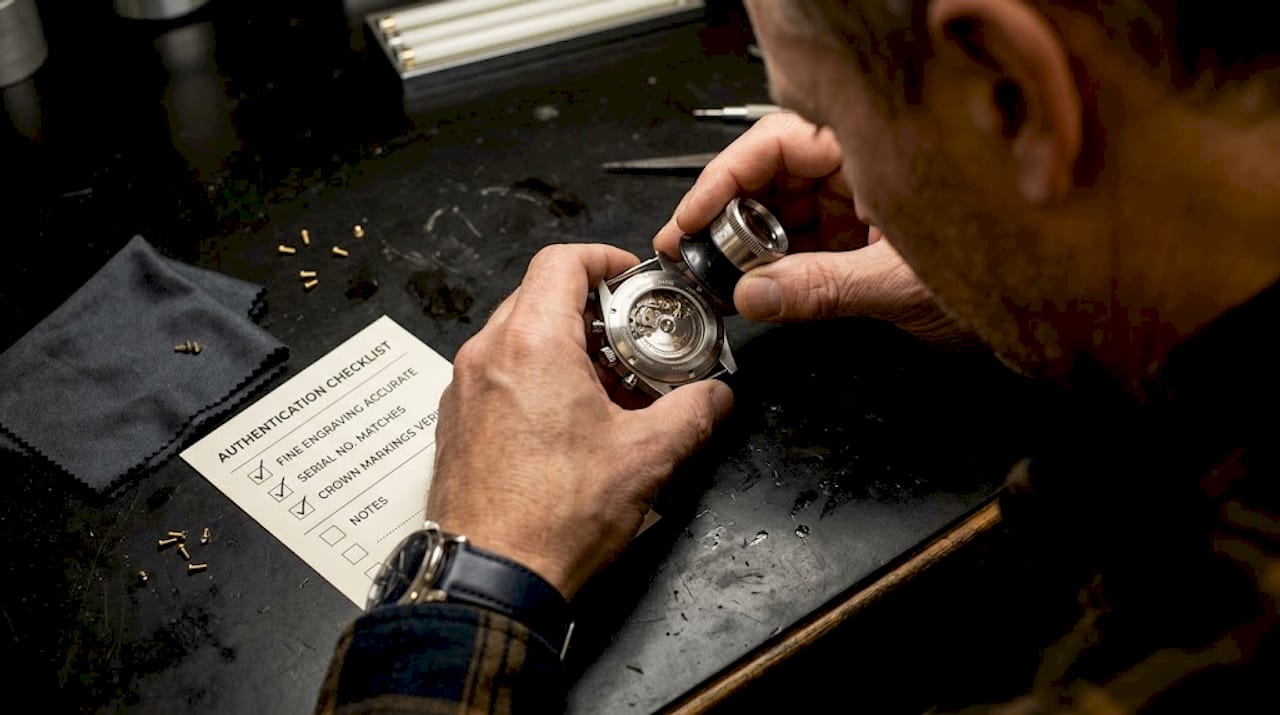
Step 1: Inspect the movement, dial, and case. Request to see the movement if possible. Examine it under magnification for Geneva stripes (Côtes de Genève), bevelled edges (anglage), and the blued screws that characterise top-tier calibres. Check the dial for the points above, and examine the case finishing meticulously.
Step 2: Check serial and reference numbers. Locate the serial number and the reference number. On most Rolex models produced after 2005, these are engraved on the rehaut. Match these numbers precisely with the accompanying paperwork. Even a single digit mismatch is a serious warning sign.
Step 3: Authenticate all paperwork. Genuine warranty cards from Rolex and Patek Philippe are printed on high-quality card stock with fine-detail security printing. Service records should show dated stamps from authorised service centres with legible technician references. COSC (Contrôle Officiel Suisse des Chronomètres, the Swiss precision certification body) documentation confirms movement accuracy but should be cross-referenced with other materials. The understanding watch certificates process is more nuanced than most buyers realise.
Step 4: Compare against brand standards.
Feature | Genuine watch | Suspicious indicator |
Caseback engraving | Deep, crisp, consistent depth | Shallow, uneven, blurry text |
Dial text | Sharp, uniform, perfectly aligned | Smudged, inconsistent weight |
Crown and pushers | Solid, smooth operation | Rough action, lightweight feel |
Bracelet finishing | Distinct brushed/polished zones | Uniform, unvaried finish |
Serial number | Clean, laser-etched or stamped | Rough, uneven, poorly struck |
Step 5: Authorised brand dealer inspection. The most rigorous final step is presenting the watch to an authorised dealer or service centre. For brand-specific verification, authorised brand channels or professional service centres are recommended for definitive checks and database cross-checking. An authorised Rolex dealer, for instance, can cross-reference the watch’s serial number against Rolex’s own production and service records, which is simply not possible through any other channel.
Following a step-by-step authentication process like this one substantially reduces the risk of acquiring a counterfeit, but no checklist is entirely foolproof without professional input on high-value pieces.
Common pitfalls: What can and can’t be trusted
A methodical checklist will catch much, but beware these common missteps that even experienced professionals occasionally encounter.
The COSC certificate trap. Many buyers treat a COSC certificate as a guarantee of authenticity. It is not. COSC certification tests the movement’s timekeeping accuracy, not the watch as a complete object, and it is entirely unrelated to whether the finished piece is genuine or counterfeit. A forger could theoretically fit a COSC-certified movement into a fake case. The certificate confirms chronometer-grade accuracy. Nothing more.
The sweep hand assumption. As covered above, movement behaviour is regularly mimicked by higher-quality counterfeits. This has become more pronounced in recent years as the market for “super fakes” has grown. A convincing sweep is now achievable with inexpensive automatic movements. Treat the sweep as a first-pass filter only.
Packaging and accessories as evidence. Original boxes, inner cushions, hang tags, and even books can all be counterfeited. Sophisticated fake operations now produce replica packaging with such precision that it is almost indistinguishable from the genuine article without close comparison. Never purchase a watch based solely on the quality of its accompanying box.
Online photograph authentication. Photographs, even high-resolution ones, cannot replace physical examination. Light, angle, and image compression can all obscure the fine surface irregularities that betray a fake. Photographs can be altered. They can also be taken from genuine watches and used to represent fraudulent ones.
Authentication method | Reliability | Limitations |
Movement sweep check | Low to moderate | Easily mimicked by counterfeits |
COSC certificate | Low for authenticity | Covers accuracy, not authenticity |
Visual dial inspection | Moderate | Requires expertise and magnification |
Serial number cross-check | High | Needs access to brand database |
Authorised dealer inspection | Very high | Requires physical access to dealer |
Pro Tip: If you are purchasing a pre-owned Rolex or Patek Philippe privately and cannot arrange a dealer inspection before payment, consider using a professional third-party authentication escrow service. You pay only when the watch is confirmed genuine.
The counterfeit detection challenge is real at scale. Specialist authentication labs across Europe report increasing proportions of high-grade counterfeits in submitted watches, driven by improvements in CNC machining and the accessibility of Swiss movements through grey-market channels. For safe buying and selling practices that account for these risks, process and due diligence are your most effective defences.
When to involve the experts: Knowing your limits
While some checks can be done independently, others require expertise and advanced tools to be conclusive. Knowing where your own knowledge ends is arguably the most important authentication skill of all.
There are specific situations where self-authentication is simply not adequate:
Purchases above £10,000: The cost of professional authentication is trivial relative to the financial risk at this level.
Uncommon or rare references: Limited editions and vintage pieces require specialist knowledge of production variations that are not publicly documented.
Watches without complete paperwork: The absence of original documentation raises the stakes for every other inspection point.
Watches sourced privately or informally: Without the protections of a reputable dealer, independent verification is essential.
Pieces intended for resale or investment: Your credibility and the watch’s resale value depend on documented authentication.
Full authentication typically requires an expert to inspect the piece in person, including checking the watch against a verified database. Authorised Rolex dealers, for example, can run the serial number through the manufacturer’s internal records to confirm production date, original configuration, and service history. This database access is unavailable to independent parties and cannot be replicated through any other means.
“Engaging a professional for authentication is not an admission of inexperience. It is what experienced collectors routinely do for high-value acquisitions.”
The cost of professional inspection varies. An authorised dealer inspection is typically offered at no charge for straightforward cases. Specialist horological authentication services may charge between £100 and £500 depending on complexity. Compare this to the risk of losing five, six, or seven figures on a counterfeit, and the value proposition is obvious.
When sourcing watches, particularly rare or sought-after references, working with established networks dramatically reduces exposure to counterfeits. For guidance on safe luxury watch sourcing through verified channels, the difference between a trustworthy source and an unknown seller represents one of the most significant risk variables in the entire process. There are reputable alternatives for luxury watches when navigating the broader market, but scrutiny must increase in proportion to unfamiliarity.
A collector’s take: The mindset that truly secures your investment
Here is something the standard authentication guides rarely say directly: most collectors who acquire fakes are not careless. They are overconfident. They have seen enough genuine watches to feel they can rely on instinct, and that instinct is precisely what sophisticated counterfeiters target.
The dangerous moment is when you think, “this feels right.” Feelings are not authentication. Procedures are. The collectors who consistently make sound acquisitions are those who respect the process even when they are certain, who submit every significant purchase to professional scrutiny regardless of how convinced they feel, and who cultivate long-term relationships with dealers they genuinely trust.
Those relationships are worth more than any checklist. A trusted dealer who knows your collection, your investment goals, and your risk tolerance will flag concerns before they become problems. They will source watches with documented provenance. They will tell you when to walk away.
The uncomfortable reality of trading high-end watches is that the market rewards patience and rigour, not speed or instinct. The best investment you can make in your collection is not a particular reference or complication. It is the discipline to authenticate everything properly, every single time.
Next steps: Accessing trusted authentication and sourcing services
Putting this framework into practice is straightforward when you have the right partners. At Horology Kings, we work exclusively with serious collectors and investors across the UK who need confidence at every stage of a transaction.
Whether you are authenticating a piece you already own, considering a significant private purchase, or seeking a specific reference through our expert sourcing network, our team provides transparent, consultative support throughout. Every watch we handle is subject to rigorous verification, and our clients benefit from direct access to a specialist network built on verified provenance and professional integrity. Visit Horology Kings to discuss your authentication needs, or explore our bespoke watch sourcing service for rare and sought-after timepieces.
Frequently asked questions
Is a smooth sweeping seconds hand enough to confirm a luxury watch is authentic?
No. Many modern counterfeits successfully mimic a smooth sweep, so this feature alone carries very little evidential weight. As established, movement behaviour is a commonly used early triage signal but is not definitive, and should always be combined with physical finishing checks and documentary review.
Does a COSC certificate guarantee my entire watch is genuine?
No. COSC certification tests only the movement’s chronometer-grade accuracy, not the authenticity of the complete watch, meaning a fake case could theoretically enclose a certified movement.
When should I bring my watch to an authorised dealer for authentication?
You should seek expert verification whenever there is any doubt, or when purchasing or selling a high-value piece. Full authentication requires in-person expert inspection and database cross-referencing that only authorised service channels can provide.
Are packaging and papers always reliable indicators of authenticity?
No. Both packaging and papers can be counterfeited to a high standard and should always be cross-referenced with physical inspection results and, where possible, brand database records rather than treated as standalone evidence.
Recommended
Comments