.png)
How the watch secondary market shapes real value
TL;DR:
The secondary luxury watch market’s value depends on documentation, condition, and provenance.
Accurate pricing requires careful scrutiny of set completeness, service history, and originality.
Diligent authentication and comprehensive research are key to confident buying and selling.
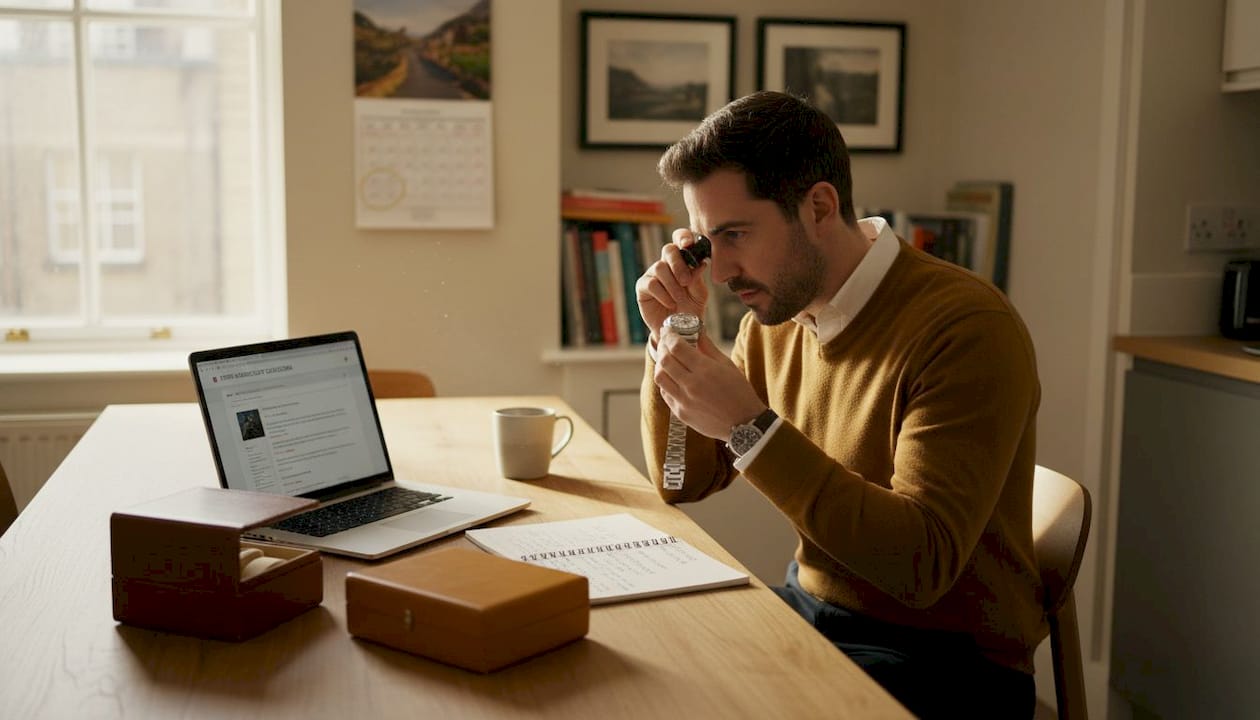
Many buyers assume that finding a pre-owned luxury watch is straightforward: locate the model, check the price, and complete the purchase. In reality, two watches from the same reference, the same year, and the same manufacturer can trade thousands of pounds apart on the secondary market. The difference often comes down to details most buyers overlook entirely, such as whether the original box and papers are present, whether the movement has been serviced by an authorised centre, or whether a dial has been refinished. This article gives you a practical, evidence-based framework for understanding how the secondary market works, what drives value, and how to trade with genuine confidence.
Table of Contents
Key Takeaways
Point | Details |
Secondary market defined | The watch secondary market includes all resale of luxury timepieces after the first retail purchase. |
Value factors | Set completeness, service history, and brand reputation all play major roles in price. |
Pricing strategies | Smart buyers use multiple indexes and thorough verification, not just headline prices. |
Application focus | Real-market results depend on detailed checks and leveraging expert insights. |
What is the watch secondary market?
The watch secondary market refers to every transaction that takes place after a timepiece has been sold for the first time by an authorised retailer. This includes private sales, certified pre-owned (CPO) programmes run by brands themselves, independent brokers, and auction houses. Unlike the primary market, where you pay a fixed price at a boutique, the secondary market is fluid. Prices shift in response to supply, demand, collector sentiment, and the individual condition of each watch.
Understanding this distinction matters enormously because the secondary market is often the only route to acquiring certain watches. Discontinued references, limited editions, and perpetually waitlisted models like the Rolex Submariner or Patek Philippe Nautilus rarely appear on boutique shelves. The secondary market is where they live. For buyers, this creates genuine opportunity. For sellers, it creates a channel where a well-maintained watch can return significant value. For collectors treating horology as part of a broader portfolio, it is a dynamic asset class unlike any other.
Participants in the secondary market include:
Enthusiasts and collectors who buy and sell to curate or upgrade their collections
First-time buyers who want a specific reference without a boutique waiting list
Investors who purchase watches as tangible assets expected to hold or grow in value
Dealers and brokers who acquire watches from the public and resell them to buyers
Auction houses that facilitate high-value sales and establish benchmark prices
One critical concept to grasp early is that secondary prices regularly diverge from manufacturer recommended retail prices (RRP). Sometimes a watch trades above retail, which creates what the industry calls a “grey market premium.” Sometimes it trades below, particularly when supply outstrips demand or when a model loses cultural currency. Proper watch valuation therefore requires far more than a single price-check.
Investment-oriented buyers often look at value retention or resale premiums versus recommended retail, but the magnitude can change as authorised retail prices change and as certification and CPO costs affect secondary pricing.
This is precisely why treating the secondary market as a simple bargain-hunting exercise can backfire. The smart approach treats every purchase or sale as its own case study.
How pricing and value are determined
Once you understand who participates and why, the next question is: what actually sets the price? The answer is never a single factor. Secondary market pricing is the product of several overlapping variables, and understanding each one gives you a genuine edge.
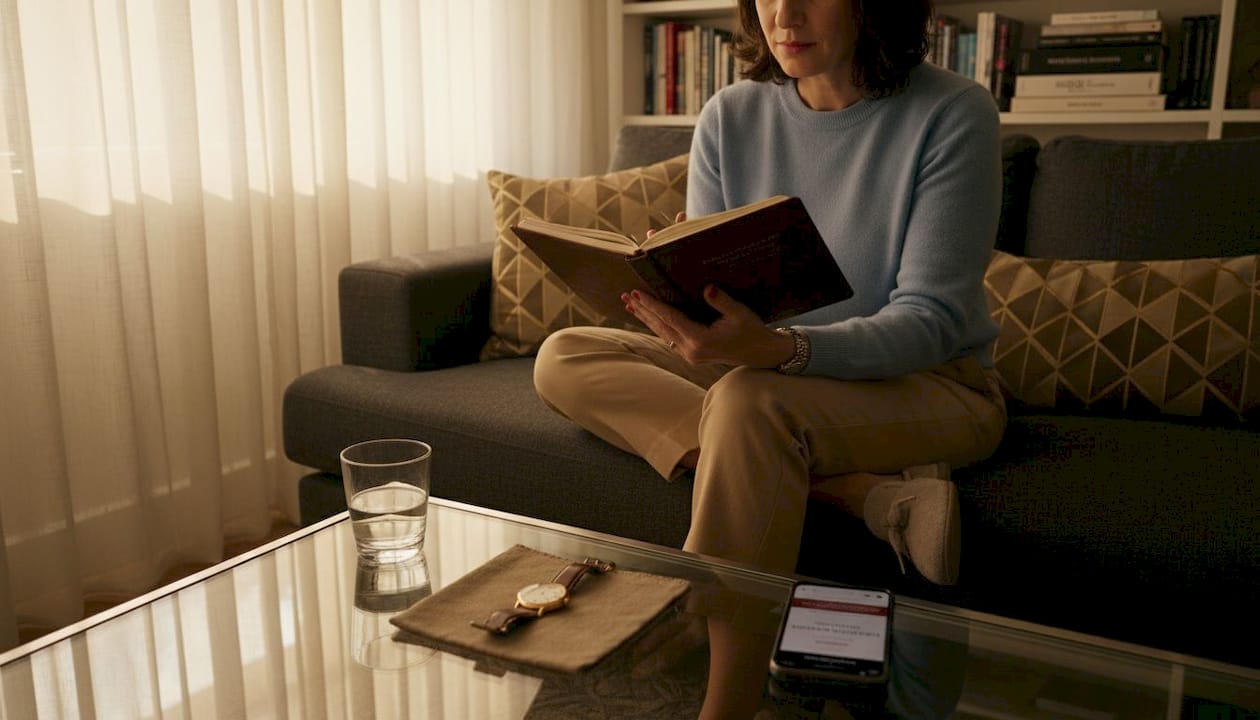
One of the most widely referenced measures is the value retention (VR) metric, popularised by Morgan Stanley in their periodic watch market analyses. VR compares the primary retail price of a watch against its secondary trading price to determine whether the model is holding, gaining, or losing value. According to data tracked across the secondary market, Rolex’s value retention stood at +6.7% versus retail at certain measurement points, meaning a watch that retailed for £10,000 could trade for £10,670 or more on the secondary market. That number fluctuates, but it illustrates how a top-tier brand can deliver returns that exceed the initial outlay.
Below is a simplified comparison of factors that drive pricing differences between otherwise similar watches:
Factor | Impact on secondary price |
Box and papers present | Can add 10–20% to sale price |
Service by authorised centre | Increases buyer confidence and value |
Unmodified, factory-correct dial | Significantly higher demand |
Third-party aftermarket parts | Often reduces value by 15–30% |
Recent service within 3 years | Marginally positive effect |
Scratched or worn case | Reduces value, extent depends on model |
The signs of true value in a pre-owned watch go well beyond the dial and the name on the case. Collectors and experienced buyers know to scrutinise every element.
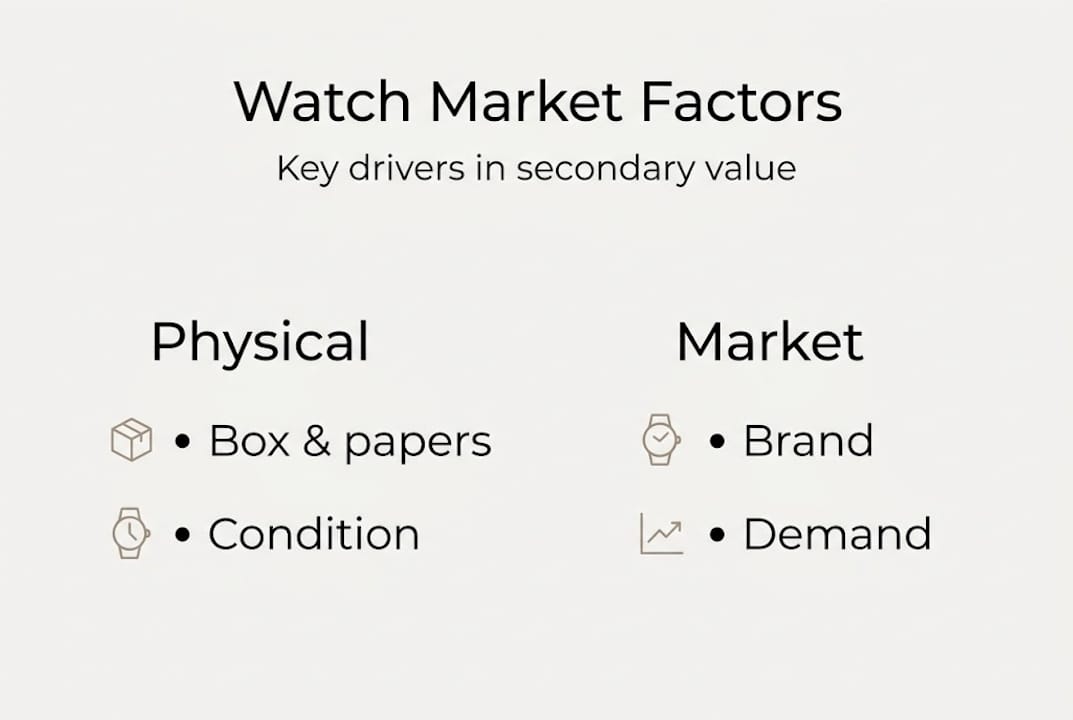
Set completeness is perhaps the single biggest variable after the watch itself. “Full set” means the watch comes with its original box, inner and outer packaging, warranty card, and any accompanying documentation such as chronometer certificates or hang tags. A Rolex Daytona in full set will routinely command a meaningful premium over the same reference sold “watch only.” The difference isn’t cosmetic; it speaks directly to provenance and care.
Service history is equally significant. A watch with documented servicing at an authorised centre tells a buyer that the movement has been properly maintained. Without this evidence, buyers apply a discount to account for unknown risk. And brand reputation itself plays a structural role; watches from Rolex, Patek Philippe, and Audemars Piguet tend to retain value more reliably than those from brands with weaker secondary demand.
The key factors impacting secondary price include:
Original box, papers, and ancillary documentation
Condition of the case, bracelet, and crystal
Originality of the dial, hands, and bezel
Service history, ideally with authorised records
Completeness of any modifications or customisations
Market timing and current collector demand
Pro Tip: Before any purchase, request scans or photographs of all documentation. A seller who cannot provide warranty card details, service receipts, or serial-matched paperwork deserves additional scrutiny, regardless of how reasonable the asking price appears.
Navigating nuance: how details redefine market value
With the drivers of value established, it is vital to see how surface-level impressions lead buyers astray unless they scrutinise the small print carefully.
Consider two examples: a Rolex Submariner Date reference 16610, both watches from the same production year. One arrives in full set with original tags, an unpolished case, and an authorised service record. The other is watch-only, with a refinished case and a replaced crown. Visually, to a non-specialist, these watches may look indistinguishable. On the secondary market, their prices tell a very different story, with the full-set unmodified example potentially commanding several thousand pounds more.
This is not an edge case. As noted in secondary market analysis, two visually similar watches can trade far apart in the secondary market depending on set completeness, service history, and modifications. For buyers who rely on photographs alone or who skip the verification process, this gap represents real financial exposure.
A useful comparison when evaluating pre-owned watches at auction or from private sellers:
Feature | Watch A | Watch B |
Box and papers | Full set | Watch only |
Case condition | Unpolished, crisp | Polished, edges soft |
Dial condition | Original, unmolested | Refinished |
Service records | Authorised, recent | Unknown |
Estimated secondary value | Higher by 20–35% | Lower baseline |
The numbers above are illustrative, but the principle is consistent across all major references. Always seek luxury watch authentication from a qualified expert before committing to a purchase.
Steps to verify a pre-owned watch before buying:
Request detailed photographs of the dial, case, movement, and all paperwork
Cross-reference the serial number with known production data for the reference
Check the caseback, crown, and bracelet for any signs of replacement or modification
Confirm service history with receipts or authorised records where possible
Consult a specialist or use a comprehensive watch valuation checklist before finalising
Research the seller’s track record, ratings, or professional credentials
If you are exploring beyond traditional channels, there are also luxury watch alternatives to major global platforms that may offer different selections or regional advantages worth investigating.
“The secondary market rewards those who treat each watch as an individual case, not a commodity. Condition and documentation are the real currency.” This outlook separates confident buyers from those who later discover they paid a premium for a watch worth considerably less.
Smart strategies for buyers and sellers
Understanding the intricacies of the secondary market is only half of the process. Knowing how to apply that knowledge is what creates genuinely confident outcomes.
For buyers, the approach must be methodical rather than reactive. Emotional decisions made quickly rarely end well in a market where small details matter this much.
Establish the correct market price by consulting at least two independent pricing sources
Request all documentation before engaging seriously with any seller
Prioritise authentication, either through a trusted dealer or independent horological expert
Factor in any likely servicing costs before calculating your true purchase cost
Understand the specific demand profile for your chosen reference, not all models behave equally
Crucially, secondary-market price data can conflict across different pricing indexes, so buyers should corroborate with more than one tracker before drawing conclusions about investment value. Relying on a single source for Rolex or Patek Philippe pricing, for example, may leave you exposed to data that is either outdated or skewed by regional market conditions.
For guidance on safe buying and selling in the UK secondary market, knowing the legal and practical safeguards available to you is an important first step.
For sellers, presentation and preparation are the primary levers for achieving maximum value.
Gather all original documentation, including box, papers, warranty card, and service records
Have the watch inspected and cleaned professionally, but avoid polishing as this reduces originality
Obtain an independent valuation before setting your asking price
Photograph the watch clearly, including serial numbers and all paperwork
Choose your sales channel carefully, whether that is auction, private sale, or a trusted dealer
The role of auctions in luxury watch sales is worth understanding before committing to a channel, as auction houses carry buyer’s premiums that affect the seller’s net return and the buyer’s effective cost.
Pro Tip: Investing in a documented service from an authorised centre before selling can meaningfully increase buyer confidence and justify a higher asking price. A service receipt from a recognised brand centre acts as proof of mechanical integrity and often recovers its cost in the final sale figure.
Our perspective: why expert diligence beats quick price checks
In our experience at Horology Kings, the most common mistake we encounter is not dishonesty. It is assumption. Buyers assume that a visually impressive watch at an appealing price must represent fair value. Sellers assume that what they paid, adjusted for time, reflects what a buyer should offer. Both assumptions regularly lead to disappointment.
The secondary market is not a commodity exchange. Every watch is a distinct physical object with its own history, condition profile, and documentation story. Two Submariner references that appear identical in a listing photograph can represent vastly different propositions when examined properly. We have seen cases where this gap runs to several thousand pounds, and in both directions. A watch assumed to be overpriced occasionally turns out to be a bargain once full documentation surfaces.
What the most successful collectors and investors share is a commitment to treating each acquisition as unique. They do not rely on a single pricing index. They do not skip authentication. And they do not let visual appeal override the process of in-depth watch valuation. The paradox of the secondary market is that the buyers who move slowly and methodically nearly always secure better outcomes than those who move quickly on instinct. Diligence is not a drag on the process. It is the process.
Find expert support for your next watch purchase or sale
Navigating the secondary market with confidence means having the right people alongside you, not just the right data. At Horology Kings, we offer expert valuations, authentication support, and a transparent buying and selling process designed to protect you at every stage.
Whether you are looking to source a hard-to-find watch from our specialist network or you want access to a trusted platform for buying and selling that prioritises authenticity and secure UK bank transfers, we are here to help. Our team in Hertfordshire works with both first-time buyers and seasoned collectors, offering the kind of personalised, discreet guidance that turns a complex market into a confident transaction. Reach out to discuss your requirements.
Frequently asked questions
What is the difference between the primary and secondary watch market?
The primary market sells brand-new watches from authorised dealers, while the secondary market covers resales, often featuring pre-owned or discontinued models that are no longer available at retail.
Can watches increase in value on the secondary market?
Yes, some watches outperform their retail price significantly. For example, Rolex’s value retention was measured at +6.7% versus retail using Morgan Stanley’s VR metric, though this figure changes over time.
How can I check if a pre-owned watch is genuine?
Inspect the box, papers, and service records carefully, verify the serial number against known production data, and seek authentication from a reputable expert before committing to any purchase.
Why do similar-looking watches have different prices?
Factors such as original box, service history, and modifications can dramatically alter secondary values. As secondary market analysis confirms, visually similar watches can trade far apart depending on set completeness and condition.
How can I find trustworthy price data for watch investments?
Compare multiple pricing indexes and consult independent specialist guidance, since secondary market data can conflict across different trackers and should never be relied upon as a single source of truth.
Recommended
Comments