.png)
Watch investor guide 2026: maximise your returns
TL;DR:
Watch investing in 2026 emphasizes value retention, servicing costs, and brand-led certified pre-owned programmes. Market momentum shows broad recovery, with Patek Philippe and Rolex leading price gains, guided by strategic data tools and documentation. Success depends on disciplined process, diversification, and understanding brand programs that influence resale dynamics.
Watch investing is defined as the strategic acquisition and management of luxury timepieces to preserve or grow capital over time. For 2026, that definition carries more weight than ever. Secondary market prices rose +1.9% quarter-on-quarter in Q1 2026, with 71% of tracked brands showing positive price performance. This watch investor guide 2026 draws on data from WatchCharts, Morgan Stanley, and Rolex’s Certified Pre-Owned programme to give you a structured, evidence-based framework for making smarter decisions this year. Whether you are building a collection for the first time or managing an established portfolio, the principles here apply directly to your situation.
How did the 2026 watch market perform in Q1?
The secondary market for luxury watches entered 2026 with genuine momentum. Value retention improved simultaneously across all eight tracked brands for the first time since 2022, signalling a coordinated recovery rather than isolated brand-level noise. That breadth matters. When recovery is concentrated in one or two names, it is fragile. When it spans the entire tracked universe, it reflects structural demand returning to the category.

The brand-level data tells a precise story. Rolex gained +1.7% quarter-on-quarter, Patek Philippe led with +3.0%, Cartier posted +1.9%, and Omega matched Cartier at +1.9%. These are not dramatic figures, but they represent consistent, positive directionality across names that collectively account for the majority of secondary market volume.
Brand | Q1 2026 secondary price change |
Rolex | +1.7% QoQ |
Patek Philippe | +3.0% QoQ |
Cartier | +1.9% QoQ |
Omega | +1.9% QoQ |
One concrete example of this momentum: the Rolex GMT-Master II ‘Pepsi’ reference 126710BLRO saw renewed price pressure upward in Q1 2026 as grey market supply tightened and authorised dealer waitlists remained long. That specific model illustrates a broader truth. Blue-chip references with constrained supply and strong cultural recognition outperform the wider market during recovery phases.
The structural caveat worth noting is that retail price increases often outpace secondary market gains, which means nominal secondhand price growth can mask declining value retention. Investors who track only the resale price in pounds sterling, without comparing it to the current retail price, risk misreading their actual position. Value retention (VR) is the metric that matters.
What are the best market-data tools for watch investors?
Selecting the right data tools is the difference between informed timing and expensive guesswork. Three platforms dominate the conversation for serious investors in 2026: WatchCharts, Bezel Club, and the Apify Watch Arbitrage Tracker.
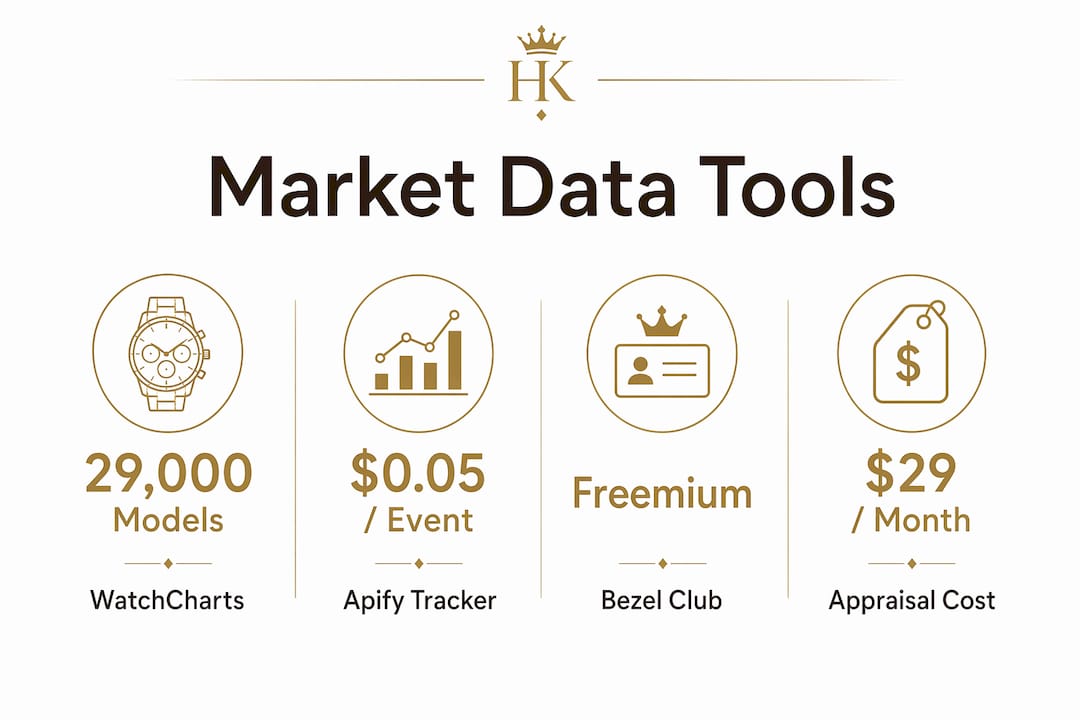
WatchCharts covers over 29,000 models with condition-adjusted median valuations at $29 per month. It is the strongest tool for single-watch appraisal, particularly when you need to assess a specific reference before purchase. The condition-adjusted methodology is its key differentiator. A raw price average across all listed examples of a Patek Philippe Nautilus 5711 is meaningless without accounting for whether those examples are polished, unpolished, full-set, or service-only.
The Apify Watch Arbitrage Tracker operates on a pay-per-event model at $0.05 per reference per day plus $0.50 per alert, monitoring price spreads across 13 marketplaces in real time. This pricing structure suits active flippers and dealers who need to act quickly on cross-market discrepancies rather than long-term holders who check valuations monthly.
Tool | Best for | Pricing model | Key strength |
WatchCharts | Single-watch appraisal | $29/month subscription | 29,000+ models, condition-adjusted |
Bezel Club | Market trend tracking | Freemium | Accessible, broad coverage |
Apify Watch Arbitrage Tracker | Cross-market spread detection | Pay-per-event | Real-time alerts, 13 marketplaces |
Bezel Club sits between the two. Its freemium model makes it accessible for collectors who are still building their knowledge base, and it provides solid trend-level data without the granularity of WatchCharts or the real-time arbitrage capability of Apify.
Pro Tip: Combine WatchCharts for appraisal accuracy with the Apify tracker for spread detection. Using both together gives you a complete picture: what a watch is worth and whether you can source it cheaper elsewhere right now.
For a broader comparison of watch-tracking platforms, including subscription pricing and feature breakdowns, it is worth reviewing independent assessments before committing to any single tool.
Why does servicing directly affect your watch’s resale value?
Servicing is not a cost centre. It is a value management decision, and treating it as anything less is one of the most common mistakes watch investors make. Recommended service intervals for major brands range from 5 to 10 years, with costs varying significantly by brand and movement complexity.
Rolex: service every 10 years, typical cost £550 to £1,200
Patek Philippe: service every 5 to 7 years, typical cost £1,200 to £4,000 or more
Audemars Piguet: service every 5 to 7 years, typical cost £950 to £3,200 or more
These figures are not abstract. If you purchase an Audemars Piguet Royal Oak for £30,000 and it is due a service within two years, you are looking at a near-term cost of up to £3,200 that must be factored into your acquisition price. Watches valued between £1,200 and £4,000 generally merit servicing over replacement to preserve their investment value. For watches above that threshold, the calculus is even clearer: service costs are a fraction of the asset value, and an unserviced movement is a liability at resale.
The practical rule is straightforward. Before purchasing any pre-owned watch, establish when it was last serviced and by whom. A Rolex serviced by an unauthorised workshop may have non-genuine parts, which directly affects both authenticity and value. For detailed guidance on brand-specific service intervals, Horology-kings has published a thorough breakdown covering the major Swiss houses.
Pro Tip: Always request a full service history in writing before completing a purchase. A watch with documented, manufacturer-authorised servicing commands a measurably stronger resale position than one with verbal assurances only.
Documentation extends beyond service records. Full-set documentation including box, warranty papers, manuals, hangtags, and original receipts can increase secondary market value by approximately 10 to 30% for upper-end watches. That is not a marginal uplift. On a £50,000 Patek Philippe, the difference between a full-set and a watch-only example can exceed £10,000. Understanding why documentation matters is therefore not optional for serious investors. It is foundational.
What role do certified pre-owned programmes play in 2026?
Brand-led certified pre-owned (CPO) programmes have reshaped how secondary market liquidity works, and ignoring them leads to mispriced acquisitions. The Rolex Certified Pre-Owned (RCPO) programme is the clearest example of this structural shift.
RCPO accounted for over 10% of all Rolex secondary market transactions in 2025, generating $594 million in total sales. RCPO stores increased slightly into 2026, expanding the programme’s reach and deepening its influence on price formation. That scale means RCPO is no longer a niche channel. It is a primary price-setting mechanism for a meaningful portion of Rolex transactions.
The implications for investors are specific:
RCPO watches carry a two-year warranty and are sold through authorised Rolex dealers, which expands the buyer pool to include risk-averse purchasers who would not previously have engaged with the grey market.
Expanded buyer pools support price floors. When more buyers compete for the same supply, downside price risk is reduced.
Grey market dealers have responded by tightening their own quality standards and documentation requirements, raising the baseline for what constitutes a credible pre-owned listing.
Ignoring brand-led CPO programmes risks misjudging liquidity and resale price dynamics, potentially leading to flawed investment valuations.
The practical consequence for your 2026 strategy is this: when pricing a Rolex for resale, you must account for what an equivalent RCPO example sells for at retail. If the RCPO price is lower than your target resale price, you face direct competition from a brand-backed, warranted alternative. That is a competitive dynamic that did not exist five years ago.
Key takeaways
Successful watch investing in 2026 requires integrating value retention metrics, servicing costs, documentation quality, and CPO programme dynamics into every acquisition decision.
Point | Details |
Track value retention, not just price | Secondary price gains can mask declining VR if retail prices rise faster. |
Use multiple data tools | Combine WatchCharts for appraisal with Apify for real-time arbitrage detection. |
Factor in servicing costs upfront | Patek Philippe and Audemars Piguet service costs can exceed £4,000 per cycle. |
Full-set documentation adds 10 to 30% | Box, papers, and receipts materially increase resale value on upper-end watches. |
RCPO sets a price floor for Rolex | RCPO’s 10%+ market share means brand-backed pricing directly competes with grey market resale. |
What I have learnt from watching the 2026 market closely
The thing that strikes me most about the current market is how many investors still treat watch buying as a purely intuitive exercise. They know the references they like, they follow a few accounts on social media, and they make decisions based on feel. That approach worked during the 2020 to 2022 bull run when almost everything appreciated. It does not work now.
What actually protects your capital in 2026 is process. You check value retention before you check the price. You establish the service history before you negotiate. You understand where the watch sits relative to its RCPO equivalent before you commit. These are not complicated steps, but they require discipline that most buyers skip when they find a reference they want.
I would also caution against concentrating too heavily in Rolex alone, despite its obvious liquidity advantages. Patek Philippe delivered the strongest Q1 2026 gains at +3.0%, and its lower production volumes mean supply constraints are more durable. Diversifying across brands with different pricing power profiles gives you exposure to different demand dynamics rather than betting everything on one house’s retail strategy.
The investors I see making consistent returns are not the ones chasing the hottest reference. They are the ones who treat watch investment value as a function of provenance, condition, and timing rather than brand name alone. That mindset is the actual edge in this market.
— Lewis
How Horology-kings supports your 2026 investment strategy
Horology-kings is a Hertfordshire-based luxury watch dealer specialising in the acquisition, sourcing, and sale of verified timepieces from Rolex, Patek Philippe, Audemars Piguet, Omega, and Cartier. For investors who want to act on the strategies outlined in this guide, the team offers expert valuations, full provenance checks, and access to rare references through a specialist sourcing network. You can buy, sell, or source watches directly through the platform, with all transactions conducted via secure UK bank transfer. For investors prioritising maintenance as part of their value strategy, Horology-kings also provides professional watch servicing carried out to manufacturer standards. If you have a specific reference in mind, the sourcing service can locate it through verified channels.
FAQ
What is the best watch to invest in for 2026?
Patek Philippe led Q1 2026 secondary market gains at +3.0% quarter-on-quarter, making it the strongest performer among tracked blue-chip brands. Rolex references with constrained supply, such as the GMT-Master II ‘Pepsi’, also continue to show upward price pressure.
How do I track watch valuations accurately?
WatchCharts provides condition-adjusted valuations across 29,000 models at $29 per month and is the most reliable tool for single-watch appraisal. Combining it with the Apify Watch Arbitrage Tracker adds real-time cross-market spread detection across 13 platforms.
Does full-set documentation really affect resale value?
Full-set documentation including box, papers, and receipts increases secondary market value by approximately 10 to 30% on upper-end watches. On a £50,000 reference, that uplift can exceed £10,000.
How often should I service a Rolex or Patek Philippe?
Rolex recommends servicing every 10 years at a typical cost of £550 to £1,200. Patek Philippe recommends servicing every 5 to 7 years, with costs that can exceed £4,000 depending on movement complexity.
What is the Rolex Certified Pre-Owned programme and why does it matter?
The RCPO programme accounted for over 10% of Rolex secondary market transactions in 2025, generating $594 million in sales. It sets a brand-backed price floor that directly competes with grey market resale, making it a critical reference point for any Rolex investment strategy.
Recommended
Comments