.png)

Watch market 2026: what collectors and investors need to know
- lewisvrichards3
- 6 days ago
- 12 min read

The watch market in 2026 is defined by two forces pulling in the same direction: premiumisation at the top and the professionalisation of the pre-owned trade beneath it. Swiss exports slipped 0.7% in the first half of the year against H1 2025, yet the segment above CHF 50,000 kept growing, and that gap tells you where the real opportunity sits.
Three things matter immediately if you’re buying, selling, or holding.
Value is concentrating, not disappearing. Pieces above CHF 50,000 accounted for 37% of total export value in 2025, meaning mid-tier and entry pieces are losing ground relative to trophy references.
The pre-owned market has overtaken new retail as the venue where prices actually get discovered. Vetted platforms and dealer networks now set realistic benchmarks faster than boutique waiting lists do.
Provenance and paperwork have become the deciding factor in price, not just condition. A full box-and-papers set with service history routinely commands a meaningfully higher realised price than an otherwise identical watch without it.
Pro Tip: Track regional export swings, not just global totals.
Key Takeaways
The 2026 watch market rewards documented provenance and top-end scarcity while punishing mid-market pieces without a clear rarity story.
Point | Details |
Prioritise the top price band | Watches above CHF 50,000 drove most 2025 export growth and remain the most liquid segment. |
Treat provenance as non-negotiable | Full box, papers, and service history narrow the gap between asking and realised price. |
Read regional export data before pricing | UK exports rose 5.8% and India 31.5% in H1 2026, while US exports fell 14.8%. |
Account for auction fees in your math | Buyer’s premiums of 20 to 26% mean hammer price rarely equals total cost or net proceeds. |
Favour structural scarcity over hype | Discontinued references and low-production complications hold value better than marketing-led limited editions. |
Table of Contents
What is happening in the watch market in 2026?
Swiss watch exports reached 12.8 billion francs in the first half of 2026, down 0.7% on the same period last year, according to the Federation of the Swiss Watch Industry’s own export communiqué.
Those figures matter because they show demand redistributing rather than collapsing. India’s growth reflects a genuinely new base of buyers entering the category, while the US softness likely reflects tariff anxiety and a stronger dollar making Swiss imports pricier for American collectors. The UK’s gain suggests sterling-denominated buyers are stepping in where American demand has pulled back.
When premiumisation concentrates over a third of total export value into the highest price bracket, it tells you liquidity and price stability increasingly live at the top of the market, not in the middle. If you’re positioning a collection for resale value, that’s the band to prioritise.
Why is the pre-owned market driving growth in 2026?
The secondary market now moves faster and more transparently than new retail, largely because platforms, dealers, and verification services have matured into something closer to a proper financial market than a hobbyist bazaar. Editorial and platform data through 2026 consistently show collector demand concentrated in the pre-owned segment, where waiting lists don’t apply and pricing reflects genuine supply and demand rather than a brand’s suggested retail figure.
Three structural shifts explain why.
Escrow and grading services have reduced buyer friction. Platforms such as Subdial and established dealer networks now offer condition grading and secure payment handling that used to only exist at auction houses.
Authentication has become a genuine value lever, not just a checkbox. A documented service history and verifiable provenance chain can add a meaningful premium over an unverified example of the same reference.
Fee structures now vary enough to matter. Consignment through a specialist dealer, a peer-to-peer platform sale, and an auction house each carry different commission structures and different speeds to cash, and choosing the wrong channel can quietly erode your net return.
The rise of vetted dealer networks has a knock-on effect worth understanding: it raises average realised prices because buyers trust the transaction enough to pay closer to fair value rather than demanding a discount for uncertainty. That’s a structural, not cyclical, shift in how the secondary market prices risk.
Which watch brands and models are holding value best?
Rarity, provenance, and genuine production constraints separate watches that hold value from those that merely look desirable. Here’s how the strongest categories rank on the secondary market heading into the back half of 2026.
Steel sports references from the major manufactures. Rolex, Patek Philippe, and Audemars Piguet sports models with genuine waiting-list scarcity remain the most liquid segment of the entire market. Their price bands sit wide, but transaction speed is unmatched because demand always outstrips available supply.
Discontinued or transitional references. A model retired or updated within the last two to three years often sees a short-term price bump as the pool of available examples stops growing while demand keeps climbing.
Complicated pieces with verifiable independent servicing history. Perpetual calendars, minute repeaters, and split-seconds chronographs from Patek Philippe and Audemars Piguet carry real appreciation potential when paperwork is complete, precisely because so few examples exist with full documentation.
Vintage Cartier and Omega pieces with original components. Cartier’s Tank and Omega’s Speedmaster both have deep collector bases that reward originality over cosmetic condition, meaning a lightly patinated original dial can outsell a freshly serviced example with replacement parts.
Pro Tip: Genuine long-term value tends to track scarcity that’s structural, meaning it’s tied to discontinued production or limited annual output, rather than scarcity that’s manufactured through marketing hype around a single limited edition. Ask how many were actually made and how many surface for sale each year before you assume rarity.
Industry commentary from Morgan Stanley’s analysis of the Swiss watch market reinforces this pattern: value concentration at the top end has been building for years, and 2026’s numbers simply confirm the trend rather than starting it.
What design trends are shaping demand in 2026?
Design language at Watches & Wonders 2026 shifted toward smaller cases, exotic materials, and mechanical transparency, and each of those trends has direct implications for future rarity. Stone dials, skeletonised movements, and materials such as lab-grown crystal featured heavily across the show floor, alongside a broader move toward smaller, more wearable case diameters after nearly two decades of oversized sports watches dominating the conversation.
That size reversal matters for collectors because it signals where brands expect future demand to sit. Smaller cases and jewellery-style watches are drawing genuinely new collector demographics, including a growing base of female buyers who have historically been underserved by a category built around 40mm-plus sports cases.
Favour pieces with distinctive, hard-to-replicate materials like meteorite or stone dials, since these tend to age into genuine rarity rather than dated novelty.
Watch for smaller case sizes becoming the next collecting wave, particularly among younger buyers who find 44mm sports models impractical for daily wear.
Be cautious with heavily skeletonised pieces from brands without a strong finishing pedigree, since the technique rewards genuine craft and punishes anything mass-produced.
If you’re curious how craftsmanship and jewellery sensibilities are converging in modern watch bands, the crossover between premium accessories and resale value is instructive, and the same logic increasingly applies to watch bands designed with jewellery-grade detailing.
Pro Tip: A trend-driven value trap almost always shares one feature: a limited edition tied to a marketing moment rather than a technical or material innovation. If the story is the anniversary, not the movement, treat it as fashion, not investment.

How do exports, auctions, and tariffs move prices?
Realised prices in 2026 move on four levers: export data momentum, auction house dynamics, platform fee structures, and tariff-driven demand shocks. Understanding how each one works lets you interpret short-term price swings instead of reacting to noise.
Swiss export figures act as a leading indicator of brand-level health. When a region’s exports jump the way India’s did at 31.5%, dealers in that region gain pricing confidence, and secondary market asks tend to firm up within a quarter. Auction houses, meanwhile, set headline benchmarks that ripple through private sales, but auction premiums (buyer’s fees typically running 20 to 26% on top of the hammer price) mean the number reported in the press is rarely what either party actually nets. Our deeper look at how auctions shape realised prices breaks down that gap in detail.
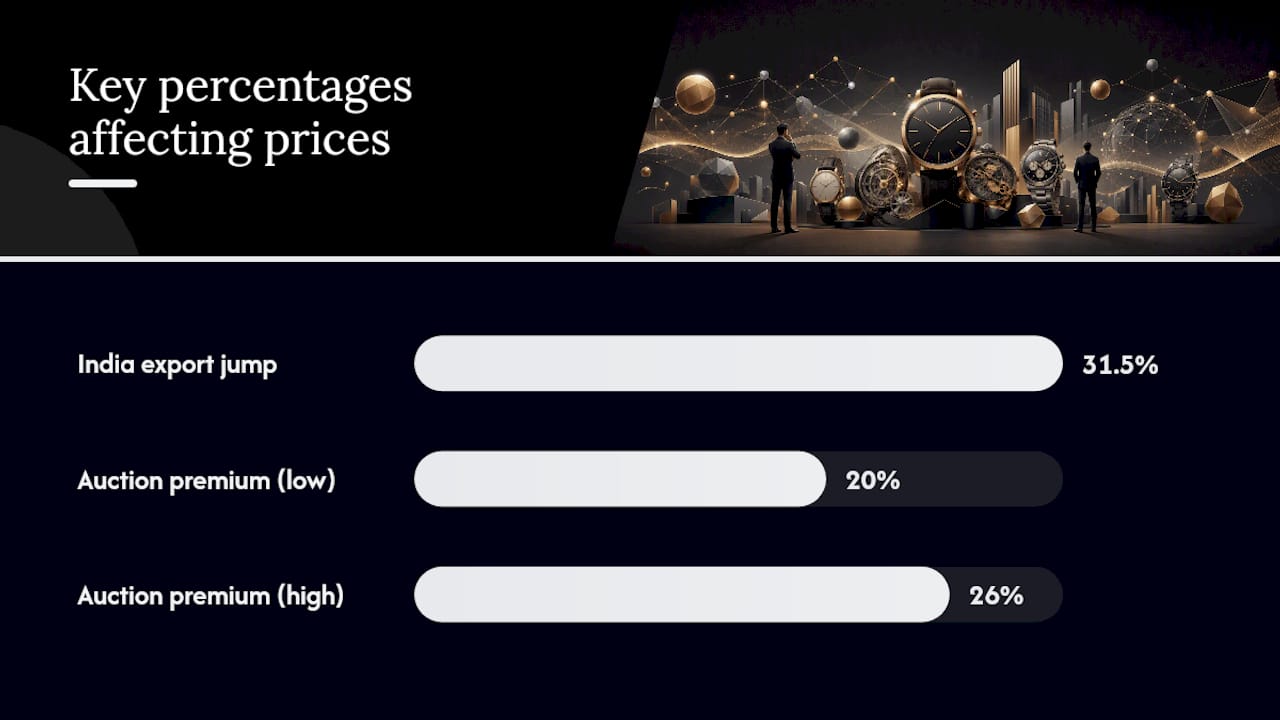
Geopolitical tension and tariff policy add a genuine wildcard. Executives across the industry have flagged trade measures and geopolitical risk as the biggest disruptors to otherwise stable demand patterns, and the US export decline this year is a visible symptom of that anxiety.
The main levers worth tracking:
Export momentum by region, which signals where dealer confidence and asking prices are firming.
Auction buyer’s premiums, which can add a fifth of the hammer price and change whether a “record price” is actually a good deal.
Platform and consignment fees, which vary widely and directly affect your net return regardless of headline sale price.
Tariff timing, since a shock tends to create short-term buying opportunities in the region absorbing the tax, before prices adjust.
The most consequential number for anyone timing a sale in 2026 is that 20 to 26% auction premium. A watch that hammers for £40,000 might actually cost the buyer £50,000 once fees land, and sellers need to account for that gap when comparing auction estimates against private sale offers.
How do you verify and value a watch before you buy or sell?
Verification and valuation in 2026 rest on the same fundamentals that have always mattered, but the bar for documentation has risen considerably. A watch without full paperwork now trades at a discount that would have been unthinkable a decade ago, when condition alone drove most negotiations.
Run through this checklist before any transaction:
Confirm authenticity through movement inspection and serial number cross-referencing, ideally with a specialist rather than relying on the seller’s own claims.
Request full service history, including invoices from authorised or recognised independent workshops, not just a verbal assurance.
Check for original components, since replaced dials, hands, or bezels can reduce value by a significant margin even when the watch still “looks right.”
Use recent comparable sales, not list prices, to set your valuation baseline, and adjust for condition grade and documentation completeness.
Insist on insured shipping and secure payment channels for any transaction conducted remotely.
Valuation itself works best as a layered exercise. Start with recent comparable sales for the exact reference, then apply a rarity multiplier if the specific example has a notable provenance detail (celebrity ownership, an unusual dial variant, a documented low production run), and finally adjust down for any condition or paperwork gaps. Our full breakdown of how watch valuation actually works walks through the multipliers dealers use in practice.
Pro Tip: An unserviced watch isn’t automatically a bad sale, it’s an underpriced one if you market it correctly. Disclose the service need upfront, price accordingly, and you’ll often attract buyers happy to service it themselves rather than pay a premium for work they’d want redone anyway. Our guide to selling an unserviced watch covers the pricing logic in more depth.
What does dealership experience reveal about the 2026 market?
Public export figures and industry reports tell you where the market sits in aggregate, but transaction-level patterns from an active dealership fill in the detail those reports can’t capture. Horology-kings has observed a consistent pattern across recent trades: sellers who arrive with complete documentation and a recent service record close deals faster and at prices closer to their initial expectation than sellers relying on condition alone.
Sellers with full box, papers, and service history typically see offers land within a narrower band of their expectation, reflecting the reduced risk a buyer takes on when provenance is airtight.
Watches sourced through the dealership’s network for hard-to-find references tend to move quickly once located, because buyers seeking a specific rare piece have usually already priced in a premium for the sourcing effort itself.
Unserviced watches submitted for sale generally realise stronger net prices when the service need is disclosed and priced in upfront, rather than discovered during buyer due diligence.
Horology-kings verifies every watch that passes through its books against movement, case, and paperwork consistency before it reaches a buyer, combining that inspection with market comparables to arrive at a fair valuation…
It’s worth flagging the limits of this kind of observation honestly: dealer-level patterns reflect the specific mix of clients and inventory passing through one business, not a scientific sample of the entire market. Treat them as a useful complement to the export and platform data above, not a replacement for it.
What are the three most likely scenarios for the watch market in 2026?
Three scenarios capture the plausible range of outcomes for the rest of 2026, and each carries distinct implications for how you should position a collection.
Scenario | Primary Driver | Effect on Top-End Values | Effect on Mid-Market | Liquidity Outlook |
Bull case | Demand recovery in the US and continued Indian growth | Strong appreciation continues | Modest recovery, lagging top end | High, especially at the top |
Base case | Continued regional divergence, stable premiumisation | Steady, gradual gains | Flat to slightly negative | Stable, concentrated in blue-chip references |
Downside case | Escalating tariffs or renewed geopolitical shock | Volatility increases, but resilience holds | Notable softening | Reduced, wider bid-ask spreads |
The base case is the most consistent with current data: regional divergence persists, the top end keeps absorbing most of the growth, and mid-market pieces drift sideways or slightly down. A downside scenario wouldn’t collapse the top end outright, since scarcity provides a floor there, but it would widen the gap between asking and realised prices across the middle of the market considerably.
What tactical rules should investors follow in 2026?
Discipline matters more than timing in a market this concentrated at the top. The rules that separate collectors who build lasting value from those chasing hype are straightforward, even if they’re not always easy to follow.
Buy the reference, not the story. A watch’s long-term liquidity depends on structural scarcity and brand pedigree, not this quarter’s marketing narrative.
Insist on provenance before price. Walk away from any deal where documentation is incomplete, regardless of how attractive the headline price looks.
Plan your exit before you buy. Decide whether a piece is a five-year hold or a flip candidate before the purchase, not after.
Diversify across price bands cautiously. The top end offers the strongest liquidity, but a well-chosen mid-tier piece with genuine rarity can still outperform if you’re patient.
Watch the auction calendar and export data together. A strong regional export reading ahead of a major auction season often signals firming demand worth acting on.
For a deeper framework on structuring a collection for genuine returns rather than sentimental purchases, our investor guide for 2026 expands on position sizing and timing in more detail.
Why the market’s real story is beneath the headline numbers
It’s sorting itself into winners and laggards more decisively than at any point in the last decade.
What gets underestimated is how much the pre-owned market’s professionalisation has changed the calculus for sellers, not just buyers. A decade ago, selling privately meant accepting a discount for the buyer’s uncertainty. Vetted platforms and dealer networks have narrowed that discount considerably, which means sellers now have genuine leverage they didn’t used to have, provided they show up with proper documentation.
The gap between what the market promises (steady appreciation across the category) and what actually delivers (concentrated appreciation in specific references with genuine scarcity) is where most new collectors get caught out. Horology-kings works with clients specifically to close that gap, pairing verified sourcing and transparent valuations with the documentation buyers now expect as standard, rather than treating provenance as an afterthought.
Where should you buy, sell, or source a watch with confidence?
Every strategy in this brief, from prioritising provenance to reading regional export swings, depends on transacting through a channel you actually trust. Horology-kings offers free valuations, secure UK bank transfers, and a sourcing service for hard-to-find references, backed by the same verification standards discussed throughout this guide. If a piece in your collection needs professional attention before it goes to market, Horology-kings’ repair and servicing team can bring documentation up to the standard today’s buyers expect. Whether you’re ready to sell, source a specific reference, or simply want a professional valuation, Horology-kings is built for exactly this kind of transaction.
Primary sources and further reading
Federation of the Swiss Watch Industry export communiqué (H1 2026) covers the official regional export figures cited throughout this guide.
Vogue’s report on the state of watches in 2026 details premiumisation trends and executive commentary on trade risk.
WorldTempus’ coverage of Watches & Wonders 2026 breaks down the design and material trends shaping new releases.
Esquire UK’s pre-owned market analysis identifies which secondary-market pieces are drawing the strongest collector demand.
Morgan Stanley’s Q2 2026 Swiss watch market report provides the longer-term industry analysis behind the value concentration trend.
Frequently asked questions about the watch market in 2026
Is now a good time to invest in watches? The top end of the market, references above CHF 50,000, continues to show the strongest value retention, making it the more defensible entry point for anyone weighing how to invest in watches in 2026. Mid-market pieces carry more uncertainty and require a clearer rarity story to justify a purchase as an investment rather than simply a piece to wear.
Are smartwatches affecting demand for mechanical luxury watches? Smartwatch adoption hasn’t meaningfully dented demand at the top of the mechanical market, where collectors buy for craftsmanship, heritage, and scarcity rather than function. The more relevant 2026 smartwatch prediction is that hybrid designs and smart features may eventually filter into entry-level luxury segments, but the trophy end of the market remains largely insulated.
Where is the best place to buy or sell a luxury watch in 2026? Vetted dealer networks and platforms with escrow protection and authentication services now offer the strongest balance of price transparency and transaction security, outperforming both informal peer-to-peer sales and, in many cases, auction houses once fees are accounted for.
How much does provenance actually add to a watch’s value? The exact premium varies by reference and rarity, but dealers consistently report that full documentation, box, papers, and service history, meaningfully narrows the gap between asking price and realised sale price compared with an undocumented equivalent.
This article provides general market information and should not be treated as financial or investment advice. Always verify current figures with primary sources and consult a qualified professional before making significant purchase or investment decisions.
Sources
Recommended
Comments